

On June 12, the federal government ordered the AI company Anthropic to cut off foreign-national access to its newest and most powerful AI models, Fable 5 and Mythos 5. Anthropic said the directive, issued under national security authorities, forced it to disable those models for everyone. According to The Washington Post, officials initially gave Anthropic 90 minutes to take one of the models offline.
Maybe the government had good reasons. The public does not yet know enough to say, because the directive is still not public. And that is itself a serious problem. Without identifying the specific threat being addressed or the statutory authority being invoked, these controls look less like a narrowly tailored national-security measure and more like an arbitrary infringement on the expressive rights of Anthropic and its users. AI models are expressive tools: They reflect choices about training, weighting, design, and guardrails. In users’ hands, they enable people to gather, create, and share information. The danger is not only that a particular model gets shut down. It is that the government claims a kill switch over AI systems — the power to suppress models that contradict its preferred views, embarrass its officials, or come from developers who defy or oppose the administration.
But while the Anthropic fight has been taking up all the oxygen and attention, two other online-safety stories have been unfolding that deserve at least as much attention.
In Britain, Prime Minister Keir Starmer announced that the government plans to ban children under 16 from major social media platforms by spring 2027. The proposal would require big tech companies to introduce age-verification technology, building on the UK’s Online Safety Act and following the model of Australia’s under-16 social-media ban. The UK government says the goal is to protect children from online harm. But critics immediately pointed out the obvious problem: To keep 15-year-olds out, platforms must find a way to check who is 15. And to do that at scale, the internet starts moving toward ID checks, face scans, and third-party verification systems, or some functional equivalent.
Meanwhile, at the White House, offices connected to the chief of staff, the first lady, the Office of Science and Technology Policy, and the National Economic Council reportedly met with children’s online-safety groups. The grand bargain forming in Washington is that Congress may block states from adopting or enforcing some of their own AI laws — what’s known as “preemption” — but only as part of a broader package of federal internet regulations. Those rules could pressure platforms to remove more speech, require age checks that double as identity checks, create new takedown rights over AI-generated images or voices, and assert government control over how AI systems are designed and what they may say.
And like the Anthropic order, it’s all in the name of safety.
It’s important to point out here that I am not a social media utopian. As regular ERI readers and FIRE supporters will know, I co-authored The Coddling of the American Mind with social psychologist Jon Haidt. In that book, we argued that overprotection was making young people more anxious, fragile, and less prepared for adult life. I also happen to think that the phone-based childhood has been a bad bargain for many kids, and that phones should be out of schools entirely.
But that does not mean governments should build a national identity-checking system for the internet, give government a foot in the door for controlling artificial intelligence, or create broad new liabilities that pressure platforms to suppress lawful expression in the name of protecting minors. I have disagreed with Jon on this point, as I’ve outlined in my review of his most recent book The Anxious Generation. And I certainly disagree with his support for the UK’s under-16 social-media ban. Britain is one of the last countries on earth that needs another lever for controlling speech — or another excuse to make anonymity online functionally impossible.
The Anthropic order, the Washington bargain, and the UK age-verification push are powered by the same dangerous assumption: if a problem can be described as a matter of safety, the government should be trusted with new leverage over speech.
The slope is more than slippery. It’s a mudslide
Unfortunately, something I and other free speech defenders have to repeat until we’re blue in the face is that regulation rarely ends where it begins. Lawmakers start with a sympathetic target, a modest-sounding standard, and a category of speech almost nobody wants to defend. Then the category expands, the logic of control migrates, and before long, a tool sold as a scalpel becomes a warhammer.
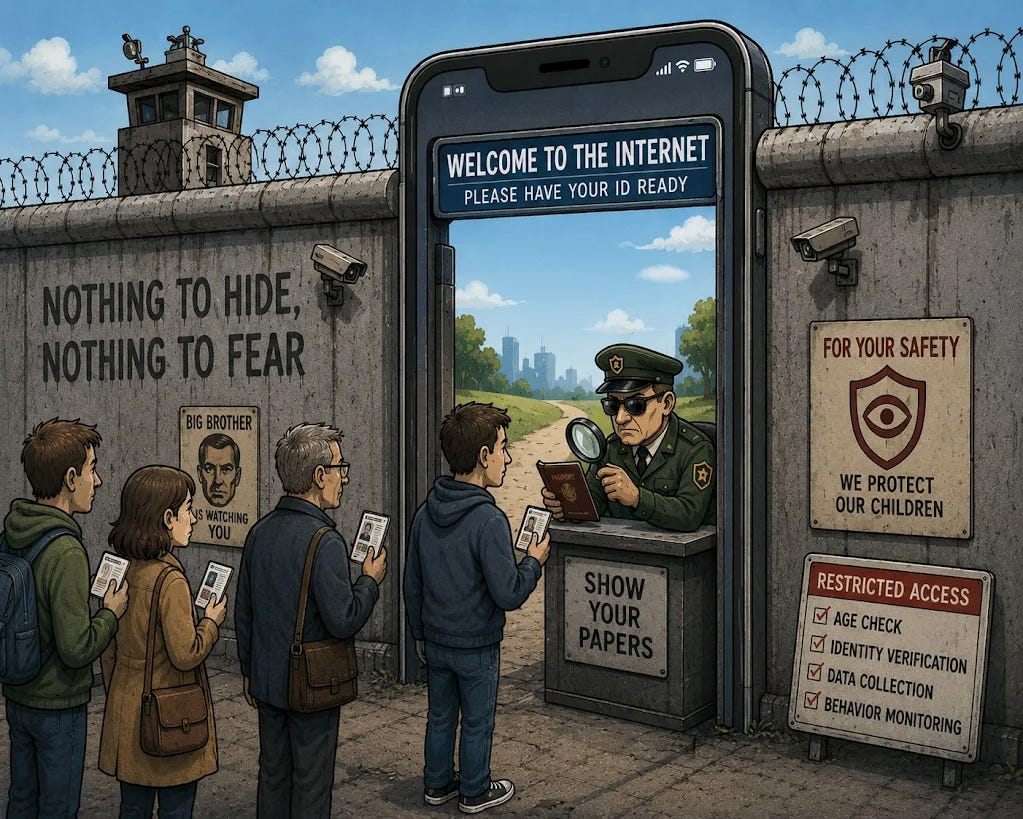
One big problem with the discourse surrounding all of this is that age verification is something of a misnomer. This is because the systems necessary to make that kind of screening possible also inevitably make anonymity for adults impossible to preserve. That means building a “show me your papers, please” internet at the very moment when anonymity is most essential.
What people arguing in favor of these policies don’t seem to get is that anonymity is not a loophole in free speech. In fact, it’s one of its oldest protections. Anonymous and pseudonymous speakers have included dissidents, whistleblowers, abuse survivors, religious minorities, political minorities, and citizens with something unpopular to say. The Federalist Papers were published under a pseudonym. So were anti-slavery pamphlets, samizdat writings under Soviet rule, and the anonymous tips and leaks that exposed corruption, abuse, and illegality in institutions that wanted those facts kept hidden.
Now is a reckless time to weaken that tradition. Freedom of speech is in global freefall. Germany has used hate speech, insult, and anti-propaganda laws to punish satire, political memes, and discussion of crime statistics. Britain reportedly arrests thousands of people a year — 13,000 in 2024, according to The Telegraph — under online-communications laws, including for social-media posts and private messages deemed grossly offensive or menacing. The European Union pressures platforms through sprawling digital regulation. In much of the democratic world, “safety” has become the respectable language of speech control.
The United States has long been the great exception, but that exception looks shakier by the day. On campus, administrators have too often tolerated or facilitated shoutdowns, heckler’s vetoes, bias-response systems, and investigations into protected speech. In Trump’s Washington, threats against universities, law firms, media companies, political opponents, and even private associations have become routine tools of governance. Groups on the left helped normalize informal censorship as moral imperative; many on the MAGA right are learning to enjoy formal censorship as retribution.
Another issue is the overextension of certain terms to meet ideological ends. The most dangerous word in this entire debate may be “harm.” On campus, we at FIRE have spent years watching this term expand from actual threats and harassment into reading controversial books, inviting visiting speakers, making jokes, offering classroom hypotheticals, hearing different political opinions, and even entertaining the presence of disfavored arguments. That was one of the central warnings of Coddling: When institutions teach people to treat emotional discomfort as danger, censorship starts to look like compassion.
Last year, then-attorney General Pam Bondi echoed this logic from the right, treating critical comments about Charlie Kirk after his murder as grounds for official retaliation. Practically anything important enough to argue about can be repackaged as harmful to someone, and “harmful to children” is the most powerful and manipulative version of the claim. That is a perpetual source of frustration for those of us who actually do want to protect kids: child protection can become the skeleton key that opens the door to censoring adults.
Some threats sound scary and new, but they’re old — and already protected against
The NO FAKES Act, designed to allow people to control the use of AI-generated versions of their voice or likeness, is the easiest part of this package to sympathize with. Nobody wants their voice or face cloned for a scam, fake endorsement, or humiliating sexual image. But existing law already protects us against fraud, defamation, privacy law, right of publicity, extortion, or harassment. AI will create hard cases, for sure, but courts can develop narrower rules around actual abuse in light of this new technology. A broad new federal right over “digital replicas,” especially if enforced through notice-and-takedown measures, will inevitably sweep in things like parody, satire, political commentary, documentary work, memes, reenactments, and criticism. Another issue is the vague and overbroad wording of the proposed law. The exceptions offered in the bill are so narrow that speakers cannot reliably determine in advance whether they apply. When in doubt, it’s smart to keep quiet, which is exactly how chilling effects work.
I will say here that federal preemption of state AI laws is, by itself, a very good idea. States are already producing a thicket of inconsistent, vague, and sometimes flatly asinine AI rules that aren’t compatible with the breadth of expressive rights Americans enjoy.
But the answer to state-level overreach is not federal overreach. As we speak, AI is becoming a tutor, editor, research assistant, librarian, debate partner, and search engine — something close to the future operating system of the planet. Rules that govern what AI systems may say, how they must be designed, what risks they must avoid, and what answers they must suppress are automatically and unavoidably rules about the future of knowledge creation itself. This is why FIRE and the Cosmos Institute have teamed up to create and promote truth-seeking AI.
Our goal must be to keep control of AI out of the hands of the powerful
The great liberal achievement of human history was separating truth from power: Denying kings, priests, commissars, bureaucrats, and mobs the authority to decide what everyone else is allowed to know. Power always wants that authority back. It wants to decide which claims are false, which harms matter, which depictions are unauthorized, which jokes are too risky, which AI answers are unsafe, and which anonymous speakers must be unmasked.
We should do everything we can to keep power’s hands off the systems through which humanity will increasingly think, learn, argue, and discover.
Granted, there are real concerns about kids and the effects of technology on their development. But a hard social problem does not justify building permanent speech-control infrastructure. A phone-based childhood can be improved through cultural adaptation, parental supervision, better parental tools, and getting phones out of schools. A federal system that weakens anonymity, pressures platforms to remove lawful speech, and gives government leverage over artificial intelligence is unlikely to solve the problems it ostensibly wants to solve, and introduces a different order of danger in the process.
The FCC is an example of a solution that has turned into a problem. It was created in large part to solve a practical issue of its time: allocating the electromagnetic spectrum. However, again and again, it has threatened First Amendment values — and under current Chairman Brendan Carr it has shown how quickly a communications regulator can become a tool for jawboning (using government pressure on private actors to do what the government cannot directly command) media companies, threatening licenses, and punishing perceived enemies of the president.
That is why civil libertarians sound so unreasonable and callous at the outset of these kinds of arguments. It’s not that we don’t see the concerns animating people. It’s not that we don’t care about addressing those concerns — in fact, most of us care a lot. What we’re doing is looking beyond the stated purpose of the law and identifying the agency that will inevitably be built, the precedents that will undoubtedly be set, and the politicians who will enthusiastically inherit and wield the tool to serve their own ends.
As Justice Robert Jackson wrote in West Virginia State Board of Education v. Barnette, the First Amendment was designed “to avoid these ends by avoiding these beginnings.”
That’s what I’m urging all of you — especially those of you with children, who are concerned for their safety and their future: Think like an American, in the best tradition of our 250-year argument over liberty. Imagine every new power in the hands of your worst political enemy, because eventually, it will be. Try to consider how those enemies might use and abuse the power you’re so eager to grant your allies. And when you come to the conclusion that this is a terrifying state of affairs, come back to this moment and recognize that you can stop it from ever becoming reality.
SHOT FOR THE ROAD
I knew Woodrow Wilson was terrible before it was cool.
I remember studying Wilson in high school and thinking, even then: Wow, this guy had a ton of terrible ideas.
It wasn’t just that he kept the United States out of World War I too long — a decision that may have made the war longer, bloodier, and more destabilizing than it needed to be. It was also that so much of his worldview seemed to mistake abstractions for reality. Did he really think the cause of World War I was some seminar-room equation about diplomacy and ideals? Germany wanted its war with France before Russia became too powerful. Austria-Hungary wanted Serbia punished and subordinated. Nationalism, empire, militarism, alliance politics, and old-fashioned power-seeking were doing what they usually do. And Wilson’s grand solution — national self-determination — sounded noble until you noticed that, if followed consistently, it could leave humanity trapped in an endless war over borders, peoples, language, ethnicity, religion, history, and grievance.
And, of course, didn’t people know he was a total racist?
On that last point, at least, public opinion has started to catch up. Most people now know — and justly criticize — Wilson’s segregationist policies, including the resegregation of parts of the federal government and his infamous White House screening of The Birth of a Nation.
Less known, though, is how much of an absolute disaster he was for free speech. During World War I, Wilson signed the Espionage Act of 1917 and backed the Sedition Act of 1918, which made it a crime to criticize the government, the military, the Constitution, or the war effort in ways officials deemed disloyal. His administration oversaw thousands of prosecutions and arrests, targeting anti-war activists, political dissidents, journalists, and ordinary citizens whose offense was often little more than speaking their minds. Socialist leader Eugene V. Debs was sentenced to ten years in prison for an anti-war speech. Newspapers and magazines were denied mailing privileges for publishing views the administration disliked. Wilson was hard-pressed to meet a dissenter he didn’t want to throw in jail, and in far too many cases he actually succeeded in doing just that.
That’s why FIRE has officially dubbed Woodrow Wilson the worst president for free speech, ever.
Check out this fantastic video from FIRE, which is part of its Figures of Speech series celebrating America’s 250th birthday.
Thanks for the coverage on this, Greg!
I used to be a big defender of a lot of online safety proposals, and I do still believe more safety measures are needed. But seeing the consequences of how it's all gone down in practice has changed my view about how strict regulations should be. A lot of this overreach does more harm than good.
Troubling as the times can seem, it's seeing people standing up like this that give me hope we will pull through this.
I’m sure others will more substantially engage with the argument here, but can I politely request you don’t use AI art? It’s one of the few uses where AI is replacing, not augmenting, human effort, and I happen to find it ugly. This isn’t some unicorn niche issue where no Shutterstock/Unsplash photo will serve.