

I was supposed to be at the White House Correspondent’s Association Dinner last weekend. I had to bail because I was still recovering from getting sick while traveling for the umpteenth time. So FIRE’s Executive Vice President, the great Nico Perrino, went in my stead.
Next thing I know, I get a news alert that made me scared I might’ve gotten Nico killed.
As we all know by now, a gunman tried to storm the event. A Secret Service officer was shot and saved by his vest. The president, the first lady, the vice president, and others had to be evacuated.
It was genuinely horrifying, but thankfully it looks like no one was seriously hurt and the shooter was apprehended. Nico was, of course, fine, but was close enough to smell the gunpowder in the air after the shooting. Also, no food went to waste. Nico was on the case early on, and those 2,600 steak and lobster dinners that never got served on Saturday were freeze-dried and donated.
Two days before the dinner, late night host Jimmy Kimmel made a joke during his monologue describing Melania as having “the glow of an expectant widow.” The first lady posted a response on X this Monday, saying Kimmel’s “hateful and violent rhetoric” is “corrosive and deepens the political sickness within America” and calling on ABC to “take a stand” over his “atrocious behavior.”
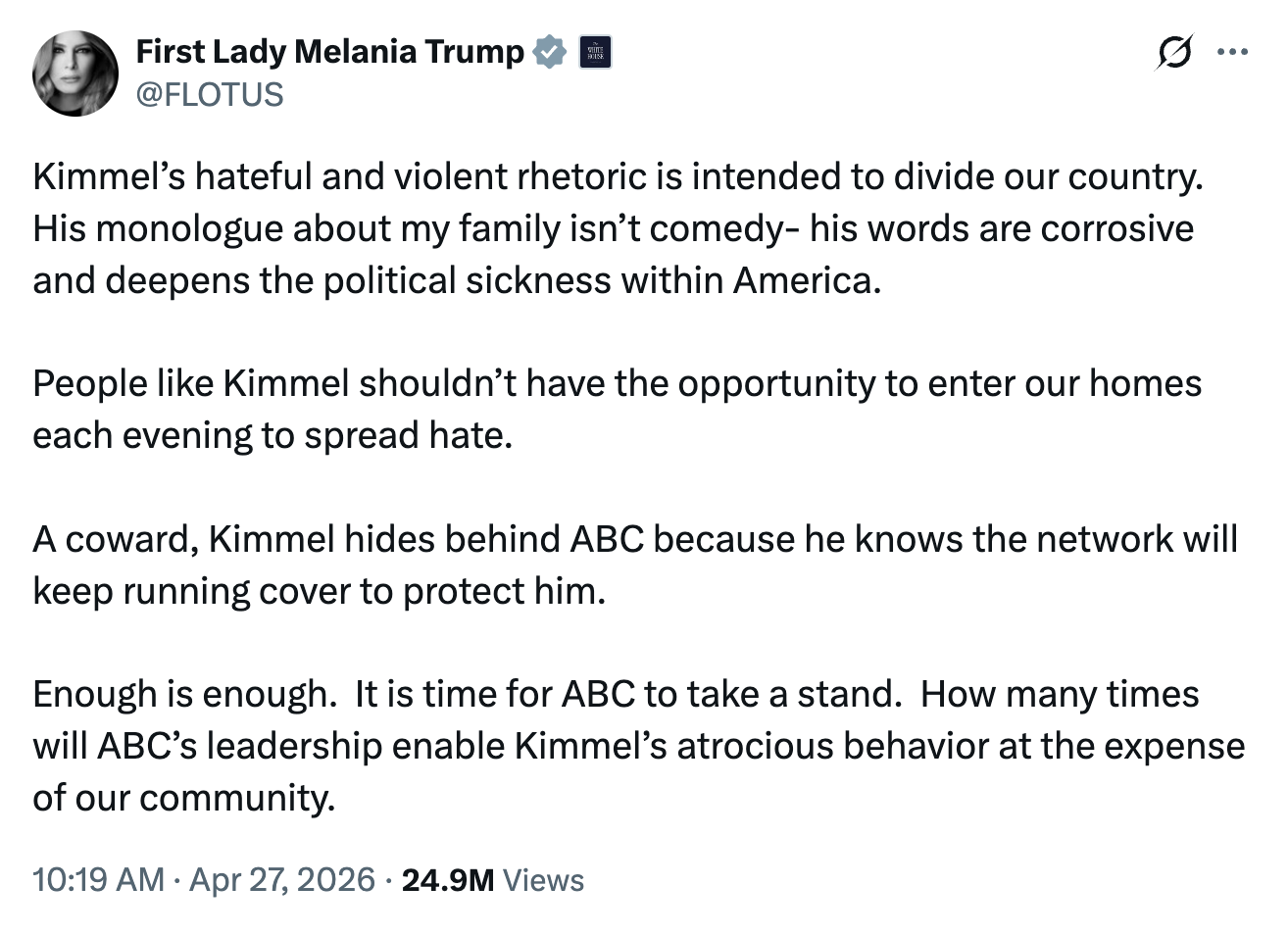
Trump, of course, followed up with his own post explicitly calling on ABC to fire Kimmel.
As FIRE Senior Writer & Editor and ERI Managing Editor Angel Eduardo put it in a piece for UnHerd Monday afternoon, déjà vu has never been less fun.
Anticipating precisely what would happen, I posted a response to the first lady on Monday morning. As I said there, Melania is of course entitled to her opinion. So is the president. So are the people who thought Kimmel’s joke was vile. But I wanted to reiterate that the White House may not pressure ABC to fire a comedian because of his jokes — which is exactly what it has done in the past, and would soon prove to be doing again. The way Midichlorians follow force sensitivity, the FCC announced a day later that it was looking into Disney’s broadcast licenses. What a coincidence!
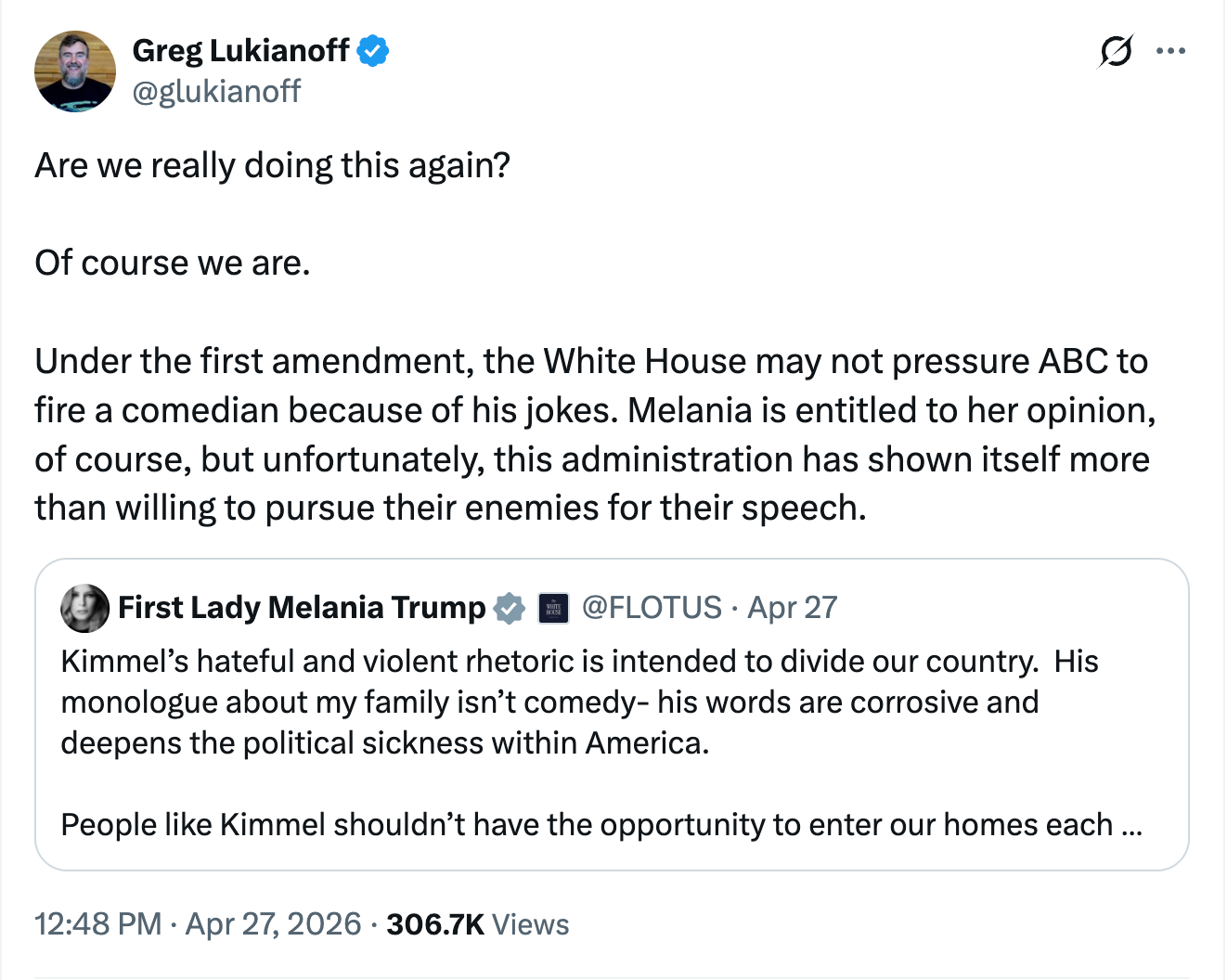
This case, once again, gets us talking about jawboning. Essentially, this is when the government pesters and pressures private companies to censor speech that the First Amendment prevents them from censoring themselves. That’s a major threat to free speech for reasons that should be obvious. That’s why the Supreme Court punting in the Missouri v. Biden case (also known as Murthy v. Missouri) was such a disappointment — and why the Court’s unanimous decision that same term in National Rifle Association v. Vullo, finding a New York State agency head’s pressure on insurance companies to drop ties with the NRA because of the NRA’s gun rights advocacy flatly violated the First Amendment, was such a resounding victory.
Jawboning is something we complained about a lot during the Biden era, and have had even more reason to complain about it under Trump. The current administration just seems to do even more than Biden did — or at least it does so much more publicly than Biden ever would have even considered.
Why this administration no longer deserves the benefit of the doubt when they do something that looks like it’s trying to chill speech
I got pushback in response to my X post, basically saying what I also said — which is that Melania and even Trump himself have a right to voice their opinions. Yes, they do. It’s right there in my post. But they are ignoring the fact that when the President of the United States calls for a broadcaster to fire a comedian over political satire, and the FCC chairman starts talking about “the easy way or the hard way” — as he did over Kimmel’s jokes back in September — we have left the land of ordinary criticism.
The FCC is not just some guy named PatriotEagle1776 yelling in my replies and exercising their free speech. It is the federal agency that regulates broadcast licenses. It has considerable power, and its abuse of it is a serious problem for everyone’s free speech.
Others in my mentions announced that the First Amendment only says “Congress shall make no law,” apparently under the impression that the president, the FCC, and the rest of the executive branch operate in a magical Constitution-free zone.
Then came the whataboutism. Always the whataboutism. What about Biden? What about Obama? What about COVID? What about YouTube? What about Europe? What about Democrats? What about every annoying campus activist from 2015? What about things I’ve been criticizing in books, articles, speeches, lawsuits, and probably in conversations with unlucky Uber drivers for the last 25 years or more?
The problem for those accusing me and FIRE of not being there in previous cases is, of course, that we always were there for those previous cases. The only exception would be that it happened off campus before FIRE expanded its mission in 2022, which would have meant it was outside of our scope as an organization at the time. Still, we are and always have been committed to being principled, and we really do take on censorship and free speech violations from the left and right. I have the hate mail to prove it. I get it every damn day of the week lately. Search through the cases yourself and see.
But the thing that I found the strangest, or most disingenuous, or — to be charitable — the most naive was the idea that Melania’s post existed in a vacuum, and that it wasn’t clearly part of a larger course of action that had already gone underway as the replies to my post were still being written. People were acting as if it wasn’t painfully obvious at this point that the FCC would once again be going after Jimmy Kimmel, and probably some other critics while they’re at it, using a tragedy to justify going after their political enemies the same way they did after Charlie Kirk was killed.
This administration uses power against enemies. It uses lawsuits. It uses regulators. It uses funding threats. It uses access gatekeeping. It uses merger pressure. It uses investigations. It uses whatever lever is closest to hand — and if that lever breaks, it grabs another one, and then another, and then another, until it’s grasping at straws or seashells.
This was true in Trump’s first term. It is true now. Saying so does not require anyone to pretend the left has been wonderful on free speech. I have written entire books arguing the opposite. But “the other side is bad too” is not a constitutional argument. It is a coping mechanism.
During Trump’s first term, he repeatedly threatened hostile broadcasters with license consequences. In 2017, after NBC reported that he wanted a dramatic expansion of the nuclear arsenal, Trump publicly wondered when it would be “appropriate to challenge their License.” He later said network licenses “must be challenged” and, “if appropriate,” revoked.
In 2018, the White House revoked CNN reporter Jim Acosta’s press pass after a hostile exchange with Trump. CNN sued, a federal judge ordered the administration to restore the pass, and the White House backed down.
In 2020, the Trump campaign filed defamation lawsuits against The New York Times, The Washington Post, and CNN over opinion pieces. These were lawsuits by the sitting president’s reelection campaign against major news organizations covering him. A president suing the press is not the same thing as your neighbor suing the HOA newsletter.
Trump’s Justice Department also secretly obtained phone records from reporters at The Washington Post, The New York Times, and CNN as part of leak investigations. That became public only after he left office, which is a useful reminder that abuses of power are often late to their own press conferences.
And now the pattern has resumed with a vengeance. The FCC pressure around Kimmel is not a bizarre one-off. It makes another episode in an ongoing constitutional tragedy. So does the pressure on ABC and Disney. So does the Paramount/CBS settlement in the shadow of merger approval. So do the renewed attacks on NPR and PBS. So does Kash Patel’s new $250 million lawsuit against The Atlantic, filed shortly before another one of his defamation suits was tossed.
The point is not that every one of these efforts succeeds in court. Almost all fail, and thank the First Amendment for that. The point is, as we have said many times, that the process is part of the punishment. Legal fees are a punishment. Regulatory uncertainty is punishment. Discovery is punishment. A delayed merger is punishment. A panicked boardroom is punishment. A newsroom wondering whether the next story is worth years of legal hassle is punishment.
That’s how jawboning works. That’s how the chilling effect works. It shows up as a demand letter, a licensing review, a regulator’s warning, a presidential post, an investigation, a lawsuit with a ridiculous number of zeroes, and a chorus of people insisting that anyone who objects must secretly hate free speech.
So yes, Melania Trump has free speech rights. Donald Trump has free speech rights. Jimmy Kimmel has free speech rights. Viewers who hated the joke have free speech rights. Viewers who laughed at it have free speech rights.
The constitutional concern begins when government power gets pointed at the speaker — and with this administration, it gets pointed at speakers a lot.
That is why the Kimmel episode is best considered in the larger context of this administration’s willingness to pursue its critics and enemies with everything it has. Trumpworld uses state power and legal intimidation against enemies, including enemies whose offense is speech. You can rely on it.
The Trump Administration’s (very) long list of jawboning and attempts to chill disfavored speech
Here’s the record. Let’s start with cases that have been dismissed.
Trump v. New York Times (Tax Story) (filed 2021, dismissed 2023): Trump sued the Times over its Pulitzer-winning 2018 investigation into his finances and taxes — reporting that was later confirmed by his own civil fraud trial. Dismissed; Trump ordered to pay $392,638 in attorney fees. The judge noted that New York had changed its law shielding against abusive defamation suits in part because of Trump:
The revised anti-SLAPP law was specifically designed to apply to lawsuits like this one. In fact, among other reasons, plaintiff’s history of litigation — that some observers have described as abusive and frivolous — inspired the expansion of the law.
Patel v. CNN (affirmed January 2025): Now-FBI Director Kash Patel sued CNN over articles reporting he helped coerce Ukraine into investigating Biden — conduct described in a House impeachment inquiry report and the congressional testimony of Trump’s own NSC senior director for European affairs, Fiona Hill. Dismissed for failure to plead actual malice; affirmed by the Virginia Court of Appeals.
Trump v. CNN (“Big Lie”) (filed 2022, closed March 2026): Trump sued CNN for $475 million over its use of the phrase “the Big Lie” to describe his false claims about the 2020 election, arguing the phrase falsely linked him to Adolf Hitler. After losing, a spokesman for Trump’s team said: “There is no doubt that Fake News CNN defamed President Trump and all of the tens of millions of Americans who have rightly stated that the 2020 Presidential Election was rigged and stolen.” Dismissed 2023; affirmed unanimously by the Eleventh Circuit in November 2025, by a panel including by two Trump appointees who, as part of the per curiam opinion, called the arguments “meritless” and “untenable”; the full court declined rehearing en banc in March 2026.
Trump v. Woodward/Simon & Schuster (filed 2023, dismissed July 2025): Trump sued Bob Woodward to block the audio release of interviews he had given the journalist, claiming copyright in his own recorded words. Dismissed; the court found Trump had “not plausibly” established any copyright interest in his own statements.
Trump v. Wall Street Journal/Dow Jones (filed July 2025, dismissed April 2026): Trump sued for $10 billion over the Journal’s reporting on a birthday letter bearing his name found in Jeffrey Epstein’s files. Dismissed for failure to plead actual malice; the judge found Trump “comes nowhere close” to the required standard. A spokesman for Trump’s legal team said they would “refile this powerhouse lawsuit… The President will continue to hold accountable those who traffic in Fake News to mislead the American People.” The deadline to refile was Tuesday.
Patel v. Figliuzzi/MSNBC (filed June 2025, dismissed April 22, 2026): Patel sued an MSNBC analyst who joked on air that the FBI director spent more time at nightclubs than at FBI headquarters. Patel’s suit declared: “Since becoming Director of the FBI, Director Patel has not spent a single minute inside of a nightclub.” Dismissed as “rhetorical hyperbole” — in other words, the judge found a reasonable person would not have taken the joke as a statement of fact. Two days before the dismissal, Patel filed a new $250 million suit against The Atlantic (more below).
And now, let’s look at some of the threats that are still outstanding:
Trump v. Pulitzer Prize Board (filed 2022, in discovery): Trump sued the Pulitzer Board after it commissioned two independent reviews of its Russia-reporting awards to the Times and Post, both of which confirmed the journalism was sound. Trump’s legal team says he “will see this powerhouse lawsuit through to a winning conclusion.” The Board has responded by demanding Trump’s tax returns, medical records, and full prescription history as part of discovery.
TMTG v. Washington Post (initially filed 2023, active): Trump Media sued the Post over reporting on financial connections between a trust linked to a “porn-friendly bank” and Truth Social. Filed in state court, removed to federal court; dismissed in March 2024 for failure to plead actual malice, but with leave to amend. Refiled, then re-dismissed in December 2024, for, again not pleading actual malice. Active in 2026 discovery.
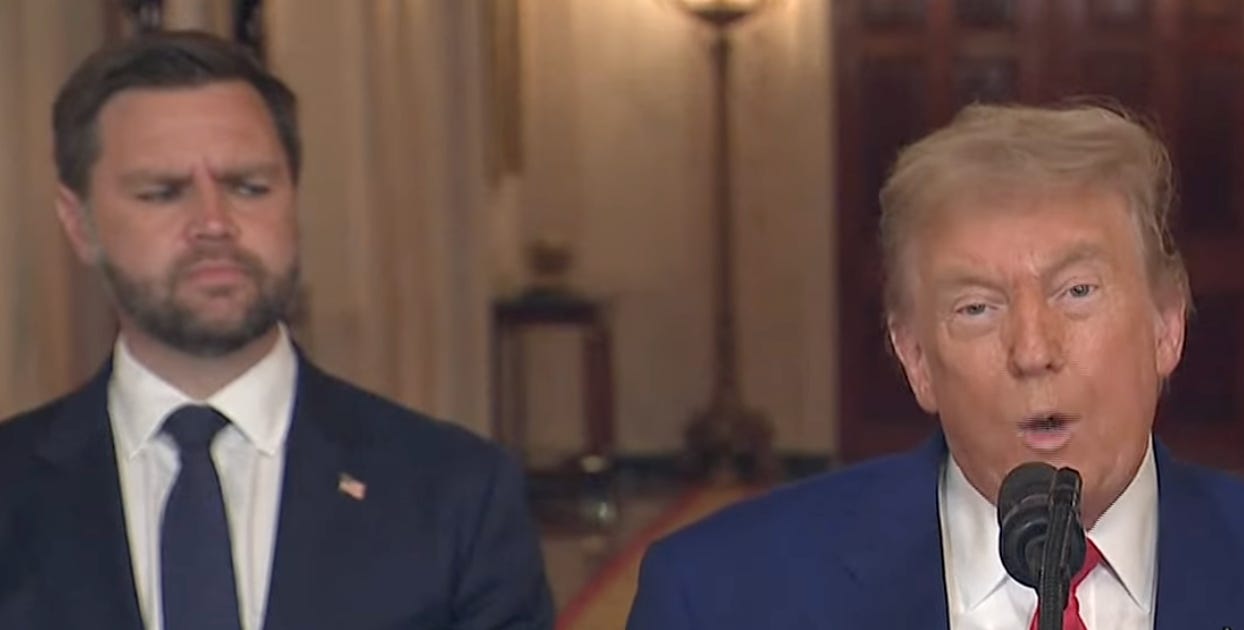
Iran reporting demand letters (June 2025, no suit filed): After the The New York Times and CNN reported a DIA preliminary assessment contradicting Trump’s claim that U.S. military action had “totally obliterated” Iran’s nuclear program, the administration sent formal demand letters to both newsrooms calling the reporting “unpatriotic.” Both outlets publicly rejected them. The Times’ lawyer said, “No retraction is needed. No apology will be forthcoming. We told the truth.” No suit filed; New York’s one-year statute of limitations expires next month. (Below is JD Vance’s expression after Trump says “totally obliterated.” Just an observation.)
Trump v. New York Times ($15 billion) (filed September 2025, active): Trump’s most expansive media suit yet, targeting financial reporting, a book by Times reporters, and a story quoting former White House Chief of Staff John Kelly’s warning that Trump would govern like a dictator. The initial complaint is worth a look, because a Trump-appointed judge struck it and required a rewrite, calling the original “decidedly improper and impermissible” and saying a complaint is not the proper place for:
[T]he tedious and burdensome aggregation of prospective evidence, for the rehearsal of tendentious arguments, or for the protracted recitation and explanation of legal authority putatively supporting the pleader’s claim for relief. As every lawyer knows (or is presumed to know), a complaint is not a public forum for vituperation and invective — not a protected platform to rage against an adversary. A complaint is not a megaphone for public relations or a podium for a passionate oration at a political rally or the functional equivalent of the Hyde Park Speakers’ Corner.
The refiled version, capped at 40 pages, is now active.
Trump v. BBC ($10 billion) (filed December 2025, trial date February 2027): Trump sued the BBC over a Panorama documentary that edited his January 6 speech in a way he called defamatory. The BBC says it will fight. An FCC probe into the same edit is running simultaneously (and we’ll talk more about the FCC soon).
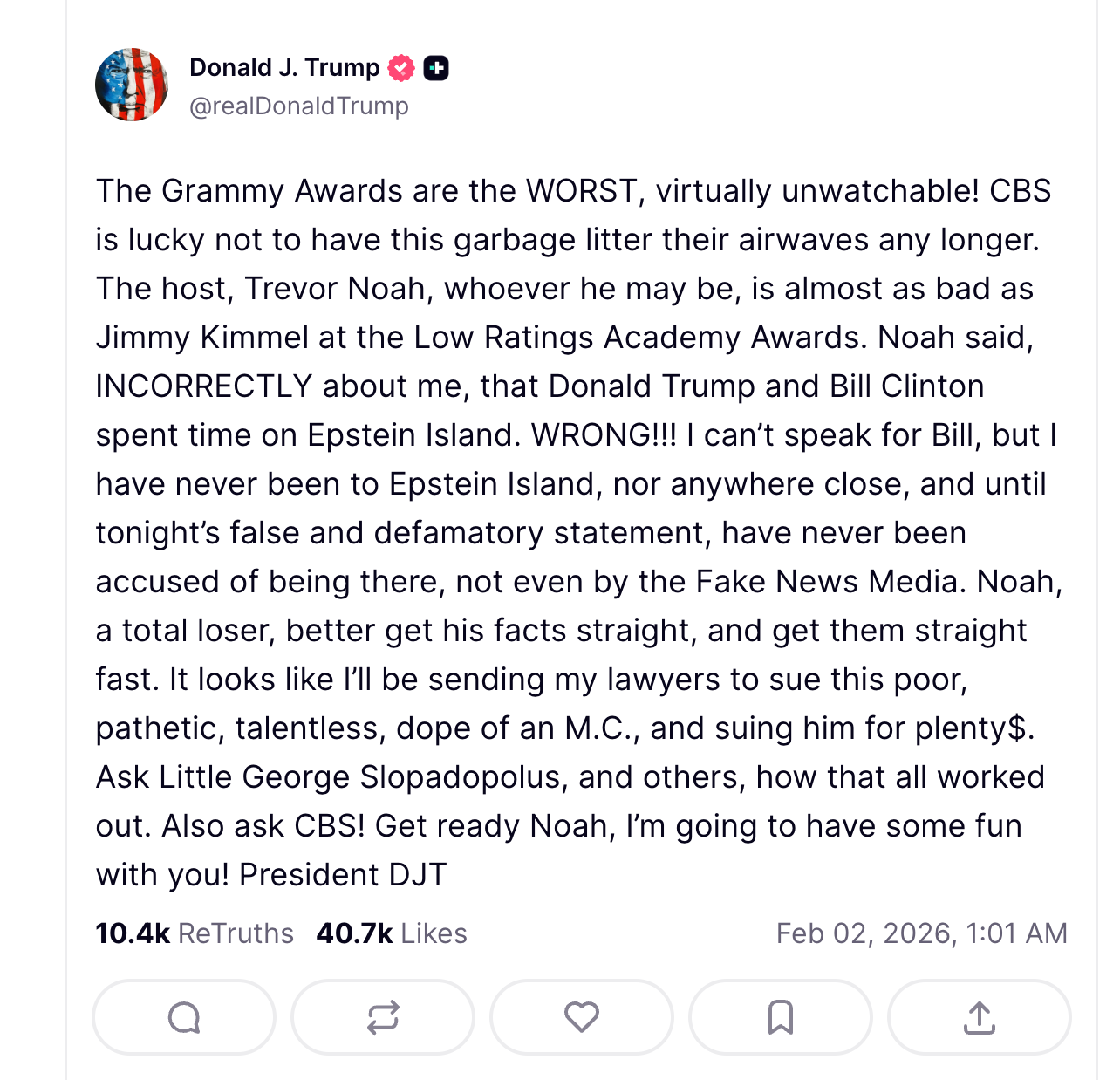
Trump v. Trevor Noah (threatened February 2026, no suit filed): Trevor Noah made a joke at the Grammy awards: “Song of the Year. That is a Grammy that every artist wants almost as much as Trump wants Greenland, which makes sense because Epstein’s island is gone, he needs a new one to hang out with Bill Clinton.”
Trump posted on Truth Social promising to sue him “for plenty$.” No suit filed, yet.
Patel v. The Atlantic ($250 million) (filed April 20, 2026): Patel sued over a story reporting that he had “alarmed colleagues with episodes of excessive drinking and unexplained absences,” citing more than two dozen sources. Before publication, Patel warned the magazine (quoted in the story itself): “I’ll see you in court — bring your checkbook.” After it published, he said, “I’ve never been intoxicated on the job, and that is why we filed a $250 million defamation lawsuit.” The Atlantic’s response: “We will vigorously defend The Atlantic and our journalists against this meritless lawsuit.”
Patel’s complaint, filed April 20, mentions his lawsuit against Figliuzzi, noting that The Atlantic was told their reporting “echoed a similar fabrication previously aired by MSNBC’s Frank Figliuzzi on Morning Joe… yet Defendants published it anyway.” On April 22, the lawsuit against Figliuzzi was dismissed, calling the former FBI official’s statements “rhetorical hyperbole.”
The Atlantic’s story begins with the anecdote that when Patel couldn’t log on to an internal computer system, he called aides and friends to tell them he’d been “locked out,” with two of the friends characterizing this as a “freak out.” The complaint characterizes the incident as a “routine technical problem,” which essentially confirms the event while challenging the characterization.
The Atlantic also states the story was sourced with two dozen people over months. Patel counters, arguing that the two hours the FBI was given an opportunity to comment was unreasonable, given the breadth of the story. But under the Supreme Court’s longstanding precedent, that wouldn’t matter unless The Atlantic’s reason for the short response window was that it entertained serious doubts about the story. That there were two dozen sources and that it echoed criticism from another lawsuit would tend to undermine the possibility of that, absent some evidence of radical abdication of journalistic standards.Melania Trump and Jimmy Kimmel (current): The administration is applying regulatory and social media pressure over a joke where Kimmel said Melania had “the glow of an expectant widow. ” Kimmel later described the joke as highlighting the couple’s age difference. On Tuesday, FCC chairman Carr announced a review of ABC’s broadcast licenses; while not directly tied to the Kimmel comments, last week, Carr said on a podcast that the FCC can “accelerate” when licenses are reviewed if there are concerns with how a network operates.
…And then there’s the FCC.
Legal threats operate on a timeline of years, but the FCC can move in days. FIRE has written a great deal about the FCC’s unconstitutional jawboning before, but let’s review the highlights.
Since taking the chairmanship in January 2025, Brendan Carr has launched formal investigations of nearly every major broadcast network and several of their flagship shows.
NBC - Equal Time/SNL: Triggered directly by the Harris SNL cameo on November 2, 2024. Carr complained the same night it aired, before he was even chairman, saying, “This is a clear and blatant effort to evade the FCC’s Equal Time rule.” (And as FIRE’s own Bob-Corn Revere explained…no, it isn’t.) When he became chair in January 2025, he reinstated a formal complaint against NBC over the same appearance, alongside simultaneous complaints against ABC and CBS over separate Trump-related content grievances.
In February 2025, a few weeks after Carr reopened the complaint, the FCC opened a probe into NBC/Comcast’s DEI practices.
CBS - 60 Minutes/Harris Interview: Triggered by CBS’s editing of a 60 Minutes interview with Kamala Harris before the 2024 election — the same interview Trump was simultaneously suing CBS over in a $20 billion defamation suit (which, once again, we’ll discuss later). The prior FCC chair had dismissed the complaint, saying that the agency would reject claims that “seek to weaponize the licensing authority of the FCC in a way that is fundamentally at odds with the First Amendment.” Carr reinstated the complaint in January 2025, the same week as the ABC debate complaint.
ABC - Debate Moderation (reinstated January 2025): Another complaint revived by Carr was related to Trump’s complaint that ABC’s moderation of the September 10, 2024 presidential debate with Joe Biden was skewed in Biden’s favor. A few weeks after reviving this complaint, Carr opened a facially neutral but curiously timed inquiry into ABC/Disney’s DEI practices.
Jimmy Kimmel/Charlie Kirk (September 2025): Triggered directly and explicitly by Kimmel’s monologue about Charlie Kirk’s assassination. Carr appeared on Benny Johnson’s show the same day to deliver the “easy way or hard way” ultimatum. Disney suspended Kimmel within days.
The View (September 2025–February 2026): Carr began questioning The View’s news-exemption status in September 2025, the same month as the Kimmel episode — the show had long been a target of conservative criticism for its commentary about Trump. He opened a formal equal-time investigation in February 2026 after the show hosted a Democratic Senate candidate, with the effect (whether intended or not) of causing CBS lawyers to cancel at least one Late Show booking out of equal-time caution.
Seth Meyers (November 2025): No formal inquiry — Carr reposted Trump’s call to fire Meyers from his official account after Meyers aired critical Trump commentary. No regulatory action followed. Trump’s criticism followed the day after Meyers criticized Trump’s position on launch assist systems on aircraft carriers.
CNN (April 2026): Carr echoed Trump’s criticism of CNN’s reporting on the Iran ceasefire — even though CNN is a cable network outside FCC jurisdiction. Carr wrote: “Fake news is bad enough for the country, but pushing out a hoax headline in such a sensitive national security moment as this requires accountability… Time for a change at CNN.”
ABC/Kimmel/Melania (April 2026): The early license renewal order issued Tuesday nominally stems from the DEI investigation opened in March 2025. The FCC says the timing is unrelated to Kimmel. The order came a day after Trump and Melania publicly demanded Kimmel be fired.
What remains after you remove the pending or defeated claims is one win, still being contested, and seven settlements. The win involves a Nevada blogger who called Patel a Kremlin asset who helped plan January 6. The blogger didn’t show up to defend the case and Patel got a default judgment. Since then, the blogger has shown up, and has moved to set aside the judgment on personal jurisdiction grounds. That motion is still being briefed.
Of the seven settlements, two involved Melania. The First Lady sued the Daily Mail in the U.S. and U.K. after it published the false claim that she had worked as an escort. The Daily Mail issued a retraction and paid roughly $3 million. The underlying claim was false, the paper acknowledged it, and no regulatory leverage was required to produce the outcome. A separate suit against a Maryland blogger over the same false claim settled in her favor as well.
Then there are the five settlements with companies that often get counted as wins:
ABC ($15 million), after George Stephanopoulos said that Trump had been found liable for rape in the E. Jean Carroll lawsuit, which was not true (he was found liable for sexual abuse);
CBS ($16 million), rooted in what Trump claimed was deceptive editing of a Kamala Harris interview; and
The three social media companies sued for deplatforming Trump after the January 6 insurrection — X (about $10 million), Meta ($25 million), and YouTube ($24.5 million).
Note, however, that four of these five had regulatory exposure. ABC settled while Disney needed FCC approvals. CBS settled while Paramount was waiting on its Skydance merger. Meta and Google faced antitrust inquiries, since resolved. Of the deplatforming defendants, X seemed to have the least government pressure, and paid the least, even though, arguably, it’s the deplatforming that’s the best known.
The record is clear: The Trump Administration likes to punish its enemies for clearly protected speech
If you’re exhausted by that pretty exhaustive list, you should be. I sure am. We at FIRE all are. Look, yesterday the Justice Department indicted James Comey because they believe he Instagrammed a threatening picture of seashells, and I’m too tired to think of a way to make that sound less insane. It sounds like the FBI was social media stalking its ex (director). Why? Were they worried he was running a younger, hotter agency?
The fact is that this administration has obliterated any benefit of the doubt that they may not intend to punish their opponent for their speech. At this point, there is no universe where Trump or any of his people can publicly call for the firing of a late night host where I’m not going to brace for another First Amendment fiasco. I knew it when I posted what I did on X in response to Melania this Monday, and it took less than 24 hours for my concerns to be vindicated.
Thanks to ERI Editor in Chief Adam Goldstein, ERI Managing Editor Angel Eduardo, FIRE Senior Attorney Adam Steinbaugh, FIRE Operations and Strategy Lead Carrie Robison, and FIRE Legal Fellow Jacob Gaba for contributing research to this piece!
SHOT FOR THE ROAD
Another Greg on the Run, this time from the lovely streets of Boston!
Greg, I don't envy you your job, but I really appreciate you doing it. Especially since the two comments before mine are both saying "whatabout". /Em facepalm.
We should note that the sword Trump seeks to wield was sharpened by others.