

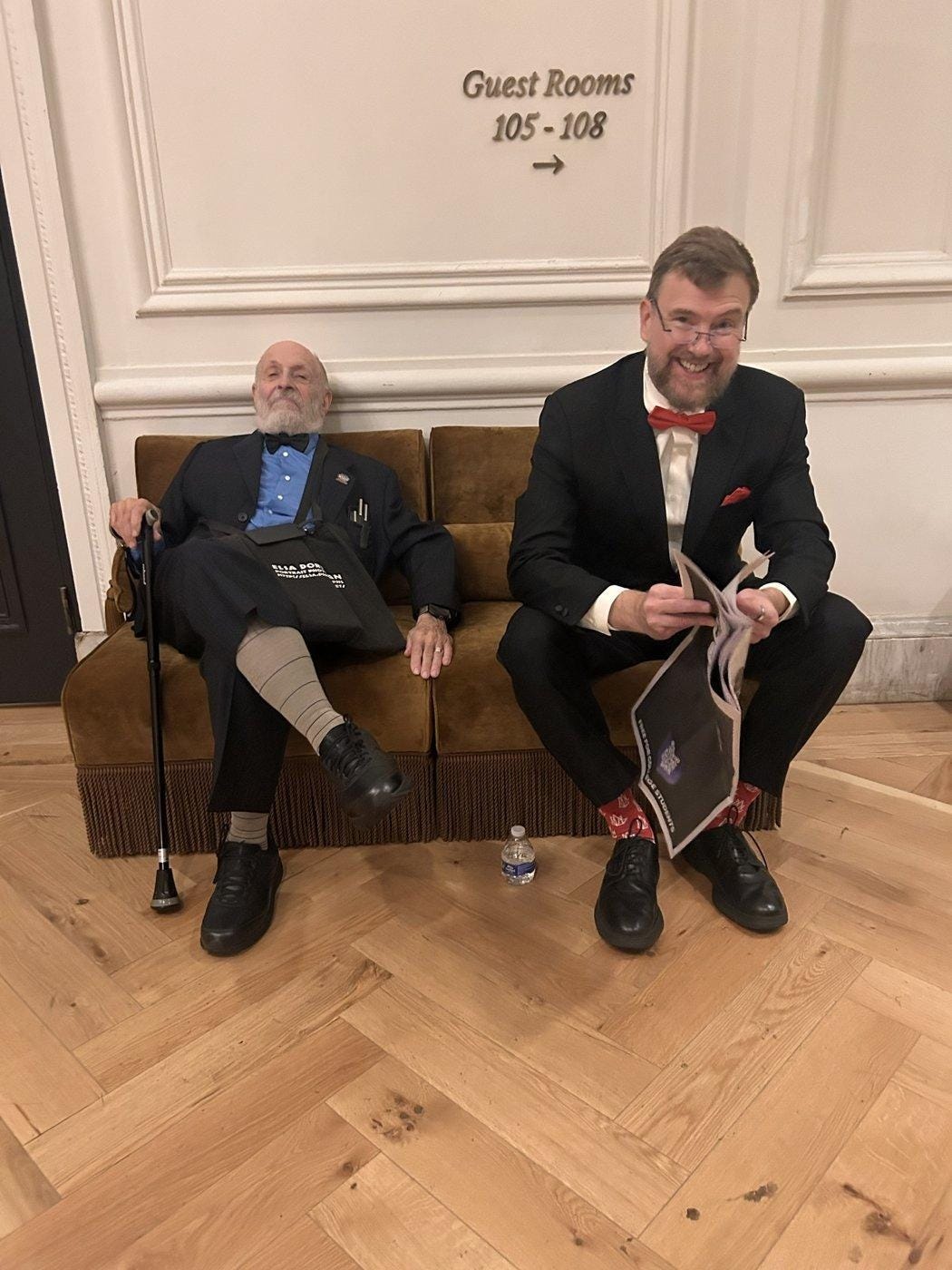
Not too long before he went onstage to deliver a speech at our Soapbox gala this past Friday night, FIRE co-founder Harvey Silverglate had me sit down next to him.
As we sat together on a couch in a hallway of the Bellevue-Stratford in Philadelphia, Harvey handed me a copy of the Harvard Crimson. He wanted me to read an article about alleged discrimination at his law school alma mater that failed to mention the free speech dimension at all. As I sat and read the paper, the great Will Creeley, FIRE’s legal director, was able to snap this shot of the two of us.
It will be one of my favorite photos for the rest of my life.
Harvey has been my mentor, my friend, and one of the most important people in my life for twenty-five years. Way back in 2001, he also ruined my wonderful life in San Francisco. I’ll get to that in a moment.
First, the conference: Soapbox was by far the most ambitious event FIRE has ever attempted. Three days of events, entertainment, and panels on free expression in a beautiful Philadelphia hotel, and we totally sold out — the tickets, not the principles. We’re not Jefferson Starship here.
Those three days were something I really needed, because after twenty-five years of fighting these battles, I’d gotten pretty grim.
Last month, I was onstage at Oakland University with Nadine Strossen, who’d been one of my heroes long before I ever imagined we’d write a book together or work side by side at FIRE. I was pretty down. Freedom of speech seemed in freefall, globally, and even in the United States, the country most zealously committed to freedom of speech, neither side of the political fence seemed to be supportive anymore.
I always feel like the grizzled cynical cop two days away from retirement whenever I share a stage with Nadine. Meanwhile, Nadine, always comes off as the wide-eyed, optimistic rookie in our buddy cop movie even though she’s twenty-four years my senior and has been doing this work far longer than I have. While we were in Oakland, she told me something I really needed to hear: “It’s always been like this. It’s always just a handful of people who defend speech that’s not on their side.”
And she was right. When the ACLU defended the neo-Nazis in Skokie, it lost tens of thousands of members, and it came down to a cadre of true believers like David Goldberger, Nat Hentoff, and Aryeh Neier, who never relented and never gave up on the idea that free speech is for everyone. I had seen the other side of that myself. On my very first day as an ACLU intern in 1999, I praised Skokie at lunch and one of the attorneys responded by saying, “We don’t defend harassment here.” I was flummoxed. I thought it was the single thing they’d be most proud of.
I was surprised by this largely because of the lucky timing of my birth, and where and how I grew up. Being a little kid in the 1980s and young and cool in the 90s it was easy to delude yourself that small-L liberalism and freedom of speech were on the march. That had been the direction, after all, for at least a solid 20 years globally, and in the law for a good 50 years. At twenty years old I was in Prague, learning how a weird rock band called the Plastic People of the Universe helped inspire Charter 77, which started with about 240 signatures in a country of fifteen million. I had watched freedom expand across the world, and somewhere along the way I started treating that expansion as the natural direction of history. It wasn’t. What I had witnessed was an astonishing accomplishment. Again and again, freedom survived because a remarkably small number of people were willing to man the wall and keep the goblins at bay. I had inherited a period of free speech, heading in the right direction because of the work of a tiny number of giants and brave rebels.
Getting over yourself
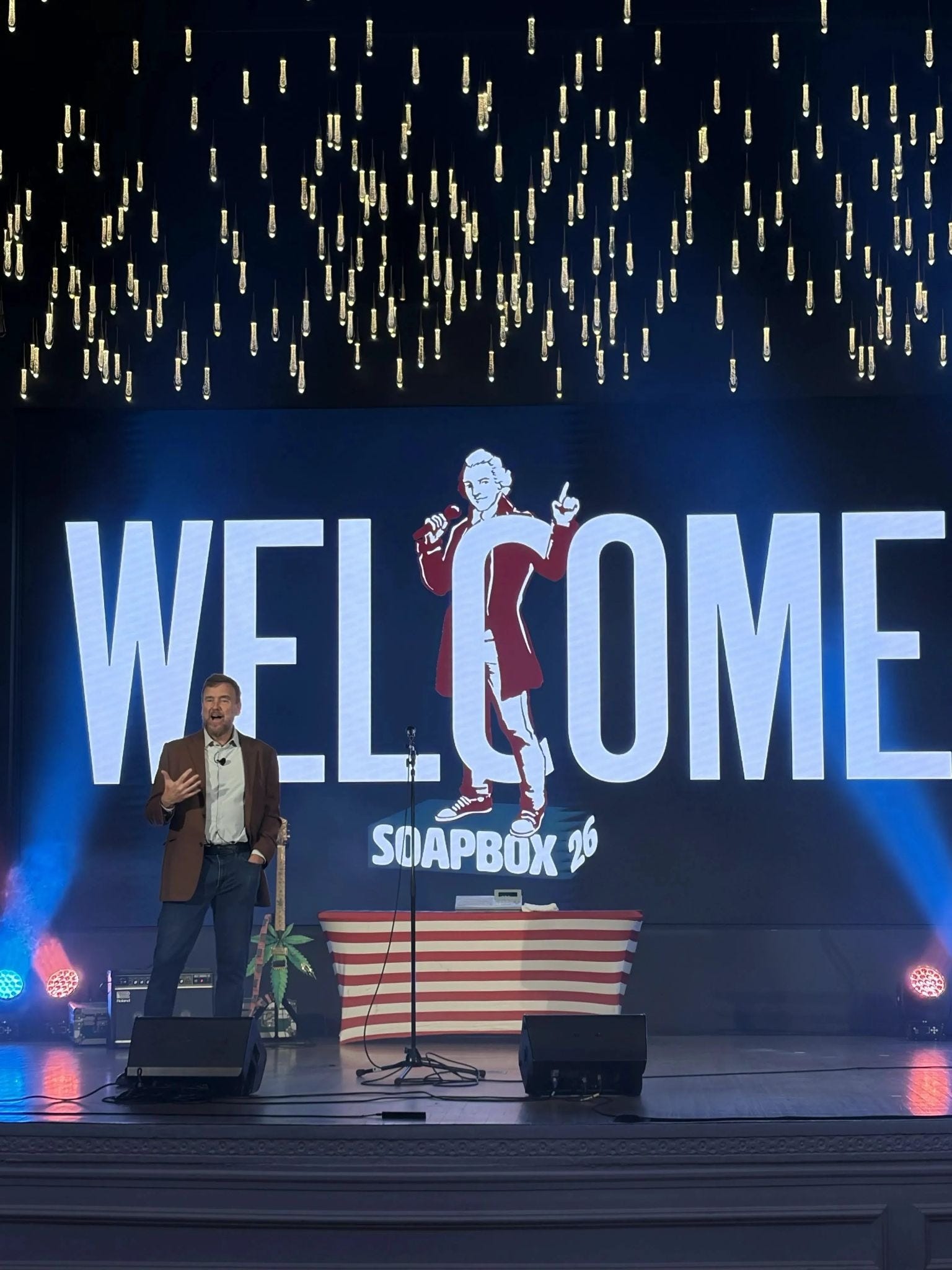
On Wednesday night, I welcomed everyone to the extended family. “I know a lot of you,” I told the room, “which means I know you vote for different people and have very different ideas about what’s true, what matters most, and probably what’s funny. I hope you all end up loving each other, but it’s fine if you don’t. Either way, we’re comrades in arms. We’re in this foxhole together.”
What holds the family together is that we understand the extraordinary, world-changing power of free speech. Power would love nothing more than to control truth itself, which is why freedom of speech is, as Frederick Douglass said, “the dread of tyrants.” But there’s a less appreciated thing. As believers in a liberal republic (liberal in the classical sense, don’t freak out conservatives), we also know the value of getting over ourselves.
When you live through a big historical moment as it’s actually happening, you get the honesty of first impressions. On the night the Berlin Wall came down, a Communist spokesman fumbled a press conference, and a border guard with no clear orders finally just opened the gate. That’s the shock of the real. That’s history before your brain files it in the appropriate folder. Then, devilishly quickly, we squeeze it into the categories we already had, and too often those folders go straight into the ideology drawer.
Tidier. Easier. And a lot less true.
Americans already knew this, even if some people are working hard to make us forget. Our culture is full of little sayings about it: It’s a free country. Who am I to judge? Walk a mile in another man’s shoes. To each their own. Every one of them says that you might not be the center of the universe, and that you are certainly wrong about any number of things. I know I’m wrong about any number of things right now. I just don’t know which ones yet. A free speech culture is built out of those little sayings. The First Amendment is what we wrote down when we were afraid we’d forget them.
Living successfully in a democratic republic, a liberal republic, is, in large part, about getting over yourself. It’s a secret everyone in that room knew but the rest of the country increasingly forgets, because it doesn’t come naturally to us as a species. Nobody gets anywhere if every partnership starts with, “First agree with all my priors, then we’ll talk.” (A practice that has been far, far too common on campus for my entire career.)
I ended that welcome address by telling all the Soapbox attendees who this group who can keep free speech alive: intellectuals, weirdos, and people who felt completely sane and normal up until five minutes ago. Interestingly, it was also very often a small group of free thinkers in the city of Philadelphia, right by the FIRE office, that made the difference.
“Welcome to Soapbox,” I said. “You’re one of us.”
On Thursday morning, I gave the official conference opening talk, and it came down to one idea:
The good news is that freedom of speech has always depended on a surprisingly small number of people willing to stand up for it.
The bad news is that, apparently, we’re those people.
I know that’s a lot of responsibility. It freaks me out a little bit, too. I’d love to believe that the Constitution, the courts, or history itself will take care of free speech without much help from us. But I have spent too long watching how easily people abandon their principles when their own side is in power. Even Britain arrests thousands of people a year for speech that would be protected here, and at home both the hard left and the hard right see free speech as a tactic, not a principle.
The only test of whether you believe in freedom of speech at all is whether you will defend the people you disagree with, or even hate. Defending your own side is just political self-interest.
“So look around the room,” I said to our attendees. “These are the people willing to take on their friends, their political allies, their professions, and sometimes the entire damn world. It’s you. It’s the person sitting next to you. It’s all of us.”
What one person can do
On Friday night, I introduced Harvey with a promise: if you’re ever doubtful that a single person can actually make a meaningful change for freedom of speech, I have someone to introduce you to.
In 2001, I was happily living near Bernal Hill in San Francisco. Spectacular view, loving my life. Harvey was looking for a legal director at the newly-formed FIRE, and he asked Kathleen Sullivan, then the dean of Stanford Law, for a recommendation. She recommended me, which is still one of the greatest compliments of my life. Then Harvey called and persuaded me to move across the country to join a tiny organization nobody had heard of.
Harvey basically ruined my dope life in SF, and I wouldn’t have it any other way.
Harvey has been cheerfully and stubbornly defying powerful people and fashionable opinion his entire life, and it ran in the family. When he was young, his father challenged a corrupt union election. Thugs showed up at the family’s Brooklyn apartment, and they ended up moving to New Jersey. Years later, at Princeton, Harvey mocked the exclusionary Ivy Club interviewers by answering their questions in an exaggerated Jewish accent. “Vy vouldn’t I vant to join the Ivy Club!?”
They walked out. Later, as a lawyer, he defended deeply unpopular clients, including Nazis who didn’t even want a Jewish lawyer.
In 1999, after the letters poured in in response to their book The Shadow University, he and Alan Charles Kors started FIRE with borrowed furniture, almost no money, and a mission most universities considered absurd. Harvey thought they’d solve the problem in ten years, which he was unfortunately wrong about. However, twenty-seven years later, FIRE is a major national force for free expression, all because a few people refused to accept the status quo.
Harvey also gave me the best advice I’ve ever received. I was struggling with how alienating and isolating it can be to defend unpopular speech. Barring the people who really get it, and as mentioned, those people are few, you will piss off everyone at some point. In fact, you will piss off people unavoidably just by doing anything important in this world. So I’ve been looking for advice on how to handle this and Harvey gave me the insight I’ve been following to this day. Harvey told me to pick just ten people whose judgment I truly trust: people who know me, care about me, and will tell me when I’m full of shit. Don’t give thousands of strangers the power to determine how you feel about yourself.
That bit of advice became an essay here in ERI earlier this year. When I sent it to Harvey, he replied that he loved it. He also said, “I should probably start figuring out who my ten are!”
‘Pick Your Ten’: The best advice I ever got in my life

Last month, we marked a bittersweet milestone in the history of my organization, the Foundation for Individual Rights and Expression.
Courage needs psychological stamina, and Harvey taught me how to preserve both my principles and my sanity while going the distance. It has been invaluable.
Harvey also wasn’t the only living proof in the building during Soapbox. David Goldberger, the ACLU lawyer who took the Skokie case, received the award that bears Harvey’s name, which we give to people who follow Harvey’s lead in being fearless against the power and pressure of would-be censors. At our 2023 gala in New York City, we gave the first Silverglate Award to Nicholas and Erika Christakis.
Imagine if Harvey had decided somebody else would take care of it. Imagine if he’d thought the odds were too great. He’s funny, warm, dogged, brave, sometimes gloriously unreasonable, and I love him dearly.
Earlier in the week I said that history is often changed by a surprisingly small number of people. Harvey is living proof. He’s changed my life, and he’s changed the lives of countless people he’ll never meet. Now, this is on us.
Other highlights from Soapbox
The inimitable hip-hop artist Afroman opened the conference with a short concert on Wednesday night. In 2023, seven Ohio sheriff’s deputies sued the rapper for nearly four million dollars over music videos he made from his own security footage of their raid on his home the previous year. In March, a jury found for him on every count.
To close our gala on Friday night, comedian Alex Edelman was both hilarious and moving in his tribute to listening, understanding, and the importance of freedom of speech even for the people you hate — and, more difficult still, for the people who hate you.
We also had the drumline from the Philadelphia 76ers come in for a performance.
(These poorly-shot videos are from my cell phone. Real video from the conference will be available soon!)
In between these awesome things, it was a banquet and an embarrassment of riches for people who love engaging conversations and communication across divides. Four university presidents came — on purpose — and two of them shared a panel with Heather Mac Donald.
The Alliance Defending Freedom and the American-Arab Anti-Discrimination Committee sat on the same panel. Name another room where that happens!
Matt Taibbi has already written a brilliant piece about the conference, titled “Free Speech Will Survive.”
Sarah Isgur and David French taped a live Advisory Opinions, andThe Fifth Column closed the conference with a live episode. I’ll link both when they’re out. Also joining us were Freddie deBoer, Dean W. Ball, Jesse Singal, Musa al-Gharbi, Ilya Shapiro, Pouya Nikmand, Lawrence Lessig, Sally Satel, David Cole, Jeffrey Rosen, Steven Pinker, Nick Gillespie, and many more!
On Thursday night, we also got a great performance of I’m Not a Comedian, I’m Lenny Bruce, Ronnie Marmo’s one-man show telling the story of the legendary comic’s fight against the censors.
Soapbox was truly incredible in every way. I could not be prouder of the entire team at FIRE. Genuinely. It took everybody to pull this thing off.
SHOT FOR THE ROAD

And speaking of Soapbox, one of the coolest panels of the whole event, as far as I was concerned, was “The Science of Open Minds,” with Nita Farahany, Barbara Oakley, Andrew Hartz, Ph.D., and the great Dr. Heather Berlin. Someone in the audience said to me “you could build a whole weeklong conference around” that one panel, and I couldn’t agree more.
Almost nobody connects freedom of speech, the First Amendment, social psychology, and neuroscience. They should. The links run deep, and they’re a big part of why Heather and I are writing a book together titled Reality Test.
And it’s a big day for Heather; she just launched a Substack, Berlin on the Brain, and I’m going to be pushy about it: go sign up. She’s a world-class neuroscientist and clinical psychologist who writes about why we do what we do. Paid subscribers get to take part in her monthly Ask Me Anything, “Pick My Brain,” which is basically group therapy with an actual expert in how your brain actually works.
Her TED talk also just came out, and it’s about a paradox that landed uncomfortably close to home for someone who spent the last year gripping the steering wheel about the state of free speech. The harder you try to control everything, the more you get in your own way, and letting go turns out to be one of the best ways to stay in control.
Do it now. Your brain, as Heather will happily tell you, is extremely good at “later.”
An incredible event. A singular success. A monument to the incredible dedication and work ethic of the people at FIRE.
It looked like this took a monumental amount of time and energy to pull off. It came through, every moment of each of the 3 days of the event. It offered a star-studded, 1 million+ IQ speaker lineup like no other, ever. It was smashing, exciting, invigorating, phenomenal.
I realize it took a lot to pull this off. Please do it again.