


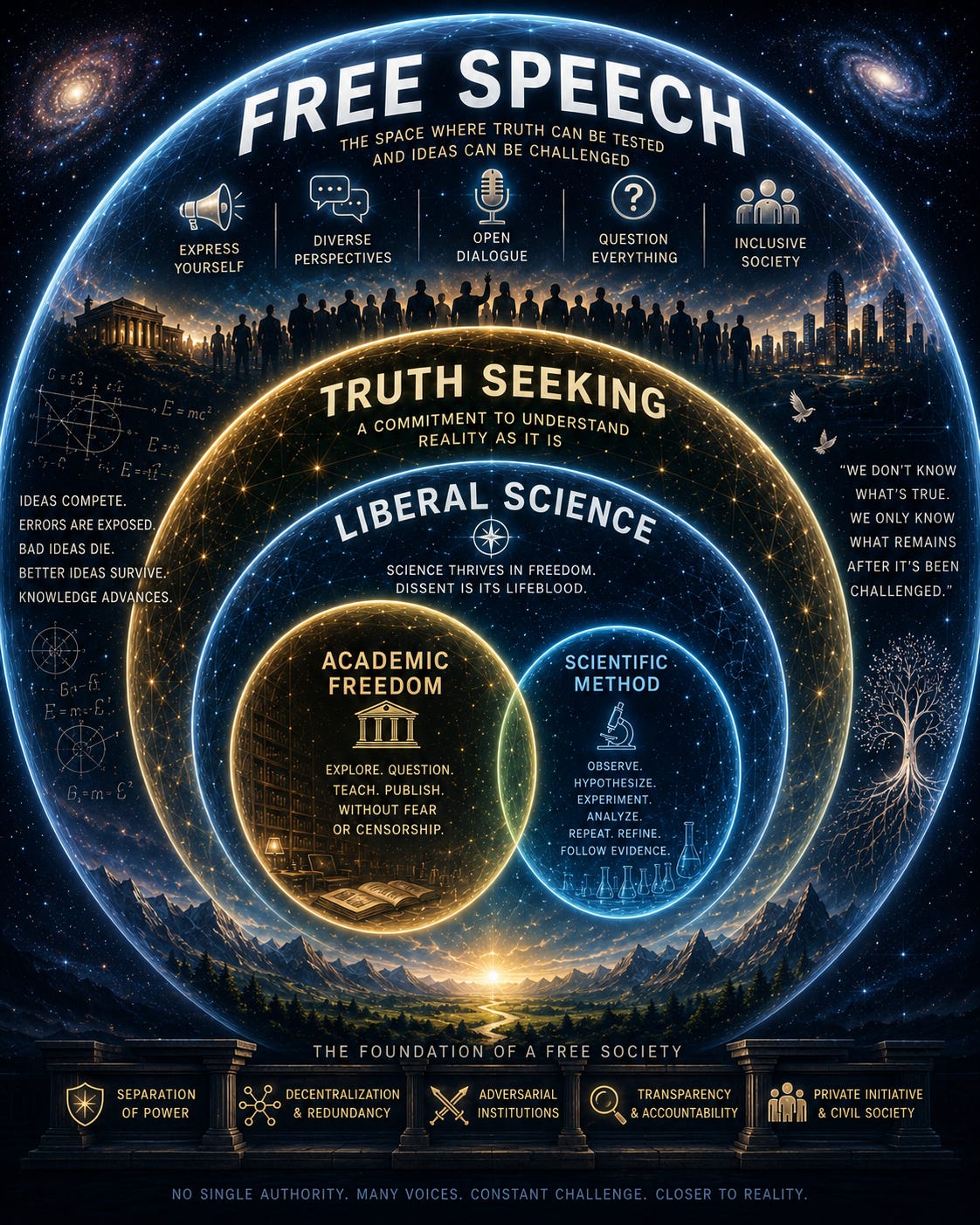
I’ve been writing and talking a lot lately about how humanity creates knowledge, and I suspect some of my readers are wondering why a civil-liberties lawyer seems to have pivoted to the philosophy of science. The answer is simple: they are the exact same topic.
People often talk about free speech as if its primary purpose is self-expression, personal autonomy, or participation in democracy. Those are all enormously important. But the deeper reason I’ve spent decades defending free speech is that it remains humanity’s most effective tool for figuring out what’s true — or, perhaps more accurately, for discovering what’s false.
Long before I became a First Amendment lawyer, I was fascinated by the history of scientific censorship. The stories of Galileo, Darwin, and countless others drove home a lesson that has only become more important to me over time: whenever societies try to protect people from ideas, they also protect bad ideas from scrutiny. Truth doesn’t emerge because authorities decree it. It emerges because claims are challenged, tested, criticized, and forced to survive contact with reality.
That’s why I’ve always viewed free speech as far more than a political right. It is an epistemic technology — a social invention that allows us to compare competing explanations of the world. Democracy, individual freedom, and scientific progress all benefit from and depend on that process. But the process itself comes first.
Free speech is not a secondary luxury that sits alongside science, journalism, and academic inquiry. It is the larger Boolean sphere inside of which those truth-seeking technologies exist. It is, quite literally, the systematic application of doubt and, most importantly for the parallels to freedom of speech, of dissent.
The broken reality-testing machine
At FIRE, our historic focus on higher education taught me that academic freedom is just a specialized version of this exact same principle — the systematic application of dissent and skepticism. The point was never that professors possess some special inheritance of wisdom and should be left alone. Professors are often wrong, and sometimes gloriously wrong. The point is that knowledge advances through challenge, criticism, dissent, and the constant possibility that what “everyone knows” might turn out to be false.
Universities matter not because they protect scholars from scrutiny, but because they create spaces where assumptions can be tested, orthodoxies challenged, and sacred cows occasionally introduced to the concept of a slaughterhouse.
The claim that academic freedom and free speech are unrelated — made by Stanley Fish in The First, among others — is utterly bizarre. As best I can tell, it’s also simply a tactical move to argue about why free speech can be limited, but academic freedom shouldn’t be (a self-serving argument for an academic, if there ever was one). Even authoritarian regimes understand the connection. The Chinese Communist Party does not tolerate political dissent, but it is forced to tolerate a meaningful degree of open disagreement within scientific and technical fields because otherwise their bridges fall down and their technology stagnation sets in.
The trouble is that outside many hard STEM fields, the tolerance for challenge often narrows. Knowledge creation requires discipline, first principles thinking, and genuine viewpoint diversity. But when politics, ideology, and institutional prestige become too intertwined, people stop asking whether a claim is true and start asking whether it is safe, loyal, or useful. That’s when disciplines risk becoming more interested in justifying their existence than questioning their assumptions.
The result is that our societal disconfirmation apparatus is badly damaged. Between ideological monocultures, intense conformity pressures, the ongoing replication crisis, and university administrators who think their job is to manage speech rather than protect inquiry, too many fields are insulated from serious challenges.
This looks incredibly obvious to anyone outside the elite academic bubble. When the public watches a scholar, journalist, or scientist get professionally destroyed for stating something that a large majority of ordinary citizens believe is true, they do not conclude that the institution is carefully maintaining high intellectual standards. In those cases it’s just obvious that social pressure has made objective inquiry impossible.
They aren’t imagining things, either. In The Canceling of the American Mind, Rikki Schlott and I documented hundreds of these exact cases. More broadly, data shows that roughly one in six professors report having been punished or threatened with punishment for their speech. To my knowledge, that level of expressive inhibition is historically unprecedented.
Early glimpses of a challenge system
Despite this, I have become more optimistic recently because we are finally seeing the first signs of something genuinely new. As regular ERI readers will know, FIRE and the Cosmos Institute have partnered to fund spot grants for AI development focused on truth-seeking and epistemic humility. Through those collaborations, I’ve watched projects like Replication Radar and Priori experiment with using AI not as an all-knowing oracle, but as a systematic challenge system.
These tools are designed to identify weaknesses in research, surface neglected findings, expose hidden assumptions, and help users map the biases of the systems they rely on. They demonstrate a massive, underappreciated concept: AI is useful for much more than generating answers. It can be used to challenge answers.
This is the foundation of a concept that neuroscientist and clinical psychologist Dr. Heather Berlin and I are working through for our next book project. We are calling it The Reality Test Project.
The premise is audacious, scary, and massive: What if we built systems specifically designed to challenge human knowledge at scale? Not just within a single journal or a single field, but across the entire accumulated body of human scholarship?
Here is how a multi-generational project like that actually scales:
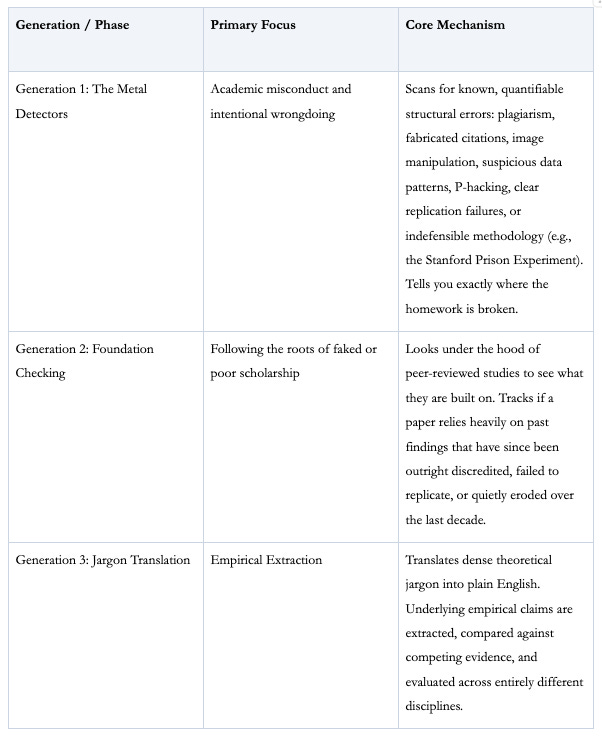
We shouldn’t stop with current English-language scholarship, either. A system like this could scour historical archives, translate foreign-language literatures, and unearth valuable, overlooked work that was ignored simply because it was unfashionable, politically inconvenient, or unlucky when it was published.
The funny thing is that people often hear words like “disconfirmation” or “falsification” and assume they’re talking about tearing knowledge down. In reality, they’re talking about how knowledge gets built. The only way we figure out what’s true is by discovering what’s false. That’s harder than it sounds because our brains are constantly trying to convince us that we’re right, even when we’re not.
The printing press didn’t usher in the Scientific Revolution by confirming what everyone already believed. It helped expose how much of what “everyone knew” was wrong. A lot of medieval certainties ended up in the intellectual scrap heap. Good. That’s how we got modern science and, eventually, jet planes, antibiotics, Nespresso machines, and Game Boys.
The separation of truth and power
One of the most important discoveries of the modern world is that truth and power need some distance from each other. Power can fund inquiry, protect it, and create the conditions under which it flourishes. But the moment power gets to supervise truth, truth has a funny way of becoming whatever power needs it to be.
That’s why freedom of speech, a free press, academic freedom, and the separation of powers matter. They’re anti-corruption mechanisms for knowledge itself.
The same principle applies to AI. If artificial intelligence is going to help us discover what’s true, it can’t become a tool for enforcing what powerful people want to be true. Governments, corporations, activist groups, and ideological movements will all be tempted to use AI to shape what people see, what questions they ask, and what conclusions they reach. That’s how censorship will increasingly be sold: not as censorship, political control, or orthodoxy, but as safety, risk management, and optimization.
If AI becomes a tool for enforcing elite consensus, it won’t need to ban books. It can simply make certain questions harder to ask, certain arguments harder to formulate, and certain conclusions harder to imagine.
But the same technology could do the opposite. It could help us challenge assumptions, test claims, expose errors, and hold every institution — including AI itself — to higher standards of scrutiny. The goal should not be artificial intelligence that tells us what to think. It should be artificial intelligence that helps us figure out when we’re wrong.
To ensure it becomes the latter, we must absolutely reject the creation of a “silicon pope.” If a single, monolithic AI engine is crowned as the supreme arbiter of human knowledge, it will be captured by political and corporate interests within forty-eight hours.
Instead, we need to follow the wisdom of Montesquieu and the American Founders: we must implement a strict separation of powers.
This project requires a decentralized, adversarial ecosystem of several different kinds of independent engine crawlers, allowing every serious player in data verification and scholarly integrity to contribute. Crucially, these systems must live in private institutions completely outside of traditional academia so they cannot be swallowed by the same bureaucratic capture and social conformity that ruined the universities. Their single-minded mission should be to flag research that must either be done over or completely abandoned.
To be clear, I don’t mean that we should uncritically trust our AIs in this process. Instead, we should use their ability to independently highlight potentially bogus knowledge. This way, we can triage where human experts should review the record and intervene with more or less research.
The physical anchor: Replication University
Software alone cannot fix a cultural collapse of trust. The digital ecosystem needs to be anchored by physical reality.
That is why this effort must include the creation of Replication University — a brick-and-mortar institution, or preferably a network of them, whose sole institutional purpose is to check society’s homework. Replication University would exist entirely to disconfirm. It would be a physical sanctuary completely insulated from the social pressures of academic conformity, explicitly structured with genuine viewpoint diversity, and laser-focused on high-integrity replication studies. You’ll hear more about this soon.
We are approaching a moment when humanity has the ability to systematically challenge not just individual claims, but the entire map of human knowledge itself. Finding out what we don’t know at that scale would be one of the most important discoveries we could possibly make.
Computer scientists, statisticians, open-science advocates, lawyers, and publishers are likely already working on individual pieces of this puzzle. If that is you, I want to hear from you in the comments. Once we have a clearer map of reality, improving the world becomes a much easier project. That’s the goal, and that is the most noble and important use for AI that I can imagine.
SHOT FOR THE ROAD
FIRE IS HIRING! If you’re fired up about the future of AI and you’re a lawyer who is ready to do something about it, or you know someone who is, let me direct your attention to FIRE’s open position for Lead Counsel, Tech and Free Expression Policy!
The Lead Counsel, Tech Policy and Free Expression reports directly to FIRE’s Legislative and Policy Director and plays a central role in advancing the organization’s mission to protect freedom of speech involving AI, social media, and other emerging technologies.
Admittedly, I was a little reluctant to post this, but it overlaps enough with your sentiment that I'll go for it.
I'm an older software engineer by trade, so I come at this from the hands-on technical side. Lately, however, I've been using AI to identify and surface challenges in team dynamics. I'm consistently amazed at its ability to synthesize, distill, and even "read between the lines" from meeting transcripts, especially when you add some well-chosen context.
I can’t help but see parallels in broader society. During a recent many-hour conversation with ChatGPT, I came across Google’s 'Habermas Machine' and the Cosmos Institute. Pursuit of human solidarity should outweigh our pursuit of "vibe coding"!
Below is where "we" eventually landed:
AI’s most underappreciated value is not that it can produce answers or automate isolated tasks. Its deeper value is that it can be brought to bear on the raw, messy residue of civic and social life: public claims, institutional records, complaints, hearings, audits, investigations, policy debates, service failures, bureaucratic decisions, media narratives, citizen feedback, and recurring social disputes.
Modern societies already generate vast evidence about how they actually function, but that evidence remains scattered, delayed, contested, politically softened, and far too large for unaided human attention to synthesize reliably.
In that sense, AI should be understood as a new layer of civic perception. It can distill complexity, preserve context, surface patterns, expose contradictions, notice omissions, and convert diffuse public unease into shared objects of examination. It need not be treated as an oracle, ruler, or substitute for judgment. Its value is more subtle and potentially more important: it can help citizens, institutions, journalists, researchers, and public officials see patterns in social reality that are otherwise too fragmented, too buried, or too inconvenient to remain visible.
This matters because many civic failures are not failures of intelligence or concern. They are failures of synthesis. The knowledge needed to understand and improve public life often already exists, but it is distributed across agencies, professions, communities, records, incentives, anecdotes, and time. AI offers a practical way to curate that latent knowledge at scale — to transform institutional exhaust into civic intelligence.
Until someone witnesses this directly, the value can sound abstract. But once seen, it becomes difficult to unsee: AI is not merely a productivity technology. It is a sociological instrument — a way to interrogate human systems, preserve collective memory, and help societies reason about themselves with a breadth, continuity, and humility they have rarely possessed before.
Greg, your work on this is going to matter immensely—I can hardly wait to watch it unfold.