


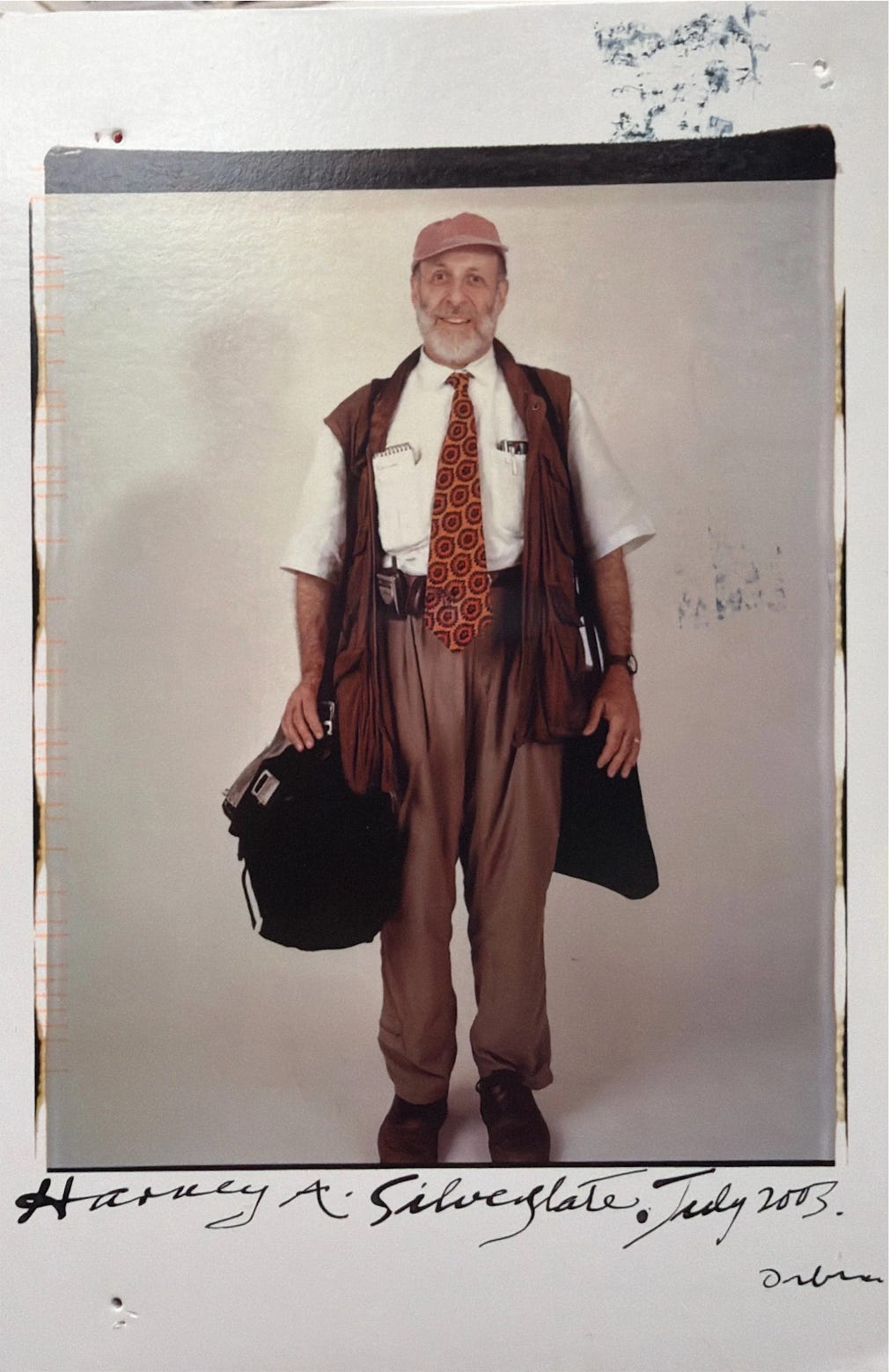
Last month, we marked a bittersweet milestone in the history of my organization, the Foundation for Individual Rights and Expression.
Our co-founder and my mentor, Harvey Silverglate, decided to step down from FIRE’s Board of Directors after 27 years of service to the organization. He’s moving to the advisory council, so this is not goodbye, exactly. Harvey remains very much Harvey, which is to say deeply engaged, relentlessly principled, funny, warm, and still more capable than almost anyone I know of cutting through nonsense with a single question: What, exactly, is the principle supposed to be here? Still, it is the closing of a pretty important chapter in our organization’s history.
For those who don’t know FIRE well, the short version is that we were founded in 1999 to defend free speech, due process, and freedom of conscience on college campuses. This happened during a period when too many universities were congratulating themselves on their commitment to liberty while simultaneously enforcing speech codes, running sham disciplinary processes, and generally treating basic rights as inconveniences that could be brushed aside whenever administrators found them awkward. We have grown a great deal since then, and the mission has broadened, but the core idea remains quite simple: rights matter most when they are hardest to defend, and they are not rights at all if they belong only to the people your tribe already likes.
That understanding was in FIRE from the beginning, because it was in Harvey.
Long before FIRE, Harvey had already built an extraordinary career as a civil liberties and criminal defense lawyer. His public and principled defense of free expression dates back to the late 1960s, when he represented student anti-war protesters on trial. Since then, he taught at the University of Massachusetts Boston, and Harvard Law School. He has also served on the board of the ACLU of Massachusetts for over three decades. In 1999, Harvey co-authored The Shadow University with his FIRE co-founder Alan Charles Kors. It was a book that did as much as anything to explain the campus speech and due process crisis to a broad audience, and helped lay the intellectual groundwork for the organization we now know and love.
But the résumé version of Harvey, while impressive, is not really the point. The more important thing about him is that he belongs to that increasingly rare breed of civil libertarian for whom principle is not a costume and freedom is not a mere slogan. Harvey has spent his life defending liberty consistently — even when it is inconvenient, even when the rights-bearer is unpopular, and even when defending the principle means disappointing people who would greatly prefer that you just pick a side and stay there.
My first experience with Harvey was talking to him on the phone in 2001, looking out my window at a spectacular view of San Francisco from near Bernal Hill Park. Shortly before that, Harvey had asked his former employee Kathleen Sullivan — then dean of Stanford Law School and my law school mentor — whom she would recommend to be the first legal director of this new organization he was launching. She named me. It remains one of the greatest compliments that I have ever gotten in my life. Certainly the most influential one.
I loved talking to Harvey from the start. We discussed all kinds of things, including much of what I liked and didn’t like about The Shadow University. He was trying to sell me on a vision for a new organization — one that would require me to leave this amazing life I had built for myself in San Francisco. That was tough. I loved the city, I loved my friends, and I loved the exhilarating feeling that life there could become almost anything. But I had also always wanted to be a First Amendment lawyer. That was why I went to law school in the first place, after all, and it was what I specialized in once I got there. This was my chance. And while it was a difficult decision, Harvey’s frankness, passion, principle, humor, and warmth were a huge part of why I decided to make the move.
I started at FIRE on October 2, 2001. I became president five years later.
I have made no secret of the fact that I find this to be a challenging job. I have written about that in The Coddling of the American Mind, and I talked about it very explicitly in my appearance on The New York Times’ “The Daily,” podcast — particularly when discussing the way the culture war itself can become simply exhausting.
I don’t mean that in a melodramatic way. I mean that being stuck in the middle of the culture war, especially if you are trying to apply principles consistently rather than tribally, can be alienating in a way that is hard to explain to people who haven’t lived it. I became clinically depressed and suicidal as a result of this work.
When you defend liberals and progressives, your liberal and progressive friends may love you for it. When you defend anyone else, some of those same people can suddenly become furious, as if your principles were only valid so long as they stayed safely inside the tribe. For example, an ex of mine didn’t like that a lot of my work was defending conservatives and Republicans. I told her, “Listen, I’m an old-school ACLU guy. I think even Nazis deserve freedom of speech.” Her response? “I think Republicans might be worse.”
Meanwhile, conservatives often assume that if you are defending lefties, or defending neutral principles when they would prefer a partisan fight, you must be either stupid or morally compromised. I actually almost got into two bar fights in Philadelphia during my early days at FIRE, for the crime of defending lefty professors’ rights.
If you do this work right, you can end up in the unhappy position of doing exactly what you think integrity requires while still disappointing almost everyone who wishes you would become a little more predictable and a lot more tribal.
That takes a toll.
I had my breakdown way back in 2007, and odd as it may sound, I count myself lucky for that. Not because there was anything enjoyable about it, obviously, but because it means that when people come to me now totally burned out, or deeply anxious, or just hollowed out by what the culture war does to the human nervous system, I can say that I’ve already been there. I know that kind of exhaustion from the inside. And while things did get better after 2008, that certainly did not mean everything was rosy after that. The 2010s were still brutal in their own special way — especially as social media amplified every fight, sped up every moral judgment, and made it feel as if all conflict had to be immediate, total, and somehow permanent.
At one point during those years, I asked one of my old bosses how he dealt with being publicly unpopular. To be frank, he gave me some uniquely unhelpful advice: If I cared what people thought, there must be something wrong with me, probably something traceable to childhood damage.
Well, fine. Of course I have that. I think most people do.
But I care what some people think because I’m not a sociopath. Human beings are social animals. That is not a flaw in the design; it is part of the design. Hume understood that. Adam Smith understood that. (This is currently top-of-mind because I just finished the fantastic book The Infidel and the Professor: David Hume, Adam Smith, and the Friendship That Shaped Modern Thought by Dennis C. Rasmussen). Our moral sentiments are bound up with our social instincts, and our desire to be respected by people we ourselves respect. So I never found “just stop caring what people think” to be especially useful advice. If you really did not care what anyone thought of you, it would not make you enlightened, it would make you alarming.
Thankfully, Harvey gave me much better advice.
At first I wasn’t sure he even had any. He just seemed so unflappable, so genuinely hard to hurt — which also seemed surprising, given that he was so warm and clearly loved people so much. But his advice was very simple and very impactful. In fact, it was the best advice I have ever received in my life.
He told me to pick my ten.
You can have friends whose opinions you don’t take seriously, and you can have opponents whose point of view you very much do. So, pick your ten. Figure out who the small number of people are whose judgment you genuinely trust, the people who know you well enough and love you enough to tell you the truth when you’re wrong, when you’re being unfair, when you’re getting carried away, or when — to use the technical term — you are full of shit. Then, when the crowd is screaming, when the internet is losing its mind, when strangers are confidently informing you who you are and why you did what you did, bring it back to those ten. Ask yourself what they would think. Ask yourself whether they would be disappointed in you. Ask yourself whether they would tell you that you had acted unfairly, or out of vanity, tribalism, or cowardice. Or even better, go and ask them yourself.
This was life-changing. In an instant, Harvey had given me a mechanism for blunting the impact of endless anonymous adversaries, trolls, critics, and sycophants. It helped me enormously, and I still think about it all the time.
Now, I should be clear that, as it is with all good advice, I have not always followed it perfectly. I still sometimes find it hard not to care what people outside my ten think. But remembering to bring it back to them, and checking myself against what they think, has made me far happier and far saner, even as the culture war and the threats to free speech have gotten worse. Harvey’s advice has given me a way to distinguish between criticism that matters and noise that only feels like it matters because it arrives at such an overwhelming volume (in both senses of that word).
As I said earlier, I’ve lost people due to the work I do. Dear ones. Ones that it still hurts to think about. People whom I love but could never understand why I had to defend what they saw as “the bad guys” alongside those they approved of and agreed with. But I am also very lucky in the composition of my ten. I’m still best friends with my best friend since I was three, and with my best friend from high school. They will always tell me if I’m full of shit. They are not impressed by public drama, and they are not intimidated by it either. They know me too well. That is part of why their judgment is so useful.
For a long time, I did not hand out Harvey’s “pick your ten” advice very often. I didn’t know that many people who were in a situation as difficult and alienating as my job can sometimes be. For a long time, I thought this was advice for people living under a peculiar kind of pressure: people in public life, people stuck in the middle of ideological warfare, people who spend their days being denounced by one side for not hating the other side enough, and denounced by the other for not joining the bar fight.
I no longer think that.
At this point, most of us are living with some version of that pressure. The culture war has become a 24-hour, seven-day-a-week force in American life, and has been for a while. It invades friendships, families, workplaces, schools, and the portal to the universe that sits in all our pockets. This new paradigm has trained us to confuse visibility with significance, outrage with insight, and the judgment of strangers with moral reality. A lot of people who have never thought of themselves as public figures now live in a constant low-grade state of exposure, agitation, and social vigilance.
One consequence of this is that Harvey’s recommendation is no longer niche advice for a handful of people with especially public jobs. It is useful for almost anyone trying to keep their sanity and decency in a society that makes it very easy to lose both.
So, pick your ten. Make sure they are people who really know you. Make sure at least some of them are capable of telling you hard truths without cruelty or relish. Make sure they are not merely people who agree with you, but people whose judgment you trust more than you trust your own mood on a bad day. And then, when the world starts trying to get into your head, bring it back to them.
It’s the best advice I ever got, and I got it from Harvey Silverglate — a man whose contributions to my life and the organization I now lead cannot be overstated.
I love you, Harvey. You transformed my life. You gave me, and gave so many of us, an organization we are deeply proud to work for. Thank you for finding me in San Francisco. Thank you for the example you set, for the steadiness you brought.
And most importantly, thank you for the wisdom you gave me at exactly the right time.
It was long past time I paid it forward.

SHOT FOR THE ROAD
Rather than continue talking about him, I should just let the man talk for himself! Here is a great profile FIRE just did in — you’re kidding me?! — 2013?! It was that long ago? Oh dear God, I’m old.
Well, it still looks great and really gives you the flavor of this great figure in the history of American free speech (and one of my favorite people on the planet)!
This was really a beautiful and vulnerable essay. We are so often spectators in society, eating popcorn in the stands while we watch real heroes fight the good fights. Greg, you are one of those heroes, and you are actually making the world a better place at great personal cost. Having left the cult I grew up in, I know what it's like to be shunned by community and people I loved because I was true to my integrity. It's a heavy price to pay, but you couldn't live with yourself otherwise. I have tremendous respect for the personal sacrifices you have made on the battlefield. Thank you for all you have done.
I'm not sure that I have even one person whose counsel I fully trust to be accurate.