


I’ve known Kristen Waggoner, president of Alliance Defending Freedom, for years.
FIRE has worked with ADF just as we’ve worked with the ACLU: If you’ll stand up for free speech with us, we’ll stand with you — even if we have sharp disagreements on other issues.
Personally, Kristen and I also have our own political differences. She is very much a political conservative. She’s also serious, principled, and battle-tested on matters of compelled speech and conscience.
You might remember when students shouted down a panel Kristen was on at Yale Law School in 2022. As deans, administrators, and even police officers stood idly by, the protestors pounded the walls, chanted “Fuck You FedSoc,” stomped the floor, and created so much noise that the audience was unable to hear the panelists. The irony was that the panel was literally about how liberals and conservatives can make common cause on issues involving civil liberties.
This past fall, the Russell Kirk Center awarded Kristen the second annual Richard D. McLellan Prize for Advancing Free Speech and Expression at a gala in Washington, DC. (I was honored to accept the inaugural prize in 2024.)
I was thrilled to pass the torch to someone as deserving as Kristen, so I was happy to celebrate her and participate in a panel conversation at the event.
Before hearing Kristen’s remarks, I already thought the international situation for free speech was bad. I’ve been talking for years about what I call the “shrinking circle” of free speech — the idea that, as moral concern expands, we paradoxically use that concern to justify sending cops to your door over opinions. I’ve written about speech arrests in the UK, “hate speech” laws in the EU, and AI-powered repression in China and Iran. Just last week in The Washington Post, I outlined some of the wildest recent cases of “hate speech” censorship coming from Europe — and warned that we should absolutely not go down that road here in the States.
Kristen’s talk really shocked me, though, by talking about a lot of cases I hadn’t heard of. While I knew a lot about the abuse of blasphemy laws in the UK and Europe and threats against big names like comedy writer Graham Linehan (the co-creator of beloved UK TV series like Father Ted and The IT Crowd, who was arrested in Heathrow airport for anti-trans tweets he made while in Arizona), there were many more examples of threats from what might be called simply “the left,” or “political correctness” in a previous era, or “wokeness.”
This led me to do a deeper dive into other cases I might have missed, and with a lot of help from ERI Editor in Chief Adam Goldstein, I was pretty horrified by what I found.
I was already pretty cynical about the situation over there. The idea that it might be even worse than I thought was saying a lot.
But first let me back up and explain why this matters.

Westboro, the expanding circle, and the shrinking circle
In the United States, our Supreme Court upheld the Westboro Baptist Church’s right to stand outside funerals with signs saying things like “God Hates Fags” and “Thank God for Dead Soldiers.” WBC members believe that the deaths of our soldiers are part of God’s judgment against the U.S. for tolerating homosexuality. The Supreme Court, in Snyder v. Phelps, held 8-1 that their outrageous funeral protests were protected speech under the First Amendment, and I fully agree.

Almost nobody likes Westboro. I certainly don’t. But we protect their right to speak because if you don’t believe in free speech for everyone you don’t really believe in free speech for anyone. Every citizen has the right to think what they will and say what they think, without asking the government’s permission first.
That’s the “eternally radical idea.” It means you don’t get censored because your theology is harsh, your politics are unpopular, or your language is impolite.
Professor and philosopher Peter Singer talks about the “expanding circle”: the way moral concern spreads over time to include more groups — slaves, women, racial minorities, LGBTQ people, and so on. That’s real, and often good.
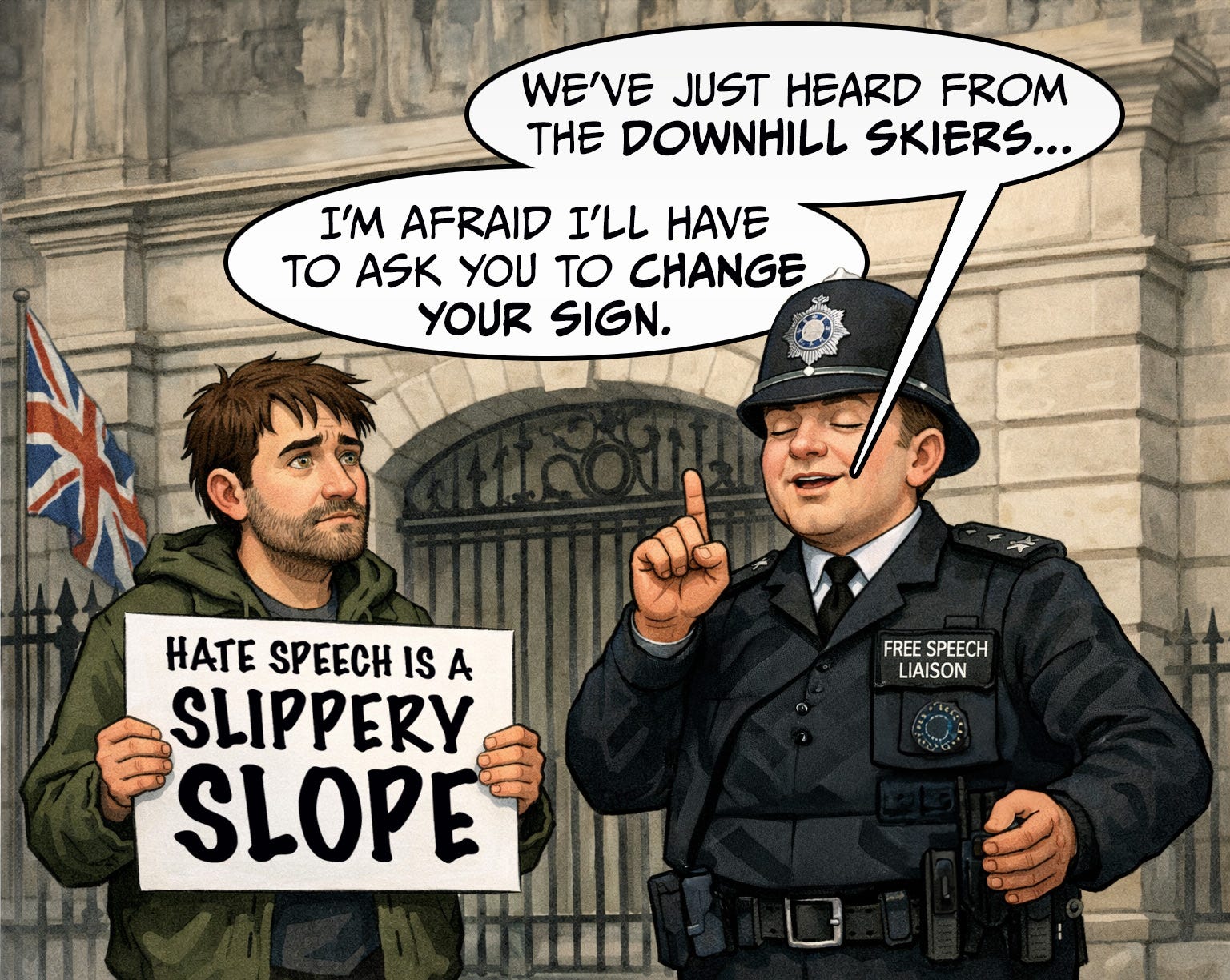
But there’s a dark twist. In much of Europe and the UK, we’ve now used that expanding circle logic to shrink the circle of free speech. We say, “To show compassion for vulnerable groups, we must criminalize speech that offends them. It’s not really censorship if we do it to protect people.”
This leads to police knocking on your door over Bible verses, memes, jokes, “misgendering,” or angry texts about someone who just beat you up. The cops arrive, the handcuffs are real, and yet everyone involved will tell you they’re acting from pure motives.
Here’s the thing: censors always think their motives are pure. From inquisitors to commissars to modern “hate speech” units, they all believe they’re preventing some existential harm. That has never made it okay to strip people of their basic rights, and it doesn’t change the fact that this is precisely what they’re doing.
In the United States, we (still) recognize that. In the EU and the UK, they increasingly do not. And that’s more dangerous to how we treat speech in the US than the abuses that happen in places like China or Iran, because we aren’t likely to turn into China or Iran. But we may turn into the UK, or Germany, or Finland, where they purport to maintain their belief in free expression but have rationalized it into a corner where it can do very little good. So while we’re never shocked at horrifying censorship in China or Russia, we should continue to be shocked by the retreat from liberalism that we’re seeing in the Anglosphere and in Europe. We also need to be vocal in opposing it, because it really could happen here.
If the forces arrayed on the left have their way, we will look a lot more like the UK. And if the forces on the right have their way, we will look a lot more like Hungary. Either way, we won’t be recognizably American.
Britain: Memes, misgendering, and a mother who texted the wrong insult
If you want to see what speech policing looks like in a country that still considers itself a liberal democracy, look at the UK.
Between the Communications Act of 2003 and the Malicious Communications Act of 1988, British police have broad power to arrest people for messages that are “grossly offensive,” “annoying,” or likely to cause “distress” or “anxiety.” Recent statistics show more than 12,000 arrests in 2023 for online speech — over 30 people a day. (For a sense of scope, If the US were to arrest people at the same rate per capita, it would be 60,000 a year.)
Behind that number are real people in real handcuffs.
A 51-year-old army veteran named Darren Brady shared a meme that arranged pride flags into a swastika to make a heavy-handed point about authoritarian tendencies in parts of the LGBT movement. Hampshire Police turned up at his house, arrested him, and, in a bodycam clip, an officer calmly explains that someone has “been caused … anxiety” by his post, and that’s why he’s being taken away. He was offered a “hate awareness” course in lieu of prosecution — ideological homework as punishment. Only after national outrage did the police back down and scrap the course.
Catholic commentator Caroline Farrow was making dinner for her kids when Surrey officers came through her front door in 2022, arrested her on suspicion of “malicious communications” and harassment over a feud with a trans activist, and seized phones and laptops — including her children’s devices. She was taken into custody, questioned for hours, then released without charge.
Here’s one of the most surreal cases I’ve seen: a 34-year-old mother of four, Elizabeth Kinney, who says she was beaten badly enough by a man to require hospital treatment. In private text messages to a friend afterwards, she called him a “faggot.” The friend reported her, and prosecutors charged her under the Malicious Communications Act. She pled guilty and was convicted of a homophobic offense, receiving an enhanced community order, unpaid work, and rehabilitation days. As of the last reporting, no one had been charged for the assault.
In other words, the woman in the hospital gets a hate-crime conviction; the guy who put her there walks away. If that is your idea of “compassionate” law, something has gone badly wrong.
And then there’s Britain’s gift of the phrase “openly Jewish.” In April 2024, during a pro-Palestinian march in London, police approached Gideon Falter, head of the Campaign Against Antisemitism, who was walking near the protest in a kippah, and told him that because he was “quite openly Jewish,” his presence might provoke the crowd and he could be arrested for breaching the peace.
Sadly, because the UK is such a prolific source of speech suppression, we could fill a jukebox with its greatest anti-speech hits:
Roslaind Levine and Maxie Allen were arrested and held for 11 hours for suspicion of harassment, evidently for calling an employee at their daughter’s elementary school controlling in a WhatsApp chat for parents.
Iraq war veteran Jamie Michael made an emotional Facebook post two days after a mass stabbing at a Taylor Swift-themed birthday party, where a UK-born son of immigrants murdered three children. Michael’s post urged people to “get ready,” and warned “we’re under attack” by “scumbags” and “psychopaths.” For his emotional reaction, he would be arrested and spend 20 days in jail for using “dehumanising language” before being acquitted at trial.
Police visited contractor Jon Richelieu-Booth to ask him about photos on LinkedIn where he was posing with a shotgun; he explained they were taken on his birthday trip to America, and the police left. Two weeks later, they arrested him, charging him with possessing the firearm he already told them he didn’t possess.
(As Adam Goldstein said, “The idea that anybody who holds a shotgun like this needs to convince people he doesn’t own one is amazing.”)

At some point, it might be faster if the UK just incarcerated everybody and then selectively let people go free on good behavior. (Am I getting the dry British humor right, mum?)
The cultivated culture of silence in the UK has real costs, and the grooming-gang scandals are the proof. In places like Rotherham and Telford, inquiries found abuse on a staggering scale — girls being groomed, trafficked, and raped for years while institutions minimized complaints, blamed victims, or moved too slowly to stop it.
A recent government-commissioned review found that police and councils still too often avoid recording or analyzing ethnicity in organized child-abuse cases, in part because officials fear being accused of racism or inflaming “community cohesion.” And yes, that fear is tied to a fact that makes people tense: in several of the most notorious group-based cases, many identified offenders were of Pakistani or British Pakistani heritage.
These are deadly serious and ugly topics. But in a free society — where we’re supposed to be equal citizens and voters — you have to be able to discuss hard realities without treating questions as taboo. When you can’t, institutions learn to look away, predators learn they can keep going, and the people who pay the price are the innocents — in this case, many young girls — left hurt, unheard, and too often without recourse.
This is likely to get worse now that the Employment Rights Act 2025 came into effect in October. The Act includes a provision that requires employers to prevent third-party harassment of employees. It could be read, however, to require employers to police private conversations that might be overheard in public, such as at a pub. The Act imposes a test of reasonableness on employers; regulations slated for 2027 will give examples of presumptively reasonable steps.
When a joint committee of Parliament raised concerns that censoring third party speech would infringe on their human rights, the UK government responded that business owners are only asked to do what is reasonable, and that “disproportionate interference” with rights would not be reasonable. But the word disproportionate is doing a lot of work here. Yes, they intend the law to interfere with speech rights, but only in ways the UK government would deem reasonable — and they’ll give employers an example of what reasonable means sometime between four and sixteen months after the law goes into effect.
Germany: The rapist walks, the critic goes to jail
Germany, because it may have learned some of the wrong lessons from its history, has long had strict speech laws — among them, bans on Nazi symbols and Holocaust denial. But the logic has spread.
In Berlin, police raided the apartment of American novelist and political satirist C.J. Hopkins in November, seizing his computer and interrogating him on suspicion of spreading pro-Nazi propaganda. The basis for the accusation was a book critical of COVID-19 policies, its cover using a swastika-and-facemask image as political satire.
That’s it. That’s the “Nazi material.” Never mind that its use is to make an unflattering comparison between modern health policy and national socialism. Nobody who can read is going to look at the book cover and say, “Well, I was just in favor of mandatory masking, but now that I see this book cover, maybe death camps are a good idea.” Hopkins had already been prosecuted in 2023 for tweeting the image of the book cover.
Another case that deserves more international attention involves a group of nine young men who gang-raped a 15-year-old girl in Hamburg. They were convicted but because they were underage, all but one avoided jail time. Later, a woman in Hamburg sent furious WhatsApp messages to one of the perpetrators, calling him things like a “disgusting rapist pig.” The convicted rapist complained and the woman who sent the messages was prosecuted for insult and defamation, convicted, and ordered to spend a weekend in jail.
Yet another German case: politician Marie-Thérèse Kaiser, from the right-wing AfD, posted about gang rapes involving Afghan men and suggested that welcoming more Afghan refugees risked more such crimes. She referenced real statistics about Afghan suspects. Courts convicted her of Volksverhetzung, “incitement to hatred,” and an appeals court upheld the conviction, saying her post violated the “human dignity” of Afghans by presenting them as dangerous sex criminals.
You can criticize her tone and politics, if you like, but the underlying question remains: Can a politician in a democracy cite uncomfortable crime statistics about a specific immigrant group to argue against a refugee policy without facing criminal prosecution?
Finland: Grandma on trial for quoting Romans
Kristen’s speech in November started with a case from Finland, and once you know the facts, it’s hard to shake.
Päivi Räsänen is not some anonymous troll. She’s a physician, a mother, a grandmother, a long-serving member of Parliament, and a former interior minister. She’s also a conservative Lutheran.
In 2019, she posted a tweet criticizing her church leadership for officially supporting Helsinki Pride. Attached was a photo of Romans 1:24-27 — the standard “traditionalist” passage condemning same-sex relations. Years before, in 2004, she had written a short church pamphlet explaining the Lutheran view of sex and marriage. She also did a radio debate along the same lines.
For that, Finland’s Prosecutor General charged her with “agitation against a minority group” — essentially “hate speech” — under a section of the criminal code that sits next to war crimes and crimes against humanity. Lutheran Bishop Juhana Pohjola was charged too, for publishing her pamphlet.
Police interrogated Räsänen for hours about her beliefs. Prosecutors pored over her pamphlet and sermons line by line, asking which parts of the Bible she intends to believe. She faced the possibility of fines and a criminal record.
She won. In 2022, a district court acquitted her unanimously. In 2023, the Court of Appeal acquitted her unanimously again.
That should have been the end of it.
Instead, prosecutors appealed again. In 2025, the Supreme Court of Finland agreed to hear the case. The state is still arguing that quoting Romans 1 and defending historic Christian doctrine about sexuality can be a criminal offense.
Oddly enough, this question has already been resolved in neighboring Sweden, under a rationale that would also apply to Finland, in theory. In 2003, pastor Ake Green was convicted of violating Sweden’s hate speech laws (see Chapter 16, section 2) by delivering a sermon that said that homosexuality is “a deep cancerous tumor in the entire society.” His conviction was voided because upholding it would have conflicted with Sweden’s obligations under Articles 18 (protecting freedom of thought and religion), 19 (protecting freedom of expression), and 26 (promising equality under the law) of the International Covenant on Civil and Political Rights. Finland is also a member of the covenant, and in theory, Räsänen’s speech should also be entitled to its protection.
Even if Räsänen ultimately wins a third time, thousands of people will have heard the message loud and clear: quote scripture at your own peril.
Norway: ‘Men can’t be lesbians’ and Facebook heresy
In also neighboring Norway, the target is not a conservative Christian but a gender-critical lesbian feminist.
In 2020, the Norwegian parliament expanded Penal Code §185 — the hate-speech law — to explicitly cover gender identity and expression. Shortly afterward, lesbian filmmaker and artist Tonje Gjevjon posted on Facebook that men cannot be lesbians, and criticized male-born people presenting themselves as “lesbian mothers.” In late 2022, she received notice that she was under police investigation for possible hate-speech crimes, with a maximum penalty of three years in prison.
She was never convicted, but the process is the punishment. When stating “men can’t be lesbians” can plausibly lead to a hate-speech probe with multi-year prison time on the table, it’s rational to keep your head down.
Switzerland: Ten days in jail for saying skeletons have a sex
It is not an especially controversial idea that sex can be usually determined by examining skeletal remains, even if there are exceptions. Not so in Switzerland, where Emanuel Brünisholz, a musical instrument repairman, was sentenced to ten days in jail for an anti-trans Facebook comment. In a 2022 reply to a member of the Swiss National Council (sort of their House of Representatives), Brünisholz wrote: “If you dig up LGBTQI people after 200 years, you’ll only find men and women based on their skeletons. Everything else is a mental illness promoted through the curriculum.”
Brünisholz was arrested in 2023 and convicted in December 2024, where he was fined 500 Swiss francs. After exhausting his appeals, he refused to pay on principle, announcing in September of 2025 that he would be serving his alternative punishment — ten days in jail — last month.
What makes this case so sinister is that it looks like a roundabout way of criminalizing dissent from orthodoxy. Whether Brünisholz is right or wrong about anything he says isn’t the point; the point is that using the systems of government to punish someone who doesn’t agree with the mainstream view is the opposite of a free society.
We’re not the ones who need to apologize
I want to be very clear about something: The United States does not need to apologize for having a robust free-speech tradition. We are not the backwards cousins here. We are the last people standing up for an insight that used to be common sense in the West: you can’t trust governments with the power to decide which opinions are too offensive to say.
What we should apologize for, as Americans, is every time we waffle on that principle. Every time we flirt with hate-speech bans. Every time we say “sure, censoring your opponents is fine over there, we just don’t want it here.” Every time we treat people like Graham Linehan as partisan entertainment instead of cautionary tales.
Equal citizens in a free society have a right to:
Object to immigration policy.
Quote their religious texts on sexuality.
Say “there are two sexes.”
Insult a rapist or abuser in a private text or message without becoming the one the state prosecutes.
Quote the Bible.
If you can be arrested, prosecuted, fined, or professionally shattered for any of that, you are not living under free speech in the sense the First Amendment enshrines.
The Supreme Court has a blunt way of putting this: Speech on matters of public concern is “at the heart of the First Amendment’s protection,” because speech about public affairs is “the essence of self-government.” In other words, we don’t protect speech because it’s polite. We protect it because we are supposed to be citizens — voters — whose judgments matter. And voters can’t do their job if the state trains them to speak in euphemism, or only in whispers, or not at all.
And if we, in the United States, start to lose faith in that — if we decide that the European model is more “civilized,” that being spared offensive opinions is more important than retaining equal rights — then the strongest bulwark for free expression left in the world will have fallen.
A decent way to measure whether you’re actually free is to ask what you’re allowed to say about the subjects that matter most: rape, child rape scandals, violent crime, immigration policy, religious doctrine, war, and even basic claims about sex and the human body. If you have to watch your language on questions that cut to the very heart — because the wrong phrasing can bring the police, a prosecutor, or a professional tribunal — then you’re not a free and equal citizen in the ordinary sense. You’re a subject being managed.
The day after Christmas, French newspaper Le Monde published an op-ed advocating for Europe’s side in the EC’s €120 million fine of Elon Musk’s X over a lack of transparency and, allegedly, blue checkmarks being too confusing. The authors claim that “the myth of ‘European censorship’ is wielded by the Trump administration to avoid regulating Big Tech.” Trump must be extraordinarily powerful indeed, to have engineered tens of thousands of arrests across the UK and Europe to provide evidence for this “myth.”
I would humbly suggest an alternative possibility: Americans have watched how “responsible” democracies treat their own citizens when they talk about the hottest, hardest subjects, and have recoiled from importing that model here. Because once the government gets to decide which opinions are too dangerous to say, your vote starts to matter a lot less than the sensibilities of whomever holds power.
Back to Kristen — and what we do next
So back to Kristen Waggoner.
We’ve been on the same side and on opposite sides of various fights. We don’t share a comprehensive worldview — FIRE is proudly nonpartisan, ADF is explicitly conservative and religious. But when it comes to the core question of “Does the state get to punish you for not saying the approved thing?” we’re allies.
Kristen’s work defending people like Päivi Räsänen in Finland is one important line in a global battle to preserve the idea that rights are not favors the state dispenses to the well-behaved. Rights don’t just protect the speaker; they protect the citizen. If we’re equal in theory but unequal in what we’re allowed to say, then that equality is cosmetic. Your vote is still counted, but your voice is trained.
My worry, after listening to Kristen’s remarks this fall and looking at the cases above, is that we are entering a moment where even many Americans who think they support free speech are getting used to the idea that “responsible” democracies censor bad opinions “for good reasons.”
No.
In the history of censorship, everybody always thinks their reasons are good. That’s the problem.
Serious problems require serious talk — frank, direct, sometimes uncomfortable talk. A society that can’t discuss rape scandals without tiptoeing, or violent crime without ritual disclaimers, or immigration policy without fear of accusation, or basic biology without legal risk is not “more civilized.” It’s more brittle. Brittle systems don’t protect the vulnerable; they protect the predators and the bureaucrats who prefer not to notice.
Here’s another radical idea: you are an equal citizen, not a subject. You get to hear ideas, weigh evidence, change your mind, or not, without the government protecting you from other people’s thoughts. If your rights end where someone’s feelings begin, you don’t have free speech of any kind. China is just as willing to let you say things that don’t offend anyone; it’s just more honest about whose feelings are really determining when the cops show up at your door.
Probably the most important point to make here is that, if you have even one example of someone being arrested, getting a visit from the cops, or being charged for taking an unpopular position on one of the biggest political hot-button issues in a society — immigration, crime, religious fundamentalism, religious expression — they will not trust what they hear in the media, or even what they hear in society, as being genuine or authentic.
This leads to a genuine epistemic crisis, where people cannot tell what their countrymen honestly think, or what the world actually looks like in terms of public opinion and perception — and that is a disaster. People in control, or at the top of society, can be such fools in thinking that if they could just better control the opinions people express, popular opinion will go right along assuming the preferred ruling class’ position is correct. But that relies on a model in which people are even stupider than ruling class people often assume they are.
What happens instead is people conclude that no one is saying what they really think, and that the media, politicians, and even their fellow citizens cannot be counted on to show what they really think — because if there’s even the slightest risk of being arrested or punished for it, who would?
That’s what a chilling effect is, and it is poison to any society — particularly a democratic one, or at least nominally democratic one. Yes, the European Union is right to be concerned about misinformation and disinformation, but they completely misunderstand the way to overcome an epistemic crisis. The only way — literally the only way — to do it is to have institutions that people trust to engage in candor and honesty, both about what’s really going on and, most importantly, about what people really think about what’s going on.
A system that sends cops to your door when you say something slightly out of line cannot be that system. Ever.
Much of Europe has forgotten that. The UK is in danger of forgetting it. If we forget it here — if the shrinking circle closes around the last big holdout — we lose not just a legal principle, but the engine that made liberal societies dynamic and self-correcting in the first place.
If we blow it here, we blow it everywhere.
SHOT FOR THE ROAD
Here’s Kristin’s speech, which started me down this path:
I can't thank you enough for all your work and writings about free speech and the rule of law, but I just need it to be said that it cannot be understated how bad the situation is right now in the UK. As an Englishman, I've watched my country decay over the past ten years, and I've never been so terrified in my life. What we need is our brothers across the pond, now more than ever.
Do not abandon us just because of our despotic leaders. It was only a few years ago when the Joe Biden administration was doing very much similar things. I see many Americans speaking of Britain as if Biden's curbs against free speech didn't happen. (Disinformation Governance Board, Covid censorship)
Starmer is destroying our once great nation faster than I ever thought possible. We cannot survive until 2029, which is the next general election. I'm speaking here with genuine fear that if the United States doesn't intervene, they will not have any of Britain left to rejuvenate when Farage wins. If that means a US warship sailing up the Thames (to be parked outside Parliament, so be it), I am that serious. My country is dying.
But, for now, until it does fall, I can at least read your work (via VPN) as sometimes even Substack is blocked and unable to be accessed. Often coincidentally, topics that the government wants controlled, fancy that. Many an article on immigration I can’t access without workarounds.
So until I can no longer read your work, I thank you for it
Oof, that was a tough read. I couldn't stomach all of it, but I thank you for documenting it, and fighting so vigorously. Our course indeed seems perilous.