


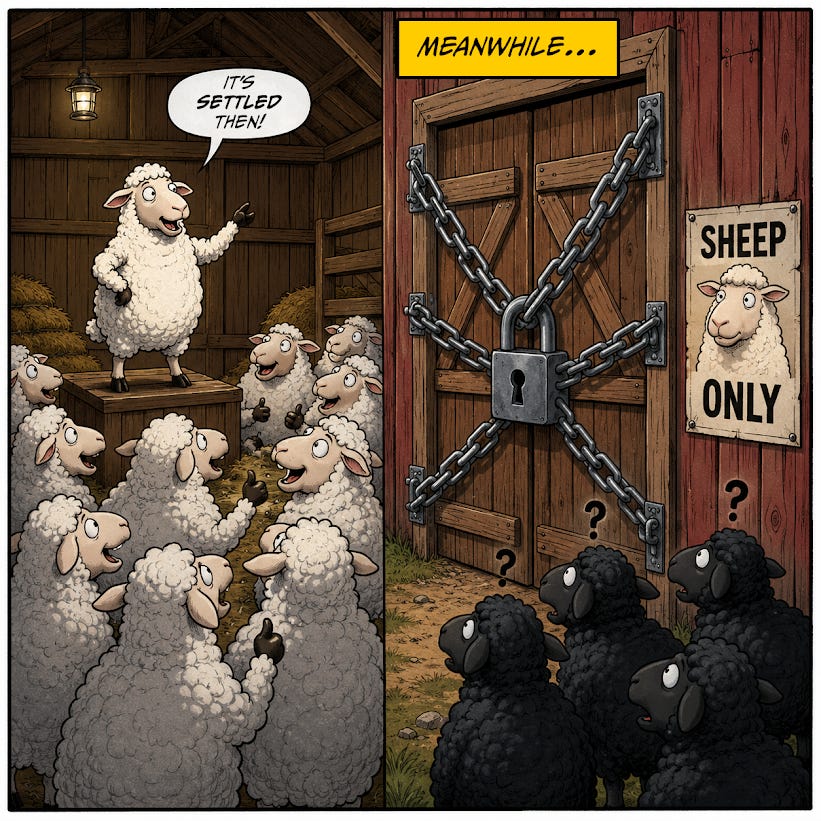
I spend a lot of time on college campuses and to this day, one of the stranger experiences I keep having is running into skepticism that there is even a free speech problem in higher education.
You can cite survey data. You can cite FIRE’s cases. You can cite shout-downs and disinvitations, ideological litmus tests, faculty self-censorship, DEI loyalty oaths, investigations of professors and students for protected speech, and the many students and professors who will tell you privately what they are afraid to say publicly.
Still, someone will usually say, in effect, “This is a nothingburger.”
But the skepticism that frustrates me most is about the most obvious point of all: that higher education, especially elite higher education, leans decidedly to the political left. This is one of those things everybody knows and yet many people still somehow resist saying plainly. My best guess is that even many of the people denying it know it’s true, they just don’t think admitting it is tactically wise.
And because there are many different kinds of evidence, there are many different ways to dismiss each one. Faculty surveys? People lie on surveys, or the sample is biased. Voter-registration data? Party registration is crude. Campaign donations? Well, that only tells you professors give to Democrats. Maybe they’re donating to centrist Democrats, not the progressive wing of the party.
Fair enough. Every method has limits. But when many different methods keep pointing in the same direction, you should start updating your view of reality.
And now we have another level of data.
FIRE’s new report on faculty ideology helps answer the “maybe they’re just centrist Democrats” objection. The report, written by University of Rochester political scientist David Primo, does not merely ask whether faculty donors give to Democrats or Republicans. Rather, it uses campaign-contribution data to place faculty donors and politicians on the same ideological scale. That lets us ask a more precise question: what kind of Democrats are we talking about?
Very “progressive” ones, it turns out. Not NPR-totebag-and-recycling progressive. More like, Bernie Sanders-but-peer-reviewed-by-a-room-full-of-people-snapping progressive.
Why higher ed being an ideological monoculture is a serious problem
Before getting into the numbers, it’s worth reiterating why any of this matters at all.
The most important mission of higher education — the one that best justifies its special legal protections, public subsidies, tax advantages, prestige, and autonomy — is knowledge creation. Universities are supposed to help society see the world as it actually is.
That happens through a continuous and rigorous process of disconfirmation. Test claims. Try to prove things wrong. Eliminate what fails. Over time, if the process is healthy, you establish a cloud of probability around what might be true.
That process requires an unusual amount of freedom. It requires dissenters — people willing to say, “I think the premise everyone here accepts is dead wrong.” And it requires a culture in which being wrong is not fatal, and being on the wrong side of a hot-button political issue is not career suicide.
Higher education does not work well when professors and students face what Rikki Schlott and I, in our book The Canceling of the American Mind, called the Conformity Gauntlet: This is a series of intellectual and professional hurdles that keep out dissenters and defectors from the orthodoxy. It consists of layer after layer of hard and soft pressure to say the right thing, avoid the wrong topic, signal the correct commitments, and stay away from questions that might make you socially and professionally radioactive.
That’s the crux of the problem here: if there are almost no people in the room who actually reject the dominant assumptions, or if they are there but have learned to keep quiet, higher education’s primary function ceases to work at all.
That is why faculty ideology matters. It’s not because conservatives are always right — good lord, no. It’s not because progressives are always wrong — also no. It matters because any knowledge-producing institution that becomes too ideologically uniform loses one of its simplest and most critical error-correction mechanisms.
FIRE’s faculty ideology report: what the numbers show
Primo’s report looks at faculty at 55 elite and flagship universities, the same schools FIRE studied in its 2024 faculty survey, which includes 112,516 faculty members. He matched those faculty members to campaign-contribution records using Stanford’s Database on Ideology, Money in Politics, and Elections, also known as DIME, which includes more than 850 million itemized contributions going back to 1979.
Of the faculty members studied, 30,289 — about 27% — had enough giving history to receive a reliable ideology score. If the analysis is restricted to faculty who gave $200 or more to a candidate or political committee in at least one election cycle, the number is 16,253, or about 14%.
This matters because party labels only tell you so much. “Democrat” can mean Joe Manchin or Bernie Sanders. “Republican” can mean Susan Collins or Ted Cruz. Primo uses CFscores, a campaign-finance-based measure developed by political scientist Adam Bonica, to place donors and candidates on the same ideological scale.
The result is striking, though totally unsurprising to people like me, who have been dealing with college campuses for more than a quarter century.
Among faculty donors in the 55-school sample, the median ideology score is -1.02. Among $200-plus donors, the median is -.95. For comparison, Alexandria Ocasio-Cortez’s CFscore is -1.16, and Bernie Sanders and Elizabeth Warren both score -1.14.
Primo’s conclusion is memorable: AOC, Sanders, and Warren, among the furthest-left members of their respective chambers, would appear only slightly left of center in a legislature made up of faculty contributors. That is the part of the report that should end the “maybe they’re mostly moderate Democrats” argument. Nobody who is worried about the Squad being swing voters is in the middle of anything except season eight of The Handmaid’s Tale.
I want to be clear, here: Professors have every right to be progressive. They can believe what they want, donate to whom they want, and argue for whatever politics they think best. I do not want government ideological quotas for faculty hiring. I do not want trustees marching into departments and demanding one conservative, one libertarian, one socialist, one Catholic integralist, and one guy who keeps bringing up Boethius. That way lies madness. (Or worse, another vice provost.)
The concern is that primary function I mentioned above. Universities are supposed to be places where ideas are tested, and testing requires disagreement. Disagreement requires having people in the room who do not share your priors and are willing to say so.
Primo’s report is only the latest confirmation. UCLA’s long-running HERI Faculty Survey has asked faculty about ideology since 1989. Analyzing those data, researchers Phillip Magness and David Waugh found that by 2016 faculty identifying as “far-left” were equal in size to all right-leaning faculty combined. Overall, left-leaning faculty outnumbered right-leaning faculty about 6 to 1 — especially in the humanities and social sciences.
FIRE research fellow and manager of polling and analytics Nate Honeycutt’s 2021 and 2022 surveys found the same basic pattern. Faculty identifying as “far-left” or “very liberal” exceeded all right-leaning faculty, with a left-right ratio of 6.9 to 1. FIRE’s 2024 faculty survey of more than 6,000 faculty members at 55 universities found that far-left faculty outnumber far-right faculty 16 to 1, and strong Democrats outnumber all Republicans by 2.5 to 1. At some point, the faculty stopped leaning and started doing ideological hot yoga.
Voter-registration studies tell the same story from another angle. Mitchell Langbert and FIRE’s own chief researcher Sean Stevens studied more than 12,000 professors in the 30 states that include party affiliation in voter-registration data. They found that Democrats outnumber Republicans 8.5 to 1.
And then there’s the FIRE finding I’ve found clarifying for years: self-identified Marxists and socialists outnumber conservatives nationally among faculty. That does not mean every college campus is just a Trotsky reading group that appointed a Title IX coordinator. But it does tell you something important about higher education’s ideological center of gravity. In most American institutions, conservatives dramatically outnumber self-identified Marxists. In academia, the reverse is often true.
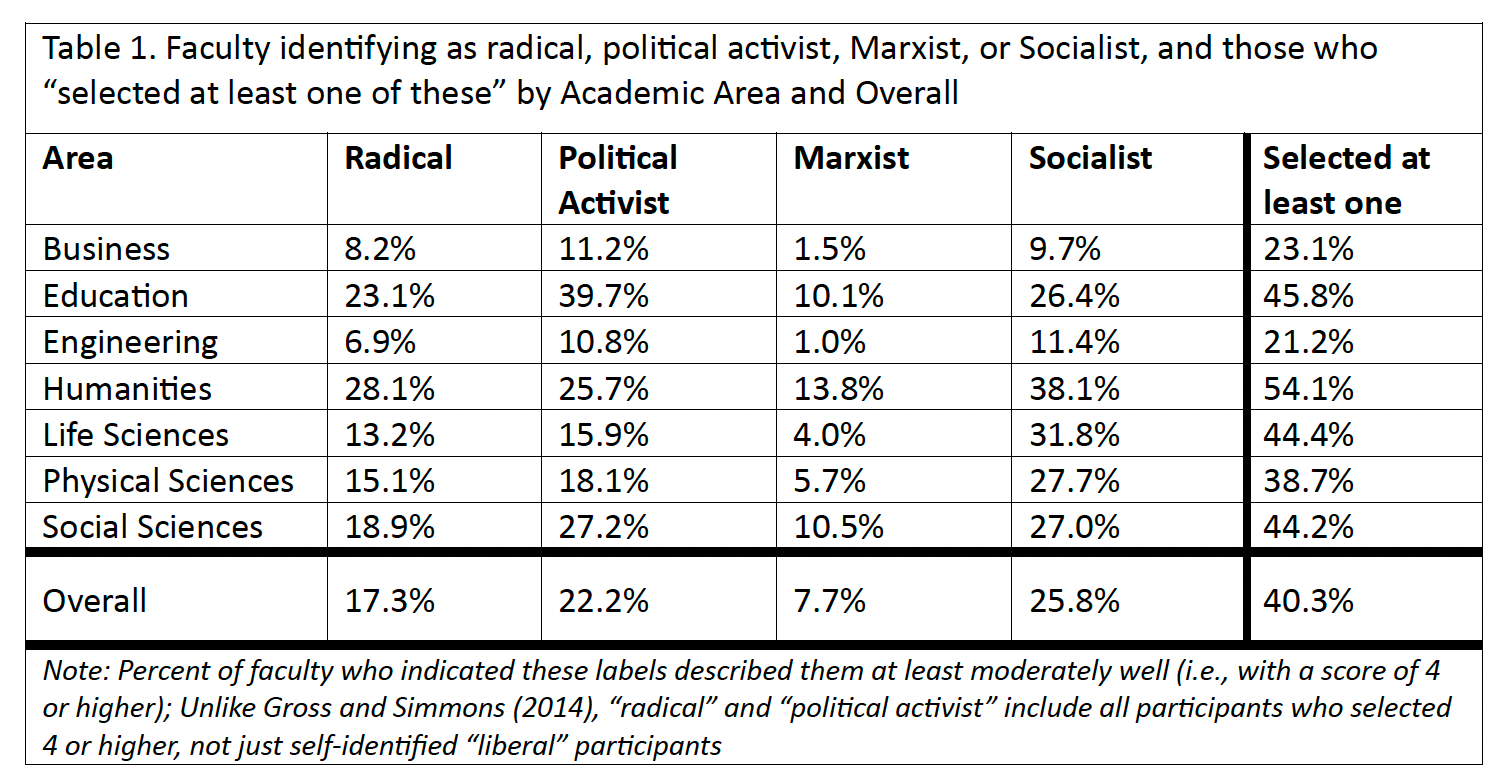
That is remarkable. If higher education were as curious about itself as it claims to be about everything else, it would treat that fact as a major research question rather than a public-relations problem.
If you’re wondering whether the political leaning of faculty has any effect on their actions, Primo’s research also finds that faculty are unusually politically engaged. That matters because politically active faculty are more likely to shape departmental norms, influence hiring climates, mentor graduate students, and signal what younger scholars are allowed to say if they want careers in academia.
In 2024, faculty in the sample were about four to five times more likely to make campaign contributions than the average American. About 13.2% of faculty in the dataset made campaign contributions of any disclosed amount, and 7.6% gave at least $200. By comparison, 3.5% of American adults made disclosed campaign contributions in 2024, and 1.5% gave at least $200.
The range across institutions is also fascinating. At Brigham Young University, 15.7% of faculty had any contribution record, and 3.9% had given $200 or more. At Stanford, 43.4% had any contribution record, and 30.5% had given $200 or more.
Primo also compares faculty donors in 2024 with all individual donors in 2024. He writes that there is “essentially no mass to the right of center” among faculty donors, while such a right-of-center mass exists in the donor population overall.
That phrase “essentially no mass to the right of center” is dry academic prose. Let me put it another way, paraphrasing my friend John Cleese, and his friend, Graham Chapman: The fantasy of a group of right-of-center faculty donors is no more, it has ceased to be, it has rung down the curtain and joined the choir invisible.
How this reality actually warps reality on campus
Despite all of this being concerning enough, the report’s most important finding may be about concentration. Here’s why:
Primo finds a leftward shift over time among both faculty donors and donors overall, but he also found that the faculty distribution is much narrower. The interquartile range — the spread of the middle 50% of the data — has “essentially shrunk to nothing over time” for faculty donors.
The problem is not only that the median faculty donor is far left, it’s that the politically active faculty have become tightly bunched. The middle is where most people meet and mingle, with the extremists occupying a relatively tiny space on either end of the bell curve. But now, the middle is no longer spread across liberals, moderates, libertarians, conservatives, left-liberals, civil libertarians, communitarians, old-school labor Democrats, Burkeans, religious liberals, and interesting cranky people who are wrong about half of everything but right about the half everyone else missed.
That is how institutions become strange without realizing they are strange.
If everyone around you shares the same assumptions, those assumptions stop feeling like assumptions. They start feeling like reality. And when this happens, the dissenter does not seem like a colleague with a different interpretation. He seems ignorant, cruel, unserious, dangerous, “anti-science,” “harmful,” or in need of a long meeting with an assistant dean whose title contains at least three abstract nouns, an ampersand, and the word “belonging.”
The school-level data reinforces this. While there is variation among institutions — Texas A&M is about four times as ideologically spread out as Berkeley, and Duke is about twice as spread out as Columbia — Primo notes that median ideology is extremely similar across nearly all schools, hovering near -1. However, this doesn’t mean the “more diverse” schools are suddenly centrist. They just have enough right-of-center or less-left representation to stretch the distribution a bit more.
The field-level findings are also revealing. Unsurprisingly, humanities is the most left-leaning field. Business is the least left-leaning. No one needs a grant to guess that. What is surprising is that, according to Primo, the medians are essentially the same across fields. Even business faculty who make campaign contributions lean strongly left.
Another important but likely unsurprising finding is that the least ideologically diverse and most left-leaning fields are also the most politically active. Humanities faculty give at the highest rate — over 35%. Business is a little over 25%. Agriculture is around 18%. Engineering is a bit above 20%.
So the fields most responsible for shaping students’ understanding of history, literature, politics, identity, culture, morality, oppression, power, and America itself are among the most left-leaning, least ideologically diverse, and most politically active. That should worry anyone who cares about knowledge creation.
One reason this debate gets stupid so quickly is that people use terms like “liberal,” “left,” “progressive,” and “Democrat” as if they are interchangeable. They are not.
A center-right libertarian liberal and a center-left civil libertarian liberal may disagree on taxes, regulation, unions, guns, abortion, immigration, or the size of government. But they often share a deeper commitment to the liberal rules of the game: free speech, due process, viewpoint neutrality, individual rights, pluralism, skepticism of concentrated power, and a willingness to let people be wrong in public.
That old civil-libertarian liberalism can exist on the center-left or the center-right. It is the tradition that says bad people can have good arguments, good causes can use bad methods, and no institution should be trusted with the power to decide which opinions are too dangerous for adults to hear.
Campus progressivism is often different. It is more comfortable treating speech as harm, equality as requiring bureaucratic management of outcomes, dissent as evidence of moral defect, and institutional neutrality as complicity. It tends to be more identitarian, more suspicious of procedural neutrality, more willing to trade open inquiry for a promised moral result.
I am not saying every progressive thinks this way. Many thoughtful progressives care deeply about civil liberties. But the center of gravity has shifted in the last couple of decades, and many universities that still call themselves “liberal” are no longer liberal in the older civil-libertarian sense. Rather, they are progressive institutions with liberal branding.
This distinction matters. A university dominated by center-left civil libertarians would still have problems. It would still need more conservatives, libertarians, religious traditionalists, and other dissenters. But it would be much more likely to defend free speech, tolerate disagreement, and teach students to argue about ideas — which would keep them more on track to fulfilling the university’s primary mission of knowledge creation. A university dominated by progressivism is decidedly less likely to do these things, which fundamentally undermines the pursuit of knowledge.
How to pull universities back from the abyss
Okay, so things are pretty bad. What can we do?
Well, as I’ve been saying for years now, there are several fairly easy things that can be done. First, universities should adopt institutional neutrality and actually mean it. They should stop issuing statements on every war, election, Supreme Court decision, protest, viral video, or moral panic. When an institution takes an official position on contested public questions, it teaches students and faculty that there is a campus-approved view of reality. Dissent inevitably becomes riskier in that scenario, and the chilling effect of that is real. Not every grim headline requires a campus-wide push notification from the president’s office confirming that it, too, has feelings.
Second, universities should recommit to real due process. Notice. Evidence. A chance to respond. Neutral decision-makers. No more shadowy proceedings that punish first and discover facts later. This is where a corollary to the Golden Rule ought to come in: adjudicate the rights of others the way your own rights should be adjudicated.
Schools should also stop using ideological litmus tests in hiring and promotion. DEI statements, and “fit” tests too often function as conformity filters. They do not reliably identify good teachers or serious scholars, they just identify people fluent in the modern esperanto of faculty collective guilt acknowledgement.
Another important intervention is making serious disagreement part of the university curriculum. Students should not graduate from elite universities having encountered only cartoon versions of arguments held by half the country. Thinking you understand conservatism because your professor gave you the verbal equivalent of a sock puppet with a villain mustache is like thinking you can perform spinal adjustments because you once played Mortal Kombat as Sub-Zero. Courses on contested topics should include scholars who genuinely disagree. Sometimes that means co-teaching. Sometimes it means better reading lists. Sometimes it means bringing in visiting speakers. Sometimes it means creating programs specifically designed to expose students to serious arguments that their departments have filtered out.
Importantly, university presidents and trustees also need to stop pretending they are powerless. If a department has spent decades narrowing the range of acceptable opinion, it makes no sense to ask that department to be the sole judge of viewpoint diversity. That is like asking a cartel to write antitrust law. This does not mean donors or politicians should dictate conclusions. They should not. But boards and presidents are responsible for the health of the institution. If universities become politically homogeneous environments where dissent is chilled and students are protected from serious disagreement, leadership has failed.
The implications of this are much bigger than campus politics
This cannot be treated as just another culture-war skirmish, or a problem that solely concerns those involved with higher education. FIRE’s report matters because it gives us a sharper picture of how ideologically narrow the politically active academy has become, and this has serious implications for the discovery and creation of knowledge. That affects all of us, on campus and off.
Universities are supposed to be reality-testing institutions. They should produce better maps of the world. They should train students to ask whether the consensus is true, not merely to repeat it in the approved vocabulary. When higher education loses viewpoint diversity, it loses one of the simplest checks on motivated reasoning. When universities lose institutional neutrality, they become political actors. When they lose due process, they become less trustworthy. When they lose free speech, they lose their error-correction mechanism. When they punish dissent, they teach everyone else to shut up and get in line.
Yes, some attacks on higher education are unfair. Some are opportunistic. Some are cynical. But we also have to acknowledge that universities did not lose public trust by accident. They squandered it through ideological litmus tests, administrative double standards, shout-downs, disinvitations, and a habit of treating dissent as contamination. When legislatures attempt to intervene on campus in ways that dictate outcomes and bypass real inquiry, it’s hard to tell how many administrators are upset at the intrusion into academic freedom — and how many just think that’s their job.
That’s what a loss of institutional trust looks like. And you do not rebuild trust by demanding applause. You do it by making your claims easier to test.
The academy needs viewpoint diversity, yes. But viewpoint diversity is only one piece of the larger repair job. We need stronger systems for protecting knowledge creation itself: replication, citation audits, adversarial collaboration, red teams, prediction ledgers, and AI tools designed to challenge consensus rather than flatter it.
Neuroscientist and clinical psychologist Heather Berlin and I have been calling this broader effort The Reality Test Project. The ambition is large: use new tools, including specially designed AI, to help test what humanity thinks it knows.
The alternative is to keep doing what human beings naturally do: mistake consensus for truth, status for expertise, moral confidence for evidence, and institutional prestige for reality. And then, because we just love taking flamethrowers to grease fires, training AI on all of that so our reality warps exponentially.
More on that soon.
SHOT FOR THE ROAD
The American Revolution was not inevitable. John Adams had to plead the case and faced fierce opposition from colleagues including John Dickinson. But the process by which the Founders debated and eventually decided to draft the Declaration of Independence is a perfect example of how productive discourse — even tense and sometimes scathing — sharpens arguments and refines ideas. 250 years later, we should be grateful those conversations were able to be had unfettered and uncensored.
Sadly, this analysis is very much on point. Too often, we have let the loudest, most intransigent voices (among both faculty and students) dominate the conversations, set policies, and establish norms on campus. But I have found that my students, particularly the ones entering college in the last couple years, are hungry for an education that challenges them rather than one that simply reinforces their pre-existing beliefs. I had one student in my Southern history class this semester who said it was “refreshing” to read a wide variety of primary sources, rather than just ones that toed a particular ideological line.
Very few right leaning people or even centrists ever consider going into teaching at any level. So what do you expect. I graduated with 500 engineering majors and one was headed to teaching.