


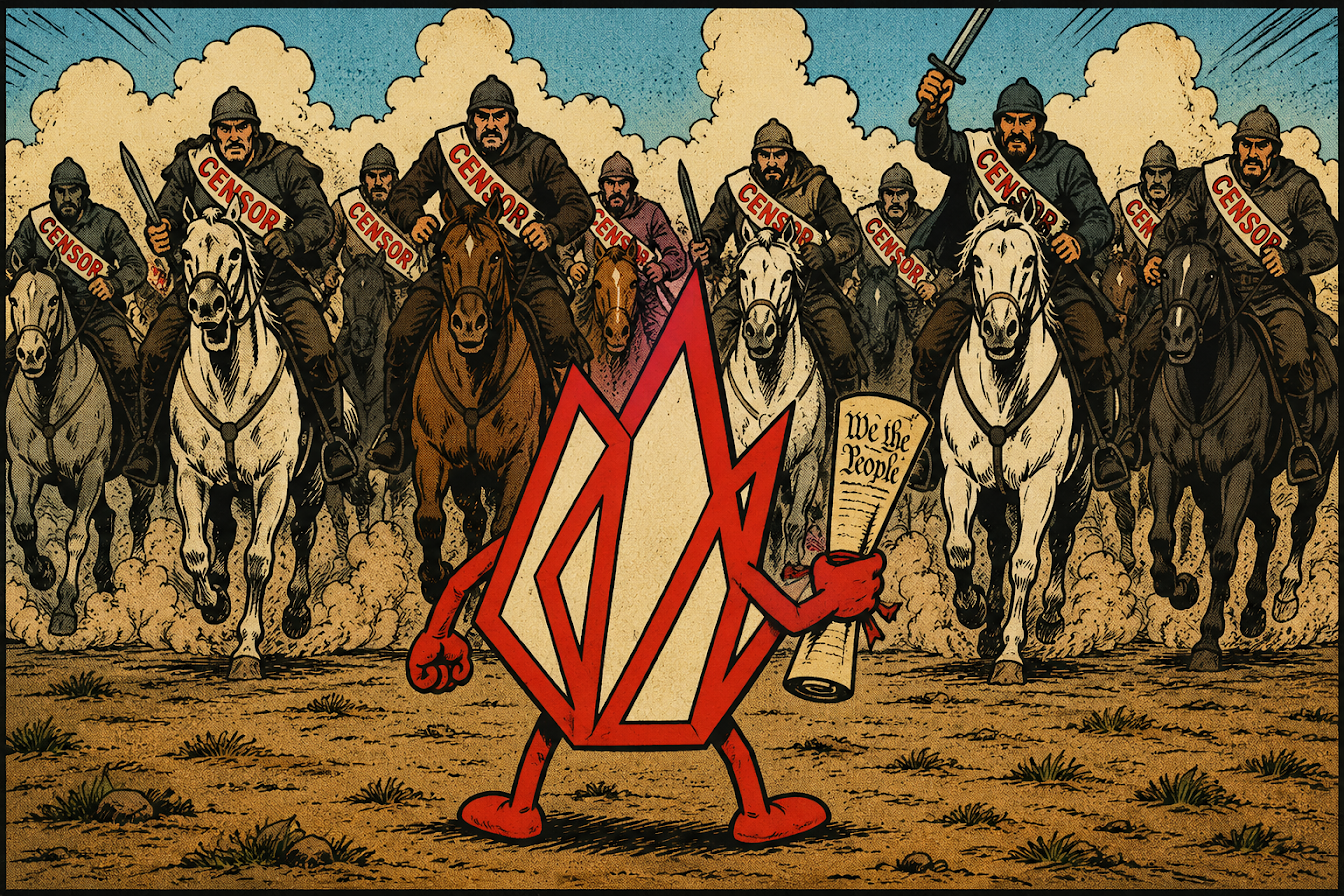
Regular ERI readers will know that some of my biggest hobbyhorses lately have been social media, age verification, and AI — particularly how it intersects with free expression and, perhaps most importantly, truth-seeking and knowledge creation.
Just in the last few months I’ve discussed the UK’s age-verification push, the U.S.’s own overbroad proposed AI regulations, the fight between the Pentagon and Anthropic, and much more.
In all of these posts and others, I’ve been struggling to convey how serious this is and why those of us who care about free expression are so concerned. We are in a moment where people seem ready to give as much power to the government as the government will take (which is as much as you’ll give it) to fix problems that are not nearly as bad as the proposed cure.
And to be clear, the concerns are real. People worry about what these technologies will do to work, to children, to politics, to privacy, and to society itself. Those fears are understandable. Every transformative communications technology has inspired fears, sometimes justified ones.
What worries me is that fear has a way of making old mistakes look like new solutions.
Throughout modern history, whenever a new way of communicating emerges, a familiar argument follows close behind: this technology is too dangerous, too disruptive, too influential to be left free. And the proposed answer is almost always the same — give the government more power.
But governments do not possess some magical ability to eliminate risk, panic, misinformation, extremism, or social conflict. What they can do is acquire new authority over the systems through which people communicate, learn, organize, search, publish, and exchange ideas. And once governments acquire those powers, they rarely surrender them voluntarily. And they always abuse them.
That is why the stakes are so high. We are debating the future of the infrastructure through which billions of people will speak, argue, search, publish, organize, learn, and understand the world. Resisting the ancient impulse to put authorities in charge of what people may say and know helped give us the best things in the modern world: science, liberal democracy, individual rights, pluralism, innovation, and the astonishing expansion of human knowledge. If we forget that lesson now, just as the channels of knowledge are being rebuilt all around us, the consequences could last for generations.
Today, FIRE’s executive vice president (and host of the So to Speak podcast!) Nico Perrino sent an email to staff that conveyed this sentiment better than I ever could. So I am sharing it in full here, only making minor changes and adding links and parentheticals to make it easier for people outside FIRE to understand.
From: Nico Perrino
Date: Jun 23, 2026, 1:23 PM
Subject: Current challenges for free speech & emerging tech
To: FIRE staff
Hey everyone,
At yesterday’s Rapid Response meeting1, and again today, we discussed the headwinds we face in ensuring that First Amendment standards apply to new communications technologies, particularly social media and artificial intelligence.
In Congress and the states, there is renewed momentum behind legislation that would regulate constitutionally protected speech and burden access to it through age-verification and other requirements.
In the courts, recent rulings from the Fifth and Sixth Circuits involving laws passed in Texas and Ohio call into question decades of established First Amendment precedent.
And in the court of public opinion, social media and AI remain deeply unpopular. Many people do not think of free speech when they think of these technologies, and they may not instinctively understand how our arguments apply.
We are already doing a lot to meet these challenges: directly litigating or filing amicus briefs in nearly every major case, engaging with lawmakers, hosting a free speech and emerging technologies event series, coordinating through an internal working group, communicating with our partners, and staffing up to accommodate the expanding workload.
That said, the headwinds are growing stronger. At yesterday’s Executive Team meeting, we agreed that an important first step is to acknowledge the scope and scale of the opposition. From there, we need to ask what more we can do, and how we might adjust our tactics and strategies to be more effective.
Over the coming months, you can expect more conversations across departments toward that end. We want each department to think critically and creatively about what it can do to help ensure that First Amendment protections extend to new communications technologies. We also want to improve our messaging by stress-testing our talking points internally and externally, and sharing which arguments are landing and which are not.
I recognize that these questions are hard. Many concerns about social media, AI, and other emerging technologies are real and deserve thoughtful engagement. Civil liberties work often requires us to acknowledge that the case for censorship can be emotionally and politically powerful.
Sometimes the harms cited are grave: war, national security threats, civil unrest, child safety, or life-and-death emergencies. But the old solution is still the wrong one: giving the government more power over speech, thought, and knowledge itself.
Our role as a First Amendment organization is to insist that, even when a technology is unpopular or disruptive, the government must still meet the demanding standards the First Amendment requires before it regulates speech.
Ultimately, we want to look back at this moment 25 years from now and say, “We did everything in our power to meet the moment.”
Civil liberties victories can take a long time, and the opposition can be intense. It took 140 years for the Supreme Court to first strike down a speech restriction on First Amendment grounds. Comstockism, McCarthyism, and censorship during World War I were all astoundingly popular.
The same pattern has often held for new communications technologies. We dealt with centuries of licensing requirements for printed matter. The Supreme Court initially held that movies did not receive First Amendment protection. Broadcast communications have been burdened by censorial laws for nearly a century.
The internet was the major exception. When it began to be widely adopted in the 1990s, the government quickly tried to regulate its content by likening it to broadcast communications. Public opinion was largely on the censors’ side, and the Communications Decency Act passed with overwhelming majorities in both houses of Congress.
Fortunately, civil libertarians recognized what was happening and acted quickly. The Electronic Frontier Foundation had formed. The Cypherpunks got organized. And the ACLU developed a litigation strategy that culminated in Reno v. ACLU, which applied full First Amendment protection to the internet. EFF attorney Mike Godwin thought he might be long retired before the Supreme Court vindicated First Amendment rights online. But when the Court delivered its ruling in 1997, he then asked himself “whether I ought to retire from civil liberties work, my job being mostly done.”
Of course, his job would never be done. That’s not how civil liberties work. As ACLU founder Roger Baldwin often reminded people, defending the Bill of Rights requires “eternal vigilance.” That’s why Greg calls free speech “the eternally radical idea.” There will always be censors, and there will always be people — sometimes most people — who believe they have a point. Oftentimes they do. But after the passions and factions of any given moment subside, we almost always look back at censorship as a misguided solution, no matter how commonsensical it seemed at the time.
When I interviewed former ACLU Executive Director Ira Glasser for my forthcoming book, I asked him why the ACLU fought for free speech rights in the early internet era. He told me, “If the First Amendment wasn’t going to apply to this new means of speaking in roughly the same way that it applied to the old means of speaking, then free speech was going to really be wounded, because in a short period of time that was going to be the major way in which speech was spoken. And that turned out to be an understatement.”
I think we stand at a similar moment today. Whether we like it or not, much of where we speak and access speech will occur through new internet-enabled technologies, including social media and AI. For many people, these technologies are already a primary way of gathering news and information. If the First Amendment does not apply to them in the same way it applies to older technologies, then the First Amendment — and FIRE’s mission to defend free speech — will be seriously compromised.
We cannot let that happen.
If you’ve made it this far, thank you. For now, please begin thinking about creative tactics and strategies your department could deploy on these issues, and stay tuned for more scheduled discussion in forthcoming meetings.
Onward —
SHOT FOR THE ROAD
In light of Nico’s points — particularly regarding the fact that the technologies are new but the proposed solutions are the same — I’d like to reshare my remarks at FIRE’s 2023 gala in New York City, which I’ve titled “Fight the Guardians.” Power will always tell us it needs still more power for our own good, and it’s up to those of us who believe in the truly radical idea of human freedom to push back.
This is where members of FIRE’s team meet to discuss breaking news and whether we need to take action on anything
What an eloquent write up (both Greg and Nico). Thank you.
To everyone reading, you can do two things **right now**: call your congresspeople about these two bills (it'll take five minutes):
- Oppose KOSA: https://www.congress.gov/bill/119th-congress/senate-bill/1748
- Support JAWBONE: https://www.congress.gov/bill/119th-congress/senate-bill/4749
Thank you for this, I found it valuable to get some insight into how FIRE is approaching this issue. I've been enthusiastically following FIRE's work for a couple of years now, but have to admit that lately I've been tuning out a lot of your AI-related content because I'm so exhausted with the topic of AI in general. But being grumpy about it isn't going to help anything, and the reality is that government regulation of the digital information landscape has the potential to be catastrophic to the free exchange of ideas and knowledge.