


Stories of the week
The Lonely Work of a Free Speech Defender (The Daily)
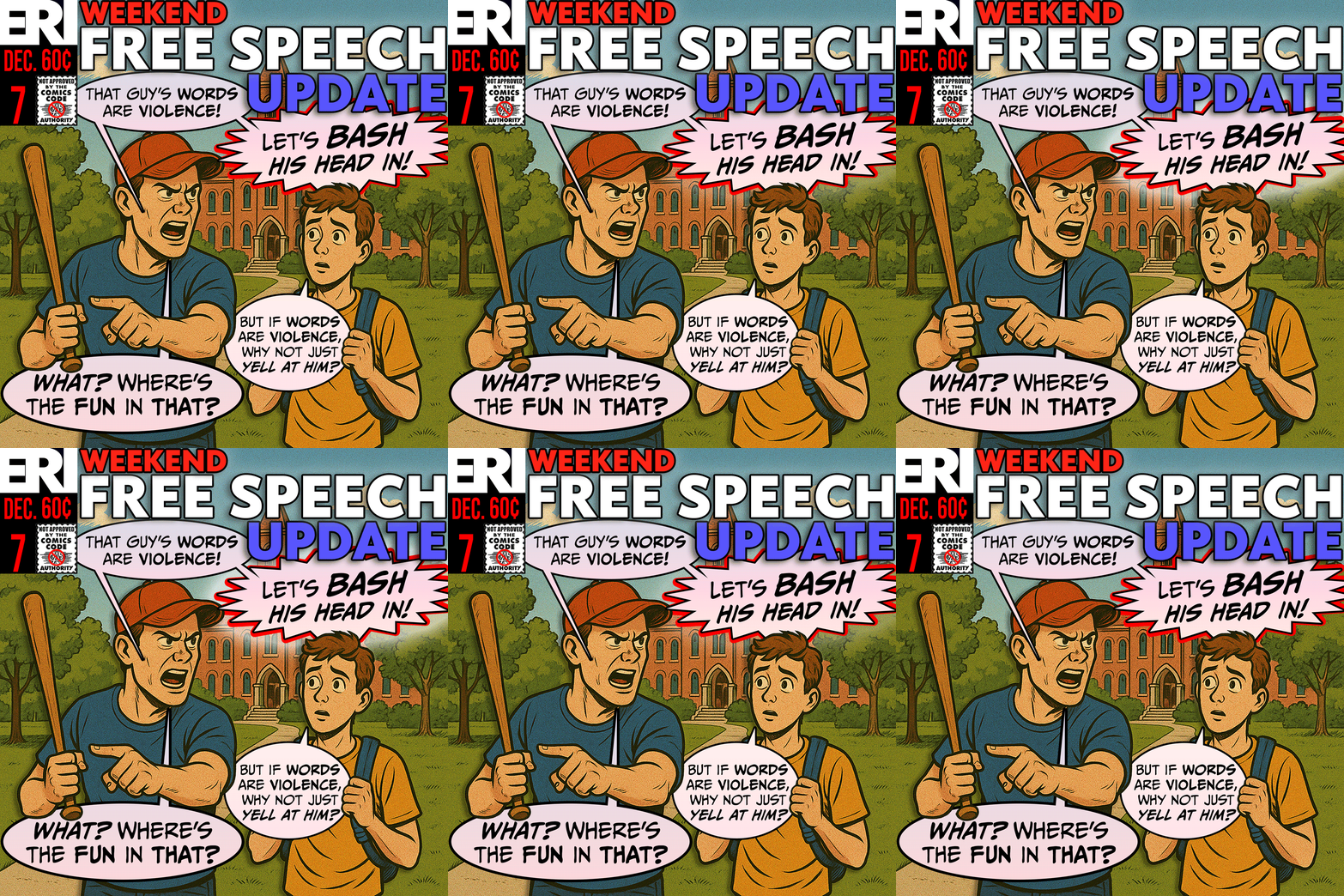
“When people start thinking that words can be violence, violence becomes an acceptable response to words,” said FIRE Chief Research Advisor Sean Stevens. “Even after the murder of Charlie Kirk at a speaking event, college students think that someone’s words can be a threat. This is antithetical to a free and open society, where words are the best alternative to political violence.”
The Free Speech Forum is an immersive, week-long experience designed for rising 10th through 12th graders who want to strengthen their understanding of free speech and the First Amendment. From June 21–27, 2026, students will gather in Washington, D.C. for an unforgettable program that combines expert-led learning, hands-on skill building, and meaningful peer connections.
This week in ERI
But hearing all of that compressed into a single, carefully edited conversation — with the good, the bad, and the deeply awkward moments intact — is a different experience. It’s more personal than I usually get in print; it includes some stories I’ve never told in detail on a big platform before; and it shows how all of these pieces (CBT, depression, Yale, Harvard, Charlie Kirk, law firms, student protests, and my four-year-old drum crisis) fit together into one long argument about why free speech matters.
This week in Expression
Politics of dissent during World War I by David L. Hudson Jr.
Campus views harden after Kirk assassination by Sean Stevens
If free speech only matters when convenient, it isn’t free at all by Samuel J. Abrams
Free speech is not a decorative ideal meant for ceremonial brochures or abstract jurisprudence seminars. It is a living civic discipline, and it demands that we cultivate tolerance even — especially — when it offends our sensibilities. That discipline has historically been one of the United States’ most distinguishing features: the belief that robust public debate, rather than enforced consensus, is the engine of democratic resilience.
FIRE in the press!
Rivalry isn’t trademark infringement (Detroit News) by Jeff Zeman
London Calling: Ronnie’s First Amendment Roundup
Second Circuit affirms preliminary injunction against NY Attorney General enforcing state false-advertising/unfair-trade-practice laws against advocacy around abortion pill reversal protocols
The U.S. Court of Appeals for the Second Circuit affirmed a Western New York federal district court’s preliminary injunction against New York using general state defective-acts-and-practices or false-advertising laws to target advocacy for abortion pill reversal (APR) protocols meant to counteract oral medication-induced abortions. NIFLA and its similarly non-profit, faith-based co-plaintiffs do not offer APR themselves, or charge for information about it (or for any pregnancy-related or parenting services they offer), but rather have made and wish to continue making statements calling APR “an effective process … that can reverse the effects of the abortion pill,” where “time is of the essence” if one chooses to use it, and that it involves a drug “used to support pregnancies with a risk of miscarriage for decades.” But plaintiffs stopped making such representations and sought injunctive and declaratory relief under the First Amendment after New York’s Attorney General brought a civil enforcement action against a similar (non-plaintiff) organization for statements that are the same as or substantially similar to those of the NIFLA plaintiffs. The Second Circuit held the district court correctly granted plaintiffs a preliminary injunction on grounds they will likely succeed on their constitutional challenge, as their APR advocacy does not involve commercial speech that either does no more than propose commercial transactions or is mixed commercial/noncommercial speech that should be treated as the former, making application of New York fair-trade laws to NIFLA’s and its co-plaintiff’s advocacy a content-based regulation of speech subject to strict scrutiny. As the AG did not mount a strict scrutiny defense for potential enforcement against plaintiffs’ speech, they are likely to succeed on the merits. And that means they face irreparable harm if unable to engage in APR advocacy during the pendency of the case, the public interest favors upholding their free speech rights, and the AG has no interest in pursuing unconstitutional enforcement action. The court rejected state arguments that the speech is commercial because “someone must bear the cost” of APR “be it insurance, the medical provider, or a charity,” and plaintiffs offer services in the “stream of commerce” that have commercial value, noting that “would be true of any non-profit providing information, free services, and access to third-party providers.” The fact that “there will be some payment for services steps removed from the original provision of the information or service does not suffice to transform … ideological and religious advocacy into commercial activity.” Nor did it matter, the court held, that consumers may think plaintiffs will arrange for APR because their speech is “analogous to” ads for other medical services that “have long been considered commercial speech.” And it rejected AG arguments that the district court treated as dispositive that the plaintiffs’ motivation underlying their speech is “religious and moral, rather than economic,” noting it considered a range of factors, not just that one, in concluding the speech is noncommercial. “To hold otherwise” on all these points, the Second Circuit noted, “could potentially subject a sweeping range of non-profits to regulation of their speech for providing the public with information and resources concerning critical services.”
International free speech stories of the week
A Zambian-American influencer and political vlogger has been sentenced to 18 months in prison for hate speech for making insulting remarks about Zambia’s President Hakainde Hichilema.
Zambian-born Ethel Chisono Edwards, who also holds US citizenship and works as an estate agent in New York, has a large following across various social media accounts. Known as “One Boss Lady”, she has become renowned for her rants about the president over the last two years.
The 42-year-old was arrested at Zambia’s main airport three months ago after arriving to attend her grandmother’s funeral.
A Visit by the German Thought Police by CJ Hopkins
Hong Kong man arrested for alleged sedition in relation to fatal Tai Po blaze (HKFP)
National security police arrest former district councillor, volunteer over Tai Po fire comments (The Standard)
Videos of the week
This was a big weekend for college football, or so I’m told. FIRE took the opportunity to highlight some recent troubling cases at two of the schools that competed on the gridiron yesterday.
Indiana University (the worst-ranked public school & third-worst school overall in FIRE’s 2026 College Free Speech Rankings) fumbled big-time on free speech!
And it looks like the University of Alabama needs a reminder that viewpoint diversity is a "flag on the play.”
Greg, can you or FIRE make the cartoon at the top of this post into a poster or t-shirt? I would gladly buy several of them to wear and give as presents.
I missed the part of the survey where 90% of students say “words can be violence”, the lead-in statistic literally doesn’t appear.
What does appear is that 30+% of the general public seems to feel the phrase “words can be violence” wholly or somewhat matches their view.
Where did I miss the 90% response?