

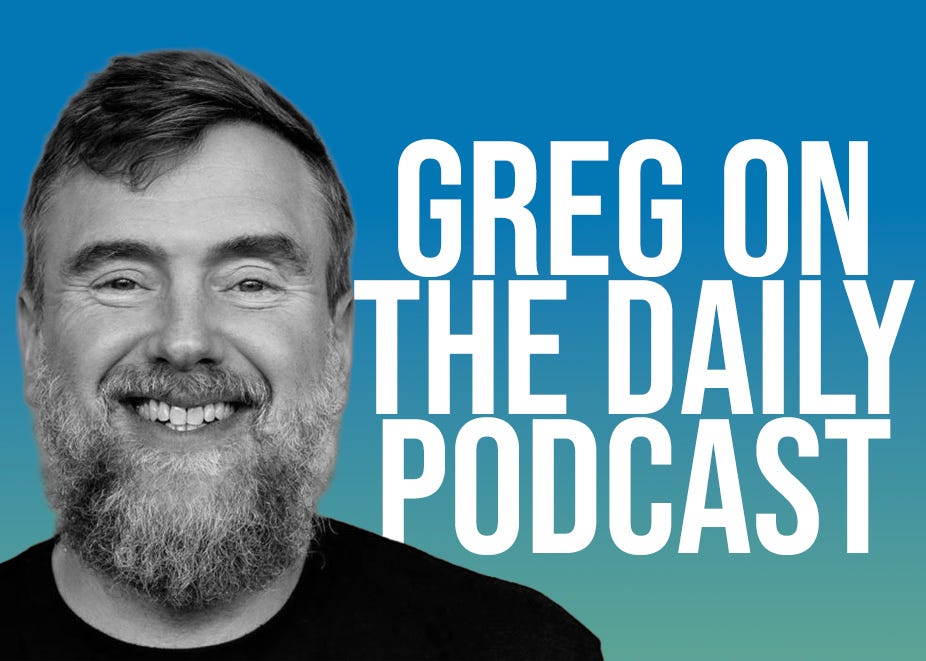
The episode is called “The Lonely Work of a Free-Speech Defender,” and you can listen to it on Apple, Spotify, and everywhere else you get your podcasts.
Back in October, the team from “The Daily” reached out to “pick my brain.” (As you’ll hear, we start by defending the phrase “pick your brain,” which was presented to me in some article at some point as being an offensive thing to say. I find that profoundly silly and a step towards Victorianism. Let’s try to figure out what people actually mean by what they’re saying instead of finding more and more ways to be offended.)
What I didn’t expect was that they’d interview me three separate times: first for about two-and-a-half hours, then another hour-long session, and then a final half-hour follow-up. That amounts to over four hours of conversation for what ended up being a 52-minute episode, which got me nervous.
When someone has that much raw material, they can make you sound like Jean Valjean or Dr. Evil, depending on how they cut it. And The New York Times has not always been especially fair to me or to FIRE. They ran an op-ed years ago by Jim Sleeper that wrongly suggested I’d “doxed” Yale students, when in fact I’d explicitly condemned doxing them. FIRE even published a response at the time walking through how badly that piece misrepresented what I actually did and said.
So my anxiety wasn’t totally irrational. In fact, I had some trouble sleeping last night knowing this was coming out.
Having listened to the episode this morning, though, I’m actually very proud of how it turned out. Natalie Kitroeff, my interviewer, was excellent: curious, probing, and fair. I walked away genuinely liking her.
Why free speech feels personal to me
One of the reasons this episode feels a little different is that Natalie gently kept steering us back to why I care about this stuff so much. We talk about:
My strange, four-year-old “bad drum” Christmas memory, stuck between a British norm of politeness and a Russian demand for brutal honesty.
My discomfort with conformity and crowds (I am, tragically, the free speech lawyer who cannot stand being in a baseball stadium hearing people cheer in unison).
And my 2007 mental health crash — checking myself into a hospital after going to a hardware store to find a way to end my life — and how cognitive behavioral therapy (CBT) helped me learn to “talk back” to catastrophic thoughts and eventually led to my book with Jon Haidt, The Coddling of the American Mind.
Natalie got me to say out loud something I usually only imply: Free speech isn’t just a legal concept to me, it’s about the right to be who you actually are. When someone tells you, “You can’t say that,” they are often saying “You can’t be that.” They are demanding inauthenticity — and that is horrifying.
That’s why I’ve always loved Salman Rushdie’s line about stories: “Those who do not have power over the story that dominates their lives, power to retell it, to rethink it, deconstruct it, joke about it, and change it as times change, truly are powerless.” Freedom of speech is how we keep that power over our own stories.
Yale, doxing, and why I published the Christakis video
One thing the episode touches on, and that I want to underline here, is the Yale Halloween incident from 2015 — the confrontation of Nicholas Christakis that I filmed and later put online.
Here’s a piece of the story I haven’t talked about enough in public: When I first filmed the confrontation, I did not plan to publish it. I knew the footage was explosive. But that night, at a talk on campus that I was giving on free speech, a student who said they worked for the Yale Daily News told me the paper was planning to publish selectively edited clips that would make Nicholas look as bad as possible.
Given what I know about how “he said, she said” campus controversies usually end for professors in the crosshairs, that set off every alarm bell in my head. I had a video showing Nicholas displaying what I still think was almost superhuman restraint in the face of a very personal and nasty pile-on. If all the public was going to see were cherry-picked clips that turned him into the villain, I was pretty sure that he and his wife Erika — who had set off the firestorm by sending what I thought to be a thoughtful and reasonable email about students and their Halloween costume choices — would be out of jobs and permanently smeared.
So I posted everything I had, unedited, so people could judge for themselves.
I wanted people to come to their own conclusions after seeing what happened, not to get the students in trouble. In fact, when outlets like The Daily Caller started “outing” specific students, I condemned that. The goal was to protect Nicholas and Erika’s academic freedom and to defend a campus culture where the right to dissent isn’t swallowed whole by a supposed “right not to be offended.”
Unfortunately, the old Times op-ed I mentioned earlier painted that very differently, misconstruing my effort to prevent a one-sided media pile-on into an accusation that I had “doxed” students. I put the video online, but I didn’t name the students or really focus on them individually at all. The Daily Caller, however, published their names, their parents’ incomes, and even facts about their upper-middle class backgrounds.
That’s part of why I was so relieved — and, frankly, grateful — that “The Daily” episode let the Yale story sit in a much more accurate frame: as part of a broader pattern where students increasingly see getting people fired as the natural endpoint of disagreement.
If you’re new to the Yale saga and want a quick primer, FIRE’s case page is a good starting point.
What the episode of ‘The Daily’ actually covers
To give you a sense of how wide this conversation ranges without spoiling the whole thing, here’s a list of what we cover:
Early FIRE work: We talk about one of my first big cases, the defense of Professor Sami Al-Arian at the University of South Florida — not because FIRE endorsed his politics (we didn’t), but because firing a tenured professor for a public outcry over his speech would have been a catastrophic victory for the “heckler’s veto.”
The campus shift: I walk through the dramatic change I started seeing around 2013–2014 — demands for trigger warnings, new speech codes, and the “life is pain” vs. “any pain is a sign something is wrong” tension that would later become a major theme in The Coddling of the American Mind.
Trump, Harvard, and federal power: We get into why I think Trump’s recent attacks on law firms, universities, and media — including threats aimed at Harvard, NIH funding, and even late-night hosts — represent a genuinely new level of danger: federal power being used openly as a weapon against dissent, not just cultural pressure.
Charlie Kirk and the Bushart case: We talk about Charlie Kirk’s assassination and the wave of firings and punishments of people who said harsh, even cruel things about him online that followed. (In October, I spoke at the site of Kirk’s murder.) Then we get into the case of Larry Bushart, a 61-year-old retired cop in Tennessee who spent 37 days in jail over a meme that quoted Trump saying, “we have to get over it” after a school shooting — and added the caption, “This seems relevant today,” in the context of Kirk’s killing. FIRE is now representing Larry.
Platforming extremists and group polarization: We also tackle the “Nick Fuentes on Tucker Carlson” question: “Does giving someone like Fuentes a big platform help expose his ideas to criticism, or just normalize them?” I try to make the case that free speech is a necessary (but not sufficient) condition for a healthy society, and that isolating dangerous ideas inside echo chambers can actually radicalize people further. (Also, something that didn’t make the cut from the very long interview: I’m annoyed by fans of Fuentes and Carlson who argue that conservatives who think Fuentes and Carlson should have no part of the Republican Party or conservative movement are engaging in deplatforming. They miss the point. No, I don’t like people being kicked off of social media for their opinions, but political movements are all about who is and isn’t representing your message. )
Am I responsible for Trump? Late in the conversation, Natalie puts Jason Stanley’s “this is all FIRE’s fault” criticism directly to me: Did our work warning about illiberalism on campus help lay the groundwork for Trump’s rise and his weaponization of Cancel Culture? My answer, in short: If you ignore or dismiss people who have spent decades warning you of a serious problem, you don’t get to blame the person who was ringing the alarm bell when the backlash shows up. I tried my ass off to get people on the left to care about the problem on campus. I even wrote for the Huffington Post from 2007 to 2017 trying to make the case. And I was very clear that not only is this wrong, not only are liberals themselves often targeted, but that a right-wing backlash was inevitable and would be worse the longer it was put off.
That’s just the tip of the iceberg; the episode moves quickly, but we cover a lot of terrain.
Why I hope you’ll listen
If you’re a regular ERI reader, a lot of the themes we hit in the conversation will sound familiar:
Free speech as the alternative to violence.
The mental-health cost of telling people they must never hear anything that upsets them.
The way both left and right fall in love with censorship when they are in power.
The danger of treating words and ideas as literal violence, which — as I argue on the show — hands genuine extremists a moral permission slip to answer speech with force.
But hearing all of that compressed into a single, carefully edited conversation — with the good, the bad, and the deeply awkward moments intact — is a different experience. It’s more personal than I usually get in print; it includes some stories I’ve never told in detail on a big platform before; and it shows how all of these pieces (CBT, depression, Yale, Harvard, Charlie Kirk, law firms, student protests, and my four-year-old drum crisis) fit together into one long argument about why free speech matters.
So if you have time today, I’d be honored if you’d give my conversation on “The Daily” a listen on Apple, Spotify, or wherever else you get your podcasts. And, if you think it’s worth it, please share it around:
If you’ve ever wondered how a somewhat awkward, conformity-averse juvenile delinquent ended up spending his life defending speech for people who often can’t stand him… this episode isn’t a bad place to start.
SHOT FOR THE ROAD
Here’s a trilogy of Christmas-themed media to enjoy as your own miniature advent calendar this weekend:
Shazam!
ERI readers likely know I’m generally more of a Marvel fan than a DC fan, but Zachary Levi’s tour as The Big Red Cheese was pure family fun. Is it a Christmas movie? Yes! Just like Die Hard! And Eyes Wide Shut!
“Everyday is Christmas” by Sia
Australian singer-songwriter Sia revived the tradition of the full Christmas-themed album a few years back. My personal favorite is “Underneath the Mistletoe,” but don’t miss the video for “Santa’s Coming For Us,” featuring a laundry list of celebrities.
The Guardians of the Galaxy Holiday Special
This is a warm and funny 42-minute romp that is officially MCU canon (sitting between Thor: Love and Thunder and GOTG Vol. 3). It also illustrates how good ideas can replace bad ideas in a marketplace, even if the bad idea is, “Let’s kidnap Kevin Bacon because Peter Quill likes him.”
Bravo yet again, Greg. Always so proud to support you and FIRE in this most important work. Keeping the "civil" in "civilization."
wonderful recounting of how you got to where you are!