

Stories of the week

The Trump administration has a record of punishing critics, and its officials are no strangers to filing lawsuits meant to silence dissent by driving up the cost of speaking. Today’s filing from FBI Director Kash Patel has all the markings of that playbook.
The First Amendment sets a high bar on defamation cases against public figures. In order to win, Patel must prove not only that The Atlantic published false information, but that the reporter knew it was false or had serious doubts about it, and published it anyway. That high standard is important so that all of us — reporters and citizens alike — can hold our government accountable.
This week in ERI
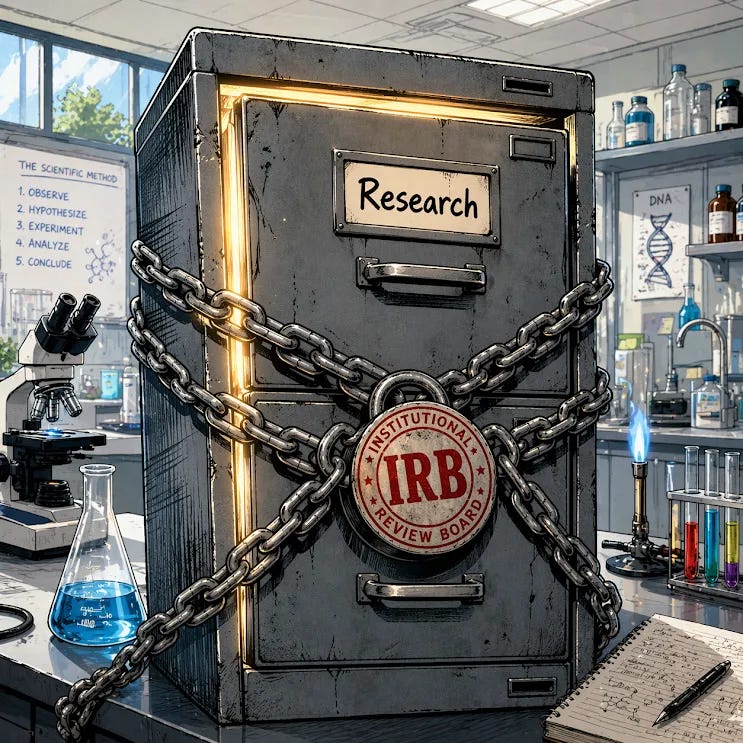
How institutional review boards threaten groundbreaking research in higher ed by Nate Honeycutt & Ryne Weiss
This week in Expression
This week on So to Speak
Truly an embarrassment of riches with a So to Speak one-two punch for the second week in a row:
First up, we’ve got a FIRE monthly webinar (brought to you by host & FIRE EVP & So to Speak host Nico Perrino , Special Counsel for Campus Advocacy Robert Shibley , Director of Public Advocacy Aaron Terr , and Senior Attorney Colin McDonnel) on topics ranging from the recent controversy involving reporting by The Atlantic on FBI Director Kash Patel’s alleged proclivity for getting pie-eyed, the proliferations of so-called “Charlie Kirk Act” legislation addressing free speech in higher ed, Tik Tok & social media, FIRE’s upcoming Soapbox conference, and more!

And next, Nico sat down with Electronic Frontier Foundation Executive Director Cindy Cohn to discuss free speech (and its limitations) online.
This week in FIRE’s blog
On April 16, the university updated its original statement with this language:
Carolina is committed to upholding the First Amendment rights of our students and student groups to engage in free expression. This is true even when we believe those instances of expression may be offensive to members of our campus community . . .
For the record, the University is not investigating any student or student group for the articles that appeared in the April 1, 2026 edition of The Daily Tar Heel or for the recent Hill After Hours video. Our April 6, 2026 statement was issued out of concern for members of our community, many of whom were clearly distressed. That statement was in no way intended to chill free speech on our campus, and we retract those portions of our message that may have suggested our students and student groups were engaged in unlawful conduct or conduct that could subject them to discipline.
University of North Texas cancels art show — then power-washes protests by William Harris
California lawmakers threaten free speech regarding immigration groups by Carolyn Iodice
DOJ investigation into University of Washington over off-campus bake sale is a recipe for trouble
FIRE in the press!
Where Protest Ends and Censorship Begins (Chronicle of Higher Education) by Connor Murnane
Indeed, FIRE has always defended the right of students and faculty to criticize speakers and protest peacefully. We even stand ready to protect the rights of those who call for censorship, though we flatly disagree with their aim. The more troubling question is whether a campus committed to free inquiry should treat organized efforts to silence speech as a healthy norm. If one believes colleges are places where ideas should be tested and refined through argument, it is difficult to endorse a campus culture in which some participants actively work to prevent ideas from being aired in the first place.
Never a good reason to dilute right to free speech (Otago Daily Times) by Sarah McLaughlin
As countries from Australia to France to Spain to the US jump on the trend of age verification on the internet, the risk that the global internet will be the greatest victim of the free speech recession rises exponentially.
London Calling: Ronnie’s First Amendment Roundup
Just two quickies this week:
Las Vegas Review-Journal, Inc. v. Eighth Judicial District Court in and for County of Clark: The Supreme Court of Nevada memorialized its late-January emergency order that vacated – as a manifest abuse of discretion imposing an unconstitutional prior restraint, and as a violation of court access rights – a district court’s order and directions in a high-profile criminal case that restricted media from publishing the identity of an alleged victim, even though it had been repeatedly disclosed in public filings and open court, ancillary to which the court threatened to hold in contempt anyone who published it, and ejected several Las Vegas Review-Journal reporters from the courtroom while the alleged victim testified, because they refused to acquiesce to the court’s order.
NetChoice v. Griffin: Yet another state restriction on minors’ access to social media gets preliminarily enjoined, this one in the federal district court in Western Arkansas, which enjoins the state’s new age-verification/parental-consent law that also lowers the triggering age from 18 to 16 years old, prohibits “addictive” practices, prescribes default settings for minors (including for hours-of-use and privacy), and requires platforms to create an online dashboard for parental supervision, with the court holding NetChoice is likely to succeed on its vagueness challenge to the addictive practices provision, on its compelled-speech challenge to the dashboard provision, and on its First Amendment challenges to the other provisions, even under intermediate scrutiny.
International free speech stories of the week
Free speech complaints system to come into force at universities (BBC) by Branwen Jeffreys
Retired Pastor Faces Trial Under U.K. Speech Laws for Preaching John 3:16 Near Hospital (Reason) by Reem Ibrahim
Journalist Mehmet Yetim arrested in Turkey for ‘spreading disinformation’ (CPJ)
More than 20 arrested over Queensland’s controversial ‘from the river to the sea’ laws during weekend of protests (The Guardian) by Joe Hinchliffe
Canada: Court to decide if public universities must uphold freedom of expression and be liable for Charter infringements (Justice Centre for Constitutional Freedoms)
On June 4, 2024, the Court determined that provincial universities are not government entities and, when delivering post-secondary education, are not delivering a government program. And yet, the Province of British Columbia allotted nearly $7 billion in funding to provincial universities in its 2024 budget, describing provincial universities as “service delivery agents for the provision of services on behalf of the government.”
‘Greg on the Run’ of the week
I recorded this last week, but given the violence at the White House correspondence dinner it seems extra relevant today. I am once again tapping the sign that WORDS ARE NOT VIOLENCE:
This was so good.
Hi Greg - what's FIRE's opinion on NYC bills 1-B and 175-B?