



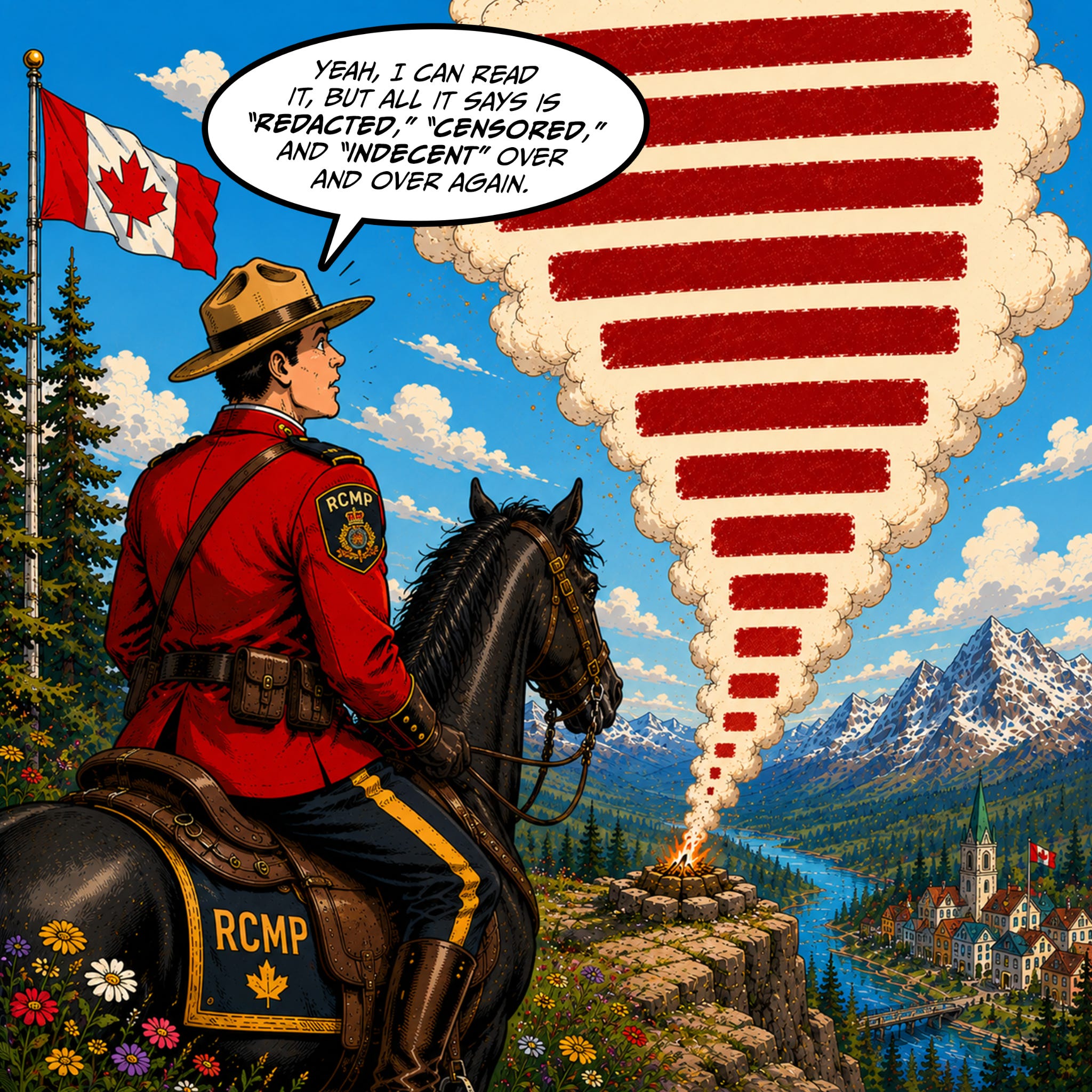
If you’re in America and smell something burning up north, it’s unfortunately not just the Canadian wildfires. In recent months, our hockey-mad friends have also been torching a number of its free speech protections — beginning with a legal shield that has been part of its law since 1970.
Until now, a Canadian charged with a hate-propaganda offence could raise the “good faith religious opinion” defense, a narrow protection for sincerely expressing an opinion on a religious subject or advancing an argument based on a religious text. The defense predates Canada’s Charter of Rights and Freedoms, which was adopted in 1982, by twelve years. The Combatting Hate Act, which received Royal Assent on June 18 and takes effect July 18, repeals it.
The government’s reassurance is that this changes nothing for the faithful: preaching, teaching, and reading scripture “in good faith” still won’t clear the bar for willful promotion of hatred.
Maybe. But two things happened at once here, and both are bad.
First, the categorical safe harbor is gone — so whether a sermon or a quoted verse is protected now depends on context, audience, and how a prosecutor reads the room. Second, in the horse-trading that got the bill through Parliament, the government also dropped the longstanding requirement that the Attorney General personally sign off before a hate-speech charge can proceed. In the absence of these two barriers, clergy and ordinary believers now get to wonder, in advance, whether saying the quiet part of their faith out loud will be read as hatred by someone with the power to charge them.
American law has a name for what happens when people must guess what they are allowed to say and, because of the uncertainty, end up not saying anything at all: a chilling effect. We have little doubt Canadians will feel that chill, even in wildfire season.
There’s more. Close behind the Combatting Hate Bill, a new Ottawa bylaw taking effect August 1 will mandate a 50-meter “bubble zone” (that’s about 164 freedom feet) around schools, hospitals, places of worship, daycares, and care homes. Inside the bubble, protest is simply banned. Not “protest that blocks the door,” or “protest that disrupts planned events,” but any protest at all. A councillor actually proposed narrowing the mandate to only prohibit conduct that actually obstructs access, and the motion lost. The Canadian Civil Liberties Association, Canada’s analogue to the ACLU, warned that two people standing on a sidewalk reading a pamphlet about peace would now be in violation of this bill. This is an intentionally broad blanket ban on expression that was once protected in Canada.
There’s more. In early July, Canadians learned of a 35-page internal memo from Industry Minister Mélanie Joly’s department — titled “Misinformation and Disinformation Strategy” — floating “legal action” against users on Facebook, X, and LinkedIn who post what the government deems “false and misleading information.” What action, exactly? Beats us. That part’s redacted. The visible portion assures everyone that whatever it is will be “documented, proportionate, and subject to senior level approval.” And don’t worry, the department itself would decide what counts as “factually incorrect, misleading or out of context.”
You read that right. This memo proposes giving the Canadian government the power to deem criticism false and punish (somehow?) the author for publishing that false information or the platform for hosting it — who exactly would be the target of “legal action” is also unclear. If that sounds familiar, it should. The Soviet Union had something very much like it. And if it strikes you as bizarre that Canada is doing this, we’re with you. Giving the government power to determine what is misinformation functionally gives it control of truth itself. Every government makes mistakes, and every government has incentives to conceal those mistakes, defend its policies, and discredit its critics. This policy and others show Canadian officials seemingly ignoring these very real risks.
One risk Canadian officials are not ignoring, though, is that of… deepfake bestiality. Yep. The recently-enacted Protecting Victims Act creates “a new hybrid offence which prohibits distributing bestiality depictions, including deepfakes, with a maximum penalty of 5 years on indictment.” We can’t help but wonder what gross (or possibly hysterical) incident led to this particular law. Canadians may want to avoid making any satirical images inspired by this Vice Presidential tweet.
As Americans, we can say with love that we are not a people known for excessive curiosity about the inner workings of our polite neighbor to the north. But after a month of speech news drifting down from our toque-wearing cousins, one of us (Adam) stood up, walked to the window, looked out over the streets of Washington, and in a moment of Seinfeldian clarity asked the open air: what is the deal with Canada?
So we tried to figure it out. We may have missed some distinctly Canadian subtlety — our legal expertise ends roughly at the border — but whatever nuance we’re missing, the overall picture is not good. Here, for similarly confused Americans, is the deal, as best we can tell.
How Canada balances expressive rights away
TL/DR: In Canada, freedom of expression is real, but conditional.
The Charter guarantees expression, religion, assembly, and association — a bundle that, on paper, maps reasonably well onto our First Amendment here in the States. The catch is the sentence right before that, which says those rights are subject to “such reasonable limits prescribed by law as can be demonstrably justified in a free and democratic society.”
Since a 1986 decision called R. v. Oakes, that clause has been operationalized as a balancing test: the government can limit a right if it has a “pressing and substantial” objective and pursues it through means that are proportionate and impair the right as little as reasonably possible.
Compared with the American system — which sorts speech by content, viewpoint, forum, and category before it ever reaches a test — Oakes looks elegant: one rule to govern them all. But that elegance comes at a sinister cost. A balancing test is also a creativity test for motivated reasoning. Give a sufficiently motivated official two values to place on a scale, and the scale will tend to tip exactly where the official already wanted it to — followed by a long, sincere-sounding explanation of why the government’s interest was simply too pressing to ignore. In other words, rather than constrain the outcome, the test can launder it.
It gets easier to censor, not harder, when the decision-maker is not a court at all. Under a pair of Canadian Supreme Court decisions known as Doré and Loyola, courts give substantial deference to professional regulators, licensing bodies, and administrative tribunals that restrict expression. Instead of reviewing the right from scratch, a court asks whether the official reasonably balanced the speaker’s Charter rights against the agency’s statutory mission. The right shows up not as a trump card but as one interest among many — and it is weighed first by the very institution that wants to limit it.
What can go wrong?
Now add the institutional setting. Many Canadian speech disputes begin not in courtrooms but in human rights tribunals — bodies designed, staffed, and funded to find and remedy discrimination. FIRE has watched this exact dynamic on American campuses with Bias Response Teams: an institution built to find harm will find harm, because that is the only tool in the drawer. It’s the hammer-and-nail problem, and it has a testable form. When an ambiguous social conflict lands in front of a body whose entire purpose is to identify discrimination, the question it asks is not “is this protected speech?” but rather “can this speech be described as discrimination?” And with the aforementioned balancing test on hand, the answer can almost always be yes.
The American equivalent, for what it’s worth, is that we have no legal doctrine at all for weighing speech against someone’s dignity — because dignity isn’t a right here, and speech is. Our resolution for the hurt-feelings case is the less formal doctrine of “Have a Coke and a smile and…”
We do not believe freedom of speech can safely be made subordinate to other rights — or to an amorphous concept like dignity — because speech is the mechanism by which a society debates, challenges, revises, narrows, and expands its understanding of every other right. And wherever governments have tried to turn “dignity” into an enforceable legal standard, its vagueness has become a very concrete threat to freedom of expression.
A cavalcade of concrete examples
So far we’ve been keeping things hypothetical for the sake of outlining principles and risks here, but we’ve got receipts too. In fact, the cases have been stacking up for years.
In 2022, Jordan Peterson’s professional regulator, the College of Psychologists of Ontario, ordered him into a mandatory “coaching” program over off-duty political posts — including calling a former Trudeau aide a name, insulting a city councillor, and mocking a magazine cover. Because Peterson is such a cultural flashpoint, many people on the left treated the punishment as a verdict on him rather than a warning about the power being claimed. But disliking the speaker is not an excuse to ignore the principle. Under Doré, an Ontario court upheld the order: a professional regulator may police your lawful political speech.
In December 2025, Professor Frances Widdowson was arrested for trespassing at the University of Victoria after attempting to speak about disputed claims of residential-school mass graves. Now, Canada’s residential-school system was unquestionably brutal, and thousands of Indigenous children died in its custody. But the famous “215 children” at Kamloops were not bodies excavated from a mass grave; they were underground anomalies identified as possible burials by ground-penetrating radar, and the claim remains unconfirmed by excavation. At another residential-school site, the excavation of 14 similar anomalies found no human remains. None of that excuses the horrors of the residential-school system, but it does show why claims should be investigated rather than treated as sacred, and why Widdowson shouldn’t be in handcuffs for discussing it.
One more: This February, the B.C. Human Rights Tribunal ordered former Chilliwack school trustee Barry Neufeld to pay $750,000 — the largest award the tribunal has ever made against an individual — for a five-year campaign of Facebook posts, emails, interviews, and public remarks against gender-identity policies in schools. Neufeld called the province’s SOGI program a “weapon of propaganda” built on an “absurd theory.” He described affirming transgender children as “child abuse,” accused educators of trying to “recruit … troubled kids into this new fad,” and warned that teaching children about sexual orientation and gender identity primed them for sexual abuse. In one particularly ugly post, he claimed there were “far more teachers who abuse kids than Catholic Priests,” and elsewhere suggested that modern schools produced more abuse victims than residential schools. So no, this was not polite policy criticism, and nobody needs to pretend otherwise. But three-quarters of a million dollars for a campaign consisting of speech, imposed by a tribunal, is a number designed to be seen from orbit. Even critics who despised what Neufeld said noticed. Pierre Poilievre called it “Orwellian.” John Cleese said he would stop booking shows in British Columbia. Neufeld is seeking judicial review.
Virtually none of these actions could survive serious First Amendment scrutiny in the United States. Our Constitution permits the government to punish threats, incitement, harassment, obstruction, fraud, and defamation — not speech merely because officials consider it hateful, offensive, undignified, or false.
That is the crucial difference: Canada asks whether the government balanced speech against its preferred interests reasonably. The First Amendment asks whether the government had any legitimate power to punish the speech in the first place. In our running effort to track speech threats worldwide, Canada keeps turning up like a bad loonie. (They stopped minting pennies more than a decade before we did.)
The convoy and the cost of emergency power
For the clearest look at what Canada will do when it decides political expression has become intolerably disruptive, consider the Freedom Convoy. And stay with us even if you thought the convoy was obnoxious, because civil liberties that apply only to protesters you like are not civil liberties. They are favors — ones that will be withdrawn if you stop agreeing with the powerful.
In early 2022, thousands of protesters and hundreds of trucks converged on Ottawa to oppose COVID mandates, especially vaccination requirements affecting cross-border truckers. The protesters believed they were resisting government coercion, defending their bodily autonomy and livelihoods, and forcing political leaders to listen to people they had dismissed. Their opponents saw an unlawful occupation that subjected residents to relentless honking, disrupted businesses and trade, and allowed a determined minority to impose enormous costs on everyone else. The protest was deeply disruptive, and related blockades closed critical border crossings, including the vital trade route at Windsor. But it was also overwhelmingly peaceful — and that distinction matters.
When organizers Tamara Lich and Chris Barber were later tried, the judge acquitted them of intimidation, emphasizing that they had repeatedly urged protesters to remain peaceful. They were convicted of mischief. The Crown nevertheless sought prison sentences of seven and eight years. The judge instead imposed 18-month conditional sentences, explaining that she wanted to deter unlawful conduct “without chilling political protest.” The prosecution’s appetite and the court’s restraint, side by side, tell you quite a lot.
But the larger civil-liberties story is what the government did in the moment. On February 14, 2022, it invoked the Emergencies Act for the first time since that law replaced the War Measures Act in 1988. Among the powers it switched on was the ability to freeze the bank accounts of people connected to the protest — without a criminal charge, a conviction, or a court order.
It’s hard to understand how extreme this measure is without putting it into the context of daily life. Imagine someone drives to Ottawa, or sends forty dollars to a crowdfunding campaign. Days later, they’re standing at a grocery checkout confused as to why their credit card charge keeps getting declined. The state has moved beyond stopping unlawful conduct and into frustrating the machinery of the ordinary life of its critics: their rent, their groceries, their savings, their ability to function. And what the state can do to one, it can do to you.
That’s not just our American independence talking. In January 2024, the Federal Court found the invocation unlawful and unconstitutional, violating the Charter’s protections for freedom of expression and against unreasonable search and seizure. In January 2026, the Federal Court of Appeal upheld that ruling. Warning against the government’s theory, the court noted that treating blockades of critical infrastructure as national-security emergencies “could stifle all kinds of protests,” including actions involving pipelines, nuclear plants, and railway lines.
This is something we keep trying to get through people’s heads as free speech advocates: The power a progressive might tolerate when it is aimed at right-wing truckers is the same power that can later be aimed at climate protesters, labor organizers, or Indigenous land defenders. Governments do not build coercive tools with a single-use setting. The tool stays in the drawer, waiting for the next official who finds your cause intolerable.
The government is now seeking leave to appeal to the Supreme Court of Canada. The Canadian Civil Liberties Association — hardly a right-wing outfit — called the invocation “unnecessary, unjustifiable and unconstitutional” and helped defeat it in court.
You’ll notice that the CCLA thread runs through this entire story. The same civil-liberties left that challenged the government over the convoy also opposed the Combatting Hate Act and Ottawa’s bubble-zone bylaw. Critics want to dismiss concern over these issues as a conservative grievance. It clearly isn’t. It is a classical-liberal warning about what happens when governments acquire broad powers to suppress expression — and the people sounding it span the political spectrum.
When consensus becomes enforced conformity
Canada is a left-leaning country, and some of its political calm comes from a degree of ideological agreement that Americans can barely imagine. Sure, there is real dissent — Quebec sovereigntism, Alberta alienation, a growing populist right — but the country’s leading political, cultural, academic, and professional institutions cluster around a consensus-minded center-left.
“Consensus” sounds healthy, and sometimes it is. A society that broadly agrees on basic rules can be stable, cooperative, and pleasant to live in. But genuine consensus has to survive disagreement. Once institutions preserve agreement by punishing dissenters, the word becomes a flattering label for conformity.
Social psychologists distinguish between “loose” cultures, which tolerate deviance and weak social norms, and “tight” cultures, which enforce norms strongly. Tight cultures often function smoothly. They are also prone to treating an unwelcome idea as antisocial, discriminatory, disloyal, or professionally disqualifying. The dissenter is no longer someone who may be wrong, but a problem the institution must manage.
That is the danger of a narrow Overton window. The people inside it may experience broad agreement and social peace. The people outside it experience investigations, compelled coaching, cancelled talks, tribunal awards, frozen accounts, and laws written broadly enough to make them guess what they may safely say. (As a Hong Kong security official explained this week, if you tell people exactly what they can’t say, that will just “let criminals off the hook.”) Canada’s consensus remains calm in part because the cost of disturbing it keeps rising.
At the height of McCarthyism, Edward R. Murrow warned, “We must not confuse dissent with disloyalty.” Canada increasingly confuses dissent with harm.
Fairness requires acknowledging that the harms prompting these laws are real. Ottawa’s bubble-zone bylaw followed genuinely ugly conduct, including a protest outside the Soloway Jewish Community Centre, which also houses a long-term-care facility. Drums and bullhorns reportedly agitated patients with dementia and retraumatized Holocaust survivors. Police-reported hate crimes in Canada more than doubled between 2018 and 2024. Lawmakers did not invent these incidents. They did, however, choose remedies that sweep far beyond them. Harassment, threats, intimidation, obstruction, and mischief were already illegal. The new powers reach the peaceful protester inside a blanket bubble zone, the preacher guessing how a prosecutor will hear a verse, and the citizen wondering whether contradicting the government’s account of events could invite legal action.
When a government responds to unlawful conduct by regulating an entire category of expression, it is targeting the debate itself. Ottawa’s bylaw even exempts labor picketing. The state, as ever, has a remarkably good ear for the difference between protest and protest it likes.
Canada is preview of the global free speech problem
Despite everything we’ve said here, though, Americans have no grounds for smugness. Many of the ideas now entering Canadian law were beta-tested on American campuses: speech as one interest to be balanced against dignity, inclusion, safety, and emotional harm; dissent recast as discrimination; censorship presented as care.
Governments across the democratic world increasingly treat expression as a social risk requiring supervision. Regulators police professional speech. Tribunals balance speech against dignity. Ministries classify misinformation. Politicians promise to protect the public from dangerous ideas. Every new authority comes wrapped in reassuring words: safety, fairness, truth, inclusion, proportionality.
Our own government has pressured platforms, pursued whistleblowers, flirted with debanking, and looked for ways to suppress speech officials considered dangerous or false. The appetite is bipartisan because power finds censorship useful regardless of who wins the election.
Canada has simply moved farther toward making that appetite routine. Its officials can invoke balance, reasonableness, professional standards, social harmony, and senior-level review. Each phrase sounds moderate in a vacuum, but together they create a system in which the government may decide what counts as hatred, misinformation, discrimination, or unacceptable disruption — and then punish people on the losing side of that definition.
The American free-speech tradition begins with distrust of anyone claiming that authority. Free speech allows us to challenge, revise, narrow, and expand every other right. It is how a pluralistic society handles deep disagreement without demanding ideological surrender. Once speech becomes subordinate to dignity, safety, inclusion, or official truth, the officials defining those values acquire power over the boundaries of public thought.
That is why Canada matters beyond Canada. It offers a preview of a democratic world with fewer outright bans and more administrative controls; fewer declarations of censorship and more balancing tests; fewer forbidden opinions and more opinions that carry professional, financial, or legal consequences.
The courts have occasionally applied the brakes, and the Canadian Civil Liberties Association keeps sounding the alarm, but Canada’s political leadership shows little appetite for changing direction. A disturbing event produces public pressure, public pressure produces broader authority over speech, and broader authority becomes the starting point for the next controversy.
Canadians have long earned a reputation for kindness, sanity, and unshowy courage. Courage is exactly what their speech culture now requires. At this rate, the anthem may need an edit: “the True North, strong and free … ish.”
A right that yields whenever officials invoke a sufficiently pressing interest is a right in name only. Canada is showing the world how censorship advances in a modern democracy: politely, procedurally, and one “reasonable limit” at a time.
SHOT FOR THE ROAD
I was thrilled to sit down with @Jason Willick on The Washington Post’s new “Make It Make Sense” podcast for a wide-ranging conversation about free speech in higher education. We talked about the Trump administration’s confrontation with Harvard, the use of Title IX and civil rights law on campus, and how elite universities helped create the backlash they now face. We also explored the cultural forces driving censorship, the erosion of free expression, and the high stakes of artificial intelligence, as well as how control over AI systems may become one of the defining free speech issues of the future.
Great summary. I'm a proud Canadian living in the US and have long admired the freedom-striving culture of those truly devoted to the 1A. You are on spot-on in your analysis of Canada in that it has similar aspirations, but falls short on execution. The tyranny of good intentions can lead to rationalizations that may offer some catharsis in the short-term to troubling circumstances, but at great long-term cost. In addition to the CCLA, the Canadian Constitution Foundation is also worthy of support. They are the closest analogue to FIRE that I have found in Canada. https://theccf.ca/
The true north strong and free is now a CCP colony. Democrats have the same approach to free speech as Canada and Europe. America is the last bulwark left against commissar tyranny.