


A new social media platform called W is being pitched as a homegrown European alternative to Elon Musk’s X. What could possibly go wrong!?
To fight what its CEO calls “systemic disinformation… eroding public trust and weakening democratic decision-making,” W plans to require user identification and photo validation. Its name stands for “We,” and the two letter Vs that form the W stand for “Values,” and “Verified,” respectively.
W is a distinctly European project. Announced at the World Economic Forum in Davos, it promises decentralized servers in countries protected by EU data protection laws. CEO Anna Zeiter says that if it converts “political Brussels” to the platform, “we’ll have already achieved a great deal.”
If W is meant as just another alternative to X, and Europeans are free to use either platform as they see fit, then W might merely be a bad idea: a platform seemingly designed solely to comply with a complex array of European nations’ terrible free speech laws, each one more restrictive than the last.
Our own work has already shown what Europe’s speech environment looks like on the ground. In the long ERI deep dive Greg wrote on censorship in Europe, the takeaway wasn’t “a few quirky laws” — it was a continent-wide pattern of using “harm,” “hate,” and “public order” as elastic justifications for state pressure on speech, backed by real enforcement and real fear. Add to that the last few years of the EU’s increasingly explicit “information-ecology” mindset — where the problem isn’t just illegal content but “misinformation,” “disinformation,” “offense,” and “trust” itself — and you get a regime that doesn’t merely punish speech after the fact, but tries to engineer the conditions of speech in advance. Against that backdrop, a platform built around values-and-verification, launched in Davos, and designed to harmonize with Europe’s regulatory defaults should be treated as a policy instrument with an app attached.
If, on the other hand, W is being positioned to occupy the market following an EU ban on X, then the new “competitor” is really part of the EU’s increasingly sinister strategy to censor outsiders and keep an uncomfortable level of control on the information ecology. W is nominally publicly owned but will almost certainly be dominated by EU policies and norms.
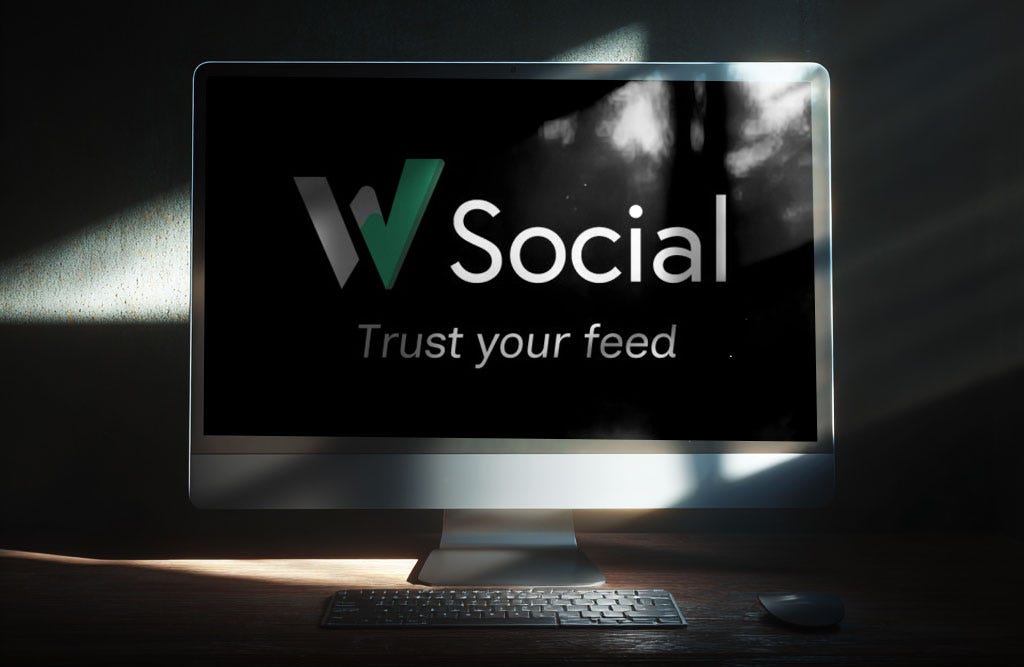
As Greg explained, Europe is not a place that believes in a culture of free speech that Americans would recognize. The idea of W, with its slogan, “Trust Your Feed,” is not only creepy, but all too consistent with Europe’s existing approach of state-dictated speech controls. How do you know your feed is trustworthy? The government says so!
We are always blown away that it seems like Europe has learned that the primary lesson from its authoritarian and even totalitarian past is that you should massively centralize power, just make sure the good guys are in charge this time. And who are the good guys? Coincidentally, they’re EU bureaucrats. And their friends!
Anyone who promises to save you from disinformation is asking you to give them the power to decide what’s true. W’s parent company is We Don’t Have Time, “the world’s largest media platform for climate action.” Maybe you agree with them about climate change. Are you sure you agree with them so much about everything that you trust them to decide what’s disinformation, and presumably, which views won’t be tolerated on the platform at all? Organizations are made of people, and people are fallible. U.S. attempts to stop disinformation have failed in part because humans don’t always know what’s true.
W also promises that it will be secure because it’s protected by EU data protection laws. But those laws don’t generally protect your information from the EU governments themselves, if they believe that information is necessary to protect national or public security. And if a privacy law doesn’t protect you from the government, and the platform requires you to identify yourself to the public to use it, then what privacy is left to protect? Yes, we hate targeted ads as well, but traditionally it’s actually been the guys with the exclusive monopoly on force that you should be most worried about, and those guys are the government.
If W shouldn’t be the arbiter of truth (because human history is full of once-disfavored ideas that are now accepted wisdom), and it doesn’t protect you from government reprisal, what will it actually do? If X is eventually banned in the EU, and it sure seems like that’s the plan, one thing it would do is advance the EU’s effort to sanction and censor American tech companies.
Propping up homegrown alternatives that are well-connected to government censors is something that Russia and China have done; whether W is in that model remains to be seen. But there is nothing about the EU’s regulation of speech that would suggest to a neutral observer that stronger ties between governments and platforms would improve speech on those platforms. And given how willing European states are to jail their citizens for online speech, users should be cautious about speaking on a platform where anonymity is impossible.
SHOTS FOR THE ROAD
And now back to the United States, where things are also pretty freaking terrible this week as well!
If you haven’t yet, now’s the perfect time to read Greg’s latest for The Free Press, “The Campaign to Crush Free Speech in Minnesota.”

Then don’t miss ERI’s own Angel Eduardo and FIRE Director of Public Advocacy Aaron Terr, writing about Miami Beach police visiting people who criticize the mayor.
It is sad because as a European Europe used to be one of the best places to live. Now that it's going communist I think the US might be the last place where freedom and peace can be found.
Freedom of expression—as defined by the individual doing the expressing—is dead in Europe. This is just a gussied up casket to prove it.