


Story of the week
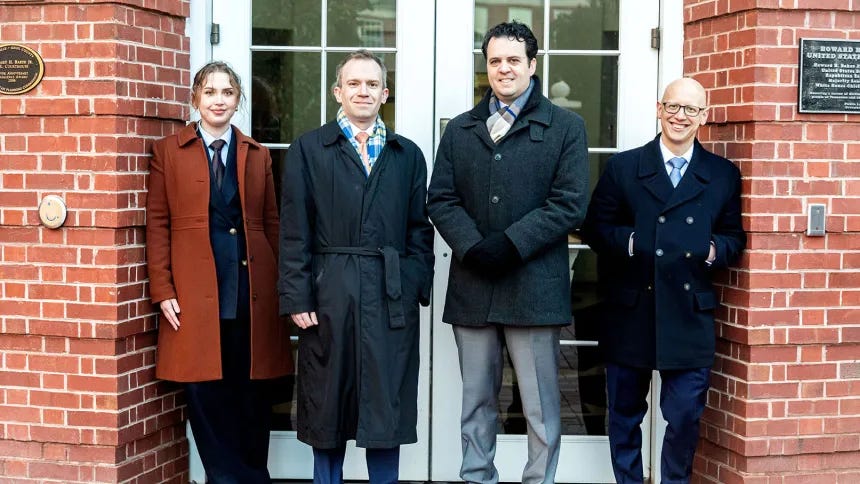
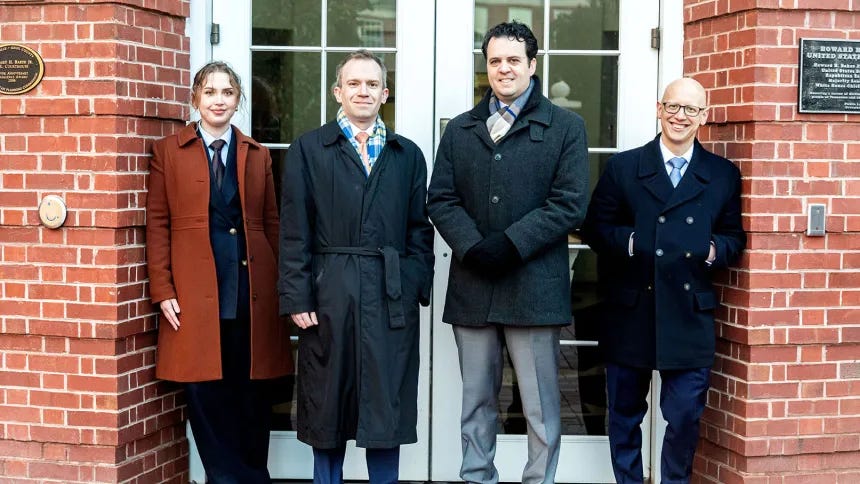
FIRE attorneys at the Knoxville courthouse.
Two years after a Tennessee high school student sued Tullahoma City Schools for suspending him over Instagram memes lampooning his principal, a jury found that the school district’s actions violated the First Amendment.
“This isn’t just a victory for our client, it’s a victory for any high school student who wants to speak their mind about school online without fear of punishment,” said FIRE senior attorney Conor Fitzpatrick. “Our client’s posts caused no disruption, and what teenagers post on social media is their parents’ business, not the government’s.”
This week in ERI

This week in Expression
A lot of the more “tolerant” majors are disproportionately filled with people on the left. But once you control for that, they tend to be more tolerant of both sides. The preprofessional majors tend to sit at the bottom of both axes. Conversely, even some of the “woke studies” majors actually do fairly well. African American studies has above-average left- and right-wing tolerance.
That said, theater is indeed extremely intolerant of right-wing speakers, and gender studies is similar in that regard. Interestingly, women in theater have roughly average female tolerance, while men in theater have the lowest right-wing tolerance of men of any major on the chart by a large margin (~5 percentage points). In fact, men studying theater have about the same right-wing tolerance as women in theater.
This week on So to Speak
This week, So to Speak host & FIRE EVP Nico Perrino spoke with University Maryland professor of history and author of The American Revolution and the Fate of the World Richard Bell about the legacy of Thomas Paine and Common Sense.
This week in FIRE’s blog
VICTORY: Catholic University of America reverses Reddit ban on campus Wi-Fi
Online speech is powerful. That’s why Iran is silencing it. by Sarah McLaughlin
If the Islamic Republic of Iran has its way, the news you read and the social media you follow won’t show the truth of the shocking events happening right now within the country. A mass internet shutdown orchestrated by the government this month is threatening to silence expression from courageous Iranians, at least 12,000 of whom are now dead at the brutal hands of the state, who are fighting back against their oppressors.
London Calling: Ronnie’s First Amendment Roundup

Megan Thomas Law, PLLC v. Syracuse Regional Airport Authority
Court holds airport’s rejection of employment lawyer ad with “HR called it harmless flirting … We call it EXHIBIT A” tagline likely violated the First Amendment
The federal district court for Northern New York granted an employment law firm’s preliminary injunction motion, and denied Syracuse Airport Authority’s bid to have the case dismissed, in a First Amendment challenge to rejection of the firm’s proposed billboard under the airport’s ad policies. Its original policy barred “inappropriate, immoral, offensive, or objectionable” ads and those with “political or religious messages,” while a new one, which the Authority hastily adopted when the firm sued, bars “ads for tobacco and marijuana, ads with profanity [or that] disparage or are false, misleading, or deceptive.” The airport said it had no concern with the ad identifying the firm’s services, including sexual harassment expertise, or the slogan “No Fear, No Shame, Just Justice,” but it found the tag line “When HR called it harmless flirting ... We call it EXHIBIT A,” and the “potential for disruption presented by this type of accusatory and inaccurate statement,” to be “specifically problematic.”
On the firm’s preliminary injunction motion to require performance of the contract for the airport to display the ad, the court held it was likely to show a First Amendment violation, regardless of which policy applied or what kind of forum the airport created with its advertising spaces. That’s because in all types of forums, viewpoint-based restrictions are prohibited and content-based ones must be reasonable. The court held the policy’s disparagement ban was viewpoint-based, as illustrated by its use to reject the tagline because “sexual harassment is a sensitive topic,” and/or it assertedly “denigrates HR departments” or “may ‘intimidate’ or ‘threaten’ men,” or just “would risk alienating some segment of the traveling public.” The falsity provision, meanwhile, may be fine on its face, the court held, but applying it to the law firm’s ad, and in particular its tagline, was not reasonable: “No reasonable person could believe plaintiff is saying use of the term ‘harmless flirting’ automatically grants any plaintiff a valid legal claim.” The court also held refusing the ad was viewpoint-based and unreasonable under airport’s old policy, for the same reasons, but also because it applied/defended its restrictions with a “litany of dubious rationales and post hoc justifications.” The court thus rejected the airport’s motion to dismiss the case, and granted the law firm’s preliminary injunction motion, but stopped short of ordering the airport to display the ad in favor of having the parties brief what preliminary relief should issue, including the options of enforcing the ad contract to require posting of the ad, or requiring the airport to revise its policy and (presumably) consider the ad anew.
Bonus case: As the week drew to a close, the federal district court for Northern California denied the government’s motion to dismiss the FIRE-brought constitutional challenge in Stanford Daily Publishing Corp. v. Rubio to Immigration Act provisions the administration has been using to deport legally present noncitizens for their speech, holding the student paper and two Doe plaintiffs have standing to pursue their claims.
Bonus bonus coverage: Also this week, FIRE secured a jury verdict in I.P. v. Tullahoma City Schools that a high school violated a student’s First Amendment rights when it suspended him for posting to his personal social media account, on his own time, away from school, three memes that poked fun at his principal.
International free speech stories of the week
Over 12,000 feared dead after Iran protests, as video shows bodies lined up at morgue (CBS) by Tucker Reals, Elizabeth Palmer, Ramy Inocencio, & Joanne Stocker
Australian parliament to return to pass hate speech laws after Bondi attack (Reuters) by Kirsty Needham
The federal parliament will return next Monday, and Albanese said he wanted legislation to step up penalties for hate speech and authorise a gun buyback to pass the following day.
Australians were entitled to express different views about the Middle East, he told reporters in Canberra.
“What they are not entitled to do, is to hold someone to account for the actions of others because they are a young boy wearing a school uniform going to a Jewish school or a young woman wearing a hijab,” he said.
The proposed laws will also ease visa denials on the ground of racial bigotry, and lower the threshold for banning hate organisations including neo-Nazi groups, officials said.
Uganda Cuts Internet Days Before Presidential Election (NYT) by Matthew Mpoke Bigg & Musinguzi Blanshe
4 movies ‘disappear’ from Hong Kong Film Awards’ contenders list (HKFP) by Irene Chan
TV Series of the month
The Great is a super fictionalized, bawdy, and rollicking dark comedy about the early years of Russian Empress Catherine the Great. It particularly focuses on her attempts as the absolute ruler of Russia to reform and enlighten a country that even this proud half-Russian would admit was pretty backwards.
And because it’s about high-minded Enlightenment philosophy, it’s of course overwhelmingly about…sex. The show is obsessed with it. It’s the biggest theme. A distant second, however, are the deeper philosophical issues about whether or not an absolute ruler can even reform a country without losing his or her own head.
And it’s also a constant allegory about why representative government, checks and balances, and separation of powers, make so much sense. Because given the amazing characters — each of whom are deeply flawed and delightful in their own ways — have incredibly strong personalities in the show, you realize what a disaster it would be if any single one of them was completely in charge.
Elle Fanning absolutely shines as Catherine. Nicholas Hoult is a comedic genius in the role of bloodthirsty, libidinous, kind of daft, kind of brilliant, man-child Peter the Third. But there isn’t a weak character among the entire cast. It also excellently incorporates more modern music. And if you can tolerate a show playing VERY fast and loose with history — which it is very clear about up front by saying that it is an “occasionally true story” — you will have tremendous fun with this gem of a show.
Give up your free speech at your peril. Once they are able to silence you, the game is over. The loss of all of your other freedoms will fall like dominos after. Anyone that advocates to censor you, or to unmask your anonymity is your adversary. Treat them like one - no matter what else they say.
But why is it so vital and necessary for the combined monolithic apparatus of government, corporations, and NGOs, to brute force censor everyone while decimating the careers and reputations of the dissenters? Here is why:
The reason the First Amendment is prime directive order 1, is because it is the most important freedom we have for the same reason it is the first target an adversary subverts, disrupts, and destroys during a crime, a war, or a takeover—preventing a target from assembling, communicating, and organizing a response to an assault grants an enormous advantage to the aggressors.
"If freedom of speech is taken away, then dumb and silent will be led, like sheep to the slaughter." —Washington
The Second Amendment is second because it is the remedy for anyone trying to subvert the First.
"The 1-A is first for a reason. The 2-A is it's twin. Together they make a bond of freedom." —S.P.H.
Great post.
But I tried to watch Catherine and found it pretentious. Sorry, but I hate pretentious.