


Story of the week
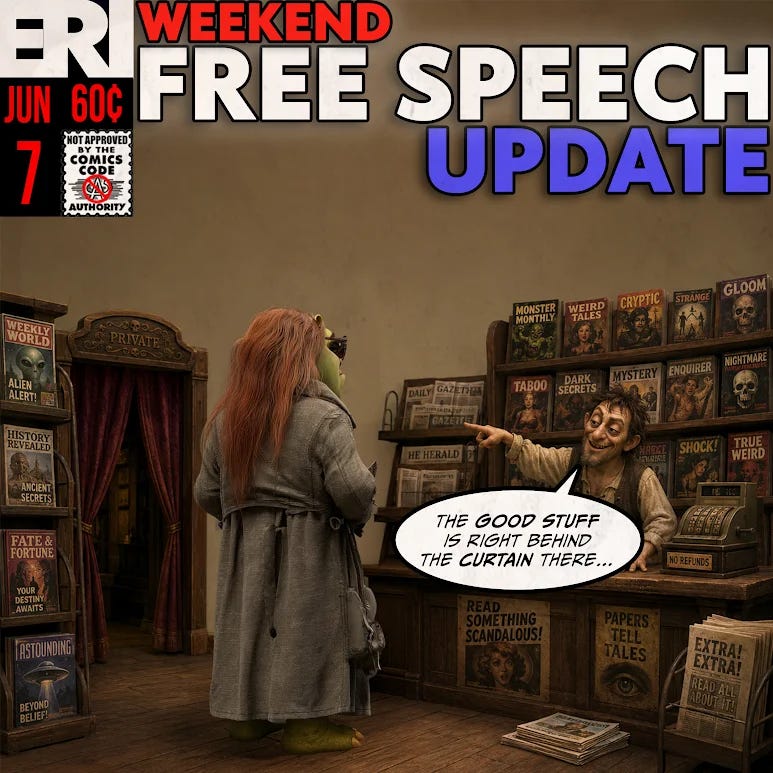
Ohio man jailed for texting Shrek’s penis to a state senator. Your questions about Shrexting, answered by Daniel Burnett & Aaron Terr
What does the First Amendment say?
About Shrek’s schlong specifically? Nothing, surprisingly. But it does have a lot to say about speech criticizing government officials — that is, that it lies at the heart of our constitutional protection for free speech. Aside from very narrow exceptions to the First Amendment, such as true threats or obscenity, the government generally cannot punish people for saying things to or about public officials, even if some find the speech offensive, insulting or vulgar.
Political speech doesn’t have to be serious or reverent to have First Amendment protection.
This week in ERI

This week in Expression
This week in FIRE’s blog
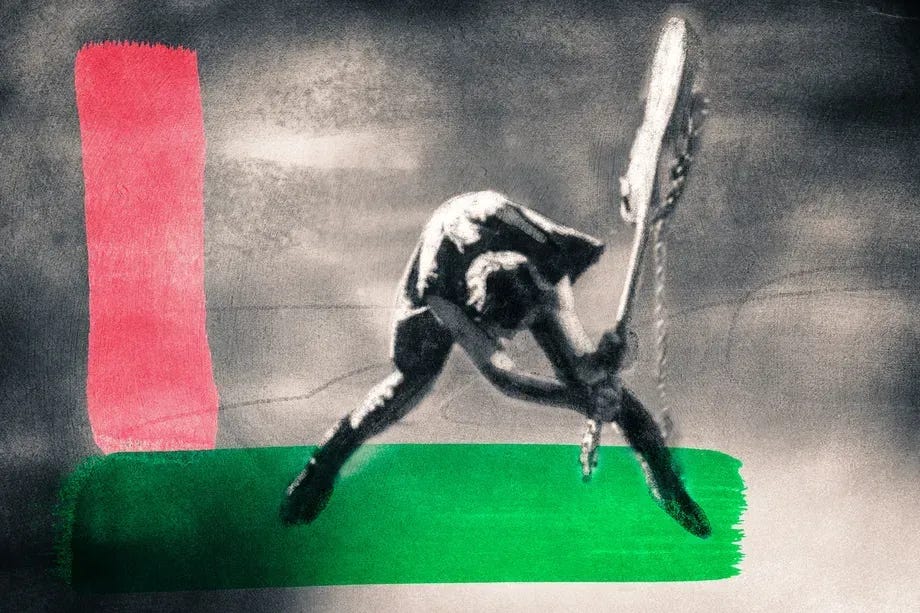
London Calling: Ronnie’s First Amendment Roundup
D.C. federal court issues temporary restraining order against feds interfering with 24/7 impeachment protest near federal courthouse based on display of “8647” messaging, holding “no reasonable observer could have viewed … the flag as a threat to the President’s life or physical safety”
The U.S. District Court in D.C. issued a TRO barring the National Parks Service and Department of Interior, and all their agents, from revoking the demonstration permit of protest group Accountability Now for displaying an “8647” flag at their downtown round-the-clock demonstration near a federal courthouse, or from otherwise seizing or ordering the flag’s removal. The “8647” slogan has become a popular call to remove the 47th President, i.e., President Trump, though federal officials—including the Secret Service’s Deputy Director in this case—have increasingly tried to paint it as a death threat, perhaps most notably in the indictment of former FBI Director James Comey for a social media post with the phrase spelled with seashells in the sand on a beach.
The court held Accountability Now is likely to succeed on its First Amendment challenge to attempts to remove or punish the flag, even as the case “implicates two fundamental principles essential to a free country,” that “content-based restrictions on political speech in a public forum—particularly restrictions that are premised on the ad-hoc impressions or views of government officials—are inherently suspect,” but “true threats to the life or safety of government officials are intolerable.” That is because “true threats” are only those “where the speaker means to communicate a serious expression of an intent to commit an act of unlawful violence to a particular individual or group of individuals,” with “true” serving to “distinguish … jests, hyperbole, or other statements that when taken in context do not convey a real possibility that violence will follow.”
And here, the court held, where officers’ actions “can be sustained only if the speech at issue satisfies both the objective and subjective criteria for a true threat,” the analysis concludes at that first step, as “NPS … offers no plausible basis to conclude that a reasonable person … would regard the flag to represent ‘a serious expression of an intent to commit an act of unlawful violence to” the President. The court notes “86” is “a slang term with no single meaning” but found in dictionaries as “meaning ‘to throw out,’ ‘to get rid of,’ or ‘to refuse service to,’“ and that it “is used far more often to mean ‘throw out’ than ‘kill.’” And while “whether ‘8647’ constitutes a true threat cannot be resolved in the abstract, without consideration of context,” the context here “makes clear that no reasonable observer could have viewed … the flag as a threat to the President’s life or physical safety”—that is, “the flag itself contains no symbols of violence” such as “knives, skulls, nooses, or other threatening symbols,” and it “was displayed … as part of an ongoing demonstration seeking President Trump’s impeachment and removal” with other “IMPEACH. CONVICT. REMOVE.” and like messaging.
All told, “[a]lthough the Court recognizes the importance and difficulty of the mission of the Secret Service, the First Amendment does not permit the government to censor political speech, which no reasonable observer would view, in context, as actually conveying a threat of violence, merely because the speaker uses a phrase that, in addition to other more common meanings, has been used to refer to an act of violence.” The court thus concludes that: “In short, the record contains compelling evidence supporting Plaintiff’s contention that it displayed the flag merely to urge President Trump’s removal from office but contains no evidence supporting Defendants’ contention that the flag represented a true threat on the life or physical well-being of the President of the United States.” And for similar reasons—i.e., Accountability Now “displayed the 8647 flag to urge that Congress impeach and remove” the President—the court also finds “no evidence that a reasonable observer would have viewed the flag as an incitement to imminent violence or … intended to incite political violence.” Consequently, it granted a TRO, with preliminary injunction proceedings to follow.

International free speech stories of the week
5 more charged after antisemitic signs displayed at March rally: Toronto police (CBC)
[Canadian] Senate committee amends C-9 to criminalize residential school denialism (iPolitics.ca) by Marco Vigliotti
Specifically, it would create a new provision in the Criminal Code making it illegal for
anyone who in public, “wilfully promotes hatred against Indigenous peoples by condoning, denying, downplaying or justifying the Indian residential school system in Canada or by misrepresenting facts relating to it.” The maximum penalty, if treated as an indictable offence, would be a prison term of less than two years.
Press Release: Laws giving police, courts greater power to combat extremism pass Parliament (New South Wales, Australia)
Romania: Draft Law Requiring NGOs, Including Media, to Publish Donor Identities (Council of Europe, Safety of Journalists Platform)
Tribute of the month

I am heartbroken to hear of the passing of a friend and an extraordinary talent, Dito Van Reigersberg, Artistic Director Emeritus of Pig Iron Theatre Company, after a long battle with cancer.
Dito was one of the people who made the artistic scene in Philadelphia such a thrilling community to witness during my two two-year stints living in that city. The second time I moved back to Philadelphia, to become FIRE president, I was extraordinarily lonely. But Dito always had a way of making me feel accepted, welcome, and at home.
I know he made so many people feel that way.
I was lucky enough to see him when he was just starting his career as Martha Graham Cracker at L’Etage in Philadelphia. I had watched another actor who preceded him improve his cabaret chops over time, but Dito seemed to arrive nearly fully formed: astounding from the beginning, and soon dominating the scene.
But as everyone who knew him knows, he was also incredibly kind, surprisingly humble for a genuine genius, and, of course, funny as hell.
I was so inspired by some of the art I got to be adjacent to during my time in Philadelphia. In fact, I still have a recording of the song “Napoleon” from Pig Iron Theatre Company’s “James Joyce is Dead and So is Paris: The Lucia Joyce Cabaret.” It was a musical about Lucia Joyce, the daughter of James Joyce and Nora Barnacle, who spent much of her life institutionalized. The song was about Lucia wondering what will become of her while meditating on a pen, a meager gift from her beloved father.
I still have a lot of the lyrics committed to memory:
The blue veins run across my map are rivers,
I cut my nails and I feed them to the moon slivers…
Father dear, I swear to you on the head of Jesus
That I will never love another man till the day hell freezes.
Father dear, I am spoiled.
Thanks for the pen.
That song always crushed me, and all the more so now that Dito is gone. I hope Pig Iron Theatre Company releases it, or, even better, that somewhere there exists a video of Dito singing it, because it was so intimate and moving.
But I am very happy to see people celebrating his too-short but wonderful life.
Rest in peace, Dito.
Here he is, as Martha Graham Cracker, singing one of my all-time favorite songs, David Bowie’s “Life on Mars.”