


Stories of the week
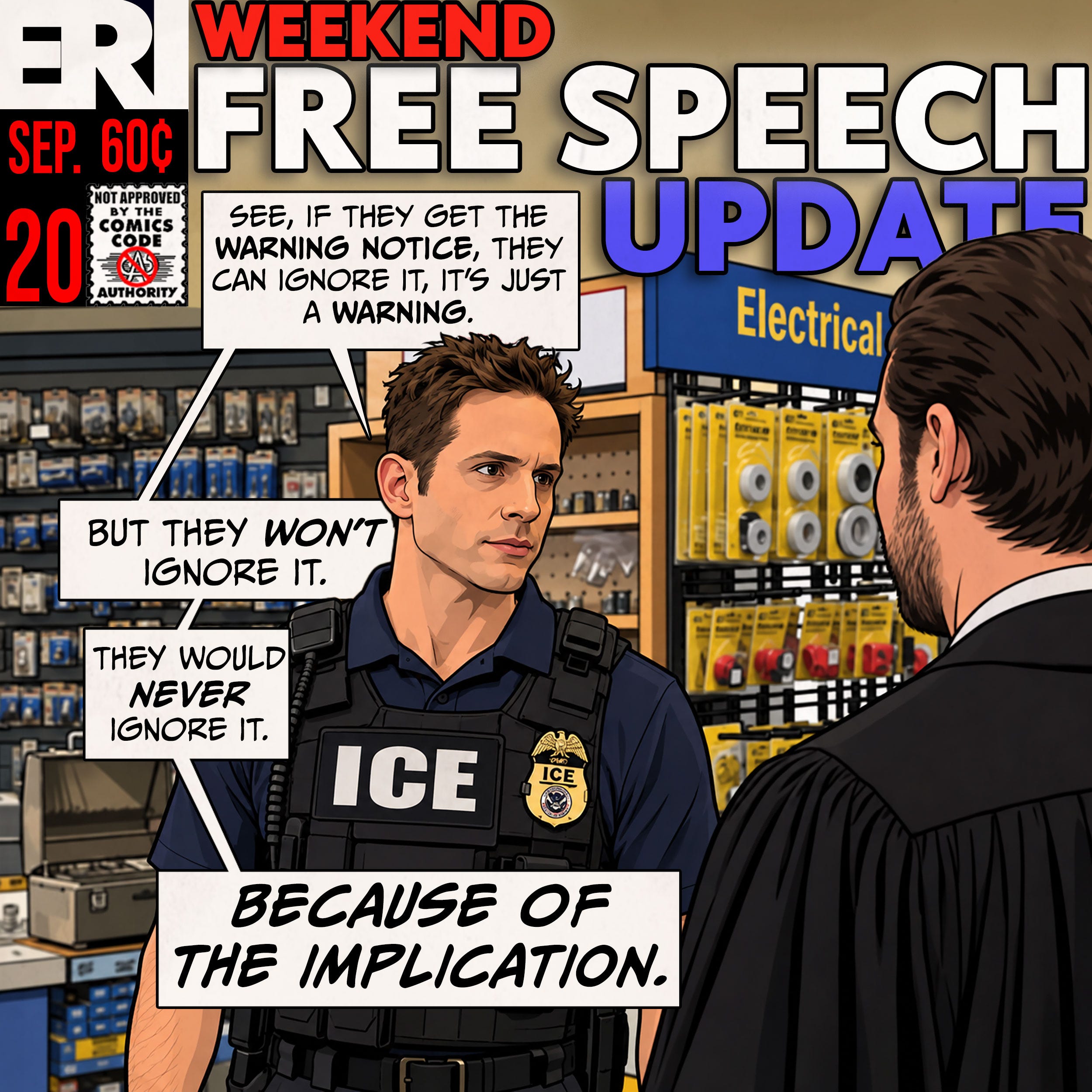
VICTORY: Federal court says ICE threatened critic by serving him with ‘Warning Notice’ over an email
“ICE knowingly pursued an American citizen for criticizing his government — speech that is at the heart of the First Amendment,” said FIRE Senior Attorney Adam Steinbaugh. “Ominous letters warning people their speech might land them in prison are meant to coerce people into silence, and that’s not how the First Amendment works.”
Dartmouth Is Open to Debate (WSJ) by James B. Meigs
This week in Expression
Does American theater believe in free expression? by Kevin Ray
Alternative for Germany wants criminal charges over ‘ethnic cleansing’ comment by Sarah McLaughlin
This week in FIRE’s blog
London Calling: Ronnie’s First Amendment Roundup
D.C. federal court vacates and preliminarily enjoins enforcement of ICE “Warning Notice” served on critic for emailing ICE’s Acting Director to shame him after shooting deaths of two Minnesotans by ICE officers
In a First Amendment lawsuit by a New York resident who wrote a critical email to then-Immigration and Customs Enforcement Acting Director Todd Lyons, after two fatal shootings by ICE agents in Minnesota, the U.S. District Court for the District of Columbia vacated and preliminarily enjoined a “Warning Notice” ICE served on plaintiff that claimed “YOU MAY BE IN VIOLATION OF FEDERAL LAW” for sending the email, threatened prosecution, insisted he “promptly … discontinue” his “behavior,” and cautioned the notice will be “taken into consideration” should he “continue to be involved” in activities that led to it.
Noting the notice “practically shouts” that plaintiff could be prosecuted “if he continues to engage in his political speech,” the court concluded it caused the “injury [of] loss of … freedom to engage in political speech now because the threat of such an investigation or prosecution looms over him like the sword of Damocles, and he is forced to self-censor under that threat.” “That loss of speech is both imminent and certain,” the court continued, as “it does not rely on Defendants actually opening a new investigation,” but rather “works because Mr. Streever is too intimidated by the threat of future government action that he will not test whether the government will follow through on its threat.”
The court noted “Defendants wisely do not contest” that the email “constitutes protected expression or that similar speech would be protected,” as it “addressed salient political decisions to a government official, an arena where the First Amendment’s speech protections reach their ‘zenith,’” and “was a far cry from a true threat of violence.” Rather, it simply “registered displeasure with Acting Director Lyons’s official conduct, forecasted [he] will lose favor with the President, and warned that the moral weight of [his] actions will haunt him in the future.”
The court thus held plaintiff “likely to succeed in showing that Defendants engaged in coercion, rather than persuasion” as they “went beyond mere investigation … when the issued the notice.” They did not, the court noted, “ask kindly if Mr. Streever would tone down his rhetoric” but instead “dispatched two agents to his home for an unannounced visit where they delivered a ‘WARNING NOTICE.’” “Although that notice ‘requested’ that Mr. Streever ‘discontinue’ his political expression, it characterized that political expression as potentially violating federal law which ‘could subject [him] to both federal and state prosecution.’” The court further held plaintiff showed he will suffer irreparable harm absent an injunction, as the “core of Mr. Streever’s claim is the loss of his freedom to engage in political expression” and “inability to engage in protected speech is an irreparable injury.”
The court thus vacated the warning notice and preliminarily enjoined the defendants during the course of the case from relying on or taking further steps in reliance on it, from issuing any substantially similar threats aimed at plaintiff’s protected expression, and from “prosecuting or issuing investigative demands to Mr. Streever relying in whole or in part” on his email to the Acting Director.
(As the decision link up to top reflects, this is a FIRE case.)
International free speech stories of the week
EU is set to propose ban on social media and AI chatbots for under-15s (Reuters) by Foo Yun Chee
According to the document, companies will have to pay a supervisory fee to fund regulators’ enforcement and supervision.
Children from 15 onwards can set up their own accounts under the proposal, while children between 13 and 14 can ask parents to open introductory accounts for social media and video-sharing platforms under parental control and with limited contacts and strict time limits.
Accounts for children between 3 and 12 will be fully controlled by parents and will only be for child-friendly services with strict safety standards, the document said. Under-3s would have no access to the services.
Details may still change ahead of the announcement.
Netanyahu: I’ll introduce bill to revoke citizenship of those who slander IDF abroad (Times of Israel) by Lazar Berman
The first bill will introduce the option of revoking their citizenship, and the second will increase the sum they can be sued for if found guilty, Netanyahu says in a video, explicitly referencing Democrats party chief Yair Golan, former military advocate-general Yifat Tomer-Yerushalmi and the filmmakers behind the recent film “NAZA.”
Appearance of the week
There are few things I’d rather spend my birthday talking about less than Macklemore and Ed Sheeran — but, alas, free speech never takes a day off.
I joined Jake Tapper on CNN to discuss the controversy over Macklemore being dropped from Ed Sheeran’s tour. My take is that there are a few important distinctions getting lost in the debate.
First, this isn’t really a First Amendment question. Robert Kraft and other private venue owners have the legal right to decide who performs in their stadiums. But the law isn’t the end of the conversation. A healthy culture of free speech depends on people being willing to tolerate political expression they dislike rather than trying to punish or exclude everyone who says something offensive or objectionable.
Second, attempts to punish political speech have a remarkable tendency to amplify it. Would we be talking this much about Macklemore’s views on Israel if there hadn’t been a campaign to bar him from these venues? Probably not. As I told Jake, this is the Streisand effect on steroids.
And there’s an important distinction when it comes to Ed Sheeran himself. If Ed had simply said, “I don’t want Macklemore on my tour,” this wouldn’t have been much of a question at all. Artists get to decide whom they want to perform with. But that’s very different from outside pressure being brought to bear because people dislike a performer’s political views.
You don’t have to like Macklemore, agree with him, or buy a ticket to see him. In fact, that’s often the healthiest response to speech you hate: criticize it, argue against it, or don’t show up. Trying to make it disappear usually just makes everyone hear it louder.
Watch my conversation with Jake Tapper below.
You left out the part that people had already bought tickets, attending a show which was promoted as a musical event, featuring Ed Sheeran.
First amendment issue? No. Misrepresentation? Yes. Macklemore should get his ass sued off for misrepresenting the purpose of his appearance, In this age in which hurt feelings are actionable, I'd say a class action suit against Macklemore should bleed him of five or ten million.
I generally like and support FIRE but why does GL say that Ed S has right of free association but not RC ???
And it's not a 'policy' difference that RC is refusing to associate with. It is a person using RC's facility to promote murdering people like RC
Seems reasonable to say 'go do that elsewhere