

Story of the week
By demanding Anthropic eliminate access solely for foreign users — a functional impossibility, per the company — the government is exercising the kind of “kill switch” on artificial intelligence we have seen repressive regimes abroad use on the internet.
By leaving the public in the dark as to the specific threat identified and the statutory authority invoked to address it, the government’s dramatic action functions as an arbitrary abuse of power. The export controls serve as a prior restraint or a licensing system, requiring Anthropic to receive government approval as a condition of operating expressive systems.
This week in ERI
The online ‘safety’ trap by me

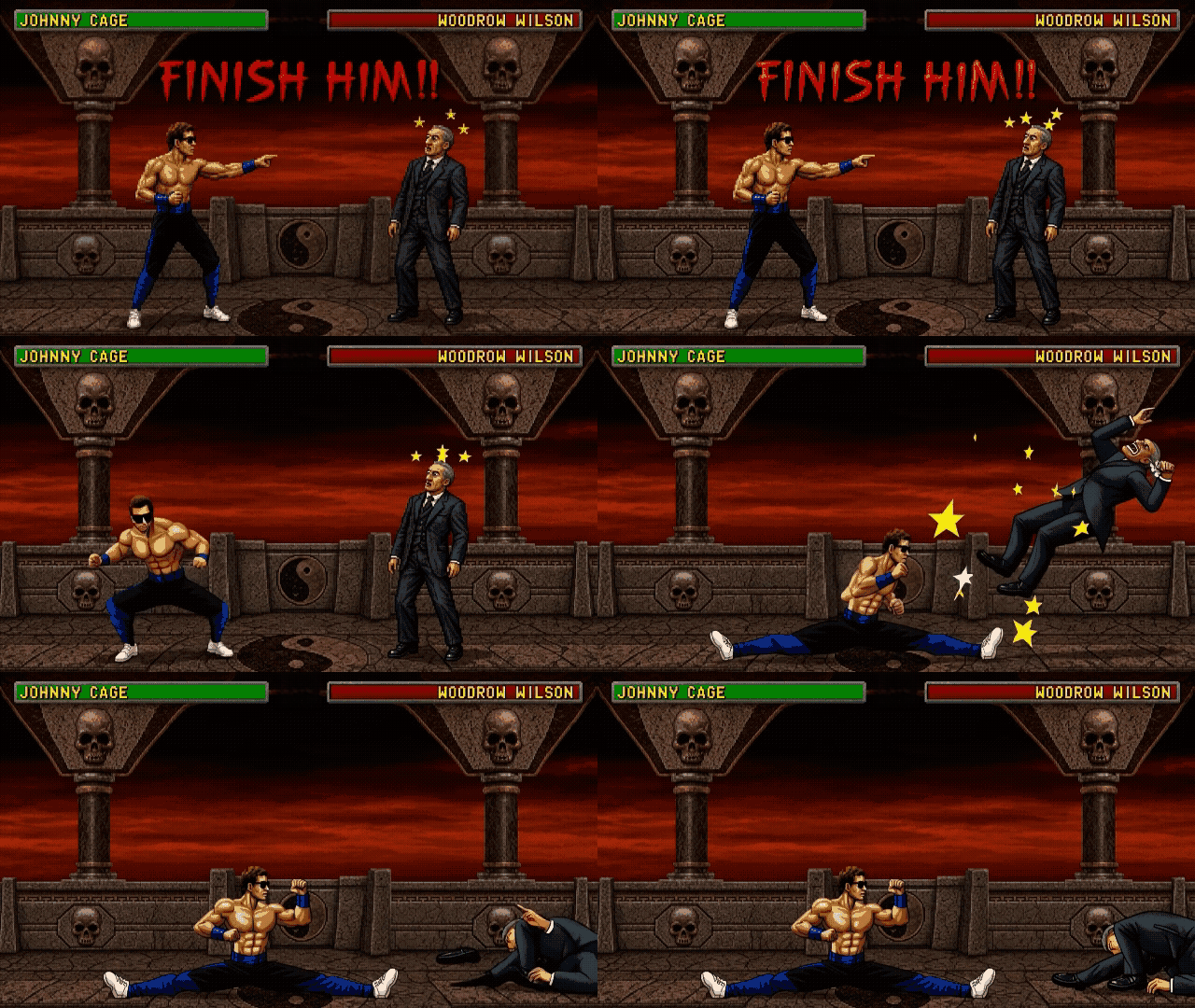
Come for the AI-free speech analysis, stay for the Woodrow Wilson takedown!
This week in Expression
Applying First Amendment principles to AI-generated expression is both a natural extension of those principles and a necessary step to prevent those principles’ weakening in other applications, including in areas like newspapers and video games.
This week on So to Speak
This week, Nico spoke with activist and self-described Satanologist T. Chaz Stevens about using satire, litigation, and “malicious compliance” to test the limits of religious liberty, free speech, and government viewpoint neutrality under the First Amendment.
This week in FIRE’s blog
Outside a New Jersey immigration detention center, reporting on protests may cost you a hospital visit by Athena Rem
Victory: Wisconsin school board backs away from ban on criticism during public comment by Isabelle Brito
On May 21, FIRE wrote to the board, explaining that the restrictions were unconstitutional and urging the board to rescind them or confirm they no longer reflected board policy.
The board responded, confirming the statement “does not reflect the Board’s current formal or informal policies and practices” and that it has “no plans to . . . enforce such restrictions in the future.”
That’s a win for every resident who wants to hold local officials accountable. At government meetings, the First Amendment protects more than praise and flattery.
UK teen social media ban is anonymity-killer for adults by Sarah McLaughlin
New York wants warning labels on AI in the news by John Coleman
FIRE in the press!
Brits May Soon Say Goodbye to an Anonymous Internet (Persuasion) by Sarah McLaughlin
But there’s a problem: these “under-16” policies will blunt all UK citizens’ ability to speak freely and anonymously online. All users, whether they’re 15 years old or 55, will need to prove their age in order to post on social media. This raises significant privacy concerns, not just for users’ ages, but for their identities. The process of age verification will cut away vital firewalls around users’ anonymity. As the rush to ban children from social media hits a global fever pitch, it’s well past time we abandon the faulty claim that only children will feel its effects.
London Calling: Ronnie’s First Amendment Roundup
NY federal court preliminarily enjoins ban on expressive or symbolic conduct within 35 feet of house-of-worship entrances or driveways, or within 10 feet of anyone in a 100-foot bubble around the entrances without their consent, for one hour before through one hour after any service, meeting, or ceremony
Calling it “unprecedented,” the U.S. District Court for Eastern New York preliminarily enjoined Nassau County’s Religious Safety Act banning picketing, advocacy, literature distribution, and all other expressive or symbolic conduct within 35 feet of entrances or driveways of houses of worship, along with its related ban, applicable in a 100-foot bubble around the entrances, against getting closer than 10 feet to anyone for such expressive purposes without their consent. Under the RSA, houses of worship are “any church, synagogue, mosque, temple, or other … location regularly used primarily for religious worship, religious education, or religious services,” an “entrance area” is “any doorway, threshold, entryway, gate, ramp, or other point of ingress or egress,” and a “driveway” is any “entry from a public street to any parking lot” where the house of worship has “an ownership, easement, leasehold interest, or other property right.” The court agreed with the plaintiffs challenging the combined bans, which apply an hour before though one hour after any religious service, community meeting, ceremony, or congregational, educational or organizational meeting or event, that: “the law’s benign purpose—to allow individuals to freely attend religious services and other events at these places, without harassment or fear, and to ensure public safety—is inconsistent with the broad sweep of the law and constitutes a substantial infringement on core First Amendment activity.”
That was so given the RSA’s practical effect. The court cited evidence that there are nearly 1000 places of worship in the county. So, with the 35-foot buffer and 100-foot bubble resulting in restrictions that reach public streets and sidewalks, the combined effects of density of places of worship and RSA limits make entire public streets off limits for any of the prohibited conduct—which the court notes “cover the waterfront” of the First Amendment activity. And given the plethora of religious services, community meetings, and other events at houses of worship, and that the RSA covers non-religious activities—i.e., any community meeting or event—its bans can make prohibited zones off-limits, based just on weekly scheduled events, for upwards or 12 hours a day, and more than 16 hours a day in some places.
Noting the parties agree the RSA is content-neutral and thus subject to intermediate scrutiny, and that insofar as its operation reaches traditional public forums it must, in addition to advancing an important government interest and not burdening substantially more speech than necessary, leave open ample alternative channels for communication, the court held the 35-foot buffer likely cannot withstand First Amendment scrutiny. It held (and plaintiffs did not contest) that protecting public safety and the right to religious freedom are important government interests. But the buffer likely flunks narrow tailoring given it “imposes restrictions on such speech essentially without limitation as to time, and in some places over sidewalks and public streets.” So the “combination of these effects imposes nothing less than severe burdens on Plaintiffs’ activities,” while “Nassau County’s interests in protecting religious freedom and public safety are insufficiently linked to the imposition of such broad suppression.”
“If the goal is to avoid harassment, intimidation, violence, or threatening speech,” the court continued, “the County could have drafted a law that criminalized such conduct. It need not have also banned peaceful conversation, polite exchange, and information distribution on public streets—what amounts to the extreme step of closing a substantial portion of a traditional public forum to all speakers.” And the county’s “proposed alternatives—that Plaintiffs demonstrate 35 feet away, leaflet during the hours there are no services, or stand stationary within the 100-foot bubble zone—are inadequate.”
Similarly, the bubble governing the 10 feet surrounding each person within 100 feet of house-of-worship entrances was not narrowly tailored, especially given that, combined with the 35-foot buffer, it is quite different from Hill v. Colorado’s 8-foot buffer around individuals within 100 feet of healthcare facilities. And the county “failed to articulate any rationale for having both a buffer and bubble … to advance their interests in protecting religious liberty and public safety.”
The court also found “an independent basis that makes the RSA susceptible to invalidation,” in “the unbridled discretion of an officer to police violations of the law.” Speakers face criminal liability under the RSA after they “receive a verbal, written, or other communicative or expressive instruction, warning, or order” from an officer—but “given the breadth of the expressive conduct and speech implicated by the law, an officer is left with the discretion to determine whether the individual standing in silence wearing a t-shirt with a political message is violating the statute or not engaging in expressive conduct at all.” Relatedly, the law is standardless as to what “instruction, warning, or order” will suffice, because the law “could encapsulate anything from a loud and clear instruction to disperse or risk criminal liability to a simple raising of the arm and pointing down the street.” In short: “There are no rules, standards, or guidelines to determine what constitutes conduct that violates the law.”
Having held plaintiffs likely to succeed on the merits of establishing the RSA is unconstitutional, the court held they also established irreparable harm, and that the public interest favors enjoining the RSA, noting that, even if the county “has a powerful, ongoing interest in protecting its residents from harm when attending religious service,” “an important government interest that is insufficient to demonstrate constitutional validity, cannot tip the equities or public interest in the County’s favor.” The court thus preliminarily enjoined the bans in their entirety and their enforcement against anyone.
International free speech stories of the week
Telegram challenges India ban over exam paper leak fears (BBC) by Nikita Yadav
Canada tables bill restricting social media, AI chatbots for under-16
“The evidence is clear: online harms are putting our children especially at risk,” said Anna Gainey, Secretary of State (Children and Youth). “The Safe Social Media Act will hold platforms accountable and help make the internet safer.”
Specifically, the framework will operate through three core duties: the duty to protect children, which will apply to all regulated services under the act; the duty to act responsibly, which will require social media services to mitigate risks associated with exposure to harmful content, apply labels to synthetically generated content, and provide clear and accessible ways for users to flag harmful content and block other users; and the duty to make certain content inaccessible, which will require the rapid removal of content that sexually victimizes a child, or intimate content communicated without consent, including deepfake sexual images.
(India) ‘Stand-up should be banned’ says city mayor (Chortle)
Video of the week
The great Bob Odenkirk reprised his iconic role as the hilarious, if perhaps a bit unscrupulous, attorney, Saul Goodman, from Breaking Bad and Better Call Saul to wish America a happy 250th birthday. It made its rounds on social media, but in case you missed it!
FIRE has no interest if you are deprived of liberty and due process based on the opinion of a psychiatrist. The most common attack on free speech in America is in the name of health, but that has never interested civil libertarians.
https://archive.org/details/aclu_20221112