

Story of the week
Authoritarian regimes are just that: authoritarian. They will lean hard on AI companies to shape and censor political speech — or perhaps even trust that those companies will voluntarily self-censor to retain market access, even without an explicit order to do so. But AI companies who profess to care about free speech have a moral duty to protect free expression and ensure their systems don’t unintentionally extend the speech restrictions of despots to users around the world.
This week in ERI
What's the (free speech) deal with Canada?

If you’re in America and smell something burning up north, it’s unfortunately not just the Canadian wildfires. In recent months, our hockey-mad friends have also been torching a number of its free speech protections — beginning with a legal shield that has been part of its law since 1970.
This week in Expression
Are AI companies doing authoritarians’ dirty work? by Sarah McLaughlin
Can the government require ID before you use artificial intelligence? by John Coleman
The global crusade to ban teens from social media is now advancing across Europe by Sarah McLaughlin
You don’t need a weatherman to know which way the wind is blowing on teen social media bans. The bans are everywhere, and more are coming. European Commission President Ursula von der Leyen announced this week that the EU will seek some form of a youth social media ban across Europe.
After punishing people for Charlie Kirk comments, colleges are paying steep settlements by Graham Piro
Kirk’s assassination was a monumental moment for many Americans who considered Kirk to be an embodiment of the value of exchanging ideas with the other side. But the First Amendment does not allow public institutions to punish their employees simply because employees speak out in ways that offend others. Rather, it provides robust protections for public employees to speak as private citizens on matters of public concern, including Kirk’s death.
America Is Failing Its Own Free Speech Standards (cross-posted from @The Next Move) by Sarah McLaughlin
Michigan State’s ethics policy gags dissent — and the public will feel the effects by Marie McMullan
German bill would criminalize denying Israel’s right to exist by Sarah McLaughlin
This week on So to Speak
This week on So to Speak, Nico Perrino sat down with University of Chicago historian Ada Palmer to dig into what the history of censorship reveals about today’s free speech debates. Together they explore how censorship has evolved from the Renaissance to the age of AI, discuss the shifting relationship between state and private censorship, the role of fear and self-censorship, and why efforts to control ideas have persisted across centuries—and what that history can teach us about the challenges we face today.
FIRE in the press!
Hochul’s data center moratorium is a disaster for New York (Poughkeepsie Journal) by Adam Thierer
Like Europe, New York lawmakers apparently believe they can regulate energy and AI innovations in their territory without regard to the costs and consequences, and then hope they can somehow still develop their domestic technology base to meet all their future market needs. As they say, you cannot have your cake and eat it too. In reality, such moves just undermine domestic industry and options, making governments far more dependent upon surrounding jurisdictions for their energy and technology needs, while also making their citizens poorer. This is already what happened in New York following the state’s fracking ban a decade ago. Data center bans could end up being a replay of that mistake, and could also look like America’s hampering of its domestic nuclear industry over the past half century, as federal and state over-regulation made it impossible to develop critical energy infrastructure and options.
International free speech stories of the week
Hong Kong official says booksellers should ensure titles won’t harm national security after arrests (WaPo) by Kanis Leung
But Secretary for Security Chris Tang told reporters at the legislative building that the law is clear.
“If you are a bookseller, you have the responsibility to make sure the books you sell won’t endanger national security,” he said. “It’s equal to, for example, when you are selling food, you need to ensure the food won’t cause a stomach ache and is not either poison or illegal.”
Asked if authorities would make a list of banned books, Tang said that would not be conducive to effective law enforcement targeting titles that “intend to harm the country.”
“We will not let criminals off the hook like this,” he said.
European Commission Moves Us One Step Closer to the End of the Open Internet (Reason) by Elizabeth Nolan Brown
From posting political commentary on X to asking potentially embarrassing health questions on Reddit, reviewing books on Goodreads, posting to a forum for LGBTQ young people, consuming TikTok content, subscribing to Substack newsletters, joining a community for people dealing with psychological issues, and so much more, your real identity will be tied to your online activity. Tech companies, regulators, and law enforcement may be able to connect you to activity across the internet. There would be no more online anonymity, at least not in any real sense.
Podcast of the week
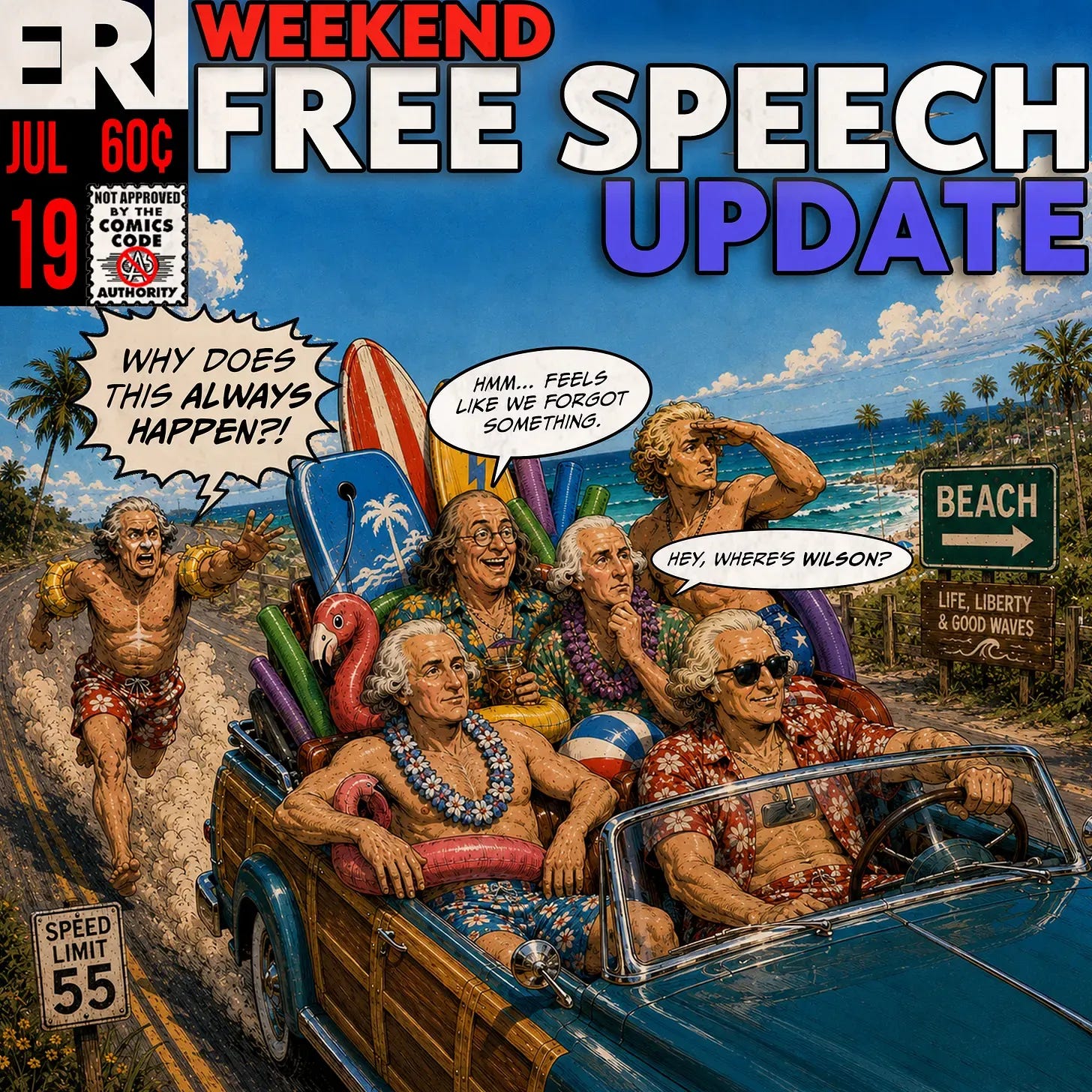
On The Blessings of Liberty podcast, Senior FIRE Fellow Jeffrey Rosen was joined by Senior Fellow at the Brennan Center for Justice & New York Times columnist Jesse Wegman to explore the life and legacy of James Wilson, one of America’s most influential yet overlooked Founding Fathers. Drawing from his new book, The Lost Founder: James Wilson and the Forgotten Fight for a People’s Constitution, Wegman discusses Wilson’s pivotal role in shaping the Constitution, his vision of popular sovereignty and democratic self-government, and how personal scandal contributed to his historical obscurity despite his lasting impact on the American constitutional tradition.
Will FIRE and Greg Lukianoff defend Shiloh Hendrix? She has been convicted of Disorderly Conduct for saying mean things to a Somali sex offender who was filming her and her child, a month after his charges were dropped by the same Minnesota justice system that prosecuted her. Shiloh’s sentence is 90 days in prison (suspended), $1,000 fine, 200 hours community service, and probation - this is a test for all people and organizations who claim they defend free speech.
Always appreciate the willingness to highlight what's going on in Canada and the difficulty of functioning in the system.