



Stories of the week
Declaring the target to be “design features” — such as infinite scroll or notifications — instead of speech doesn’t change things. The First Amendment isn’t fooled by synonyms, and what these lawsuits target is, inescapably, speech. Some allegations are aimed at content hosted by platforms that some perceive as harmful. And the ways platforms arrange, display, and choose how users consume content are editorial choices that are protected by the First Amendment. That those features might be designed to keep users’ attention is hardly a groundbreaking discovery. That is the point of all media. Imposing liability because speech is too appealing would be a breathtaking incursion on free speech.
This week in ERI
This week in Expression
Protecting teens shouldn’t require permission to speak by Zoe Armbruster
‘From the river to the sea’ is now a criminal offense for millions of Australians. Arrests are underway by Sarah McLaughlin
This week in FIRE’s blog
FIRE in the press!
Free speech must be protected amid AI fears (Minnesota Star Tribune) by John Coleman
Artificial intelligence, like other software, doesn’t speak on its own. Rather it’s an expressive tool people use to create, edit and better communicate ideas and information, similar to but more interactive than a word processor, calculator or search engine. Removing speech protections from AI-assisted expression inevitably restricts the rights of the humans who develop and use those tools.
Why the Afroman ‘pound cake’ police saga is so delectable (Washington Post) by ERI Editor-in-Chief Adam Goldstein and me
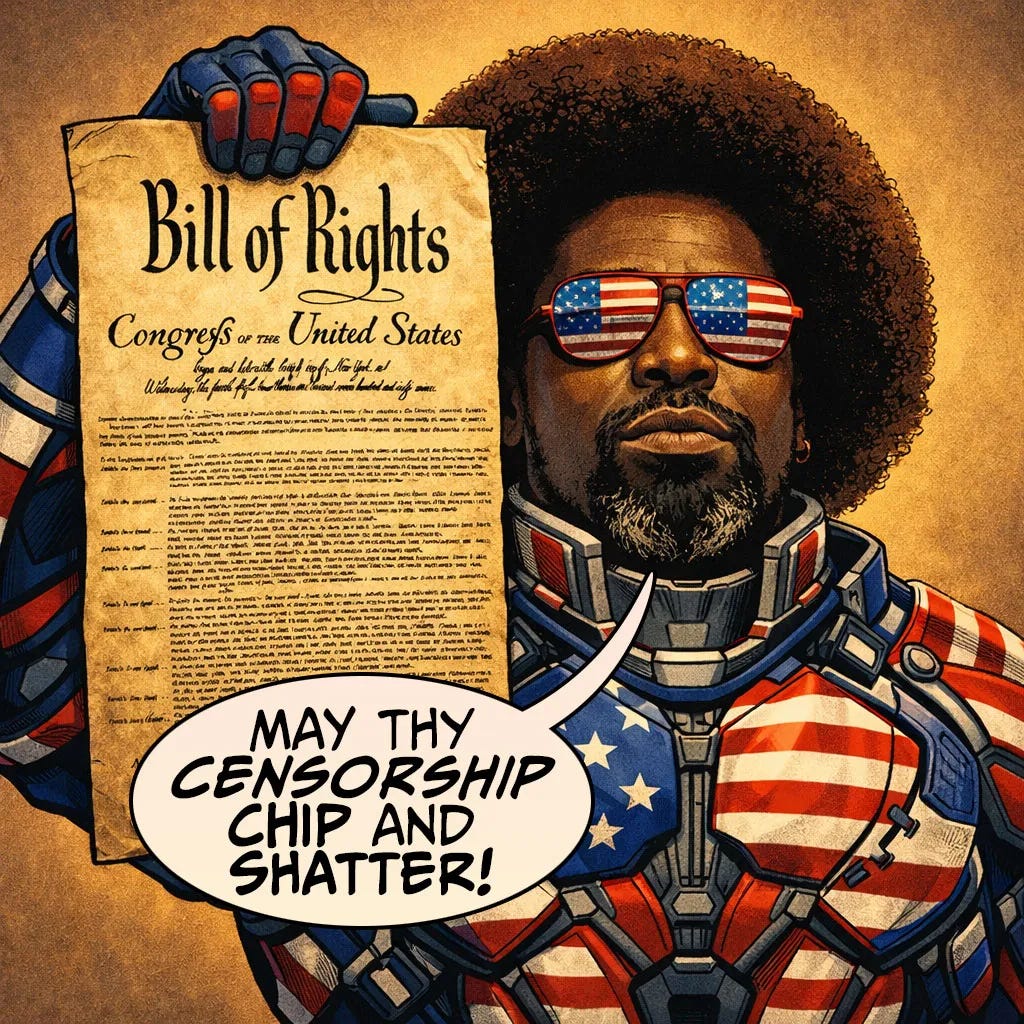
So, yes, the case is hilarious. But there is a fundamental American truth running through this whole thing, perhaps best captured in the imagery from the music video “Batteram Hymn of the Police Whistle Blower,” where Afroman marches defiantly toward the camera in his American flag suit, telling the cops, “Afroman will bring it to you.” That deserves a civil-libertarian salute: Genuinely free people have the right to tell power where to go.
London Calling: Ronnie’s First Amendment Roundup
Finding “classic illegal First Amendment” action, federal district court in California preliminarily enjoins executive branch retaliation against Anthropic’s refusal to drop AI guardrails against domestic surveillance and fully automated lethal weapons under its DoW contract—including a presidential directive banning it from all government contracts, and DoW directives designating it as a supply chain risk with which all government contractors must sever ties
The U.S. District Court for Northern California granted a motion for preliminary injunction arising out of a dispute between Anthropic, creator and provider of artificial intelligence model Claude, and Claude-user the Department of War (née Department of Defense), over demands that Anthropic permit the Department to employ Claude for “all lawful uses” without restrictions—including those barring mass surveillance of Americans and “lethal autonomous warfare.” After Anthropic went public with the disagreement, the President announced all federal agencies would immediately ban Anthropic from having another government contracts. And DoW Secretary Hegseth announced that anyone wishing to do business with the military must sever commercial relationships with Anthropic, and that the DoW had designated it a “supply chain risk”—a designation not previously applied to a domestic company, but rather one historically reserved for U.S. adversaries who may sabotage our tech systems, like foreign intelligence agencies, terrorists, and other hostile actors.
After Anthropic sued and sought among other things to preliminarily enjoin the retaliatory measures, the court concluded there was support for the “inference that Anthropic is being punished for criticizing the government’s contracting position in the press.” The court issued a blunt assessment: “Punishing Anthropic for bringing public scrutiny to the government’s contracting position is classic illegal First Amendment retaliation.” As the court summarized the matter:
The record shows that Defendants’ conduct appears to be driven not by a desire to maintain operational control when using AI in the military but by a desire to make an example of Anthropic for its public stance on the weighty issues at stake in the contracting dispute. Although Anthropic had always applied the usage policies in question to Claude Gov, it had been repeatedly lauded as a partner and passed lengthy national security vetting processes. Only when Anthropic went public with its concerns about DoW’s contracting position did Defendants set out to publicly punish Anthropic for its “ideology” and “rhetoric,” as well as its “arrogance” for being unwilling to compromise those beliefs. At that point, Defendants announced a plan to cripple Anthropic: to blacklist it from doing business with any company that services the U.S. military, to permanently cut off its ability to work with the federal government, and to brand it an adversary that could sabotage DoW and that posed a supply chain risk. Those actions go far beyond what would be necessary to address DoW’s ostensible concern about having complete operational control when using AI. ****
The court held Anthropic engaged in protected speech and suffered a significant adverse impact from government actions that “leave little question that the measures were prompted by Anthropic’s public repudiation of DoW’s contracting request and its perceived use of public scrutiny to ‘strong arm’ DoW into changing its mind.” And it rejected government efforts to play off Anthropic as just being engaged in a “contracting position” that was conduct not speech, and claims that it was Anthropic’s refusal to accept DoW’s terms, not its speech, that led to the adverse actions. The court noted that, were this merely a contract issue, DoW could have just stopped using Claude, but the government’s actions “far exceed … what could reasonably address such a national security interest.” The court continued: “Although courts owe deference to the government on issues of national security,” they “cannot defer to [its] reading of the First Amendment, even when such interests are at stake.” (The court also held Anthropic was likely to succeed in showing the government denied the company due process in summarily blacklisting it and designating it as a supply chain risk, and that the corresponding agency actions violated the Administrative Procedure Act.)
The court then held Anthropic suffered irreparable harm—not just because deprivations of constitutional rights unquestionably comprise such injury, but also because federal agencies have already moved to end their relationships with Anthropic, defense contractors using Claude-integrated APIs are assessing and in many cases looking to terminate their use, and government contractors outside the defense sector are following suit. And the balance of equities and public interest favor Anthropic notwithstanding government concerns over risks that “an AI model used in national security systems” may “be sabotaged by a hostile and untrustworthy corporate owner,” or that “the public interest is harmed if the government is unable to effectuate statutes enacted by representatives of its people.” Rather, the court emphasized that there is “a strong public interest that the laws … are not imperiled by executive fiat,” and that the government “cannot suffer harm from an injunction that merely ends an unlawful practice.”
But the court granted the government a one-week administrative stay to seek emergency expedited relief from its ruling from the D.C. Circuit, saying it would thereafter issue a separate order reflecting that Anthropic had made the necessary showing to enjoin each agency from implementing the presidential directive, and that it is entitled to injunctive relief against DoW and Defendant Secretary Hegseth.
All of which comports with the position staked out in the FIRE-led amicus brief in the case.
International free speech stories of the week
Finnish MP convicted for saying homosexuality is ‘developmental disorder’ (The Guardian) by Miranda Bryant
In a 3-2 vote, the supreme court on Thursday found Räsänen guilty of a crime when she republished the pamphlet on Facebook in 2019 and on her website the following year. She was fined €1,800. The court ruled her claim that homosexuality was a disorder of psychosexual development was incorrect.
*This is an update in a case which figured prominently in a piece we wrote back in January about the (sorry) state of free speech in Europe:
The situation for free speech in Europe is even worse than I thought

I’ve known Kristen Waggoner, president of Alliance Defending Freedom, for years.
Hungary’s government files charges against prominent journalist for alleged espionage (LA Times) by Justin Spike
Hong Kong amends security law to allow police to demand phone passwords (Jurist) by Renee Ferguson
Claims of censorship as artworks removed from exhibition (Bristol 24/7) by Martin Booth
Update of the week
*A positive development in the case we wrote about earlier this month:
The Pentagon’s Anthropic ultimatum and the case for the ‘separation of power and truth’

Control over the tools of knowledge is control over knowledge itself. That’s the principle behind every press licensed, every book banned, every broadcaster fined. Power wants control over truth. Power has always wanted that. It will never stop wanting that. And once it gets even a finger on that lever — whether it’s through regulation, contracting casc…
Video of the week
I really enjoyed sitting down with Morra Aarons-Mele on “The Anxious Achievers” podcast earlier this month to discuss themes from Coddling including the many connections between mental health and free speech.
It seems likely to me that we aren’t far off from the day we see an American arrested at Heathrow for a social media post made a week previously from his/her couch in America.
Here's a question. Why do we have to fight with our own government over our right to express ourselves how we want?
I don't want to fight and win against my government. I want a government that I don't have to fight.