


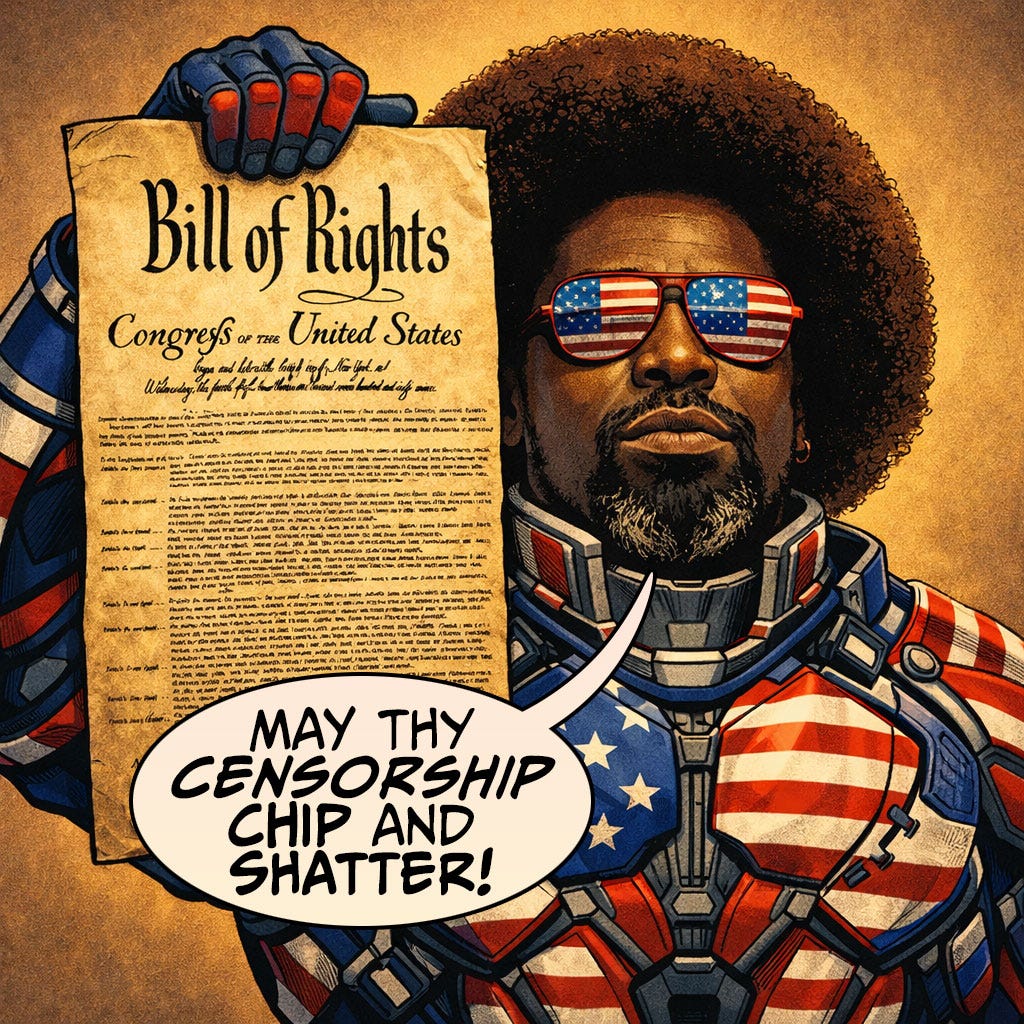
ERI Editor in Chief Adam Goldstein and I have a piece in The Washington Post today about the rapper Afroman’s courtroom victory — and the victory for free speech that came along with it.
In case you don’t know, Ohio sheriff’s deputies raided Afroman’s house back in 2022 on suspicion of drug trafficking and kidnapping. They found nothing, and after he turned the whole fiasco into songs and videos, along with one of the more memorable dessert-related free speech controversies in modern American history, they sued for $3.9 million — a sum that could buy, by our rough estimate, 163.9 tons of lemon pound cake.
A jury ultimately, and rightly, found for Afroman across the board.
Part of what makes this story so satisfying is that it feels both current and gloriously old-fashioned. It has the spirit of Cohen v. California running through it: the old “Fuck the Draft” energy; the old American idea that when power wrongs you, you get to answer back in anger, mockery, profanity, and contempt. Not because those things are always pretty. Oftentimes they are not. Rather, it’s because free people are not required to speak to authority in the tone of a worried assistant dean. They are allowed to tell power to go to hell.
And few things say “Go to hell” with quite the same style as turning a failed raid into a diss track about lemon pound cake.
The song was based on security camera footage from Afroman’s home, which showed one officer seeming to consider whether he should snatch a slice from the countertop while his fellow officers raided the house. In his deposition, the officer — dubbed “Officer Lemon Pound Cake” in the song — complained that he had received “hundreds of pound cakes” at work. As forms of public retaliation go, that is much better than what state abuse has inspired in less free countries and less free centuries. If your punishment is carbohydrates, count your blessings.
But the real reason this case landed is not just that it was funny (though it obviously was). It is that Americans are in a real free speech moment, and this one felt like a reminder of what the old deal was supposed to be.
These days, too many people seem to wait to find out how the censored person voted before deciding whether they care about the censorship they were met with. This case cut through that: Somebody with power pushes you around. You refuse to grovel. You answer back. You make them look ridiculous. You win.
That still has enormous emotional force.
It also points to something bigger, which I have thought for years: The story of music in America is, in large part, the story of free speech in America. I have long wanted to see a documentary that makes exactly that argument, because once you start looking, the pattern is impossible to miss.
Alfred Bryan wrote the lyrics to 1915’s hugely popular but genuinely divisive “I Didn’t Raise My Boy to Be a Soldier.”
Marian Anderson sang at the Lincoln Memorial after the Daughters of the American Revolution refused to let her perform at Constitution Hall, and the performance became an icon of artistic dignity against racial exclusion.
The Harlan County miner’s conflict gave us “Which Side Are You On,” an explicitly partisan song written by the wife of a union organizer.
Billie Holiday’s “Strange Fruit” turned horror into song and helped make protest music part of the moral vocabulary of the country.
Woody Guthrie’s “This Land is Your Land” called for unity (which was a remarkably un-self-aware sentiment from a full-throated Stalin supporter).
Nina Simone’s “Mississippi Goddam” answered racist terror with fury and brilliance.
Sam Cooke’s “A Change Is Gonna Come” gave the civil rights movement one of its great anthems.
Barry McGuire’s “Eve of Destruction” is a catalog of social injustices and existential threats.
Crosby, Stills, Nash, and Young’s “Ohio” reacted to the 1970 Kent State shooting with rage and urgency.
Public Enemy’s “Fight the Power” captured something old and essential in American music: the rebellious spirit — the recurring sound of people who were not in the mood to shut up and behave.
And the tradition has continued, from Rage Against The Machine’s “Bulls On Parade” to Childish Gambino’s “This is America.” (And I should probably mention Lynyrd Skynyrd’s “Sweet Home Alabama,” which was itself a kind of protest to Neil Young’s protest songs “Southern Man” and “Alabama,” calling out racism in the South.)
Throughout our history, the fight over who gets to sing what in America has always also been a fight over who gets to speak freely in America. These were not side issues. They were central to how Americans argued about freedom, equality, and the right to tell ugly truths in public.
That sort of expression has always drawn the ire of the powerful, and those of you who have been around a few decades will remember a few instances when would-be censors decided they were going to save America from its record collection.
For example, in the 1980s, a group called the Parents Music Resource Center, led by then-senator Al Gore’s wife Tipper Gore, held Senate hearings to discuss the so-called “filthy” lyrics in many contemporary artists’ work. Coming to the defense of artistic freedom? Frank Zappa, Twisted Sister singer Dee Snider, and John Denver.
And yes, if your first thought is, “Wait, John Denver? Wasn’t he squeaky clean?” Actually, yeah. That was part of what made his presence so perfect: The man who sang “Rocky Mountain High” — a song famously misread by some as drug-themed when it was really about the emotional euphoria you get by being in nature — had already learned that censors will find dirt wherever they feel like finding it.
Dee Snider’s testimony was particularly noteworthy. While being questioned about his song “Under the Blade,” which was about his bandmate’s oral surgery but the PMRC argued was about sadomasochism, Snider stunned Senator Gore into a beat of silence with the perfect line:
Songs allow a person to put their own imagination, experiences, and dreams into the lyrics. People can interpret it in many ways. Mrs Gore was looking for sadomasochism and bondage and she found it. Someone looking for surgical references would have found it as well.
In the end, the PMRC sort of succeeded. The music industry began labeling certain albums with the now-famous “Parental Advisory” sticker — a move that was formally described as a voluntary parental tool. It also backfired hilariously. The sticker became a signal that effectively said “Here’s music they don’t want you to hear,” and all but guaranteed that the very people it was meant to be kept away from would listen even more enthusiastically. The whole thing was framed as a fight for parental rights and control, but the broader fight was unmistakably about censorship, taste, and whether politicians and scolds were going to decide what the rest of us were allowed to hear.
FIRE Executive Vice President Nico Perrino did an episode on the history of music censorship on his So to Speak podcast back in 2022, tracing it from Reconstruction-era song suppression through the PMRC and into later controversies.
All of this is why I resist the very modern expectation that the best speech is somehow gentle, hygienic, and emotionally pre-approved. No. Free speech is valuable in part because it gives us a way to fight without using fists. Self-government is deadly serious business. Historically, disputes over power, humiliation, injustice, and corruption have often been settled with blood, prison, or both. Speech offers another route: jokes, chants, songs, satire, mockery, sermons, pamphlets, editorials, and sometimes gloriously juvenile acts of public ridicule. It is not always pretty or kind, and only a certain kind of Victorian mind would expect it to be. But, as I’ve argued many times — including my TED Talk from July of last year — it is always better than the alternatives of violence and coercion.
This is also why the humor in the Afroman case matters. The jokes are not beside the point. They are the point. A man gets pushed around by the state, and instead of reaching for violence, he reaches for rhyme. Instead of a vendetta, he gives us a music video. Instead of a blood feud, he gives the republic a running joke about pound cake. Honestly, that is civilizational progress.
FIRE has spent more than 25 years defending free speech in courtrooms, on campuses, and in the broader culture. I’ve been doing it for almost as long. And one of the things that doing this work teaches you is that censorship almost always arrives wearing the face of reasonableness: “Calm down. Be constructive. Do not make it personal. Do not be offensive. Do not embarrass the wrong people.” But one of the oldest and healthiest American instincts is the refusal to accept that the only legitimate response to abuse by power is polite disappointment. FIRE’s broader mission is to defend and sustain the individual rights of all Americans to free speech and free thought, and this case is a good reminder of why that mission still matters so much.
So please read our piece in The Washington Post, and then come back to the larger point: What made this case resonate was not just that it was ridiculous (though it was!). It was that it reminded people that when power overreaches, free people answer back — sometimes with a brief, sometimes with a protest, and sometimes with a song about lemon pound cake.
All of it is free expression, and all of it should be vociferously protected. It’s the American way.
SHOT FOR THE ROAD
On a much more serious note, the Supreme Court recently denied our petition to review citizen journalist Priscilla Villarreal’s case, after Laredo, Texas officials arrested Priscilla for asking police questions — something reporters do every day, and something the First Amendment squarely protects.
As FIRE’s statement puts it, the decision not to take Priscilla’s case only shines more light on the need for the Court to revisit how qualified immunity applies in free speech cases, sooner rather than later.
Dear Greg: RE: Music and censorship:
In the 1960s, the song, "Louie, Louie" by the Kingsmen was investigated by the FBI because folks suspected that its nearly incomprehensible lyrics must be pornographic. Alas, it was a harmless song concerning a homesick Jamaican sailor singing about how much he missed his girlfriend to a bartender named Louie. :-).
All the best,
Rich McNally
In the 60s, we couldn’t sing This Land is Your Land in elementary school because it was communist propaganda for state ownership of property. Then in Junior High we couldn’t sing Puff the Magic Dragon because it was about marijuana. The former was essentially true and the latter not.