

Stories of the week
Americans don’t trust the government to regulate social media. They’re right in (Expression) by Angela Erickson
In FIRE’s latest edition of the National Speech Index, 75% of Americans said they were at least somewhat concerned about government pressure on tech companies to suppress viewpoints. And 77% said the same about government access to user data for surveillance.
Those concerns cut across ideology, but they shift with power. In the fall of 2023, Republicans were especially likely to distrust government involvement in speech decisions. By April 2026, liberals were especially likely to express concern about government pressure on tech companies.
Germany Considers Law to Force Social Media Algorithm Boost for State-Approved News (Reclaim the Net) by Cindy Harper
A leaked document, obtained by Apollo News, lays out the plan and if it goes ahead, a state authority will decide which media organizations count as “reliable,” and platforms like X, Facebook, Instagram, and TikTok will be legally required to make those outlets’ content more visible in users’ feeds.
This week in ERI
And then there’s the FIRE finding I’ve found clarifying for years: self-identified Marxists and socialists outnumber conservatives nationally among faculty. That does not mean every college campus is just a Trotsky reading group that appointed a Title IX coordinator. But it does tell you something important about higher education’s ideological center of gravity.

This week in Expression
The Harvard alumni who refuse to abandon their alma mater by Bobby Ramkissoon
How Anthony Comstock became America’s most powerful censor by David Josef Volodzko
High school administrators censored the student newspaper. They don’t think they did anything wrong by Marie McMullan
This week on So to Speak
This week, FIRE Executive Vice President and So to Speak podcast host Nico Perrino presided over a debate between Harvard Law Professor Larry Lessig and Institute for Justice Senior Attorney Paul Sherman on Super PACs and campaign finance.
This week in FIRE’s blog
VICTORY: Pensacola State College backtracks, prints student-created magazine by Dominic Coletti
Student journalists at Pensacola State College will once again be able to read their work in print. After weeks of insisting that Florida’s unconstitutional Stop WOKE Act prohibited the college from printing the student-run magazine Just Opposed, PSC President Ed Meadows confirmed that the college has begun printing the magazine for students. This is a huge win, not just for the students but for free speech on all Florida college campuses.
By relying on contribution data rather than voter registration data, Primo was able to measure professors’ ideology instead of just their party affiliation. A Republican professor who gives exclusively to Maine Sen. Susan Collins (CFscore: 0.70) would score differently than a Republican professor giving exclusively to Texas Sen. Ted Cruz (CFscore: 1.52), for example.
The average ideology score of faculty donors in the 55-school sample was -1.02. That’s only slightly less left-leaning than some of the most left-wing members of the U.S. Senate, such as Vermont Sen. Bernie Sanders and Massachusetts Sen. Elizabeth Warren, who are tied with CFscores of -1.14. Notably, there was no equivalent critical mass of donations on the Republican side.

In a win for academic freedom and the First Amendment, a district court in Texas has ordered that Idris Robinson, a professor terminated for speaking at a contentious event about the Israeli-Palestinian conflict, must get his job back as his court case proceeds.
London Calling: Ronnie’s First Amendment Roundup
Ninth Circuit partially upholds preliminary injunction against ideologically grounded terminations of federal grants to University of California researchers as viewpoint-discriminatory and thus likely unconstitutional
The U.S. Court of Appeals for the Ninth Circuit affirmed in part a preliminary injunction obtained by UC researchers on a First Amendment challenge to cancellation of their Environmental Protection Agency, National Science Foundation, and National Endowment for the Humanities research grants, under executive orders that the President issued on taking office to bar federally funded research on “diversity,” “equity,” “inclusion,” and other targeted topics. When federal agencies began implementing the EOs’ mandate to terminate previously issued grants in those areas, by cancelling them en masse through form termination letters that simply stated the grants no longer met “agency priorities,” over $324 million in grants to UC were lost, with EPA, NSF, and NEH admitting they used mere keyword searches and/or titles to flag grants terminable as involving the prohibited topics.
On challenge to the terminations, the federal district court in Northern California provisionally certified two classes of UC researchers – a “Form Termination Class” that lost grants through form letters without specific explanations, and a “DEI Termination Class” whose terminations expressly cited the EOs – then preliminarily enjoined the terminations, holding the Form Termination Class likely to succeed in showing the terminations were arbitrary and capricious under the Administrative Procedure Act, and the DEI Termination Class likely to succeed in showing (among other things) the terminations violated the First Amendment as viewpoint discriminatory.
On appeal, the Ninth Circuit reversed the Form Termination Class’s preliminary injunction, on grounds the district court lacked jurisdiction over their APA challenge, because it at bottom rests on the researchers’ grant contracts with the government, any challenge to which must go exclusively to the Court of Federal Claims under the Tucker Act – but the court upheld the DEI Termination Class’s preliminary injunction grounded in the First Amendment.
Noting the First Amendment bars government from using its powers to punish or suppress disfavored speech and viewpoints, and that even in providing subsidies cannot discriminate among viewpoints to suppress what it deems “dangerous ideas,” the court held that in terminating the UC grants under the EOs, the government did not merely exercise authority to choose what programs to fund. Rather, it terminated individual grants in existing programs based on researchers’ perceived viewpoints, given that DEI (and diversity, equity, inclusion and accessibility) and environmental justice “are inherently directional” in that they “reflect perspectives rather than neutral topics,” e.g., the former conveys that exclusion of historically disadvantaged groups is undesirable.
The court thus credited the finding below that the purpose of the terminations, as supported by statements the agencies themselves made, was to suppress particular points of view grant recipients promoted. In doing so, it rejected government arguments that it may cease funding programs it no longer believes are in the public interest, as “there is a critical distinction between creating or ceasing a particular program (or subsidy, or forum) … and discriminating against disfavored speaker viewpoints within a program (or subsidy, or forum).” The court thus affirmed the preliminary injunction issued to the DEI Termination Class, vacated that granted the Form Termination Class, and remanded the case to the trial court for further proceedings.
International free speech stories of the week
TikTok and YouTube ‘not safe enough’ for kids, says Ofcom (BBC) by Laura Cress
Speaking on the BBC’s Today programme on Thursday, Ofcom chief executive Dame Melanie Dawes defended its actions but said she knew the job was “not done” yet.
“We’re talking about a twenty-year culture at Silicon Valley of not taking safety seriously; you can’t change that overnight,” she said.
Asked what the regulator would do if platforms did not comply with its rules, Dame Melanie said Ofcom was “ready to take the toughest enforcement action”.
Police drop case against artist who depicted high-profile Australians in uniforms with Nazi symbols (The Guardian) by Jordyn Beazley
Military reprimanded soldiers who raised concerns about monitoring Canadians online during COVID-19 (CBC) by Ashley Burke
‘Greg on the Run’
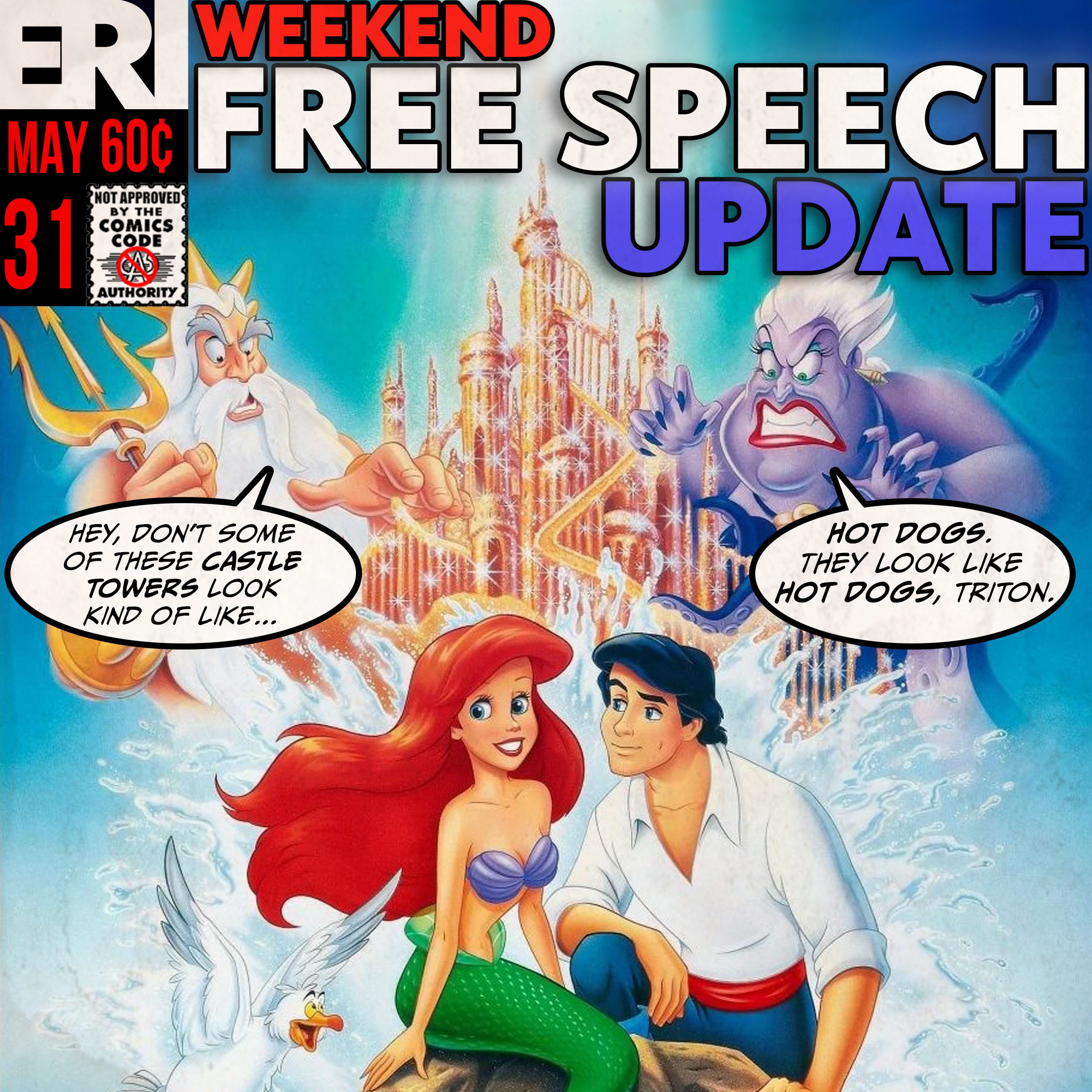
My son and I didn’t just binge Disney movies. At his request, we conducted a longitudinal study that began with Oliver and Company. I now know as much about The Little Mermaid as I probably do about free speech ... and hot dogs.
Event of the week
This week, R Street Institute hosted a panel discussion on free speech, censorship, and comedy with comedian, author, and political satirist Andrew Heaton, along with FIRE Executive Vice President and So to Speak podcast host Nico Perrino , and FIRE Senior Fellow Ronald Collins.

Why didn’t FIRE defend Douglass Mackey when he was persecuted by the Biden regime for memes?
Any school administrator or government official found violating 1A over point of view differences should be required to spend a year going around with "1A=NPOV" written on their forehead with a Sharpie. And when someone asks, they should be required to explain what it means.
NPOV=Neutral Point of View. Any 1A restrictions that are not NPOV are illegal.