


Today FIRE released its annual College Free Speech Rankings. This year, 261 schools were ranked and almost 63,000 undergraduates were surveyed. The rankings combine student survey responses with information from our databases — which track deplatforming attempts, cancellation efforts targeting students and faculty, and each school’s speech code policies — in order to measure the climate for free expression on American college campuses, as well as student attitudes towards free speech.
Go read the full report for yourself and please check out the rankings website, which provides even more depth and clarity.
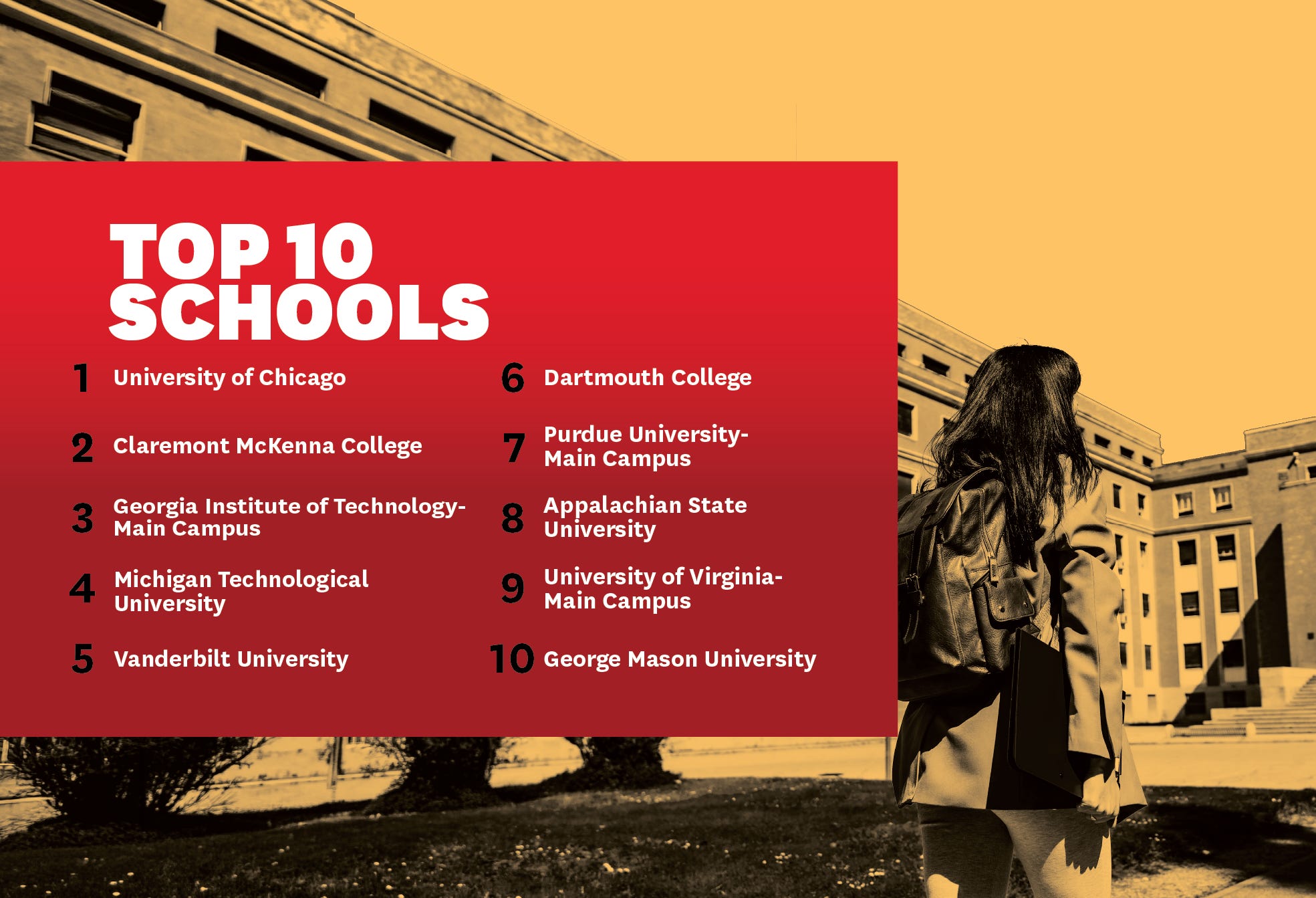
But before doing that, let’s explore which schools improved their ranking the most, which ones saw the biggest declines, and what else those changes may tell us about the state of free expression in American higher education.
The most improved schools include … Harvard
Overall, 189 of the schools ranked this year improved their score compared to last year. Some of these gains were quite modest — the University of Alaska Anchorage improved by 0.01 of a point, Clarkson University improved by 0.02, and North Carolina State University improved by 0.04 — but others were fairly significant.
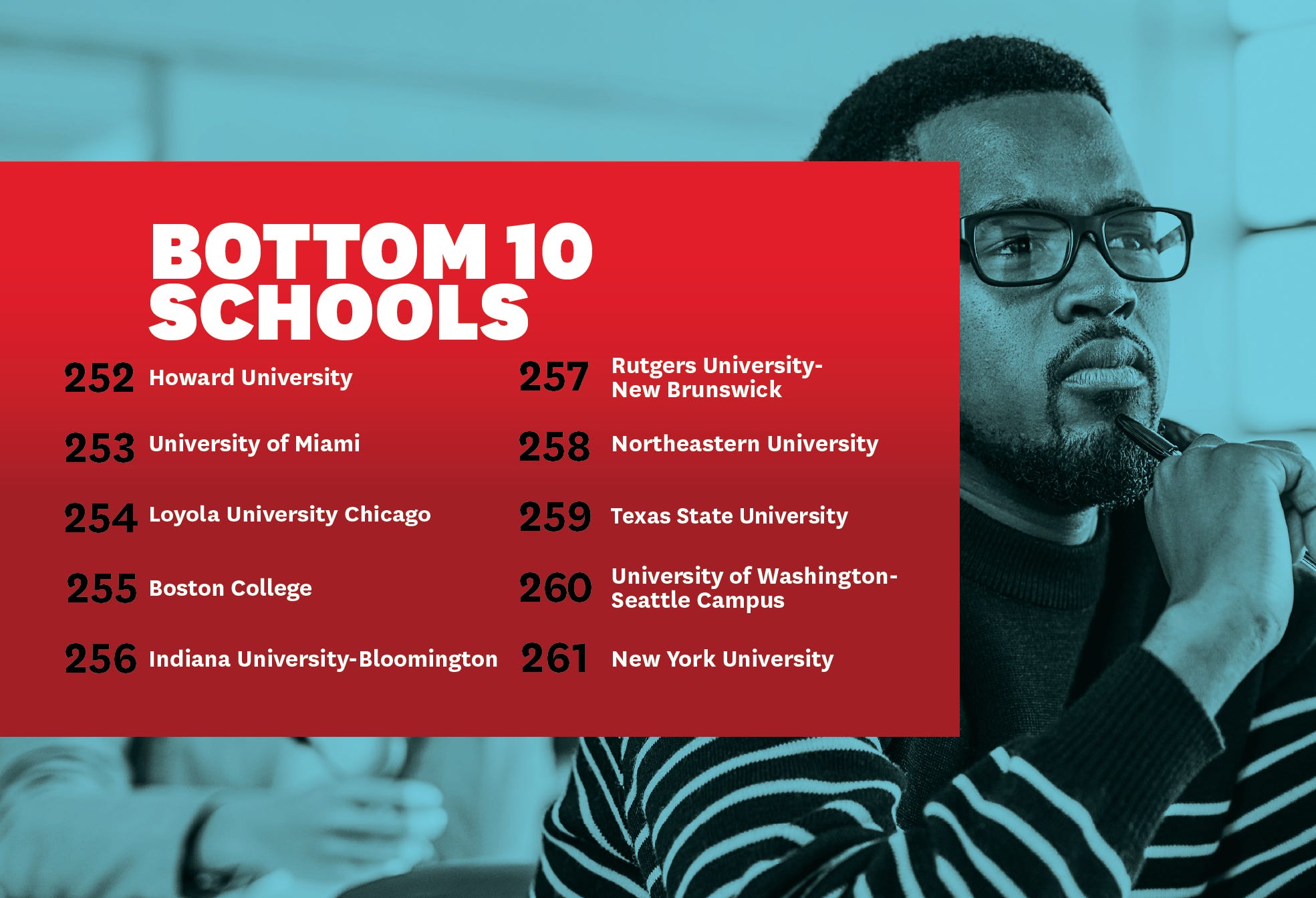
The biggest year over year increase goes to the University of California, Davis, whose score increased by almost 18 points. As a result its bottom ten ranking of 252nd last year surged to 24th this year. There are two clear reasons for Davis’ improvement. First, over the past year the university worked to reform its speech policies. In prior rankings, Davis obtained a “yellow light” spotlight rating — meaning an institution has at least one policy that restricts a more limited amount of protected expression or, by virtue of vague wording, can too easily be used to restrict protected expression. This year, it obtained a “green light” rating — meaning that its written policies do not seriously imperil speech. The other reason Davis’ score and ranking dramatically improved this year is that penalties incurred from prior speech controversies, primarily from a slew of incidents in 2022 and 2023, have mostly decayed.
Harvard University, who finished last in the rankings in 2024 and 2025 and then 245th last year, now ranks 71. Unlike UC Davis, Harvard’s rise is not due to policy reform. Instead, it is due to significant improvement on the student survey components of “Comfort Expressing Ideas” and “Administrative Support.” The former assesses how comfortable students feel expressing their views on controversial topics in five different campus settings (e.g., “in class,” or “in the dining hall”). The latter assesses student confidence in college or university administrators to protect the right to freedom of speech on campus. Harvard also demonstrated significant improvement on the “Administrative Support” component last year as well. These improvements coincide with the university’s resistance to the Trump administration’s efforts to exert more control over American higher education.
Other schools whose scores improved significantly include the two lowest ranked schools last year — Barnard College and Columbia University — as well as Georgia Tech, and Utah State University.
Texas State University and Texas A&M University implode
On the other hand, Texas State University and Texas A&M University experienced the biggest year over year declines. Texas State lost over 11 points from last year’s score and dropped 147 places in the rankings to a bottom three finish this year. The terminations of Thomas Alter, a tenured professor of history, and Idris Robinson, a professor of philosophy by Texas State University, for off-campus protected expression both contributed significantly to Texas State’s decline.
Texas A&M earns the distinction of being the lowest ranked “green light” school in this year’s rankings, at 192nd overall, down significantly from a ranking of 47 last year. This decline occurred because student perceptions on “Administrative Support” declined significantly and the university incurred additional penalties for its handling of multiple speech controversies. Those controversies include:
The termination of Melissa McCoul, a senior lecturer in the Department of English at the university, who came under scrutiny after a student secretly recorded part of her Literature for Children class that included discussion of gender identity and a “Gender Unicorn” slide, and then challenged McCoul, claiming the material was “illegal” under state policy.
The alteration of philosophy professor Martin Peterson’s syllabus for his spring 2026 core-curriculum course, “Contemporary Moral Issues/Problems” because it included two short units addressing “race ideology” and “gender ideology,” with assigned readings that included excerpts from Plato’s Symposium.
The cancellation of government and public service professor Leonard Bright’s graduate-level course, “Ethics in Public Policy”, after he pushed back during the university’s ongoing, system-driven “course review” tied to new restrictions on classroom “advocacy” related to race, gender, sexuality, and related topics.
The University of Arkansas and Clemson University also experienced notable declines for similar reasons. At UA incidents involving Mohja Kahf, a distinguished professor of English, and Emily Suski, a professor of law and the incoming dean of the university’s law school cost the school points. Clemson lost points for firing two professors — Josh Bregy (professor of environmental engineering & Earth sciences) and Melvin Earl Villaver (professor of audio technology and Global Black Studies) — for social media comments made in response to Charlie Kirk’s assassination.
Good policies are not enough
Texas A&M may hold the distinction of being this year’s worst “green light” school, but they are not the only “green light” school that leaves something to be desired. The University of California, Los Angeles (94th) and the University of Florida (119th) also perform relatively poorly compared to other “green light” schools — the rest of whom all finish in the top 50. Like A&M, performance at UCLA and UF was negatively impacted by how both schools handled multiple speech controversies. UCLA lost points for two recent incidents involving students, as well as three successful deplatforming attempts from 2024 whose penalties have not decayed fully. UF also lost points for sanctioning student and faculty expression, and for multiple deplatforming incidents.
The poor performance of these “green light” schools, compared to their similarly rated counterparts, demonstrates that having good policies on the books is in and of itself not sufficient when it comes to protecting First Amendment rights on campus. That is perhaps the clearest lesson from this year’s rankings. Protecting free expression requires more than adopting policies that comply with the First Amendment. It also requires administrators who consistently follow those policies when controversy arrives, faculty and students who believe they can speak without being punished, and campus leaders willing to defend expressive rights when doing so is difficult or unpopular.
The dramatic movement of schools like UC Davis, Harvard, Texas State, and Texas A&M also shows that a campus’s free speech climate is not fixed. It can improve — sometimes substantially — when institutions reform bad policies, avoid repeating past mistakes, and rebuild student confidence. And it can deteriorate just as quickly when administrators abandon those principles in the face of political pressure or controversy.
That is why the rankings are most useful not simply as a league table of winners and losers, but as a measure of institutional behavior over time. The question is not merely whether a university has good free speech rules on the books. It is whether those rules still mean something when they are tested.
SHOT FOR THE ROAD
Last week, after four long years, FIRE won a big case on behalf of Professor Stuart Reges at University of Washington. (Unsurprisingly, UW performed very poorly — second-to-worst to be precise — in the lastest Rankings.) After faculty were mandated to include a “land acknowledgment” in their syllabi, Professor Reges drafted and included in his syllabus his own version parodying the university-approved language. For that he was punished. I’ve seen a lot of responses from people who don’t seem to understand how bad the university’s actions were. That’s because this case highlights what I call “censorship’s heart of darkness”: compelled speech. As I’ve said before, as bad as it is to tell people what they can’t say, it’s even worse to tell people what they must say.

One correlation I am not pleased to notice - the top ranking school is U. Chicago, which also has the biggest Male/Female gender ratio of all major universities. I genuinely hope this is just a coincidence.
At what point do professors’ free speech rights give them carte blanche to teach harmful ideology that is out of line with campus curricula and viewpoints?
Presumably parents and students choose some campuses over others because they are better fits for *their* free speech and their goals and aspirations.