


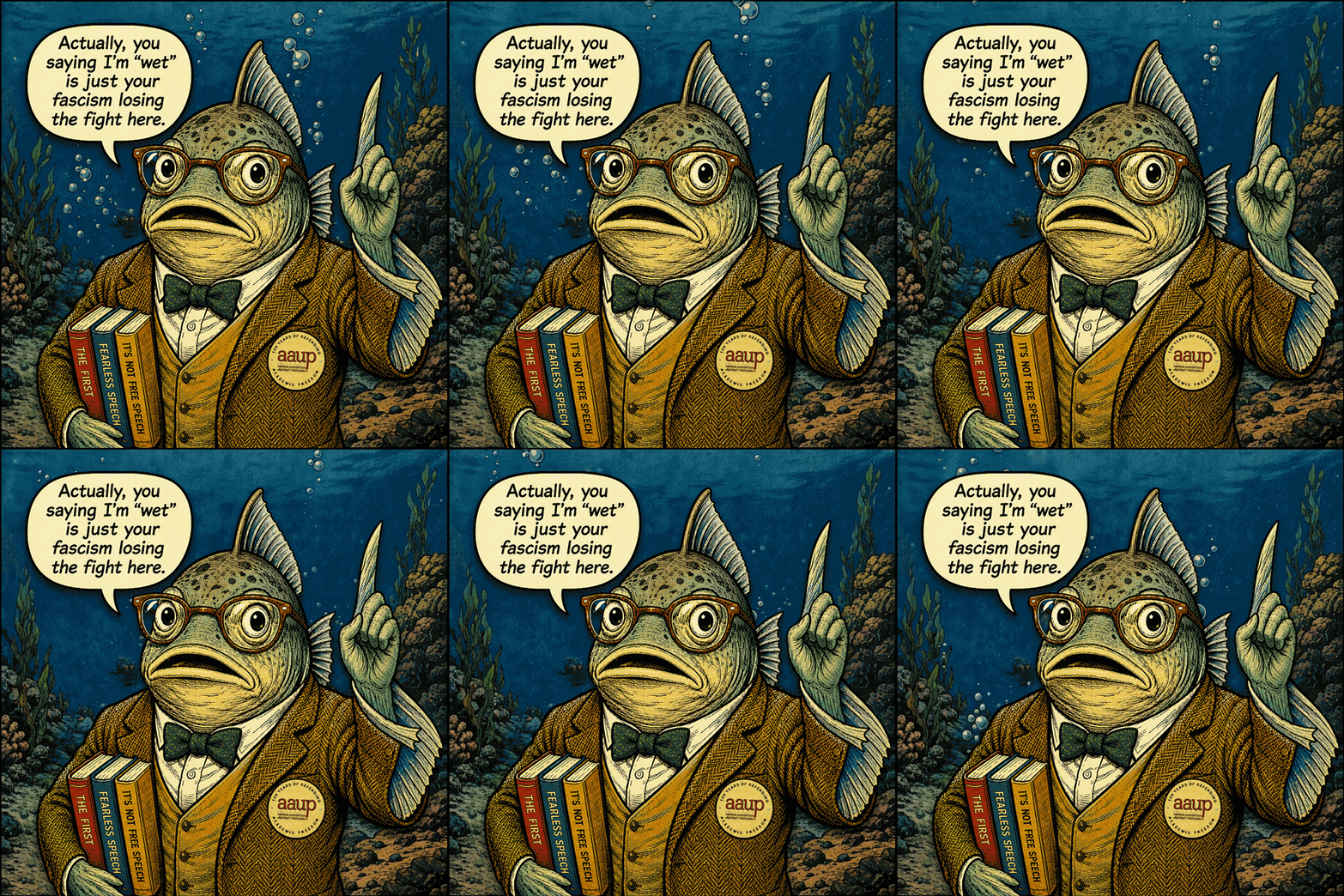
On July 30, the American Association of University Professors did something it has never done in its 111-year history: It endorsed a candidate for political office.
And this was not a general-election endorsement against some uniquely terrible enemy of academic freedom. No, the national AAUP waded into a contested Democratic primary for Michigan’s U.S. Senate seat and backed Abdul El-Sayed, the unmistakable candidate of the party’s left. He had the backing of Bernie Sanders and Alexandria Ocasio-Cortez, ran on Medicare for All, rejected corporate PAC money, and called for ending U.S. military aid to Israel.
He was also the more controversial choice, especially because of his position that Israel’s war in Gaza constitutes genocide and his appearances with Hasan Piker. Academic freedom, by contrast, was not a defining issue of his campaign, although El-Sayed had been an AAUP member and was strongly backed by organized labor. The AAUP proudly advertised the decision as its “First-Ever National Political Endorsement.” Todd Wolfson, the AAUP’s president, said roughly 80 percent of the Michigan members who voted supported making an endorsement and 97 percent favored El-Sayed.
Then came the less majestic denominator.
Inside Higher Ed reported that about 40 Michigan AAUP members attended the consultation call where the informal poll occurred, out of roughly 4,000 members statewide. Fewer still were on the call when the vote happened. One Michigan member said his “jaw dropped” when he saw Wolfson cite the percentages without the raw numbers.
That is not exactly a sweeping mandate, and yet here we are.
The more revealing part came when people pointed out that a century-old organization claiming to defend academic freedom for all professors might lose something by becoming an electoral participant in one party’s primary.
Wolfson’s response on X was: “Apparently our first endorsement has upset some people. Good.” He added, “AAUP isn’t going to respond by pretending politics isn’t happening. We’re going to organize.”
In another, now-deleted post, he called the critics “clowns” while straw-manning their arguments against the move.
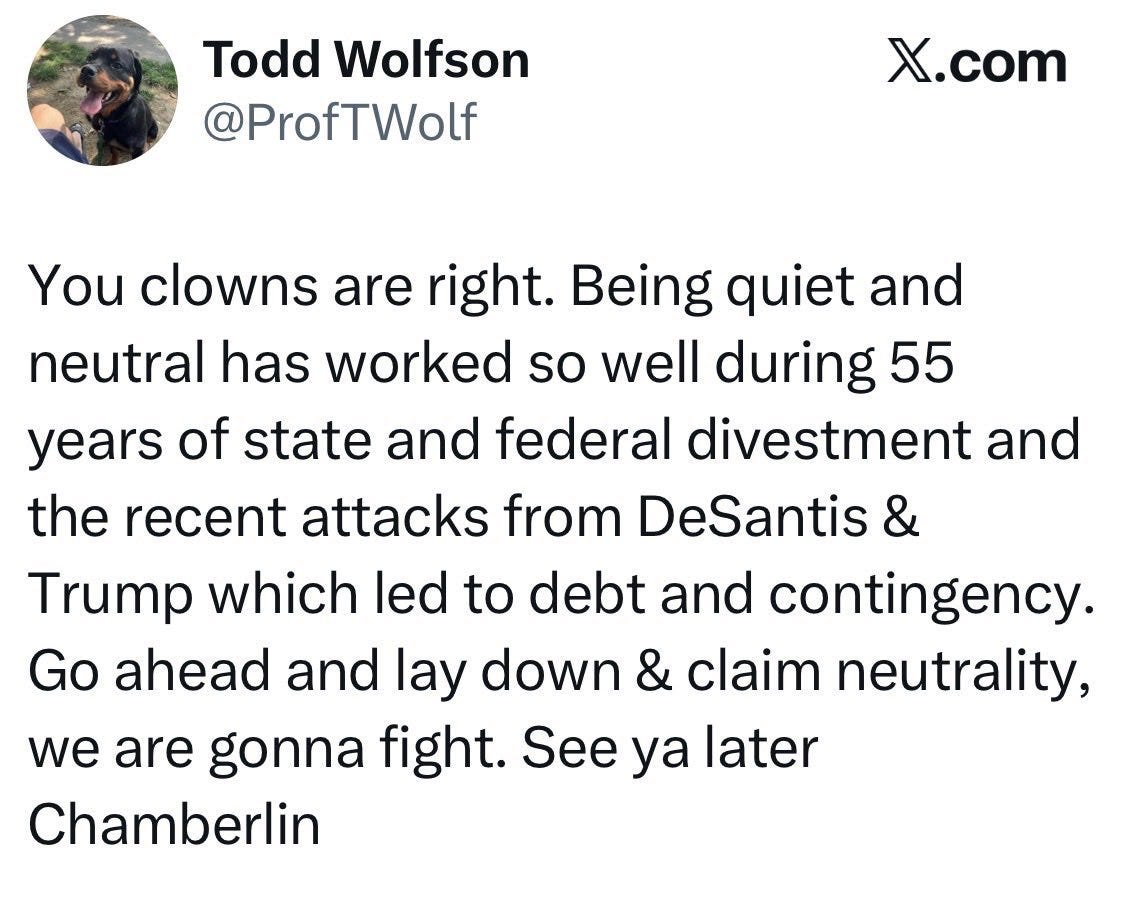
The amazing thing is that this was offered as a rebuttal. But nobody had claimed that politics was imaginary or demanded silence about attacks on universities. FIRE has hardly been silent about the Trump administration’s abuses in that realm and others. It’s absurd to claim the issue here is some martyr-like desire to roll over, dressed as neutrality.
The deeper objection to this move, though, is actually practical. Suppose you are a professor who opposed El-Sayed, or simply does not share the AAUP’s politics, and your academic freedom is violated. Are you really going to bring your case to the organization that has declared itself a left-wing political union and endorsed the candidate you opposed? More likely, you will go to FIRE or the Academic Freedom Alliance, or look to Heterodox Academy for support.
And the damage compounds. Once the AAUP behaves like a left-wing political organization, it attracts more people who want exactly that while driving away moderates, conservatives, libertarians, and anyone else who does not want an academic-freedom organization doubling as a political faction. The membership becomes still more homogeneous in the process. Internal objections get weaker. The next partisan step seems even more obvious.
That is how an organization becomes trapped inside its own box and then mistakes the view from inside for reality.
Wolfson has been unusually explicit about what changed. At a debate in June, he said that for its first 50 years the AAUP was “a professional association representing the profession,” when neutrality made sense. Over the last 50 years, he said, it “has pivoted to being mostly a union.” Then came the key sentence: “Unions are political organizations,” and the AAUP has “shifted the organization to reflect that.”
So there it is. The AAUP’s president is saying openly that his organization has been remade into a political union. Not only that, but it has formed a political action committee and signaled that more endorsements are coming.
That may be coherent, but choices have costs.
I’ve written about the AAUP’s increasing partisanship and rejection of its founding principles before, and I didn’t do it to score points or make new enemies. I did it because this is a real loss. For most of its history, the AAUP occupied a uniquely important place in American higher education. Its 1940 Statement became part of the operating system of the modern university, and FIRE treated its best reports as models of principled analysis.
That authority depended on the belief that its standards applied across political lines. A professor did not have to vote correctly to deserve academic freedom. Once the AAUP becomes an electoral organization allied with one coalition, professors outside it have reason to wonder whether the association sees them as people to protect or opponents to defeat. And why wouldn’t they?
This past spring, I gave a presentation to FIRE’s staff about the importance of cultivating and maintaining viewpoint diversity across our ranks. Unfortunately, the AAUP has become an almost perfect case study in what happens to an organization that does not share — or worse, is outwardly hostile to — that value. What strikes me most is not simply that its leaders made a bad strategic choice. It is that they seem unable to understand why anyone could see the choice as a problem.
An organization with meaningful viewpoint diversity would have had at least one person in the room saying, “Before the national authority on academic freedom endorses a candidate in a Democratic primary, perhaps we should think about what this does to our credibility with professors who vote the other way.” And an organization with meaningful viewpoint diversity would have recognized what a seriously compromised position that endorsement puts it in.
While preparing my talk I realized there were parts of the argument I had never fully written down, and I really should, because viewpoint diversity is incredibly important. Failure to preserve it puts us where the AAUP is right now, and because of who we are and how we’re wired, we are unlikely to see it until it’s far too late.
The fall of the AAUP

One of the great disappointments of my professional life has been watching the decline of the American Association of University Professors, formerly the gold standard for defense of academic freedom on campus. Of course, there have always been and still are good, principled AAUP members and chapters out there. But since the beginning of my career back …
The human problem
Human beings are self-deceiving creatures. Evolution did not design us to understand the world exactly as it is. It designed us to survive and reproduce in it. A belief that helps us do those things does not have to be true. We are perfectly capable of feeling absolute certainty about things that are, to use the technical term, bullshit.
And I do not mean “those people” are like this. I mean you. I mean me. Believing that bias is mainly a problem our opponents struggle with is, conveniently enough, one of our favorite biases.
In 1990, Ziva Kunda’s foundational paper, “The Case for Motivated Reasoning,” explained how readily the rational parts of our minds become attorneys for the conclusion we already want. Give us a reason to believe something, and we can usually construct a justification that feels principled enough to preserve both the conclusion and our self-image.
Eight years later, Raymond Nickerson’s review, “Confirmation Bias: A Ubiquitous Phenomenon in Many Guises,” showed how prior beliefs shape what evidence we search for, notice, remember, and take seriously. Evidence that supports our side gets waved through customs. Contrary evidence is detained, strip-searched, and asked to produce three forms of identification. Then, in 2001, my friend and Coddling of the American Mind co-author Jon Haidt gave the same basic process its most memorable image in “The Emotional Dog and Its Rational Tail.” Moral intuition arrives first. Reasoning trots along behind it, explaining why our immediate reaction was also, by astonishing coincidence, the principled and intellectually serious one.
In 2017, Dan Kahan, Ellen Peters, Erica Cantrell Dawson, and Paul Slovic gave this an especially nasty twist. Participants were asked to interpret a difficult numerical table. For some, it described whether a skin-rash cream worked. For others, the same numbers described whether a ban on carrying concealed handguns reduced crime. On the politically neutral skin-cream problem, greater numeracy worked exactly as we would hope: The more mathematically capable subjects were much more likely to get the answer right. But once the identical problem was framed as gun control, political identity took over. The most numerate subjects became the most polarized. They were especially good at reading the numbers correctly when the answer supported their side, and remarkably capable of getting them wrong when the answer threatened it.
That is what makes the finding so disturbing. We like to imagine that bad reasoning is a result of low intelligence. Kahan’s study suggests that greater intelligence can instead drive us faster and more efficiently toward the conclusion we already wanted. Rather than defeat bias, intelligence actually accelerates it. In an ideologically uniform institution, the cleverest people in the room may be the most dangerous because they can build the strongest arguments for the group’s blind spots.
Then, in 2023, Aileen Oeberst and Roland Imhoff gave me the term I had been looking for: belief-consistent information processing, or BCIP. I was genuinely excited when I found it because BCIP sums up a bewildering number of cognitive biases with one simple idea — what I think of as a kind of super-bias. We begin with a belief, identity, or desired conclusion and then search for, interpret, remember, and evaluate information in ways that protect it. Confirmation bias, motivated reasoning, selective exposure, asymmetric skepticism, and a long list of other named errors are all variations on that basic move. Instead of having to memorize a zoo of biases, BCIP lets you see the animal underneath.
BCIP is the human default, which is why institutions need belief-inconsistent people.
It is not enough to have brilliant people who all think alike. A room full of smart people can become extraordinarily effective at confirming what the room already believes. That is what has happened at the AAUP. Its leaders can explain at length why neutrality is surrender, why electoral endorsements are simply another form of defending academic freedom, and why concern about political homogeneity is really just a concern that fascism is not better represented in peer review. The conclusion always seems to be that the AAUP’s current political instincts are both morally necessary and intellectually unimpeachable. What luck!
I have watched the same mechanism operate in my own work. Early in FIRE’s history, I persuaded myself that academic freedom required us to defend Elizabeth Ito, a technical-writing professor who spent ten minutes of a 50-minute class attacking the Iraq War. At the time, we had many cases involving right-leaning professors, and I wanted a visible case involving someone on the left. I also worried that turning it down would make us look hypocritical.
But the First Amendment does not give professors license to stop teaching the assigned course: In Piggee v. Carl Sandburg College, the Seventh Circuit held that a college may require classroom speech to remain germane to its educational mission, while Hardy v. Jefferson Community College and Bonnell v. Lorenzo mark the corresponding line between controversial material that genuinely serves a pedagogical purpose and speech that does not.
I was wrong, and the important thing is that my bias did not announce itself as bias. It arrived dressed as principle.
That is what viewpoint diversity pushes back against. It is not a dogmatic demand that every possible opinion receive equal weight. Many opinions are wrong. Some are embarrassing. Viewpoint diversity is institutionalized disconfirmation — a structure that helps self-deceiving people discover when they are wrong.
How consensus turns phony
The trouble gets worse in groups, and particularly in groups that think they agree.
There is nothing wrong with genuine consensus. People can disagree, test assumptions, examine alternatives, and eventually reach the same conclusion. But consensus should be an aspiration rather than an expectation. When an organization begins with the goal of consensus, it often gets groupthink instead. There is actually a fascinating timeline of research on this topic that is instructive here.
In the 1950s, Solomon Asch’s famous line-judgment experiments showed the raw power of unanimity. When everyone else in the room gave an obviously wrong answer about which line matched another, many subjects went along with it despite seeing for themselves that it was incorrect. That’s how powerful the pressure is to conform. But Asch also found that unanimity is fragile. Just the presence of one dissenter sharply reduced the pressure to conform. One person saying, “No, that is not what I see,” immediately changed the dynamic in the room.
In 1969, Serge Moscovici and Marisa Zavalloni helped establish what became known as group polarization. Like-minded people do not necessarily average one another into moderation. Instead, they often move toward a more extreme version of the position they already favored. Group members hear more arguments for their side and learn which position carries status inside the group. Cass Sunstein later pulled together decades of this work in his 2002 essay “The Law of Group Polarization.”
In 1972, Irving Janis coined the term “groupthink” in Victims of Groupthink. He argued that tightly knit groups can become so focused on maintaining agreement that careful evaluation of evidence falls by the wayside. Members censor themselves, warnings are dismissed or rationalized away, “mindguards” keep inconvenient information out of view, and silence comes to be treated as evidence that everyone is on the same page.
In 1974, Elisabeth Noelle-Neumann introduced the idea of the spiral of silence: People who think their views are unpopular often choose not to express them, reinforcing the impression that a consensus exists. Two decades later, Timur Kuran’s 1995 book Private Truths, Public Lies described a closely related phenomenon he called preference falsification, in which people publicly profess beliefs they privately reject because candor comes with consequences. The result is an institution where many individuals quietly doubt an idea while assuming almost everyone else accepts it.
And in 2004, Cass Sunstein, David Schkade, and Lisa Ellman found a comparable effect in federal appellate panels. Judges sitting with ideologically similar colleagues produced more ideologically pronounced decisions. The presence of a judge from the other political camp could change deliberation and moderate outcomes.
Numerical parity was not required. All it took was the presence of one genuinely different person.
That describes the AAUP’s evolution unusually well. First, the organization became more politically homogeneous. Then dissent became rarer. Then the absence of dissent began to look like proof that no serious dissenting position existed. Eventually, the organization moved from lacking viewpoint diversity to publishing arguments against it and publicly dismissing political disagreement as fascism failing peer review.
That is how institutions become strange without realizing they are strange.
Is higher education even interested in reform?

We at FIRE have been battling overreach by the Trump administration every day for months now.
Why actual dissent matters
Organizations often respond to the problem of bias by assigning someone to play devil’s advocate. That is a useful exercise, but it is not a substitute for having someone who actually disagrees in the room.
In 2001, Charlan Nemeth, Keith Brown, and John Rogers tested this directly in “Devil’s Advocate versus Authentic Dissent: Stimulating Quantity and Quality.” Genuine dissent produced more and better ideas than assigned dissent. In fact, in some conditions, the staged devil’s advocate actually reinforced the majority’s starting position.
This shouldn’t surprise anyone. Everyone knows the designated dissenter is doing a bit. More importantly, a role-player does not bring the same information, intuitions, priorities, or persistence as someone who sincerely believes what they’re saying. People also tend to be pretty terrible at simulating arguments they despise. Their version of steel-manning becomes, “Let us imagine that I am an ignorant bigot with contemptible motives.” Shockingly, this does not produce an especially accurate account of what the other side believes.
Dissenters have to be in the room to keep the room honest. You cannot ask a monoculture to promise that it will do better next time. The AAUP’s problem is not merely that it made a partisan decision. Its internal culture appears to have reached the point where the best response to criticism is: Yes, we are political; politics is necessary; our opponents are fascists or clowns; why would any decent person object?
That is what total lack of viewpoint diversity looks like near the end of the process.
O’Sullivan’s Curse
This brings us to John O’Sullivan’s 1989 observation that “all organizations that are not actually right-wing will over time become left-wing” — what I call O’Sullivan’s Curse.
It is not a scientific law. Institutions can plainly drift rightward. But in my experience, rightward transformation usually has an identifiable source of pressure from the top: a wealthy owner, political appointees, a government, a church hierarchy, or a board deliberately imposing a new direction.
Some of this leftward drift is organic, and some of it plainly is not. In The Canceling of the American Mind, Rikki Schlott and I spent a great deal of time on the number of different mechanisms that can produce conformity: political self-selection, professional sorting, prestige pipelines, ideological litmus tests, social-media mobs, administrative cowardice, group polarization, and the cumulative pressure to keep your head down. We called the whole obstacle course the Conformity Gauntlet.
Similarly, Neil Gross’ 2012 work emphasized occupational reputation and self-selection: Institutions known as liberal attract more liberals and repel conservatives, making the reputation increasingly accurate. His forthcoming book, What Happened to College?, is considerably less reassuring about what happens after that sorting begins. Gross describes politics seeping into every corner of campus life, bringing ideological litmus tests, self-censorship, and social exclusion. And, yes, people may simply decide they do not want a career in a place where they will spend every lunch figuratively — and perhaps literally — eating alone.
You don’t have to take Gross’ word for it either. FIRE has documented that machinery for 25 years. Over the last half-century, academics have been denied opportunities (like Mike Adams, denied promotion for his conservative writing at UNC-Wilmington), targeted by colleagues (like Dorian Abbot, the University of Chicago professor deplatformed at MIT), investigated (like Ilya Shapiro, investigated over a tweet after appointed at Georgetown), punished (like John McAdams, who Marquette attempted to fire for criticizing a colleague), or taught that professional survival requires silence (like the 55% of conservative faculty who say they at least occasionally hide their political views from colleagues). Whether coercion is the main cause or just one cause among many is almost beside the point; pretending it has no causal role is ridiculous.
Lesson 3: Beware of O'Sullivan's Curse

Back in September, Ryan Enos published a piece in the Chronicle of Higher Education lauding FIRE’s record of being a principled, nonpartisan defender of free speech. He added, “We should ask what accounts for their admirable consistency.”
The remedy has to be deliberate.
An institution does not wander back into viewpoint diversity by accident, especially after decades of sorting. It has to actually want it, value it, recruit for it, and protect the people who provide it. That means actively seeking excellent people from perspectives the organization lacks, rather than posting a job into the same professional networks and acting surprised when the applicant pool looks exactly like the existing staff. It also means bringing dissenting perspectives into conversations early enough to matter. Asking the lone conservative, libertarian, religious, or merely heterodox person to bless the finished product on Friday afternoon does not count.
Disagreement also needs rules. People should be free to attack ideas without treating every dispute as proof that a colleague is stupid, evil, or unfit for the job. Dissenters need room to speak, majorities need enough humility to listen, and everyone needs to care more about the mission than winning the argument.
The AAUP is a clean example of what happens when that fails. Its leaders do not see the drift as a problem, they see it as progress. The institution does not think it was captured, it thinks it’s seen the light. That is precisely why the remedy has to begin with a conscious decision that viewpoint diversity is not an obstacle to the mission. It is part of the mission.
The clash also has to be structured so that it produces better thinking rather than miniature cancel campaigns. People must be able to criticize political ideas sharply without treating every disagreement as proof that the other person is stupid, evil, or professionally unfit. Dissenters need enough security to speak; majorities need enough humility to listen; and everyone needs a shared mission strong enough to keep the fight focused on the question rather than the dissenter’s moral worth. That is the difference between productive conflict and Cancel Culture.
How viewpoint diversity works: disagree and commit
The thing about viewpoint diversity is that it is only effective when it’s real, and when people involved really want it. It’s a pain to have people around who are willing to tell you, to your face, that you’re wrong. It makes work harder to get done. It makes meetings more tense. But the alternative, some frictionless utopia where everyone agrees, only sounds nice. It’s actually a delusion, and delusions have consequences.
What’s required is a genuine commitment to the idea that you might be wrong, and a practice that mirrors that commitment. Before things get set in stone, ask yourself: What evidence could be presented that would change your mind? Who among you is most likely to see your blind spots? Are there dynamics at play that might skew everyone’s perception, such as the boss speaking first and then everyone else parroting her opinion?
Hiring is where this kind of commitment becomes visible. You need to bring people into the room who are able and willing to disagree.
And here I’ll quickly dispense of a ludicrous straw man of what I’m advocating for: Viewpoint diversity is not a reason to hire someone who doesn’t believe in your mission. FIRE needs people who believe in free speech as a principle. It can’t sustain itself if it hires someone who regards freedom of speech as an obstacle to the causes they care about. But mission alignment is very different from political homogeneity. We should be wary of people who cannot work well with colleagues they disagree with, who treat every institutional choice as a moralistic binary between total evil and their exact position, or who see coworkers primarily as people to convert.
That said, sometimes you have to import friction. You look for the person who makes you think, “I disagree with this person about nearly everything, but they are damned good on freedom of speech,” and then you try to get that person into the building.
FIRE’s history shows the value of those structural counterweights. I was hired as legal director in part to provide a left-leaning counterbalance to a conservative executive director. When that executive director left, I supported the conservative lawyer David French as a possible successor because I wanted to preserve ideological tension at the top. That was not just an internal voyage of personal growth — though it was. It was also organizational design.
And when an institution does not yet have authentic dissent, it should manufacture some friction while it goes looking for the real thing. Red teams, outside reviewers, adversarial presentations, devil’s advocates, and formal pre-mortems are all weaker than having an actual dissenter in the room, but they are also considerably better than nothing. Epistemic humility is a habit, and habits are borne from intentional and systematic repetition.
Another potential risk here comes from the other direction. Too much doubt and back and forth can be crippling, and organizations also have to act to further their missions. Endless deliberation stops being evidence of intellectual seriousness somewhere around hour four. That is why we, at FIRE, so often cite Amazon’s principle of “Have Backbone; Disagree and Commit.” Before the decision, argue honestly. Do not soften a real objection merely to manufacture consensus. Once the decision is made, carry it out. No pocket vetoes. No quiet sabotage. No hoping the project fails so you can perform a triumphant little dance over the wreckage. Then, let reality grade the decision.
After the fact, preserve enough institutional memory to know what the dissenters predicted. Revisit the issue if the facts change or their warnings prove correct. “Commit” cannot mean that leaders acquire infallibility the moment the meeting ends.
As I sometimes put it at FIRE: If you agree with us 50 percent of the time, you should probably be a donor. If you agree with us 80 percent of the time, you should probably work here.
The AAUP shows what happens when those habits and structures fail. The institution’s internal politics become invisible to the people inside it, because fish don’t know they’re wet. Partisanship is redescribed as principle. Old commitments are rewritten to accommodate current political objectives. Critics become fascists, clowns, or enemies of academic freedom. And an organization that once spoke with unusual moral authority becomes another predictable voice in the partisan chorus.
It can continue. It can raise money. It can organize. It can even win.
It just cannot plausibly expect anyone who isn’t in perfect ideological lock-step to trust it.
SHOT FOR THE ROAD
The video below is one of those rare Shots for the Road that actually belongs on the road we are traveling. It is the staff-retreat talk from which this essay grew, and it goes further into the research and the practical work of keeping disagreement healthy.
The AAUP action is in the same vein as Scientific American, National Geographic and other flagship journals making political endorsements over the past decade . They have all destroyed their credibility.
I wonder why they bothered to go through the hassle of holding a meeting. 40 out of 4000 is so wildly unrepresentative that it wouldn't have been meaningfully less representative had Wolfson made the endorsement without consulting anyone at all!