“We’re pleased that the court recognized what we’ve said all along: This lawsuit was laughable from the beginning and never should have been brought,” said FIRE Chief Counsel Bob Corn-Revere, who led Selzer’s defense. “The First Amendment does not allow anyone in government, least of all the president, to punish people under the banner of ‘fake news.’ That may work for him as a campaign slogan, but it is not a thing in the law.”
The lawsuit stemmed from a poll Selzer published before the 2024 presidential election that predicted Vice President Kamala Harris leading by three points in Iowa. The suit asserted claims, including under Iowa’s Consumer Fraud Act, alleging that Selzer’s poll, which missed the final result by a wide margin, constituted “fake news” and “fraud.”
After multiple attempts to enter the building in the morning, CNN reporter Betsy Klein and a photojournalist were let into the premises on Thursday at noon. A reporter for MS NOW was also granted access, according to the network.
It came after the news organizations filed an emergency request for a hearing Thursday morning when the reporters hadn’t been allowed in.
In the early morning hours Thursday, Federal Judge Timothy Kelly ordered the Trump administration to temporarily reinstate CNN, MS NOW and Politico’s access to the White House after they were banned from the premises by President Donald Trump.
The numbers are startling. Nearly half (44%) of the 62,997 undergraduates surveyed across 262 campuses report that Kirk is a difficult topic to discuss openly—more than abortion, transgender rights or immigration. The assassination had the strongest effect on students’ willingness to speak out at the place where it actually happened. At Utah Valley, 62% of undergraduates feared talking about Kirk—the highest of any campus surveyed.
Within two hours of being “made aware” of Gibbons’s video of the speeding officer, a Kingsport detective obtained an arrest warrant for speeding, using a cell phone while driving, and disorderly conduct — from a court clerk. Not a judge or lawyer, but a layperson working at the court.
Just before dawn the next morning, security camera and cell phone footage captured eight armed officers raiding Gibbon’s house and arresting him in front of his mother and daughter on a flimsy charge of disorderly conduct.
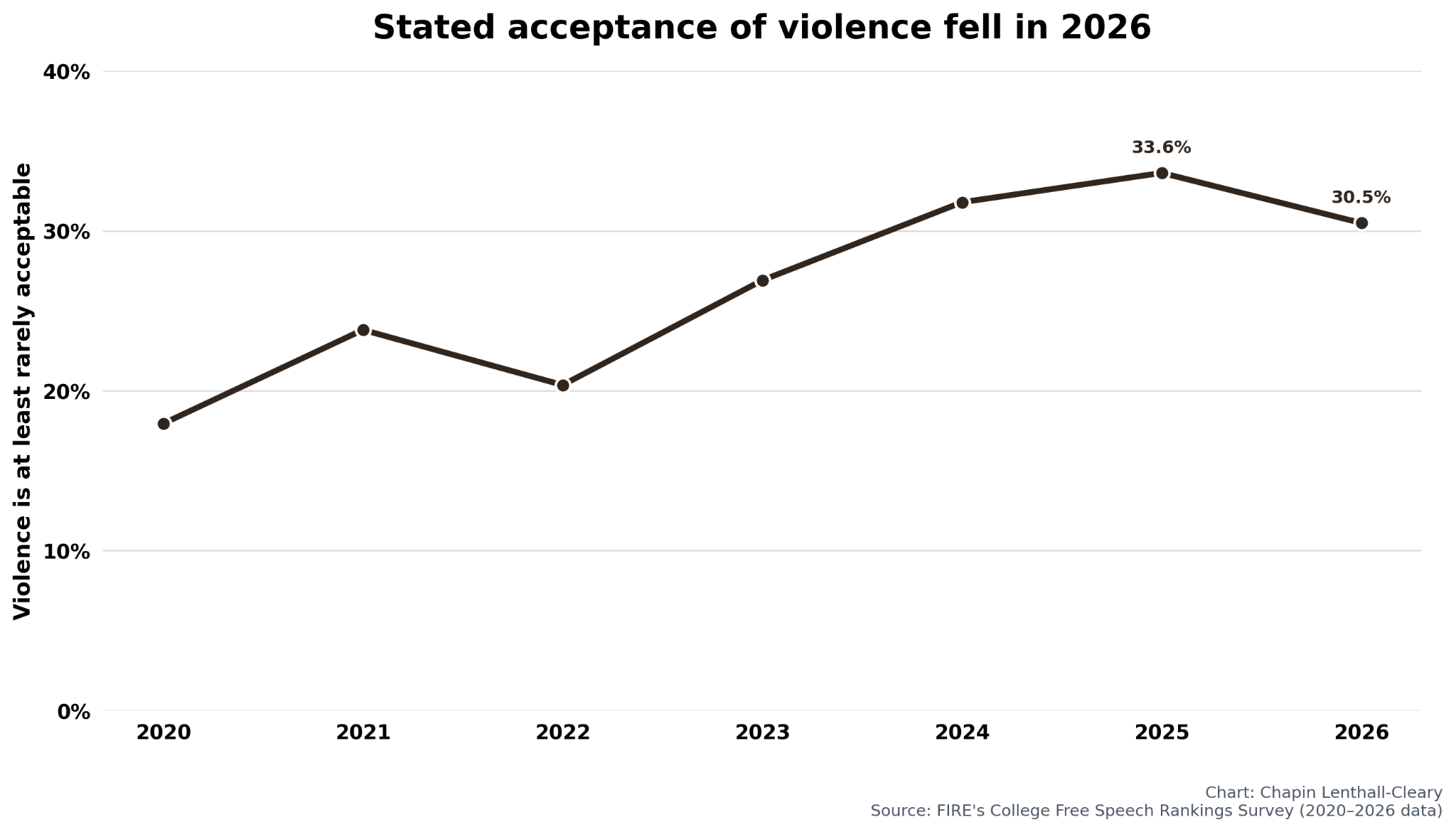
The share of students who said using violence to stop a campus speech is at least rarely acceptable fell from 33.6% in 2025 to 30.5% in 2026 — a 3.1-percentage-point decline and the first drop since 2022. Still, the 2026 estimate remains about 70% above the 2020 level, meaning nearly one in three students still endorse violence at least rarely. The decline also occurred among students on both the left and right.
While an independent press can trace its roots all the way to the founding, the tradition of having reporters stationed permanently inside the White House began taking shape in the late 1890s. Most famous was the Washington Evening Star’s William “Fatty” Price, who started his tenure as a White House reporter by staking out staff and guests outside the White House’s North Portico.
Price’s column, “At the White House,” was so successful that other reporters quickly caught on. A permanent White House beat was born. In 1896, Price wrote to President Grover Cleveland’s staff thanking them for “brightening up our table” inside the White House. Price, who described himself as “dean” of the fledgling White House “newspaper gang,” chased tips and reported on what he saw and heard inside the White House.
In his words, “There is no giving out of prepared news … Sometimes it’s a question of hard digging, as the miner put it, to unravel a story.”
FIRE staff responds to President Trump’s decision to ban CNN, MS NOW, and Politico from the White House, with President Trump citing their “constant ‘reporting’” of “FAKE NEWS!” Barring journalists from the White House because of their coverage raises serious First Amendment concerns and strikes at the heart of a free and independent press. FIRE experts break down what happened and answer your questions about the ban.
You may not share the Whitman Republican Club’s beliefs. You may share ASWC’s skepticism. But we don’t have to imagine what happens when student governments judge groups by their content or viewpoint. History offers abundant examples of groups that were unpopular in their day, fought for recognition, and later gained broader acceptance.
Another busy week with multiple decisions of note—which, as per usual, means a lightning-round:
Mahoney v. U.S. Capitol Police Board: The U.S. Court of Appeals for the D.C. Circuit affirmed a judgment that the federal regulations that prohibit demonstrating on three stairways to the United States Capitol’s East Front without sponsorship by a member of Congress are unconstitutional, because even though they govern a nonpublic forum, they are not reasonable insofar as the First Amendment does not allow the right to demonstrate outside the Capitol to turn on the discretion of a member of Congress. The court first held the Eastern Steps are a nonpublic forum because they are not a “street, sidewalk, or park” entitled to a “working presumption of public-forum status,” but rather provide a secondary entrance and exit to the Capitol for members of Congress and their staff, and thus like the inside of the Capitol—and unlike its neighboring sidewalks—they have a purpose incompatible with unrestrained assembly. However, noting that, even in a nonpublic forum, the government must exercise regulatory authority so as to follow “objective, workable standards” and to not grant officials “unbridled discretion” over the forum’s use, the court held the rules are unreasonable insofar as they allow use only if a member of Congress sponsors it. Because “protection of unpopular speech and advocacy is central to the First Amendment,” and because it is “fundamental to our free speech rights that the government cannot pick and choose between speakers, not when regulating and not when enforcing the laws,” the court held, “we cannot leave it to the selective enforcement of members.” (However, the court vacated the injunction against enforcement of the rules entered below because it was a “universal injunction” invocable by anyone, not just a remedy sufficient to give the plaintiff complete relief, so it remanded the case for the district court to re-scope the grant of relief.)
Trump v. Selzer: An Iowa state trial court dismissed a lawsuit by President Trump, Iowa Congresswoman Mariannette Miller-Meeks, and a former state senator against the Des Moines Register and pollster Ann Selzer, which claimed the former’s publication of the latter’s poll showing Harris with a three-point lead in the 2024 election amounted to “fake news” and fraud—or, more specifically, a violation of the Iowa Consumer Fraud Act and/or fraudulent or negligent misrepresentation. As the court explained: “At its core, the [suit] seeks to stretch both Iowa statutory and common law beyond their current bounds, turning speech that enjoys the highest category of First Amendment protection into a liability.” As such, the court agreed “the case is entirely disposed of by the constitutional protection of free expression,” because “the Iowa Poll and the reporting on it are fully protected political speech,” and plaintiffs could not allege “elements that would place that speech within the fraud exception” to the First Amendment. The court also held a “published estimate that proves … inaccurate is evidence only of error,” not the actual malice the First Amendment requires for liability. And it further held the state-law causes of action failed for reasons unrelated to the accuracy of the poll, because they each require a connection between the parties that plaintiffs could not plead: a consumer transaction for the statutory claim; a representation to the plaintiff for purposes of inducing him to act plus reliance on it for fraudulent misrepresentation; and a supplier of information in an advisory relationship to a limited group it knows will use the information for a particular purpose for negligent misrepresentation. (Per the link, this is a FIRE case, in which it represents Ms. Selzer.)
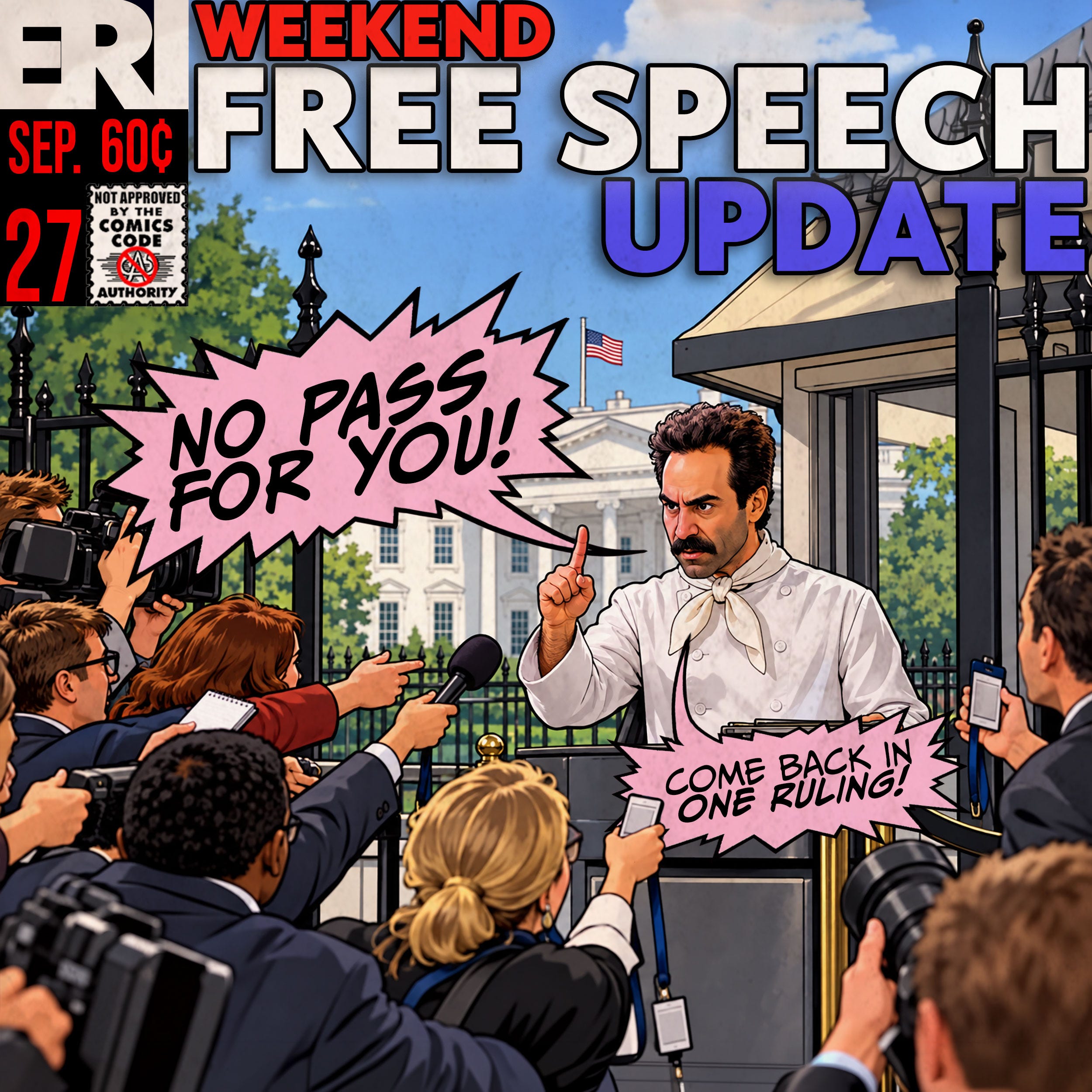
CNN v. Trump: After President Trump announced in a Friday afternoon social media post he was “banning” CNN, MS NOW, and POLITICO from the White House “effective immediately” and the outlets’ reporters were denied access over the weekend and had their “hard pass” press credentials deactivated, the federal district court in the District of Columbia issued a temporary restraining order requiring the immediate return, reinstatement, and restoration of the credentials. Noting both nearly 50-year-old and more recent precedent that “a duly issued hard pass may not be suspended without due process,” the court held plaintiffs likely to succeed in showing their hard passes were revoked without constitutionally adequate due process, due to the lack of fair notice of both what conduct would result in such a ban and of the magnitude of sanction the White House contemplated. The court also cited lack of record support for any contention that revocation of the hard passes was necessary to protect national security or that it will be endangered by an order requiring reinstatement while the case proceeds.
This week, Ofcom was served with papers by the Upper Tribunal over an appeal by Meta against so-called ‘categorisation’ under the Act that subjects WhatsApp and Instagram to additional regulatory duties. These include protecting users from fraudulent ads and increased reporting on the handling of illegal content.
Meta argues that so-called Category 1 duties are not designed for private one-to-one and small-group messaging. Roblox and Quora are also challenging Ofcom over the categorisation of their services.
On Tuesday, I joined C-SPAN’s Washington Journal to take questions after the White House pulled media credentials from outlets based on their prior coverage.
I love doing Washington Journal because it’s one of the few places on television where I can pretty much just be myself and talk to people from all over the country. And sure, every now and then, a caller takes you somewhere you absolutely did not expect to go. But that’s part of the charm of a live call-in show.
This time, though, the questions were so consistently thoughtful that I almost found myself missing the caller who wants to talk about the Freemasons, the Illuminati, or the pernicious influence of Menudo on the modern boy band.
Almost.
Thanks to everyone who called in — and everyone who watched!



So, is the press secretary also obliged to call on these guys to ask questions as well?