


Stories of the week
“Today’s important decision means that college remains a place where professors and students are allowed to debate controversial topics — even if politicians disagree with them,” said FIRE senior attorney Greg H. Greubel. “Today’s ruling makes clear something we’ve known for a long time: Governments cannot censor their way to freedom.”
Streever isn’t the only American targeted by the Trump administration for criticizing its policies. The administration has aggressively pursued everyday Americans for expressing their grievances with the government. These flagrant violations of the First Amendment should frighten Americans of every political stripe, because they threaten the very heart of the American experiment: the freedom to criticize our representatives vociferously and petition our government for change.
A Song of FIRE and ICE (The Dispatch) by Kevin D. Williamson
We’re not talking here about the lunatic ravings of some genuinely scary and dangerous figure, like maybe the author of Best Bike Rides New Jersey. This is the author of Best Bike Rides Connecticut.
This week in Expression
Canada wants to fight misinformation, a new memo reveals. But exactly how is a mystery by Sarah McLaughlin
DHS tracked a man down over an email. Now FIRE is suing by David Josef Volodzko
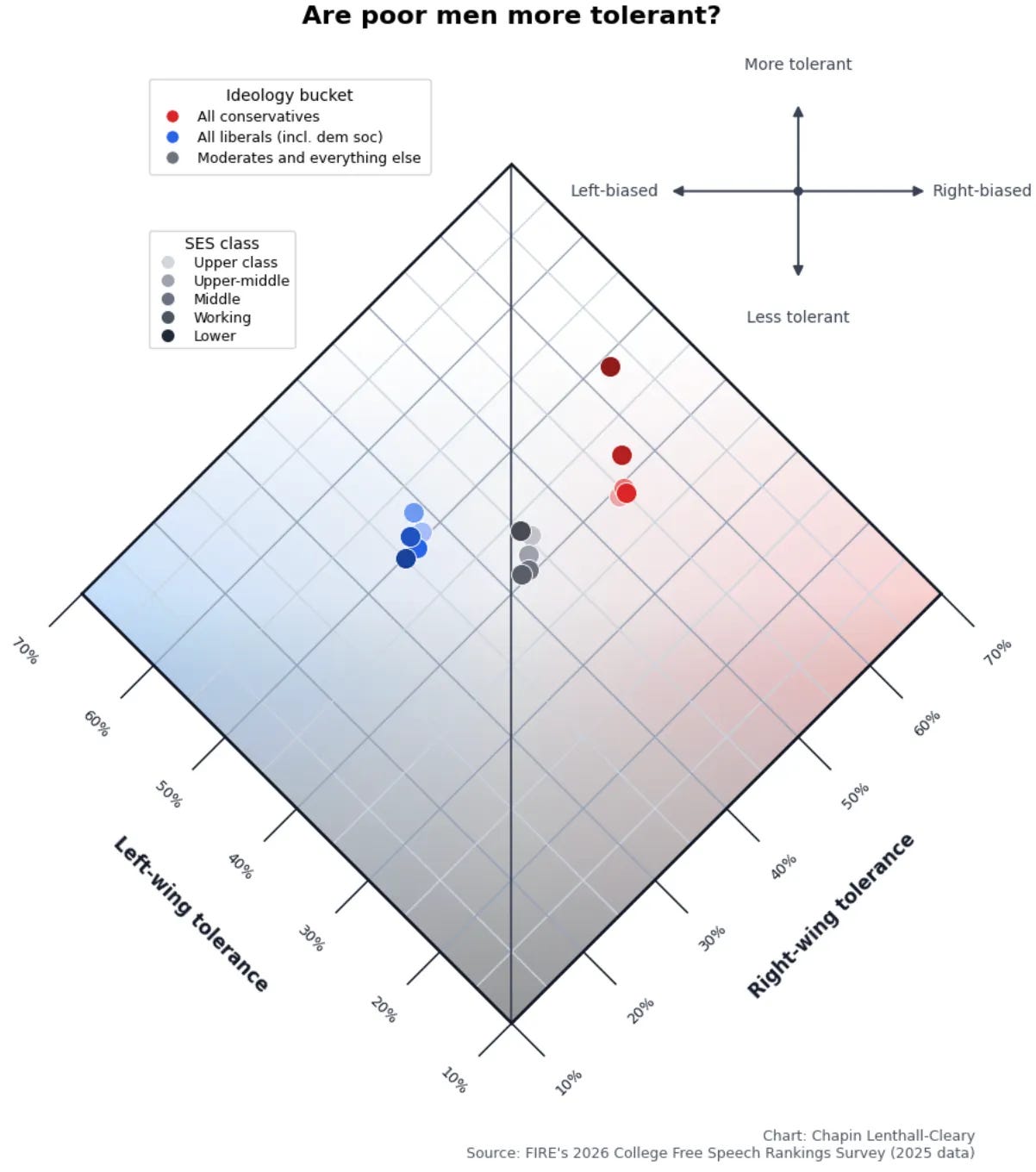
What’s special about poor conservative students? by Chapin Lenthall-Cleary
“The question isn’t whether the government may police discriminatory or negligent decisions. It may. The question is what happens when the government moves beyond regulating decisions and starts regulating what’s behind them — the process and tools that feed into decision-making.”
Democracy has a participation problem. AI may help solve it by Chloe Ratner
Hazelwood is the training-wheels version of free speech. It’s past time the Court revisited it by Marie McMullan
This week in FIRE’s blog
If someone is really threatening a government official, you don’t wait five months to act on it,” said FIRE Senior Attorney Adam Steinbaugh. “The fact that authorities didn’t respond immediately shows that David presented no threat. This pursuit is designed to intimidate lawful speech, pure and simple.”
London Calling: Ronnie’s First Amendment Roundup
Eleventh Circuit affirms preliminary injunction against Florida law barring public university and college professors from promoting or endorsing state-disfavored views on race, color, national origin, and sex
I think I can both admit my bias yet unbiasedly flag as the notable decision in our space this week FIRE’s win in the Eleventh Circuit, in which the court leans heavily into the First Amendment’s protection for academic freedom to affirm the preliminary injunction in the constitutional challenge to application of Florida’s STOP WOKE Act to the state’s public colleges and universities. The law effectively precludes instruction on specific “concepts” related to race, color, national origin, or sex, such as whether people are unconsciously biased based on race or sex, whether certain virtues like “merit, excellence, hard work, fairness, neutrality, objectivity, and racial colorblindness” are racist, and whether specific races or sexes inherently enjoy privileges or disadvantages. The federal district court in Northern Florida preliminarily enjoined the law, calling it “positively dystopian.” And the Court of Appeals has now affirmed.
The court confirms Florida’s law violates the First Amendment because “[v]iewpoint-based restrictions designed to compel or ban a set of beliefs are dangerous in any setting, and they are especially pernicious in the classroom context,” and that “goes double for broadly worded yet imprecise regulations like these, which are sure to leave both professors and their students guessing about what kind of speech might violate the rules.” Here, the Act “bars Florida’s educators from promoting or endorsing” disfavored ideas about race, color, sex, and national origin while allowing criticism of those ideas. As the majority opinion for the 2-1 panel noted: “Forcing an official government line—in a college classroom of all places—is exactly the ‘pall of orthodoxy’ that the First Amendment will not tolerate.”
In so holding, the court rejected the state’s argument that public university and college instruction is “government speech” subject to no First Amendment limits. As the court explained:
the State cast about for an existing case or doctrine that could support its speech ban in the university setting. Finding none, it tried to marry public-employee speech cases with government speech doctrine, resulting in a new rule: if the government pays a professor’s salary, it has total control over her classroom speech.
That is not a blessed union. Florida’s salary-for-speech rule is a breathtaking assertion of power to ban unpopular ideas from public discourse in the very places the State’s own statutes recognize as centers of inquiry—classrooms where students are trusted to puzzle through ideas that are good and bad, easy and hard, ideally getting ever closer to the truth. This new rule also runs headlong into the Supreme Court’s repeated, if imprecise, endorsements of academic freedom. If the First Amendment offers any boundary of protection at all for public university classrooms, this statute crosses it.
Put otherwise: “Florida’s restrictions are, as the State admits, an attempt to force uniformity of thought on students by curtailing the free exchange of ideas in universities—the very environments traditionally regarded as laboratories for expression and truth seeking.” The court made clear “the government has plenty of ways to promote its own viewpoint,” but “puppeteering every university professor in the state is not one of them.” As the court emphasized, higher education presents concepts that may challenge beliefs and sensibilities, but “the First Amendment trusts students to figure it out for themselves.”
With its ruling the Eleventh Circuit becomes the seventh federal court of appeals to expressly recognize the First Amendment rules generally applicable to public employees differ when it comes to public university faculty’s academic freedom that protects their teaching and scholarship (with no appellate court having concluded otherwise). FIRE Legal Network member Gary Edinger serving as its local counsel, and its challenge was heard alongside a related challenge filed by the ACLU, ACLU of Florida, and NAACP Legal Defense Fund.
International free speech stories of the week
[UK] Andy Burnham’s team confirms his stance on social media ban for under 16s (Birmingham Live) by James Rodger
Technology Secretary Liz Kendall previously told the BBC that an update on VPN restrictions would be coming in July. A spokeswoman for Mr Burnham told The Mirror: “Andy is committed to keeping kids safe online, and has been vocal in his support of age restrictions for kids using social media.
“He knows this ban is a critical first step to keeping kids safe online and preventing further tragedies for families. The task now is to build on the consensus across political parties to make sure it’s enforced in full, and delivered with the urgency this issue demands.”
[Canada] Federal memo considers legal action against social media posting false info (Toronto Sun)
SpongeBob censored in Russia amid ‘LGBT propaganda’ fears (TVP World) by Ewan Jones
Tribute of the week
RIP to Bonnie Tyler, the singer of one of my all-time favorite songs, and certainly my favorite karaoke song. I recently had the pleasure of introducing my 10 year old to the joy of “Total Eclipse of the Heart.” 75 is far too young, but “forever’s gonna start tonight”!
I think the situation is tricker than is depicted here. College teachers are employees of the institution that hired them, just as journalists are employees of a publisher. No one would suggest that journalists have free reign to report however they please, and that the publisher has no right to control. The fact is the publisher has absolute right to control.
Teachers have no inherent right to teach in any manner contrary to the polices of their employer, the educational institution. If a teacher doesn't like the restrictions, they can quit.
But that's not the end of it. The educational institutions generally receive all or part of their funding from government. That makes the government THEIR boss. But wait, there's more. The citizens are the boss of government. Ultimately, the citizens pay the taxes that pay the teacher. That means the citizens have, thru their government, an entirely legitimate right to censor both the institution and the teacher.
Any teacher who doesn't like that arrangement is free to work apart from any taxpayer funding. Institutions that don't want to be regulated can likewise decline government funding. Some have in fact done this.
It bothers the hell out of me that school librarians claim harassment and totalitarianism when taxpayers and parents insist on certain books being removed from the library. The librarian is an employee of these people. Ultimately, they decide, not the librarian. The librarian that doesn't like this is free to work at a library that is free of government funding.
The sick irony of all this is that taxpaying citizens and parents are made out to be the bogyman for having their own opinions and values, while over-indulged institutions and teachers claim superior rights that simply do not exist, either constitutionally or ethically.