


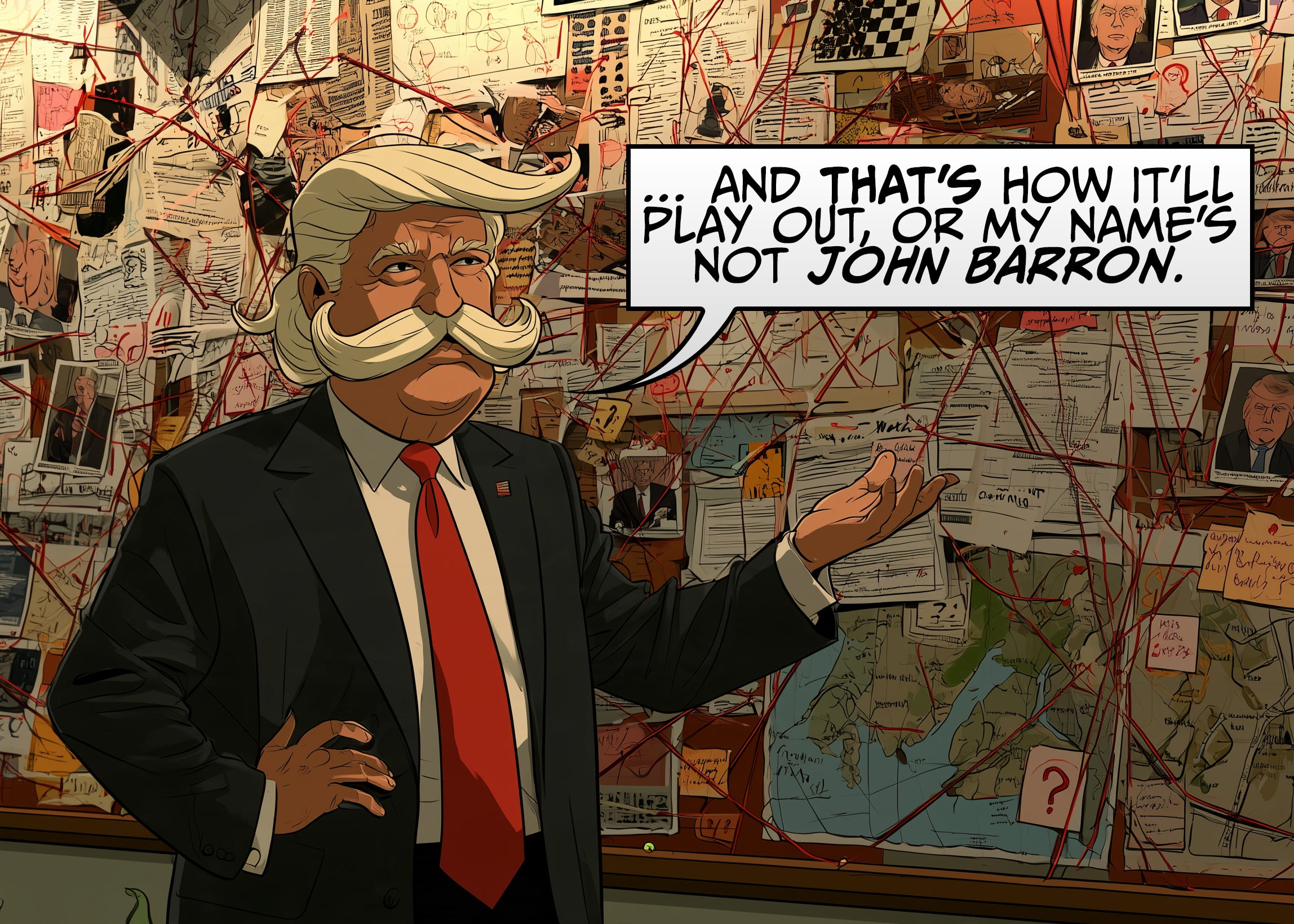
When Trump makes a puzzling or counterintuitive move, does anyone really still think he is playing seven-dimensional chess* — distracting us from the real plan by throwing us some red meat in the form of a crazy news story or executive action? I certainly don’t think so, but there does still seem to be a temptation to ascribe a much deeper game to Trump than the evidence requires.
To be fair, I do hear less of this than I used to, which is probably healthy. People have had decades at this point to get used to Trump’s methods. The distraction tactic, in particular, is hardly a secret anymore (I mean, if Saturday Night Live has been calling you out on it for ten years, the cat is out of the bag). But every now and then the old instinct still triggers in people and they can’t help but ask, What’s the real play? What does he know that we don’t? What is happening three moves from now?
Before we dig in deeper, a quick note about where I’m coming from: FIRE has spent its whole history taking on administrations of both parties, and we generally talk more about what an administration does than about the personality of the person running it. That is partly legal discipline, and partly the discipline of trying very hard to remain genuinely nonpartisan. On ERI, though, I speak for myself. Of course, I generally agree with FIRE — I run the place, after all — but sometimes I take an argument a little further, get a little more personal, or say the part that an institutional statement probably should not.
I really do try to avoid getting into the personality or character of the public figures we have to deal with in this work, but Trump’s nature seems to be the only way to explain some of his censorial behavior. His second administration has produced repeated free-speech fights over press access, lawsuits against news organizations, subpoenas, and other uses of government power affecting speakers and journalists. When the president then publicly explains why he is angry at those same people, pretending that the person at the center of the chaos has nothing to do with the analysis becomes artificial.
Anyway, I got another little whiff of the old what is he really up to instinct from my TV-buddy Michael Smerconish recently. I went on his show after Trump announced that CNN, MS NOW, and Politico were being banned from the White House. Michael’s first reaction was, “What is it he doesn’t want us talking about?”
To be fair, that was a perfectly reasonable question, and Michael put the dilemma nicely: “Ignore this issue and I become an accomplice. Take the bait and I’ve given you exactly what you wanted: a TV segment about a legal non-starter.”
And I certainly do not think Michael was wrong. Trump absolutely uses distraction. He has spent decades understanding how to make himself the story. I just offered another possibility: “It could be a deeper plan, or it could just be impulse control.”
What I meant, obviously, was lack of impulse control. Live TV ate the two most important words.
The more I watch this second administration, the more I think some of what looks like strategy may be closer to muscle memory — a habit that worked for decades, became deeply ingrained, and now gets activated almost automatically. A tactic can work so well for so long that eventually you may stop remembering why you started doing it in the first place.
So is there a strategy? Kinda. I think there certainly was a strategy at one point. And whether it is conscious, habitual, or some messy combination of the two, I keep coming back to three rules that seem to govern Trump’s behavior:
Rule One: Keep your name in the media.
Rule Two: Always stay on offense. Always.
Rule Three: Lawsuits are to create a consequence, not necessarily to win.
These rules can be effective. They can dominate the news cycle, exhaust and impose enormous costs on opponents, and intimidate people who do not have the money or appetite for a prolonged fight.
But then Trump runs into the recurring problem of… Trump, which throws it all out of whack. Let’s break the three rules down to explore how.
Rule One: Keep your name in the media
One of my favorite facts about Trump’s career is that, back in his New York real estate days, he sometimes allegedly called reporters pretending to be a Trump Organization spokesman named “John Barron” and proceeded to tell them interesting things about Donald Trump.
Most celebrities hire publicists. Trump apparently looked at that arrangement and thought, Why introduce inefficiency into the system? He could be Donald Trump. He could be Donald Trump’s spokesman. And, most importantly, both of them could spend their time talking about Donald Trump.
The practice of using fake names in this way was pioneered by the president’s father Fred Trump, who used “Mr. Green” as a sock puppet when he didn’t want landowners to know a wealthy developer was interested. But the President’s relationship to John Barron was still beyond that. Mr. Green lied about who wanted to buy a lot. John Barron lied about things like that, too, but also about Madonna wanting to date his boss. Mr. Green was a business tool; Mr. Barron was Aesop for the fable of Donald Trump.
Truth Social is basically the technological perfection of the John Barron strategy. John Barron doesn’t have to call anybody anymore. Trump can put Trump into the news whenever Trump wants. Whatever else you think of the President, he understood something very early that the rest of American culture would eventually learn from social media: attention is not merely the downstream effect of power, it is power.
Rule Two: Always stay on offense. Always.
The second rule is even simpler: Never stop attacking.
Since returning to office, Trump has filed three new lawsuits against major news organizations: The Wall Street Journal, The New York Times, and the BBC. A pre-existing case Trump had filed against CBS for $16 million was settled by parent company Paramount during a highly scrutinized merger with Skydance. Trump also re-filed a pre-inaugration lawsuit against the Des Moines Register and pollster J. Ann Selzer, in which FIRE represented Seltzer, and which was dismissed late last month.
Separately, as of July 30, the U.S. Press Freedom Tracker documented 15 subpoenas or other legal orders from the Department of Justice during Trump’s second term: a dozen subpoenas, two arrest warrants, and a search warrant. Separately, the Department of Homeland Security issued three administrative subpoenas (that is, issued without prior judicial approval) to service providers seeking records related to Georgia Fort, Don Lemon, and most bizarrely, the YouTube accounts of six journalists, ranging from left-leaning Democracy Now! to right-leaning Megyn Kelly.
Have there been more subpoenas since? Maybe; these demands are often secret. Until someone opposes them or they’re raised in a future proceeding, there’s no meaningful way to quantify them. And if the purpose of some of these processes is to intimidate or retaliate, there might not be any future proceedings.
And then, of course, there’s just what Trump says. The Trump Anti-Press Social Media Tracker, which tries to quantify the president’s online attacks on media, counts 426 posts in the 245 days between January 22, 2026 and September 23, 2026. That averages out to slightly more than one post every 14 hours, and that’s before including proxies like the vice president, FBI Director Kash Patel, and FCC Chairman Brendan Carr.
It’s important to note here that one mistake many of Trump’s opponents keep making, even after all this time, is assuming that every controversy will proceed like a normal one: Trump says something outrageous. Everyone focuses on it. Fact-checkers fact-check it. Lawyers analyze it. Editorial boards editorialize about it. Everyone prepares for the great national debate over Outrageous Thing Number 4,683. And while they’re doing that, Trump has moved on to Outrageous Things 4,684 through 4,691.
There is an obvious advantage to this, of course, and it echoes something Steve Bannon said years ago: flood the zone. Everyone else has finite bandwidth. Courts have finite bandwidth. Journalists have finite bandwidth. Civil-liberties organizations have finite bandwidth. Hell, FIRE has finite bandwidth — and we are literally in the business of keeping track of threats to freedom of speech.
Unlike the rest of us, Trump does not appear particularly burdened by the finite-bandwidth problem. In fact, he’s a lot like the Hulk in that he just keeps getting bigger the more you piss him off. So everyone else spends an enormous amount of time and energy reacting to him, while he seems not just undisturbed but positively energized by it. And sometimes, yes, that is almost certainly the point.
But we should be careful about assuming that because a tactic has strategic effects, it must have emerged from some exquisitely planned strategy session. An unattended firehose can do plenty of flooding without having a plan.
This tactic was modeled by infamous (and eventually disbarred) attorney Roy Cohn. Cohn, who had been chief counsel to Sen. Joseph McCarthy’s Permanent Subcommittee on Investigations during its anti-communist investigations in 1953 and 1954, would later represent Fred Trump, Donald Trump, and Trump Management in 1973 when the federal government sued the group for housing discrimination. Cohn’s response to the lawsuit? Countersue the federal government for $100 million (over $750 million in today’s money).
As Ken Auletta of The New Yorker summarized Cohn’s strategy: “Fight it, you’ll kill them; just deny everything and fight.” It’s not exactly Hannibal at Cannae — but check the scoreboard. The countersuit would be quickly dismissed; the underlying lawsuit was settled in 1975 with no admission of wrongdoing.
Rule Three: Lawsuits are to create a consequence, not necessarily to win
This is where people can make another mistake. They look at a lawsuit (or adverse regulatory action, or other retaliation), see Trump lose, and conclude that the overall strategy failed. Sure, sometimes, it did. But “Did Trump win the case?” and “Did bringing the case accomplish anything?” are not the same question.
Take J. Ann Selzer. The highly-regarded Iowa pollster published the results of a poll before the 2024 election showing Kamala Harris ahead by three points. Trump ended up winning Iowa by about 13 points — meaning Selzer’s poll was way off. In response, Trump sued Selzer and The Des Moines Register, the newspaper that published the poll, claiming that the poll constitutes “consumer fraud.” He sought damages and a court order barring the newspaper from publishing any future “deceptive polls” that might “poison the electorate.”
Of course, this was all absurd and unconstitutional. Consumer fraud laws are meant to stop sleazy car salesmen from selling lemons, not to keep people from mistakenly predicting the results of an election. Trump certainly knew this, but sued anyway. FIRE represented Selzer, and the judge eventually dismissed Trump’s claims against her with prejudice. But it took almost two years of work and resources that we will never get back.
Now imagine you are not Selzer and you do not have FIRE defending you (yet). Imagine you are a small publisher, independent journalist, academic, or ordinary citizen who suddenly gets a complaint from lawyers representing the President of the United States. Does it comfort you to know that, two years from now, assuming you can find or afford the lawyers in the meantime, you might win in court against this frivolous case?
As we have said before in our breakdowns of strategic lawsuits against public participation, or SLAPPs, the process itself can be punishment — and that punishment creates a real disincentive. It’s one thing to criticize the president in line at the supermarket, at dinner with your in-laws, or with your friends in a defiantly-named private Facebook group where you and your acquaintances emotionally cosplay as “the resistance.” But if you’re someone the president is likely to notice, and the stakes are real, not being sure you have the money to defend yourself (or the stomach to add yourself to the list of people his proxies will target) will pressure a great many good people into lowering their voices.
But don’t the underlying losses still matter? Depends on who you ask. Roy Cohn had his own advice here, too: always declare victory, even if you lose. The 2020 Election might be the paramount example, but we don’t have to go that far back to find others. The Supreme Court strikes down his tariffs? A win, actually. Buying Greenland? We got “everything we wanted.” Iran? Victory, victory, victory. (And also very soon.)
The IMPULSE-CONTROL PROBLEM
I’m not saying that Trump’s efforts are never distractions. The president is astonishingly good at getting attention. Constant offense has obvious advantages, like keeping people reacting to him instead of pursuing their own agendas. And in litigation, where the process can be the punishment, an eventual Trump loss won’t make the costs imposed along the way less real.
As Smerconish did on his show when I was on, the press has gotten wise enough to the distraction trick that it now sometimes debates whether covering Trump’s latest outrage is itself falling into Trump’s trap. That is progress, I guess. But there is a funny leap people sometimes make from “Trump benefited from this” to “Trump planned all of this.” Those are very different propositions. It might be true, sometimes — especially as part of a coordinated legal strategy crafted with the help of his advisors. But I also suspect that what is happening behind the scenes might be much more haphazard than it looks from the outside.
How do I know this? Because the strongest evidence against Donald Trump being the master strategist in his plans is that Donald Trump is frequently the source of the strongest evidence against them.
Imagine being one of his government lawyers. The administration has just done something constitutionally aggressive, like, say, subpoenaing a journalist. Your job is to explain to a federal judge that, appearances notwithstanding, the government acted for legitimate reasons. So you start researching all the justifications the government might have for a subpoena. Maybe it was national security. Maybe they were the only possible source of information about a crime. Maybe the journalist violated a neutral rule, like trespassing. Maybe there’s a good reason and it wasn’t retaliatory at all!
Then your phone buzzes.
Trump has posted another tirade to his social media accounts, and in so doing has helpfully announced to several million people that, actually, he did it because these people are terrible, they are liars, their coverage is unfair, he hates what they are saying about him, and they deserve what is coming to them.
At that point, I imagine government lawyers across Washington quietly closing their laptops and staring into the middle distance, knowing Chinese take-out and at least 12 more straight hours of work are in their immediate future, and wondering whether it might be time to start buying cheaper bourbon. What follows is a ritual familiar enough that it deserves a name: the Subordinate Scramble.
Trump says the thing. Everyone realizes the thing creates a legal problem. And then an army of credentialed people has to go on television, issue statements, write briefs, and explain that what the president just told the entire planet was happening is not, strictly speaking, what is happening.
J.D. Vance’s response to the White House press ban gives us a nice example. Trump explicitly tied the exclusions to what he called “fake news,” calling their reporting “fiction and lies.” Vance subsequently defended the policy in terms of fairness and the special privilege of White House access. The White House added historical arguments. The government’s lawyers eventually emphasized national security — a good if unconvincing backup argument for any presidential power.
Some of those arguments raise perfectly legitimate legal questions. They are also much harder arguments to make when the president has already told everybody why he did it, and the president’s reasons are unrelated to the official explanation.
There is something almost touching about the effort. It is the legal equivalent of following an elephant through a china shop with a dustpan. The really remarkable part is how unnecessary the self-sabotage is. Trump does not have to publish the incriminating rationale, but he seems to need to. And once he does, the legal problem changes, because the president’s own contemporaneous explanation is evidence of an improper motivation under the First Amendment.
When the government emphasized national security, Judge Timothy J. Kelly, who blocked the media ban, pointed to an awkward problem: the record from before the lawsuit did not show national security as the reason the credentials were revoked. Trump had already supplied a rather different explanation.
This is not seven-dimensional chess, checkers, or Candyland. It’s just a client who won’t stop talking. There’s nothing any deeper than MF DOOM’s “Rap Snitch Knishes”: “Do you see the perpetrator? Yeah, I’m right here.”
Sure, Trump is free to have opinions about CNN, Politico, MS NOW, The New York Times, FIRE, me, or anybody else. And I’m not going to wander into the doctrinal swamp of when a president is speaking personally, when he is speaking officially, and when presidential speech itself becomes government action. That doctrine gets messy fast, and it’s not the point.
The simpler point is about government power. When the government takes action against a speaker and the president publicly explains why the government is doing it, lawyers and judges are going to pay attention to what he said — which is why the lack of impulse control becomes such a problem.
So is there a strategy or not?
Having read all of this, someone will inevitably object: “Wait. You just spent half this piece explaining ways Trump’s strategy works. Doesn’t that mean there really is a strategy?”
Like I said, kinda. Keeping your name in the media, staying on offense, and making it costly to fight back are real tactics, and sometimes they are plainly deliberate. My point is that a tactic can harden into habit. Muscle memory can still be effective; it just does not require somebody at a whiteboard calculating 20 moves ahead.
In other words, not all strategies are seven-dimensional chess. Tic-tac-toe has a strategy. Rock, paper, scissors has a strategy. You can have a playbook with three plays in it and still win games.
In a way, Trump has finally achieved John Barron’s dream. He can tell millions of people exactly what Donald Trump thinks, exactly when Donald Trump thinks it. For a man whose first rule is keep your name in the media, this is close to the perfect technology.
Unfortunately, for a man whose lawyers occasionally need him not to explain why the government just did something, it is considerably less perfect. The old John Barron arrangement, at least, required Trump to pick up a phone, pretend to be somebody else, get a reporter on the line, and make it through the conversation. Truth Social has removed all that useful friction, and — thankfully, for those of us defending the First Amendment against abuses — it is making a mess of this administration’s bully tactics.
*Why seven dimensions? Mostly because it is more fun. The usual phrase is four-dimensional chess, but in Star Trek, Kirk and Spock played three-dimensional chess — which has always struck me as slightly funny because chess pieces are already three-dimensional. Sure, it represents two dimensional thinking, à la Kahn from Wrath of Kahn, but the game is not taking place in Flatland. Then people started saying Trump was playing four-dimensional chess, except the fourth dimension is generally considered to be time, and chess also already involves time unless both players have somehow been frozen between moves. And I’ve always liked that my friend Paul Hines considers the fifth dimension to be probability. But then again we are talking about spatial dimensions, but how does that even make sense when space and time are bound? So just to be safe I jumped to seven.
I am NOT overthinking this.
SHOT FOR THE ROAD
Two sketches for the road, because Saturday Night Live has been onto this argument for a long time.
December 3, 2016 — “Classroom Cold Open.” Kate McKinnon’s Kellyanne Conway explains Trump’s compulsive tweeting as a clever strategy to distract the media from other stories. Alec Baldwin’s Trump immediately supplies a much less flattering explanation.

And then jump ahead over the craziest decade of my life to January 18, 2025 — “MSNBC Special Coverage Cold Open.” This one may be even more on point. The panel keeps congratulating itself for having learned not to chase every new Trump provocation — and then gets yanked around by one ridiculous “breaking news” alert after another. So yes: the distraction tactic is hardly a secret.
Great piece; nice writing and interesting. I'm often trying to get people to see how they're manipulated and to stop reacting to the Latest Outrage of the Day, Trump derived or otherwise, and that he's orchestrating this purposely for reactions. I'll accept 7-dimensional, but I'm not sold yet on the muscle memory hypothesis. He could benefit from a squelch dial and knowing when too much of a good thing (for his ends) is too much. I think he's easily sixth dimension, but too sloppy. Yet, pity the fools who think they can beat him at his own game (loosely, the Resistance and state AGs, not FIRE which isn't in this class.)
The MSNBC piece is great, I thought SNL was dead beyond any chance of being funny or mildly self aware.
Never forget he was a lifelong Democrat until he decided to run for President. He uses the same tactics, just on a incredible scale with no remorse or worry about what The Establishment thinks.
I watch The Left do this all the time, especially with race/DEI/MAGA: George Floyd riots, Kyle Rittenhouse, Very Fine People Hoax. Russian Collusion Hoax, White House documents hoax, Hunter Biden laptop hoax, Suckers and Losers military comments, Vindeman impeachment hoax, Democratic Judges and AGs trying to keep Trump off the ballot. I could go on forever.
Greg's a good guy. He has a hard job, glad he's willing to do it.
By the way, it's kinda satisfying watching the Left get a taste of it's own medicine. How many good people have been driven out of politics because of the Left's lawfare? Too many to count.