


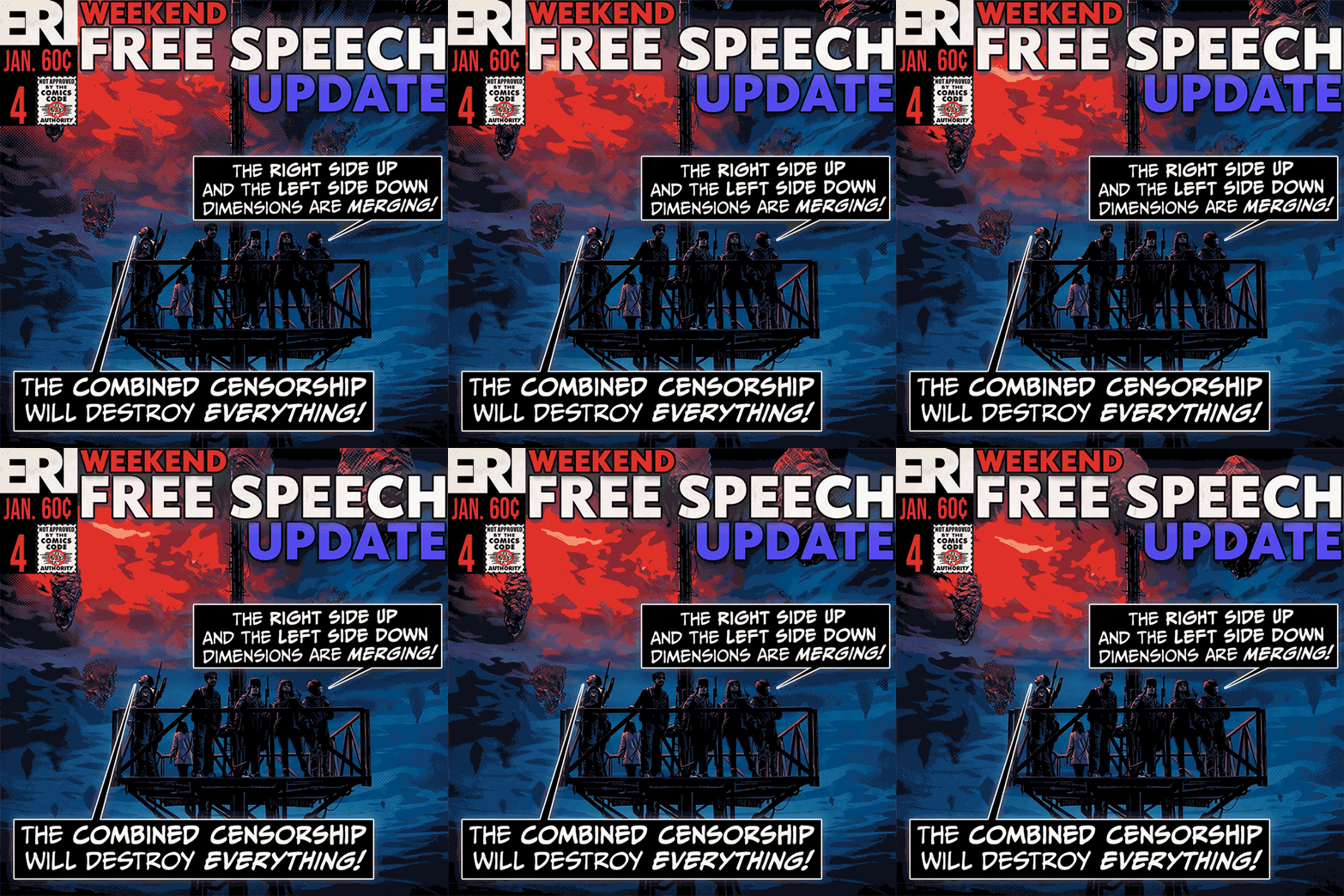
Story of the week
Universities have been strangely lucky so far that many of the administration’s most extreme tactics are the kind that courts can — and often will — stop. For FIRE’s part, we’ll keep fighting them whenever they cross the line into infringing on expressive rights. But universities need to do their share, too: Admit they have a problem, and start fixing it seriously.
This week in Expression
Free speech can’t be engineered or outsourced to apps by Samuel J. Abrams
American universities insist they are committed to free expression. Many now point to “dialogue-across-differences” programs and AI-mediated conversations as proof. Students are trained to listen respectfully, disagree productively, and engage across differences.
I see these initiatives up close: I sit in faculty meetings where they are rolled out, watch students navigate them in real time, and hear privately what they are reluctant to say publicly. And the climate for speech on campus continues to deteriorate.
FIRE in the press!
Duke shows what not to do when feds come knocking by Dominic Coletti
Duke’s fight against the Trump administration has a new front: employee speech. After the White House accused the school of maintaining unlawful racial preferences and cut millions of dollars in research funding as punishment, the University ordered its employees to keep silent.
London Calling: Ronnie’s First Amendment Roundup

Split en banc Eighth Circuit revives Springfield (Mo.) school district employees’ First Amendment challenge to mandatory equity training that compelled speech consistent with district views, and reaffirms employees should not have to pay the district’s legal fees for having brought purportedly frivolous claims
The U.S. Court of Appeals for the Eighth Circuit, on a bare 6-5 en banc majority, reversed decisions that dismissed a suit by school district employees who claimed mandatory staff equity training both chilled and compelled their speech in violation of the First Amendment, and that ordered them to pay the district’s attorney fees for bringing claims the trial court found frivolous.
An appellate panel had previously reversed the fee order but upheld the dismissal based on the employees’ lack of standing to bring them, on grounds their fear of punishment if they voiced dissenting views during the training sessions was speculative, and the requirement to complete online training modules by stating the district’s “correct” answers did not inflict legal injury. But the full Eighth Circuit vacated that decision and opted to rehear the case en banc. The trainings required attendees to “have courageous conversations,” to “stay engaged” with the training’s “uncomfortable” topics, and to “lean into” it and “share … personal experiences and identities” while “acknowledging” their “privileges” and holding themselves “accountable.” And online training modules some employees had to later complete required selecting the pre-programmed “correct” answers to move to each next question.
These included answering how social learning through an equity lens impacts serving district students and staff by saying it “cements equity and diversity as a district priority that must be followed” (rather than that it “provides suggested guidance regarding equity and diversity issues,” which, if selected, the module replied “Incorrect! This is not suggested guidance. It is required policy and job responsibility.”) Or, when asked how to respond if you “witness racism and xenophobia in the classroom,” saying it means having to “address the situation the moment you realize it is happening,” rather than “in private after it has passed,” the latter of which was also “Incorrect!” because it is “imperative adults speak up immediately and address the situation with those involved. Being an anti-racist requires immediate action.” And the school district acknowledged in the litigation that the trainings continuously instructed that silence from white people is a form of “white supremacy.”
Given all this, the en banc majority held, the employees sufficiently alleged constitutional injury from chilled and compelled speech. It began by invoking the Supreme Court’s Terminiello v. Chicago admonition that free speech invites discussion and even dispute, and “may … best serve its high purpose when it induces a condition of unrest, creates dissatisfaction with conditions as they are, or even stirs people to anger,” and can “strike at prejudices and preconceptions and have profound unsettling effects as it presses for acceptance of an idea.”
The court cited evidence that plaintiffs stopped voicing opinions and self-censored when it became apparent their views were considered unacceptable by the school district—and were not only rejected but met with hostility from district-employed trainers—so as to avoid negative consequences the district itself said would follow, including being asked to leave the training, not receiving credit for it, and having pay docked because it was mandatory. These facts, the court held “establish more than mere disagreement with a viewpoint or the requirement that attendees act professionally. It’s about suppression of viewpoints.”
Similarly, on compelled speech, the court noted it was “undisputed that it was impossible … to complete the module without accepting the school district’s view,” and as such it “did more than test an employee’s understanding of the material” but rather “compelled … agree[ment] with the school district’s views” and “forced acceptance or adoption of” them “in violation of the First Amendment.”
The court thus reversed the dismissal of the claims and remanded to the trial court, and vacated the award of legal costs in that, given the holding on standing, the claims could not be frivolous so as to justify forcing the employees to pay the district’s attorney fees (which made it twice that the position on fees argued in the brief FIRE joined won out).
International free speech stories of the week
Deadly clashes between protesters and security forces as Iran unrest grows
Britain should copy Australian social media ban, says terror tsar
Britain should impose an Australian-style ban on social media to prevent a new generation of teenagers from being radicalised online, the Government’s terror tsar has said.
Jonathan Hall KC warned that artificial intelligence, and chatbots in particular, risked leading troubled young people “down the dial of death” far more rapidly than more traditional grooming methods.
Book of the month

This month’s Prestigious Ashurbanipal Award — and the first of 2026! — goes to Faraday, Maxwell, and the Electromagnetic Field by Basil Mahon and Nancy Forbes. It’s the rare science book that feels like a human story about how truth actually gets made: Faraday seeing the world with his hands and instincts, and Maxwell taking those “invisible lines of force” seriously enough to turn them into a theory that reshaped modern life.

I’ve admired Maxwell for so long I named my second son for him. I’ve also always felt a little protective of the guy — dead at 48, beloved by Einstein, and still somehow stuck with the indignity of sharing his name with Maxwell’s Silver Hammer and Maxwell Smart when he should be spoken of the way we speak of Newton or Darwin.
This book lets him be what he was: brilliant, witty, tough and creative, while also making clear why the electromagnetic field changed everything.
Dear Greg,
IMHO, Maxwell is the second best scientist (after Newton) that every lived. He could see the invisible in the visible and in so doing discover the hidden laws of nature. Both Faraday and Maxwell always related the parts to the whole, started frrom the whole (which they both related to God as definition of the wholest whole) and, discerned the parts. They are both model scientists when it comes to learning how to think about a problem and solve it!
thanks,
randy