


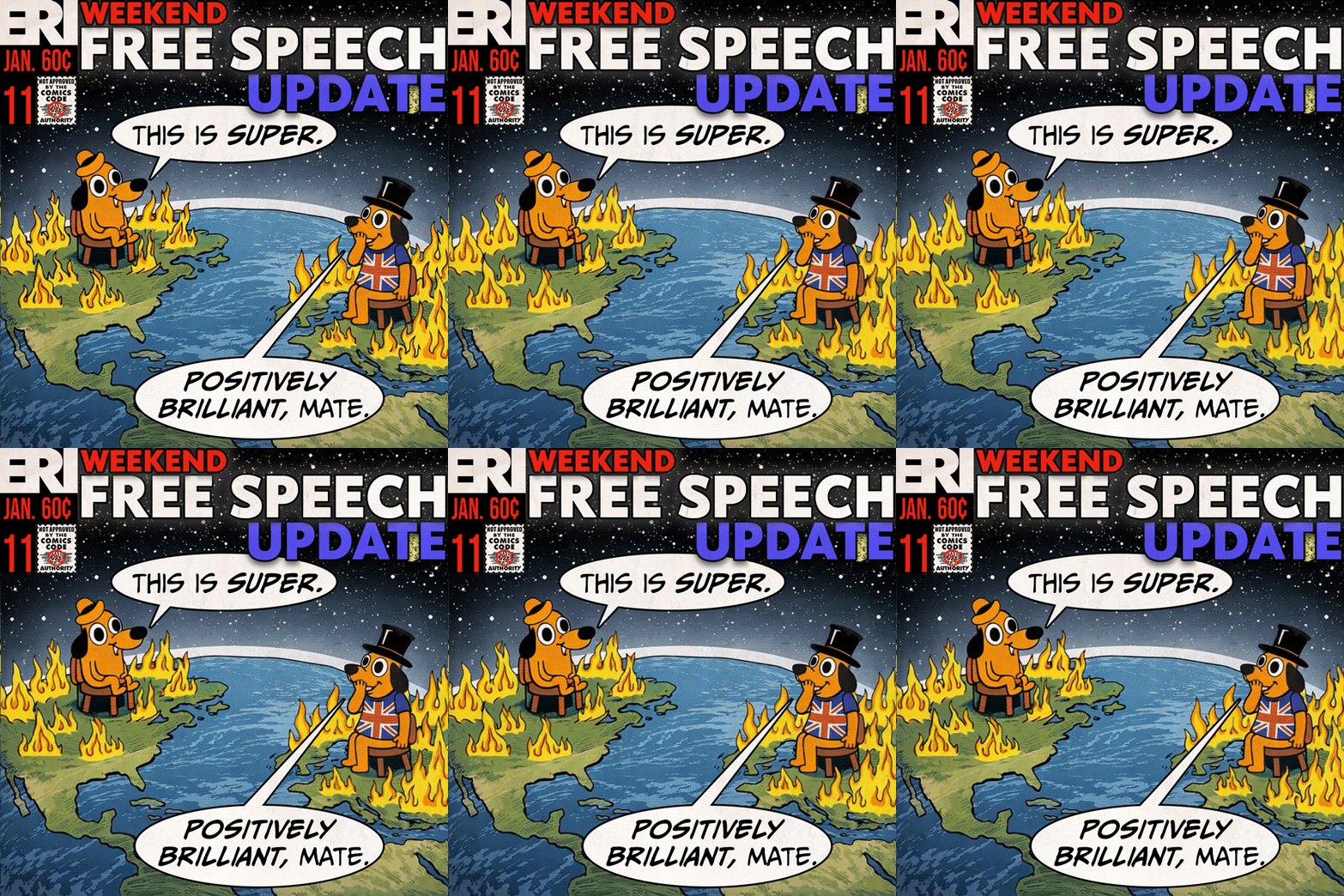
Story of the week
A Royal Paine (The Dispatch) by Matthew Harwood
If the British had any idea of who this Thomas Pain would become—he wouldn’t add the “e” until later—they may never have let him set sail to the New World to begin with. In little more than a year, this impoverished 37-year-old, who had known only heartache and failure in Britain, would find his voice as a successful editor and journalist in America’s largest city. And with his newfound purpose and confidence, he would write one of the great world-changing pieces of political propaganda ever published and help birth a free and independent United States of America.
This week in ERI
I hope we here in the States will take it as a warning: Things are bad on our campuses right now, but what’s happening in Europe is even worse. Let’s not follow suit.
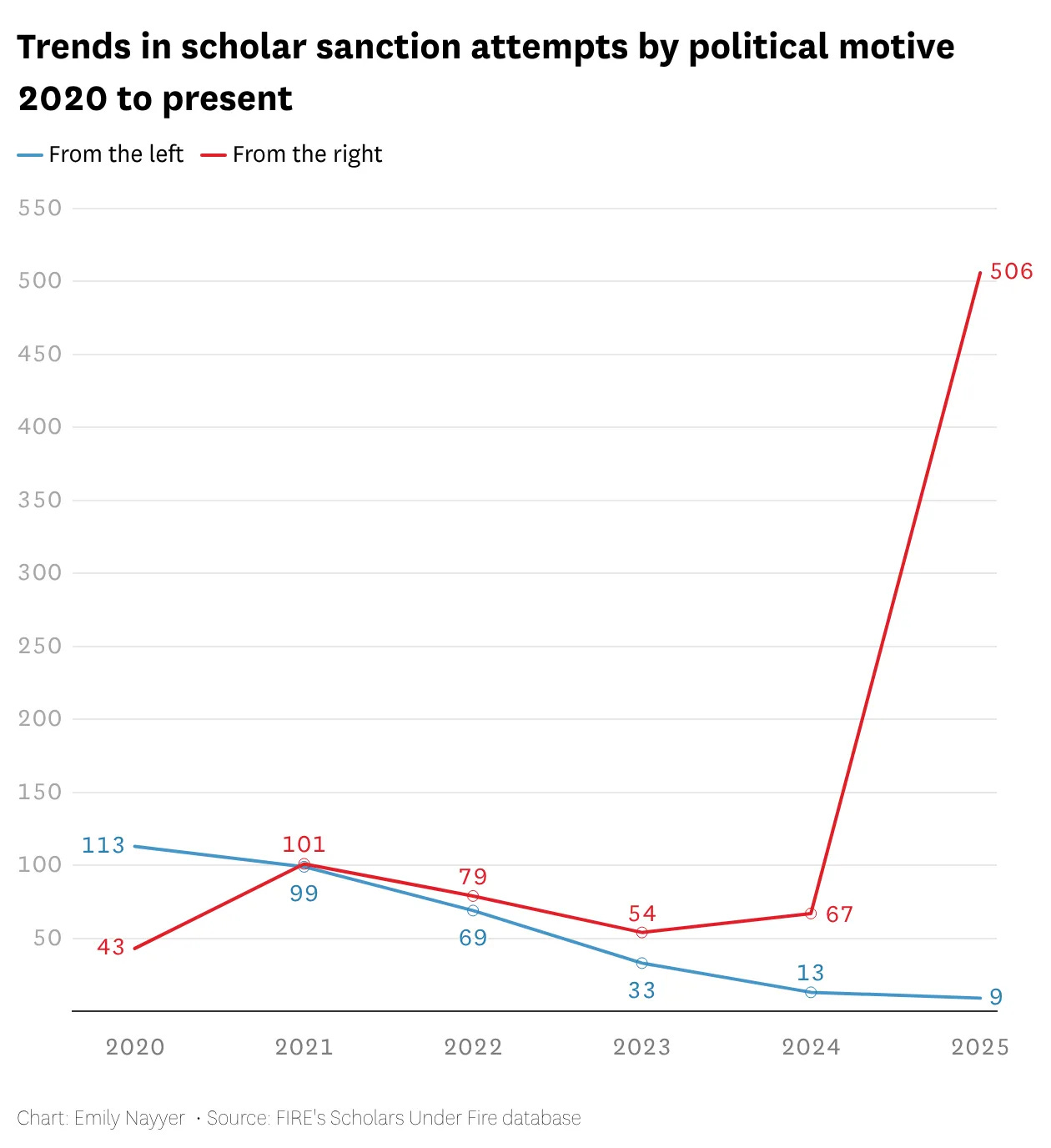
This week in Expression
This week in FIRE’s blog
Texas A&M now believes Plato doesn’t belong in an introductory philosophy course. The philosophy department is demanding that professor Martin Peterson remove Platonic readings because they “may” touch on race or gender ideology. He’s been given until the end of the day to comply or be reassigned. This is what happens when the board of regents gives university bureaucrats veto power over academic content. The board didn’t just invite censorship, they unleashed it with immediate and predictable consequences. You don’t protect students by banning 2,400-year-old philosophy.
London Calling: Ronnie’s First Amendment Roundup

Fourth Circuit reinforces the narrowness of First Amendment exceptions for incitement and speech-integral-to-criminal-conduct in vacating terrorism-related convictions based entirely on post-9/11 speech that did not urge any concrete criminal plan or provide operational assistance for any particular offense
The U.S. Court of Appeals for the Fourth Circuit has vacated convictions and ordered the acquittal of Ali Al-Timimi on charges of soliciting or inducing terrorism-related offenses, and of attempting to contribute services to the Taliban, all of which rested on his speech to others he knew at a Virginia Islamic center, “[b]ecause the Constitution forbids criminal punishment for protected advocacy—however odious the content.” Per the Fourth Circuit’s recounting, Al-Timimi “advised individuals—in quite general terms—on how to react to the September 11 attacks” by advising they do things like leave the U.S., “‘[j]oin the mujahideen,’ and fight India or Russia or the United States,” “get some training” from a combat training group in Pakistan, or “in lieu of fighting, at least ‘leave America’ and go to ‘live with the good Muslims’ in another country.” He said it was obligatory on all Muslims to help Muslims in Afghanistan and Pakistan and instructed others to “support[ ] them physically, [and] if you can’t support them physically, support them financially, [and] if you can’t support them financially, support them through speaking of them good or telling the good of what they are doing, and if you can’t do that, then at least pray for them.” And he gave general guidance to two individuals who had planned such travel on how to evade detection by advising “‘don’t take anything suspicious’; act scared and ask for a lawyer if stopped.”
The court held this speech, which formed the basis for all charges, was constitutionally protected, noting that “[p]lenty of speech encouraging criminal activity is protected under the First Amendment” including in particular the “[a]bstract advocacy of lawlessness.” The court explained that such speech loses First Amendment protection only if it has additional characteristics. For incitement, it must be directed to producing imminent lawless action and likely to incite or produce it, in which context the Supreme Court separates “mere abstract teaching” of the “moral propriety” or “necessity” of violence from “preparing a group for violent action and steeling it” to proceed. For speech that facilitates or solicits a particular crime (i.e., “aiding and abetting”), it must assist the wrongdoer with intent to further the offense’s commission, which cannot be mere advocacy of crime but rather must assist by detailing the means of accomplishing the crime or “intentionally encouraging” the specific unlawful act.
Al- Timimi’s speech did not constitute incitement, the court held, because while it urged criminal activity, it was neither sufficiently imminent nor definite to lose First Amendment protection, but rather involved only vague and general exhortations. Al-Timimi neither specified a timeframe in which to take actions or details how to carry them out, nor suggested where in Pakistan to go or which camp(s) to attend, but offered only broad urgings toward jihad against any of three different nations (India, Russia, or the U.S.) and a general need to “defend” Afghanistan based on religious obligation. The court also held Al-Timimi did not engage in speech incident to criminal conduct as he did not help anyone commit crimes even if (“to be sure,” as the court said) he encouraged them. Rather, the most he did to further commission of crimes was to advise in general terms how to react to 9/11, all of which lacked the “common thread” and “necessary component” in aiding-and-abetting cases of participating in the principal’s criminal intent. The court noted that “although participation can be comprised of speech alone, Al- Timimi’s speech was not participation but was merely encouragement,” and the evidence did not show it bore the requisite intent involving specific unlawful acts.
The court thus vacated the convictions for which Al-Timimi had been imprisoned and confined to home (post-Covid) for 20-plus years, noting in closing that “the First Amendment shields loathsome and unpopular speech as fully as it does speech that is celebrated and widely accepted,” as doing otherwise “would be to endorse a system in which speech may be punished simply because it alarms, offends, or challenges prevailing norms,” which “would undermine the rule of law by allowing constitutional protections to fluctuate with political and social pressures.”
International free speech stories of the week
Iran Is Cut Off From Internet as Protests Calling for Regime Change Intensify (NYT) by Farnaz Fassihi, Pranav Baskar, & Sanam Mahoozi
As the protests grew, internet connectivity data showed an abrupt and near-total drop in connection levels in Iran on Thursday afternoon, according to NetBlocks, an internet monitoring group, and the Georgia Institute of Technology’s Internet Outage Detection and Analysis database. The data indicates that the country is almost completely offline.
A Paris court finds 10 people guilty of cyberbullying France’s first lady Brigitte Macron (AP) by Sylvie Corbet
One defendant was sentenced to six months in prison, while eight were handed suspended sentences between four and eight months. All 10 were ordered to attend cyberbullying awareness training.
Protester detained in Sydney for wearing ‘globalise the intifada’ jacket says she should never have been arrested (The Guardian) by Caitlin Cassidy
Justice ministry seeks to end jail terms for blasphemy in Poland (NFP) by Daniel Tilles
Podcast of the week
I had a great conversation with Peter Laffin on the Washington Examiner podcast about free speech in the U.S. vs. Europe, on college campuses and the media.
Opponents of the freedom of expression and communication secured by our Constitution are highly reminiscent of the cave dwellers in Plato’s Republic. Plato used the allegory of the cave to illustrate the defects in human nature that caused Athenians not only to want to kill Socrates but also to act on their craven desire. Athenians in the greatest true democracy in history, chose, in the Golden Age of Greece, to kill Socrates, the most famous and arguably the most influential philosopher of Greece’s Golden Age.
Plato, the most famous and faithful disciple of Socrates, tried to help Athenians understand the defect in their nature that made them want to kill, and ultimately to choose to kill, a mere philosopher who sought only to enlighten. The defect Plato addressed is the defect demonstrated by fanatics in power or fanatics supporting people in power.
The truth is that many people would rather kill a dream and even kill other people who dare to dream than simply allow people to live in the light. Shortly after just such killing on a massive scale, President Lincoln underscored the sacred purpose and insight of those who sacrificed their precious lives to fulfill their oaths to support and defend our Constitution. Our President then, during our darkest days, was one of America’s greatest philosophers and a national leader made in the mold of the best of the American Revolution. He used his position and powers to emphasize that the United States of America was created to be a land of the enlightened, not the land of craven cave dwellers. We the People created “this nation” to secure “freedom” by creating “government of the people, by the people, for the people.”
Malicious compliance is a thing also. Where I fundamentally disagree with FIRE is the notion that elected officials cannot decide curriculum in public schools. That’s not a sound First Amendment position.