


Stories of the week
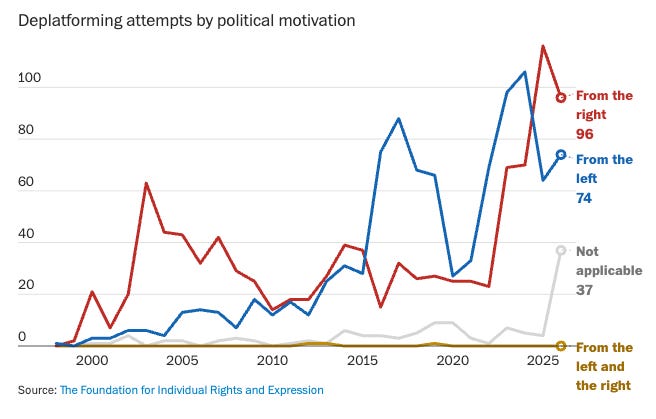
“The people of Michigan elected Michael to be a watchdog, not a lapdog,” said FIRE Senior Attorney Greg Greubel. “The freedom to voice opposition strengthens the university by encouraging ideas to be challenged and solutions to be worked out.”
This week in ERI
The Anti-Intellectualism of ‘Political Cooties’

Thank you to everyone who signed up to become paid subscribers in order to read part 1 of Breaking the Academic Filibuster!
This week in Expression
As I sat in one of Swarthmore’s libraries reading one of its Halloween warning emails, I came to better understand how the chilling effect I was feeling represented the greater intolerance present on campus. There are certain costumes you are expected to know are off-limits; there are certain statements you are expected to know are off-limits. If you just happened not to know the unspoken rules, you were out of luck. And to entertain an idea for the sake of argument was to take a social risk. The message sent by these emails doesn’t stay confined to one night on Halloween. It affects what students feel is acceptable to say, year-round, in and out of the classroom.
Government officials admit his Halloween decorations are legal. Why won’t they leave him alone? by Matthew Harwood
Student journalists know their rights. Universities should too by Jessica M. Barker
Your speech, their rules: How foreign governments censor Americans by Trace Mitchell
This week on FIRE’s blog
FIRE in the press!
After Insulting Mao Zedong, Some Offer Groveling Apologies to Protect The Bottom Line. Others Suffer in Prison (Bedrock Principle) by Sarah McLaughlin
In an interview, Mbappé said his favorite meme is “a video someone made of a guy…I think he was a Chinese dictator,” with Mbappé’s face superimposed on Mao Zedong’s body (fans have jokingly used the nickname “The Dictator” for Mbappé). French football podcast The Bridge, which posted the video, has since taken it down.
That’s all that happened. Mbappé didn’t even say Mao’s name.
But in reality, the details in these controversies don’t actually matter very much — neither does the context, the truth or falsity, or the intent. All that matters is that someone, somewhere, said something that runs counter to the Chinese government’s official political line.
London Calling: Ronnie’s First Amendment Roundup
Federal appeals court affirms invalidation of West Virginia law that prohibits disclosure of judges’ and law enforcement officers’ personal directory information on grounds that lack of knowledge and notice requirements leave it inadequately tailored to withstand constitutional review
The U.S. Court of Appeals for the Fourth Circuit affirmed the dismissal of actions brought under West Virigina’s “Daniel’s Law”—one of the numerous state enactments named for the slain son of a federal judge by a disgruntled lawyer, which bar disclosing home addresses or unpublished phone numbers of any judicial and law enforcement official if a reasonable person would believe it would create a risk of harassment or harm—agreeing with the lower court the law is an unconstitutional speech restriction.
The court rejected arguments that the statute doesn’t implicate the First Amendment because it only regulates “data not speech” and/or “pure facts the lack a particular message.” Rather, it held, while such claims may have “intuitive appeal,” the Supreme Court “has clearly held that the scope of ‘speech’” is “broader and includes data,” as “facts are ‘the beginning point for much of the speech that is most essential to advance human knowledge and to conduct human affairs.’” As the Supreme Court put it, the court notes: “If the acts of ‘disclosing’ and ‘publishing’ information do not constitute speech, it is hard to imagine what does fall within that category.”
The court similarly rejected arguments based on “history and tradition,” including claims that “a law protecting confidentiality … is traditionally exempt from the standard First Amendment analysis,” if it is for “punishing news organizations for the publication of truthful information in sensitive cases.” Rather, the court held, unlike the laws in Florida Star v. BJF and Smith v. Daily Mail, West Virginia’s statute here “is broader, granting private rights of action against a much larger group than just the press, which hold explicit constitutional protection,” and in any event the court would, even applying those precedents, still require the law to survive strict scrutiny as a content-based enactment.
And it cannot, the court held. “While the parties agree … that the law’s purpose of enhancing the safety of judicial and law enforcement officials is [] compelling,” the court noted, it held that even if a state is “fully justified in attempting to regulate” to serve that interest” if “its efforts reached more broadly then necessary to accomplish the task,” then the state “did not employ the least restrictive means of doing so,” rendering its law unconstitutional.
Here, the law’s lack of a knowledge requirement means it fails narrow tailoring. “West Virginia’s Daniel’s Law does not limit liability to even discrete inadvertent disclosures of prohibited information; liability follows automatically simply because such information relating to a broad group of people unknowingly includes information about judicial and law-enforcement officials.” Indeed, the court noted, “requiring notice prior to imposing liability is one method for narrowing the law” and “is the way that Congress and virtually every other State has chosen to narrow their” Daniel’s Laws so as to “render them less speech-restrictive” and thus constitutional.
FIRE’s amicus brief in the case made largely the same points.
Bonus case: In California Chamber of Commerce v. Bonta, the U.S. Court of Appels for the Ninth Circuit affirmed a preliminary injunction against enforcement of a California law that prohibits employers from subjecting or threatening to subject employees to adverse action if they choose not to attend employer-sponsored meetings or receive communications from the employer for purposes of communicating the employer’s opinion “about religious or political matters.” The court held plaintiffs are likely to succeed on the merits of their First Amendment challenge because the law is content- and speaker-based, “captive audience” theories have allowed such restrictions in only nonpublic government forums, and those working for private employers are not “captive audiences” whose protection from unwanted messages can be a compelling state interest. As the court noted: “California fails to identify a single case where a content-based restriction has been upheld because employees were deemed a captive audience or had their substantial privacy interests invaded in an essentially intolerable manner.”
International free speech stories of the week
[UK] Social media users may need ID to prove they are over 16, says Ofcom (Telegraph) by Charles Hymas
The regulator said the current facial age checks used by social media platforms were not accurate enough to confirm whether a child was over 16.
It said this would mean Facebook, Instagram, TikTok, Snapchat and others would need to implement other checks, such as requiring a photo ID.
Ofcom acknowledged that children aged 16 or 17 who “do not yet have a photo ID would likely need to take steps to obtain one”.
The proposal is set out in the regulator’s assessment of four methods it says could be used to enforce the UK’s under-16s ban. They are facial age estimation, passports, digital IDs and bank checks.
France proposes social media takedown within one hour (DigWatch) by Andressa Michelotti
TV show of the month
I, Claudius is the TV show of the month in tribute to the recent passing of the great Patrick Stewart. This fantastic 1976 BBC miniseries, based on Robert Graves’ novels, follows the rise and fall of Rome’s first emperors through the eyes of Claudius, played brilliantly by Derek Jacobi. It’s a fascinating, often darkly funny story of political intrigue, corruption, betrayal, and the ruthless pursuit of power, with an extraordinary cast that also includes John Hurt and Brian Blessed. Stewart plays Sejanus, the scheming commander of the Praetorian Guard who becomes one of the most powerful men in Rome, and his portrayal is masterful.
And coincidentally, just before Stewart passed, I was also thinking about how good Star Trek: First Contact was. What an extraordinary actor, and what a loss.