


Stories of the week
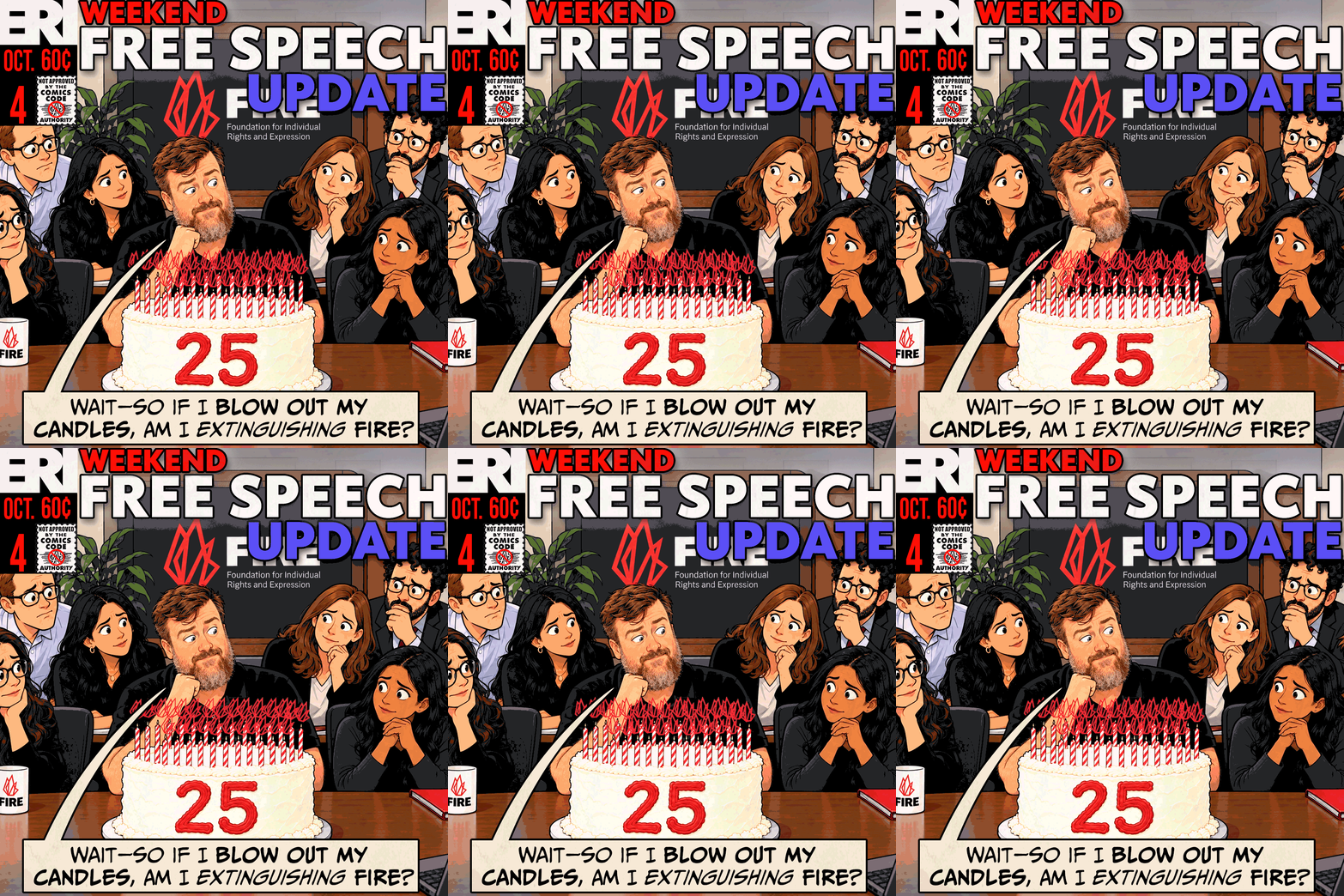
I celebrate 25 years at FIRE!
It’s at once hard to believe it’s already been 25 years and, given the job, to feel like that’s way too short a time. I feel like I’ve gotten to be 20 different people since I started at FIRE. I was hired at 26, had just turned 27 by my first day of work, and the following 25 years have included some of the hardest years of my life and many of the best.
But here I am, having gone from working with five other people to a team of 140 of the best and most principled people in the business, getting to do the work I went to law school specifically to do.
So after 25 years, what are my plans for the rest of my career? More, harder, bigger, smarter.
FIRE has become an important force for good in the United States and for the future of free speech, and I want to make sure we remain one. I want us to reach more people, help more people who are censored, create even better precedent, and help educate a generation—or more—about the eternally radical idea of free speech and why we must never take it for granted.
Thanks to everyone who helped make these amazing 25 years possible. And given that my dad just turned 100 and seems to be doing pretty well, I’m aiming for another 50.
A federal agency cannot require universities — public or private — to punish constitutionally protected speech. Nor should it pressure institutions to abandon important procedural protections when they are needed most: when students are facing potentially life-altering disciplinary sanctions.
This week in Expression
It was never just about keeping kids off social media by Sarah McLaughlin
Pepperdine banned a professor who taught about a black Jesus by Zach Greenberg
The First Amendment does not obligate the president to open up any area of the White House to reporters. But once the White House does create a space for the press to gather news and ask questions, it can’t exclude reporters “merely because public officials oppose the speaker’s view.” And even policies that are reasonable and neutral on their face, such as protecting national security, are unconstitutional if they lack factual support or the government uses them as a pretext to punish disfavored speakers.
FIRE in the press!
The First: Free Speech at a Crossroads feat. Bob Corn-Revere
Why ‘Let’s go, Brandon’ is worth a legal fight (WaPo) by Conor Fitzpatrick
Administrators may stop students from substantially disrupting the school day, encouraging drug use or engaging in “vulgar and lewd” speech. But a school’s authority to censor students’ political speech starts and ends there. “Let’s go, Brandon” falls short of that standard.
Think Higher Education Has Clear Standards for Academic Freedom? Think Again (Education Next) by Patrick J. Wolf, Alex Wolf, & Nate Honeycutt
London Calling: Ronnie’s First Amendment Roundup

New York federal court preliminarily enjoins enforcement of state law that bars basing residential rental property lease terms on algorithmic analyses
The U.S. District Court for the Southern District of New York has preliminarily enjoined a New York law that prohibits agreements not to compete with respect to residential rental dwelling units through the use of electronic systems, including AI-powered revenue management systems that recommend rent and occupancy levels to optimize property-owner revenue.
More plainly, the law makes it unlawful for rental property owners and managers to set or adjust lease terms based on recommendations from software that has a “coordinating function.” That means the law operates to bar systems that use computational software or processes—including using data to train an algorithm—to analyze historical or contemporaneous prices, supply levels, or lease or rental contract termination and renewal dates of dwelling units, collected from two or more owners/managers, in order to recommend rent rates, renewal terms, occupancy levels, and/or other lease terms and conditions. In effect, the court observed, the law prohibits protected speech, namely, algorithmic pricing advice, by making resulting recommendations an unlawful agreement. So, after finding RealPage has standing to bring a First Amendment challenge on behalf of itself and its customers, the court held RealPage is likely to succeed on the merits of its claim and is entitled to a preliminary injunction, though it “is a close call.”
Noting “the crux of RealPage’s business model is the communication of pricing recommendations to its users,” the court held that, even though the law does not explicitly prohibit communications but rather commercial actors taking action based on algorithmic recommendations, the court accepted the claim that the law ultimately prohibits price recommendations. Based on this, it held that, although speech integral to price-fixing could conceivably be unprotected as integral to criminal conduct, RealPage engages at least in part in protected speech, as pricing recommendations can be separate and apart from price-fixing. The court then held that that speech—algorithmically informed recommendations of housing prices—is commercial speech, and that such recommendations based almost exclusively on public data are not per se illegal, so they constitute protected speech.
Applying the Supreme Court’s First Amendment test for commercial speech under Central Hudson Gas v. Public Service Commission, the court held the law’s targeting of software programs, based on legislative belief they increase rents and aggravate New York’s affordable housing crisis, rested on a substantial government interest, and it went on to assume the law directly advances that interest—in short, the court accepted the asserted harms are legitimate and that the law’s restrictions may alleviate them. But on the “closest and most pivotal question” of whether the law is more restrictive than necessary to advance the state’s goal, the court held that, although a state need not use the least restrictive means under Central Hudson, the obviously less restrictive alternative of limiting any statutory ban to software performing coordinating functions based only on non-public data from horizontal competitors indicated New York’s law is more restrictive than necessary.
As the court explained: “Whether one is considering a residential landlord or a manufacturer of widgets, there is nothing untoward about considering prices charged by competitors when deciding how to price one’s own product” yet, “as written [New York’s law] makes it unlawful for a residential landlord to accept the recommendation of a consultant hired to: collect public data regarding rental prices in the area, evaluate that data using software, and make a recommendation about optimal rent prices.” The court thus went on to grant the preliminary injunction, holding that “although Plaintiff’s loss of business claim does not move the needle,” because a First Amendment deprivation is likely, it has established irreparable harm, and securing First Amendment rights is in the public interest, even with compelling government/public interests on the other side.
International free speech stories of the week
I Questioned Transgender Ideology. Now I’m Facing Prison in France (The Free Press) by Dora Moutot
The goal of these lawsuits is to silence us, and unfortunately, it’s working. I’ve realized going on national television in France to share my perspective is simply no longer viable; the risks are just too high. I’m terrified of going to prison and being financially ruined, and I believe every woman who shares my views has gotten the same message: It’s better to stay quiet than risk what comes with speaking out.
[UK] Nandy says children’s social media ban only ‘staging post’ in online safety drive (The Guardian) by Alexandra Topping
Nandy has now vowed to go further. “We shouldn’t accept that this is the end,” the culture secretary said before her speech at the Labour party conference, which will be introduced by Georgia Harrison, a campaigner against image-based sexual abuse. “This is a staging post to what must be a very active interventionist state, policing and regulating the online space so that people are safe.”
She said the UK would be “pioneers of tech as a force for good” and would promote online spaces that were “genuinely safe, inclusive and empowering”.
[UK] Massive Attack’s Robert Del Naja arrested again at pro-Palestine protest (Paste) by Bea Isaacson
Massive Attack have been vocal and active in their support for Palestine since 1999, when they first boycotted performing in Israel. Just days before Del Naja’s arrest, in what is seemingly a thinly veiled weigh-in of the Ed Sheeran and Macklemore controversy, Massive Attack posted on Instagram that “entertainment can never be bigger than resisting the apartheid & genocide of fellow human beings. ‘Neutrality’ in the face of slaughter of more than 20,000 children can never be neutrality.”
Interview of the week
It was great joining Vox’s Today, Explained to talk about the free speech crisis in higher ed and beyond. My segment is toward the end of the episode, and we talked about a recent case at Texas Tech, the broader backlash against expression celebrating Charlie Kirk’s death, and the Trump administration’s crackdown on free speech. Check out the full episode here.
A transcript would hugely improve the readability of the talk.
Both Dem & Rep/ Trump censorship should be resisted.
Dem media censorship of Rep opinions, thru the discrimination against hiring Reps in the media should also be called out.