


Stories of the week
“In America, free speech doesn’t just belong to the people who say things the government agrees with,” said FIRE attorney Conor Fitzpatrick. “Today’s ruling proves that free speech isn’t a privilege, but the inalienable right of every man, woman, and child.”
Judge Noël Wise of the United States District Court for the Northern District of California wrote in her opinion that “in the United States, freedom of speech belongs to the people. It is not the government’s to take.”
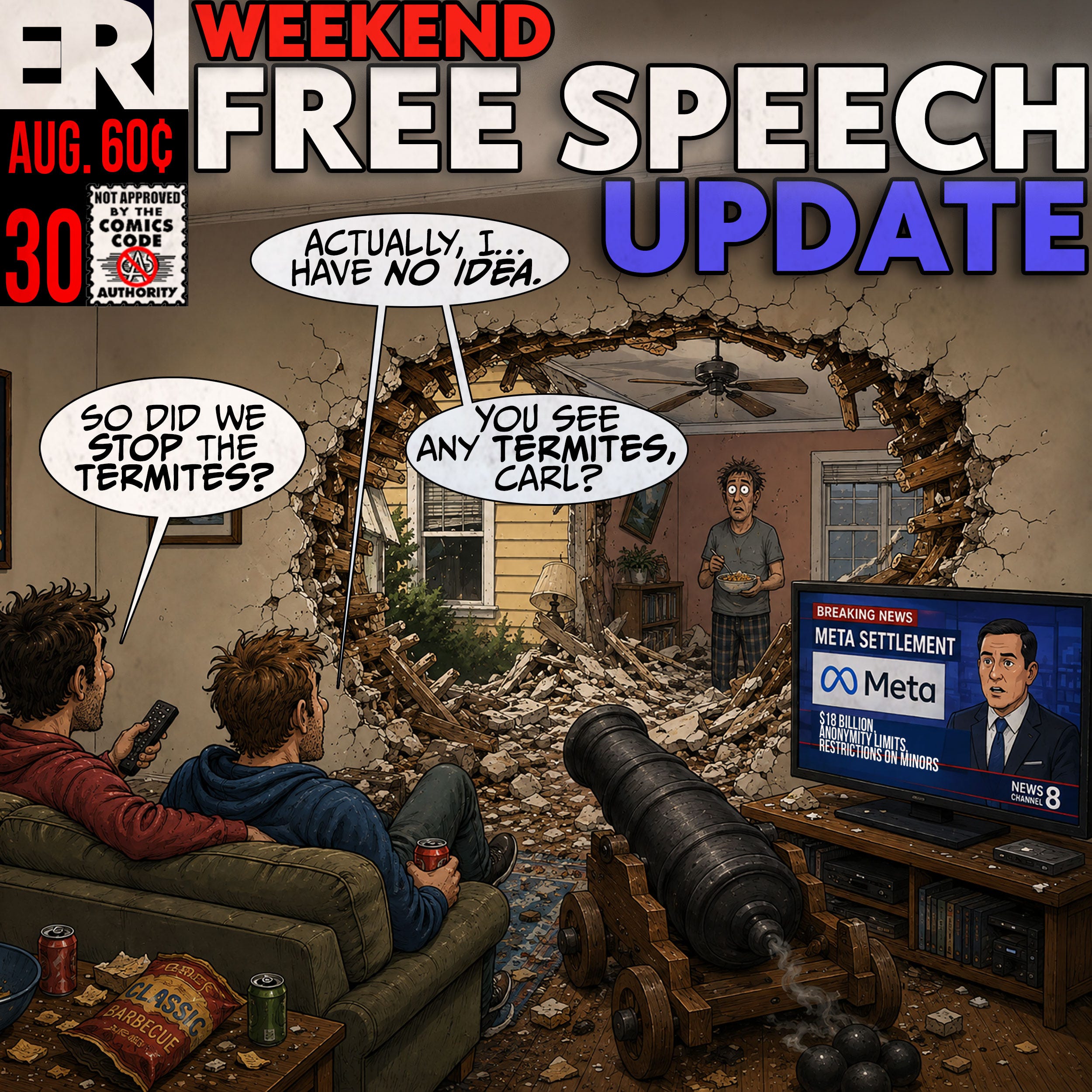
Meta Just Paid Nearly $17 Billion To Make Sure It Gets To Write The Kid Safety Rules For Every Other Social Media Platform (Techdirt) by Mike Masnik
That $17B Meta settlement comes with a catch: Your online speech rights
This Federal Case Against Minnesota Protesters Is Worth Watching if You Care About Your Civil Liberties by Matthew Harwood
This week in Expression
How many times can you prosecute blasphemous speech under other laws until you effectively have a blasphemy law?
This isn’t just a hypothetical. It’s a question the United Kingdom is posing again and again as police and the judiciary crack down on offensive speech about faith. In the aftermath of the Hamit Coskun saga — in which Coskun was violently attacked after burning a Quran and initially convicted by a judge who cited the attack as evidence for Coskun’s misconduct — more cases now suggest Britain has resurrected the concept of blasphemy under other names.
Stripes has always focused on “warfighting.” That’s not what’s at issue. What is in dispute is whether those boys at Hamburger Hill had the right to know what they had survived just as well as their mothers back home. It’s a dispute about whether the paper will continue to represent a beacon of press freedom within the world’s most powerful military.
Massachusetts has a better approach for book challenges: due process by Isabelle Brito
Nebraska school district censors anti-ICE cartoon, forces prior approval on student press by Marie McMullan
This Michigan city threatened critics over ‘cyberbullying.’ Now it’s hiding the evidence by Carrie Robison (helloiamcarrie)
This week on So to Speak
This week, So to Speak host & FIRE EVP Nico Perrino was joined by America First Policy Institute’s Senior Fellow, AI and Emerging Technology Policy Joel Thayer and Center for Democracy and Technology’s Director, Free Expression Project Kate Ruane to discuss the growing push to regulate social media and AI, particularly over concerns about harms to children. Together they examine how proposals involving platform liability, privacy, design features, and AI chatbots could collide with the First Amendment and reshape free speech online.
London Calling: Ronnie’s First Amendment Roundup
Another busy week with enough decisions of note — in particular here, a couple of appeals court reversals and a couple of district court judgments — that we’re hitting them lightning-round style:
Fellers v. Kelley: The U.S. Court of Appeals for the First Circuit remanded a decision by New Hampshire’s federal court in a challenge by parents alleging violation of their First Amendment rights for being ejected from a public high school girls’ soccer game after donning at halftime — and refusing to remove — pink “XX” wristbands in silent protest of the opposing team fielding a trans girl player, holding the trial court erred in denying a preliminary injunction based on the school’s asserted interest in preventing harassment. The court held on the “question at the center of this appeal” that “evidence demonstrates the likelihood that the school district imposed sanctions … because it disagreed with the protest message conveyed,” violating settled law that the government officials “must abstain from regulating speech when the specific motivating ideology or the opinion or perspective of the speaker is the rationale for the restriction.” The court thus declined to reach or rest its decision on whether analysis of the removal should treat high school playing fields as limited public fora versus applying constitutional rules for K-12 schools under Tinker v. Des Moines and its progeny, or to resolve whether those rules — applied to minor students on school grounds and at school events — govern school officials’ regulation of parental or adult speech. The court also rejected arguments that the school had a legitimate interest in restricting the parents’ speech because it might cause a disruption, as evidence showed there was no disruption from their “passive, silent gesture of protest,” at least not until school officials acted to remove them. And it held that the fact that there was “no evidence … any player actually saw the wristbands” undercut the district’s claim of a duty under Title IX to protect students from the speech. (FIRE’s amicus brief in the appeal emphasized the viewpoint discriminatory nature of the ejection and the inapplicability of K-12 rules for minors to adults.)
NetChoice, LLC v. Skrmetti: The U.S. Court of Appeals for the Sixth Circuit vacated and remanded a Tennessee federal district court’s denial of a preliminary injunction against the state’s Protecting Children from Social Media Act, which requires the platforms to verify the ages of prospective account holders, to obtain parental consent before allowing minors to sign up, and to give parents means of supervising their children’s accounts. It held the district court erred in deeming the loss of First Amendment rights by NetChoice’s members under the Act insufficiently certain and immediate (and by thus not fully grappling with the Act’s constitutionality), because in the appellate court’s view, the Act’s enforcement mechanism and statements by the AG in litigation showed that if it causes harms from violation of NetChoice members’ rights, those are likely to occur, not remediable at final judgment, and immediate. It also held the district court erred by discrediting assertions by some NetChoice members that they would be irreparably harmed by unrecoverable costs of complying with the law.
Stanford Daily Publishing Corp. v. Rubio: A federal district court in Northern California entered judgment granting constitutional challenges to two Immigration and Nationality Act provisions that plaintiffs allege are weaponized to revoke visas and to arrest, detain, and deport noncitizens who express opinions the government seeks to suppress. The court found standing for the Jane Doe plaintiff to challenge the provisions insofar as she is self-censoring—including decreasing or eliminating expression supporting Palestinians, criticizing American foreign policy, or opposing the Israeli government—given government pursuit of speakers like Mahmoud Khalil, Rümeysa Öztürk, and Mohsen Mahdawi for similar expressive activity, and that Stanford Daily also had standing as it “recounted myriad examples of its noncitizen members who … since the government began taking immigration enforcement actions … have: ‘quit Stanford Daily,’ ‘taken down’ or asked Stanford Daily to remove their articles, and decided against publishing articles in the first place.” The court then held plaintiffs are entitled to a declaratory judgment that, as applied to enforcement based on protected speech, the challenged INA provisions violate both the First Amendment and the Fifth Amendment’s bar against vague enactments (but it did not grant an injunction, as one of the provisions restricts all courts but the Supreme Court from doing so, and the court deemed declaratory relief sufficient as to the other, absent efforts to enforce against the plaintiffs).
The court held plaintiffs could properly bring an “as-applied facial challenge” to the provisions as applied to protected speech, and that while “the government has significant authority on matters of foreign policy and … national security,” that “authority is constrained by First Amendment rights.” Here, the court held, the challenged provisions do not work to restrict any category of unprotected speech, and the government did not establish any compelling interest separate from targeting noncitizen speakers with disfavored viewpoints, nor did it narrowly tailor the provisions to achieve any such interest. The court also held, on vagueness, that not only do the challenged provisions fail to provide noncitizens of ordinary intelligence fair notice what is prohibited, they are designed to give the Secretary of State broad discretion over what is adverse to U.S. foreign policy, so as to be so standardless as to allow discriminatory enforcement. As the court ultimately noted: “In the United States, free speech, including the freedom to criticize the government and its leaders, is not a sign of our democracy’s fragility. It is evidence of its strength. That strength is diminished when members of our society — citizens and noncitizens alike — must self-censor and ‘behave’ or suffer the government’s retaliation.” FIRE led the charge in the challenge.
Anthropic PBC v. U.S. Department of War: The Northern District of California also granted judgment on the challenge to President Trump and Secretary of War Hegseth designating Anthropic as a supply chain risk to national security, ordering all agencies to stop using its products, and banning all defense contractors from doing business with it (even if unrelated to military), after the company refused to remove certain safeguards from its Claude Gov AI and spoke out publicly in opposition to the demand that it do so. The court held the “undisputed record shows” the challenged actions were unlawful retaliation in violation of the First Amendment, Anthropic was denied pre-deprivation process the Fifth Amendment requires, designating it as a supply chain risk violated the governing statute, and the action was arbitrary and capricious. On the First Amendment violation, the court held the form and the timing of the challenged actions show they were a direct response to Anthropic’s public repudiation of the government’s demands, and that the government’s effort to “publicly broadcast Anthropic’s punishment via social media — even before the formal, administrative process of making the necessary findings to designate Anthropic a supply chain risk had begun— makes little sense except as an attempt to swiftly make a public example of Anthropic for daring to criticize the Administration.” (An amicus brief FIRE filed with the Electronic Frontier Foundation, Cato Institute, Chamber of Progress, and First Amendment Lawyers Association in support of Anthropic’s TRO motion further outlines the constitutional concerns.)
International free speech stories of the week
UK: Chinese embassy guards ‘brandish shock weapons at protesters’ (The Telegraph) by Gwyn Wright
New Zealand: New Zealand to introduce bill for under-16s social media ban (BBC) by Amy Walker
A statement said that under the Online Safety Bill, which is being introduced to parliament on Monday, social media companies would be required to “take reasonable steps” to check users are over the age of 16 by using methods including existing account information, facial age estimation and digital identity checks.
Platforms regularly used by children would also be required to regularly assess the risks they pose and report on how they are being identified and reduced.
No penalties are proposed for children, parents or caregivers for breaches of the ban, but fines for social media companies could be substantially higher than in Australia, where the maximum penalty is $99m (£51.7m).
European Court of Human Rights rules Türkiye violated Osman Kavala’s free speech and assembly rights (Jurist News) by Derren Chan
Documentary of the Month
I recently watched Marty, Life is Short, the definitive documentary about Martin Short, and it really made me appreciate him more. I was always a Martin Short skeptic, to be honest. Ed Grimley wasn’t my thing and for a while there he made a lot of terrible movies (a point joked about in the movie as he was someone who just liked to keep working and experimenting).
But watching this documentary made me realize that actually I had underestimated him. Part of the reason I didn’t recognize his great talent was because he was not a standard comedian. He was more of a comic actor, and it was through his characters that he really shone.
“The Queen Haters” (a jab at the Sex Pistols) is a sketch I actually thought was from The Kids in the Hall when I first saw it. I always thought it was funny as hell, but didn’t realize it was Martin Short!
His character in the male synchronized swimming SNL skit from the mid-1980s is so well done, too. “ I’m… I’m not a strong swimmer.”
And then, of course, there’s Jiminy Glick. So many hilarious moments — like when he asked Mel Brooks, “What’s your big beef with the Nazis?” Or that time he asked Steven Spielberg, “When are you going to do the big one?”
It’s just so good.
So consider this my mea culpa on not having recognized Martin Short’s brilliant comedic mind up until now. I really enjoyed Marty, Life is Short. It’s also, it should be noted, an extremely interesting story of a life, and a heartbreaking love story. And as a bonus, I discovered that Rick Moranis and Eugene Levy once did a Canadian take on “Girl from Ipanema.”
The YouTube stub of the Martin Short documentary (leading to Netflix) has some wonderful comments about the man.
I think the deportation ruling will eventually be overturned