


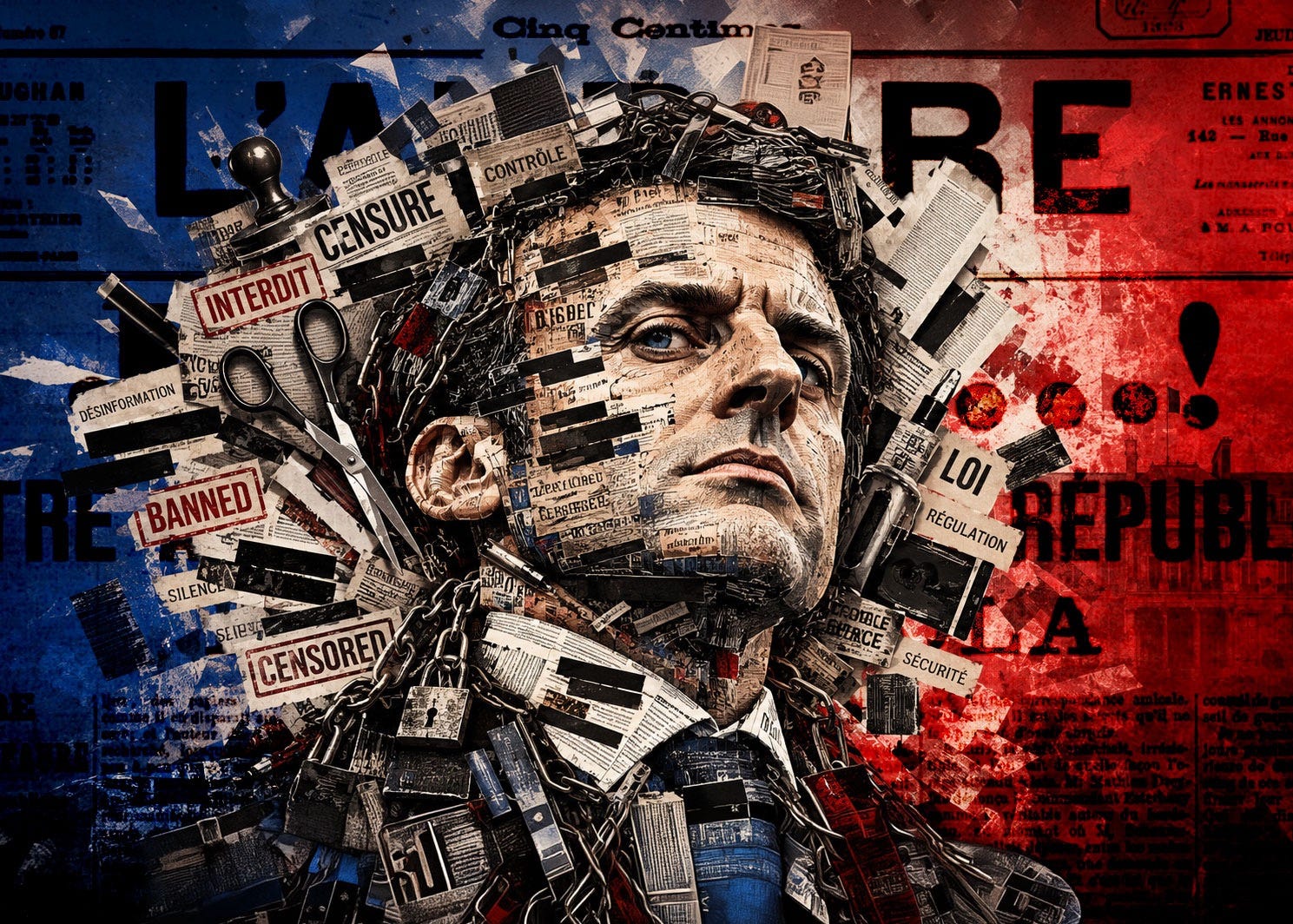
On Saturday, the 19th century town hall of Limoges, France was mostly destroyed in an act of arson. Protestors (some of whom presumably were involved in setting the fire) blocked firefighters from the site, according to the Interior Ministry. Today, the building sits gutted in what a regional official called a “catastrophe for heritage.”
Yesterday, Macron banned protests for the next few days, except for those held by trade unions.
Watching the flames take down the town hall, I couldn’t help but remember what Macron said about American free speech just a few weeks earlier. He was responding to a long-ish question about the enforcement of the EU Digital Services Act that asked, ultimately: “Do you believe that Europe has the necessary tools to combat third-party companies that are failing to protect our citizens from abuse, child abuse, or attacks on democracy?”
And in his response, he effectively said that the kind of free speech we have in America is the kind that would produce the destruction he’d be dealing with in a few weeks time.
You can find the original French exchange on the presidency’s website. Let’s look at what Macron said about American free speech, translated (note that, where italicized below, he said the words in English):
Thank you very much. First point: so-called American free speech — or rather, the version today that some people have been promoting — is the opposite of free speech. There is no freedom unless there is a limit on my freedom, one that begins with the freedom of others and respect for a common framework. I know this when I walk down the street: my freedom cannot be to hit you, to insult you, or to trash the space we all share. That is the idea some people have of free speech. So there is freedom when there is respect for the freedom of others and, ultimately, for what we call public order. Within that public order, there has to be some handling of information. That’s the first point, because there is a relationship to truth.
Macron then continued on to talk about the importance of imposing liability on reporters and editors who publish n’importe quoi (nonsense) online. Color me shocked that Macron doesn’t like people saying mean things on the internet. But more on that later.
So Macron starts by saying he’s only talking about a version of American free speech that some people have promoted. But then, twice, he attributes characteristics to this “version” that are actually true of American free speech: that it protects the right to insult others, and it protects the right to publish what he calls “nonsense.” So apparently he wouldn’t like the real thing, either?
Then he says people who espouse this “version” of American free speech believe it protects: “to hit you, to insult you, or to trash the space we all share.” That’s quite a sandwich: two things no rational person thinks are speech, with a crucial element of protected speech in the middle. I have a hard time believing Macron believes anyone would call assault or trespassing “free speech.” Doing that is like calling Saturday’s fire a French version of urban renewal.
We do, however, protect the right to offend others. The American model continues to protect speech, however insulting, until the words reach the point of incitement to imminent violence. Given that President Macron’s country is in convulsions of violence this month, I’m skeptical of the implication that the French model accomplishes a protection not offered by the American one.
We have riots too, of course. Having laws against something doesn’t magically prevent it. But President Macron seemed to be saying that the confusion of speech and violence is something derived from the American model of free speech. I would suggest the inverse is true: that the French willingness to put restraints on speech and violence on the same continuum encourages the public to think of speech and violence as interchangeable — and therefore make the transition from the former to the latter much more likely.
After all, if you can be prosecuted for your words, are you actually worse off if you’re prosecuted for destroying a bus stop? And hell, that calculus really changes when you’re able to grab a Louis Vuitton bag for free as well. That is the line that the American free speech model reinforces with a clear rule, and it is that line which the French model weakens.
And apparently, it’s a line that even French politicians have trouble finding and following.
The French government’s occasional affair with truth
Gabriel Attal, former Prime Minister of France and Renaissance’s official 2027 candidate in the upcoming elections (the same party as Macron), called for blocking social media in areas where riots are going on. It’s a tool he used in 2024, when he blocked TikTok in New Caledonia during riots following the Parisian plan to extend voting rights to more people, which Kanak independence supporters feared would dilute the self-determination of natives. France’s highest administrative court, the Conseil d’État, later ruled that the block was a disproportionate infringement on the freedoms of the people affected.
Attal wants to have the same power deployed temporarily, in limited areas. But in a nationwide protest, where would those lines be drawn? And is blocking the ability to coordinate a protest so important that it merits cutting off the ability to warn others to leave the area? What makes the French government think that blocking social media stops coordination on WhatsApp, Signal, or even decentralized apps like Session or Onionshare? Is the French government really interested in stopping riots, or stopping the public from hearing about them?
Through the lens of American free speech, we would try to determine if the social media communication is coordinating a protest or inciting actual violence. Then, we would target the speech actually doing that incitement, if such posts existed. It is hard to imagine blocking social media, writ large, in the name of stopping activity implicated by a very small portion of it. Even America’s most enthusiastic censors haven’t proposed turning off social media entirely.
As for President Macron’s concerns about targeting “nonsense” posted online, he will come to discover that the problem with threatening to punish misinformation is that it requires appointing an arbiter of truth. And the problem with appointing an arbiter of truth is that humans have a tendency to be not quite perfect. (Not me, of course. Y’all.)
Who would be the arbiter of truth, if Macron’s enhanced DSA enforcement came to pass? The French courts, first and foremost, in the model of existing press law. In the offline world, a journalist publishing incorrect information in Europe could face conviction, a mandatory right of reply, or a forced retraction. Macron wants that extended to the online world. Next up would be DSA regulators — Arcom in France and the Commission itself in Brussels, which he wants to move much more quickly and forcefully. And finally, Macron would want to rely on tiers de confiance — trusted third parties, with algorithmic transparency.
But the French government should know well that neither it nor its regulators have a clear vision of truth, any more than the rest of us do. (Besides me, of course. Y’all.) In 2020, the French government said masks for the general public were useless to stop COVID. Within months, they were mandatory. A Senate inquiry later found the government had knowingly concealed a mask shortage. In 2020 and 2021, platforms and fact-checkers called the lab leak hypothesis misinformation; more recent analysis finds it at least plausible. In 2023, much of the press reported a supposed Israeli strike on a hospital that intelligence assessments ultimately attributed to a misfired Palestinian rocket. Which version of reality would’ve been enforced might well depend on when you asked.
This matters, particularly to the people who end up in the crosshairs. In the early 2000s, French courts wrongly convicted innocent people of child abuse in the Outreau affair.
And as long as we’re talking about affairs, the Dreyfus affair, a 12-year ordeal rooted in France’s deep antisemitism (how’s that going, by the way?), is as good an example as any for how governments deal with the search for truth. In 1894, French officials found a torn-up memo in the trash that revealed someone was passing military secrets to Germany. Suspicion fell on Captain Alfred Dreyfus, a Jewish artillery officer. He was convicted in a military tribunal where the judges were shown a secret folder of “evidence” not provided to his defense. Dreyfus was sent to Devil’s Island with a life sentence.
Two years later, a new head of French army intelligence realized the real traitor was someone else, a Major Esterhazy. What did the French army do? Well, they transferred the intelligence chief to Tunisia and had another officer forge documents to strengthen the case against Dreyfus.
While all of this was going on, pieces of the story were leaking out to the press. One of those pieces was the reassembled torn-up memo. A banker recognized the handwriting as belonging to Esterhazy. The banker contacted Dreyfus’ brother, who publicly accused Esterhazy.
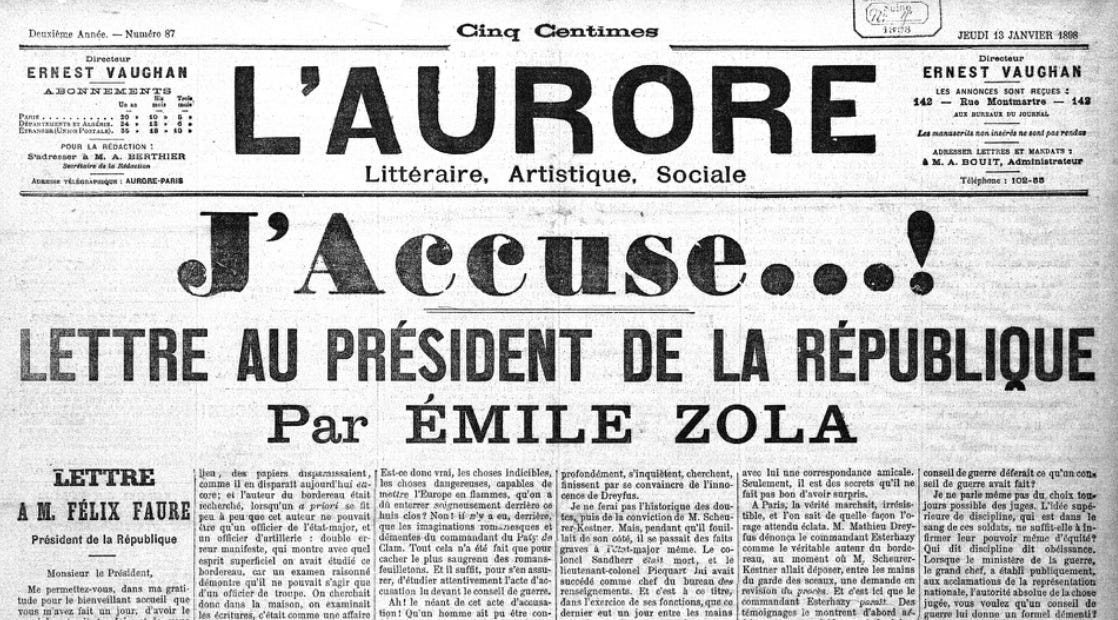
In 1898, Esterhazy was court-martialed and acquitted within minutes. Two days later, the novelist Emile Zola published an open letter to the President of the Republic, titled, J’Accuse! (French and the English translation in the link.) In it, Zola named the officers involved in the cover-up. But he did more than accuse the Republic, he dared them:
In laying these charges, I am aware that I am putting myself under the umbrella of articles 30 and 31 of the press law of July 29, 1881, which punishes crimes of defamation. And it is voluntarily that I expose myself…
I have only one passion, that of light, in the name of humanity which has suffered so much and which has the right to happiness. My fiery protest is only the cry of my soul. So dare you put me on trial and let the investigation take place! I wait.
So you might think the French government would give up the game. Nope! They put Zola on trial but limited the case to the lines accusing the government of ordering that Esterhazy be acquitted. Zola was convicted of criminal libel under France’s 1881 press law, which is still on the books, and would ultimately flee to England. But the truth was now in the public consciousness.
Shortly after Zola fled, he was joined in England by none other than Esterhazy, who confessed to being the author of the memo. In 1899, the French government held a second court-martial for Dreyfus, who was convicted again. The French president pardoned him. It was only in 1906 that France’s highest court annulled the conviction and reinstated Dreyfus. That court summed up the government’s commitment to truth: “In the final analysis, nothing remains standing of the accusation brought against Dreyfus.” Later that year, Dreyfus received the Legion of Honor in the courtyard where he’d been stripped of his rank.
Macron knows this history well. In July, he presided over France’s first national day commemorating Dreyfus’ exoneration. When talking about the necessity of the government correcting its mistakes, he said, “this insistence on truth belongs to no era; it is permanent.” He also said that “Zola was convicted in a way that was as unjust as it was stupid.” And then a few months later, he proposed extending laws like the one used against Zola to a new century of gadflies who won’t accept the government’s official position.
How France does ‘free speech’ and why it doesn’t work
So no, the version of American free speech Macron describes is not actually how American free speech works. But what about his version of French free speech? Perhaps the most important precedent is the French Revolution’s 1789 Declaration of the Rights of Man. Article four states that “Liberty consists in the freedom to do everything which injures no one else.” Article 11 promises freedom of speech while noting that people “shall be responsible for such abuses of this freedom as shall be defined by law.”
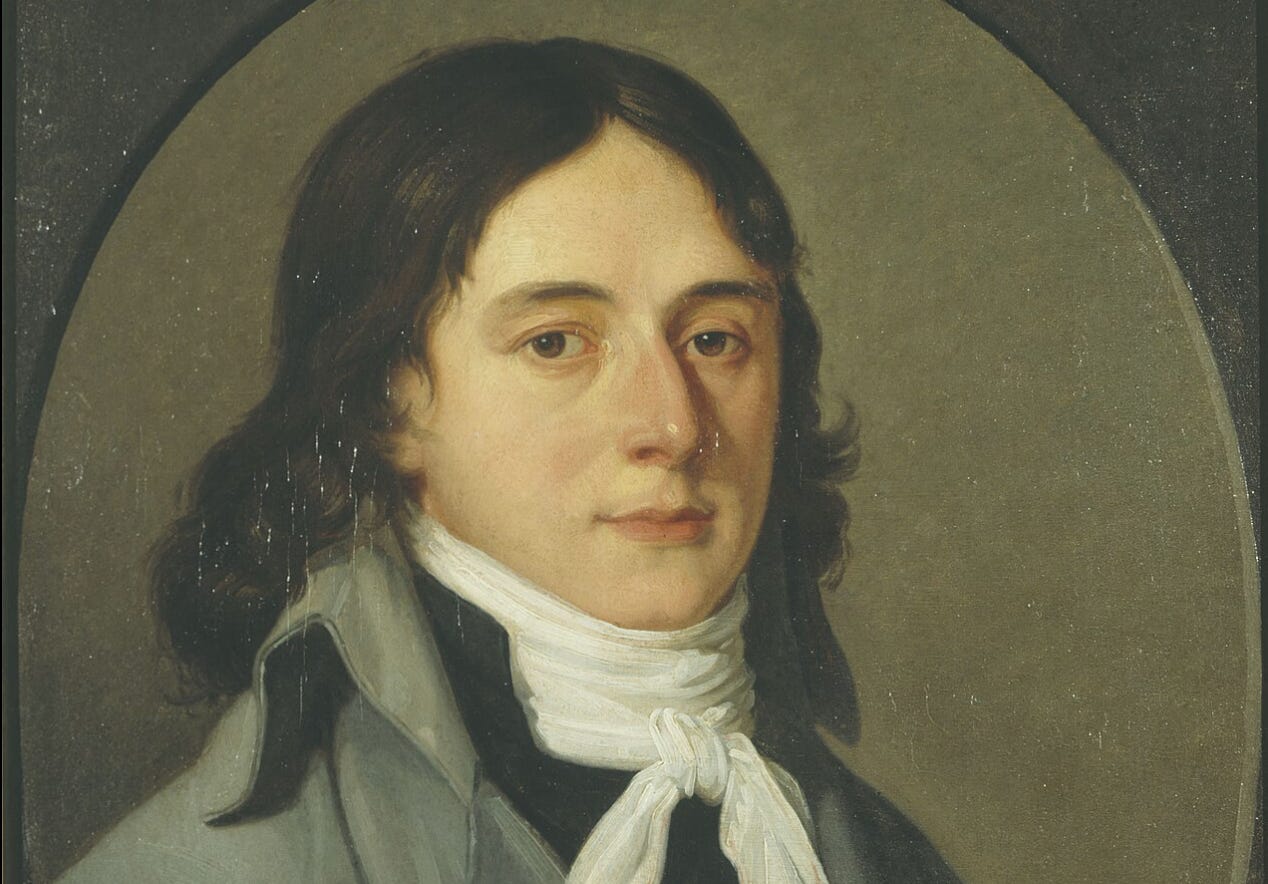
The journalist Camille Desmoulins was an ardent defender of the Revolution; his speech at the Palais-Royal helped spark the storming of the Bastille. Within five years, he was guillotined at the instigation of the Committee of Public Safety after publishing “nonsense.” He had started to criticize the Terror’s executions, you see.
Desmoulins learned a hard lesson: For the government, the truth will always turn out to be whatever is in the interest of the people running the government. For Macron, that interest might include expanding the reach of his family’s attempts to punish people who insult his wife online. Expanding the DSA’s reach might let them go after platforms, too. Quelle surprise that Macron’s smug rationalization in favor of censorship just so happens to align with his personal interest.
Whatever we want to call that interest, it is not the same as objective truth. It’s not the kind of truth newspapers strive for, and even then fail routinely to attain. The reason why newspapers are the “first rough draft of history,” as the quote oft-attributed to Washington Post publisher Philip L. Graham goes, is that rough drafts have mistakes. And it is precisely because knowing actual truth is rare that we must not, in a civilized society, condition the right to speak on a notion of truth that only time has the ability to vindicate or condemn (and me, of course. Y’all.).
As Greg has said, one of the great realizations in human history is that truth is shockingly difficult to know. And as many studies have told us, we are shockingly bad at being impartial arbiters of it. We engage in motivated reasoning, are quickly swayed by misinformation, and build suspicion or credulity based on affinity groups faster than we do on objective facts. Macron’s statement that there must be “handling of information” in a “public order” thrives in the passive voice but fails as soon as you decide who handles the information. That’s the naive part of Macron’s framework: he articulates a perfect system of speech regulation, as long as you never insert a human into it.
But we don’t live in hypotheticals, and in the real world, tolerating untruth is the cost of a real commitment to truth. Learned Hand summarized it best when he said that “the spirit of liberty is the spirit which is not too sure that it is right.” France needs a model of free speech more like that. It needs a model that tolerates insults, that draws a bright line between anger and arson, and that mistrusts its own instinct to dictate truth. What France is currently doing clearly isn’t working — not because the French misunderstand what Americans mean by free speech, but because they understand all too well what Macron means by it.
SHOT FOR THE ROAD
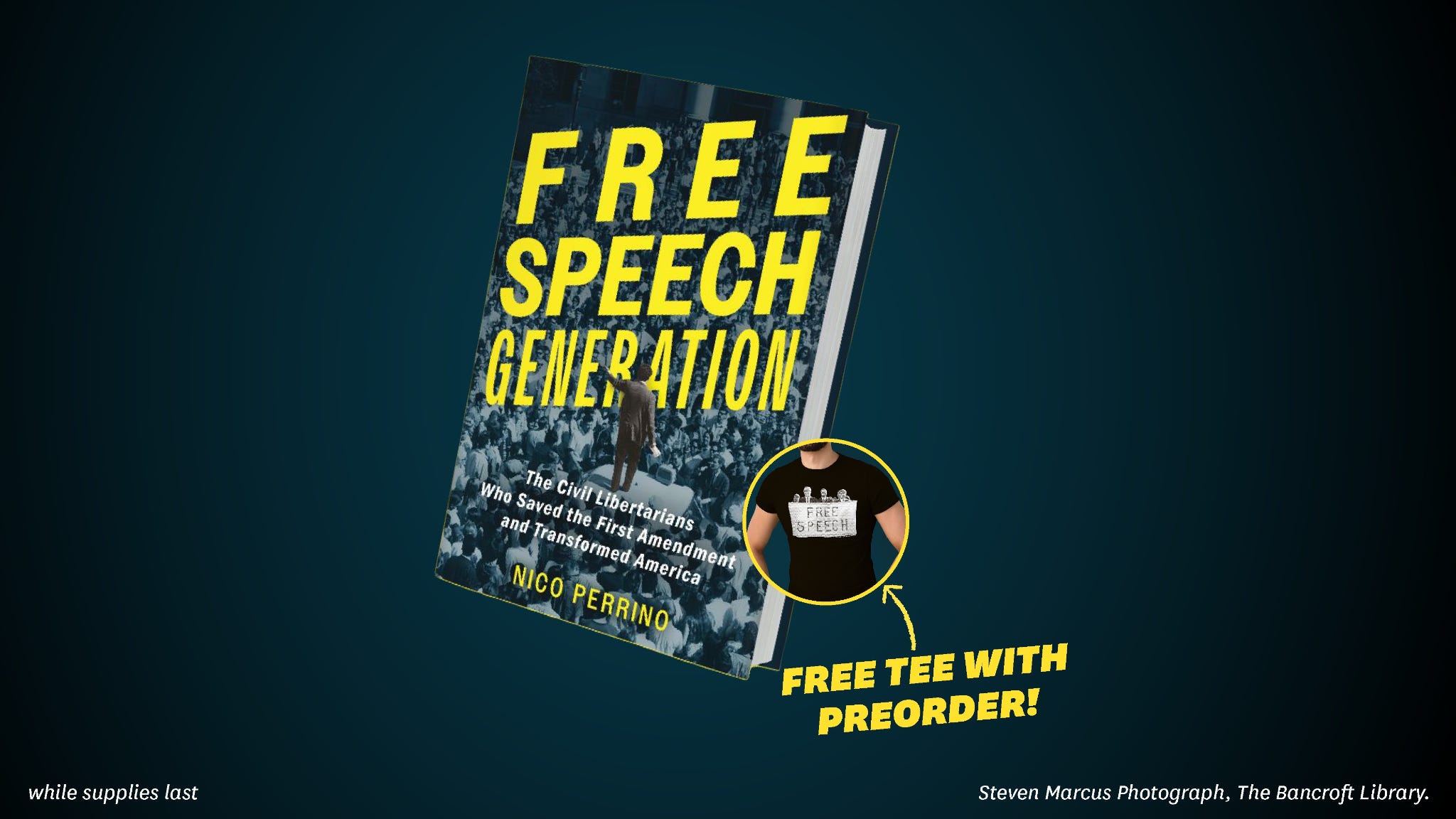
What’s better than a fantastic new book on free speech? A fantastic new book on free speech that comes with a FREE t-shirt when you pre-order it!
Ladies and gents, FIRE Executive Vice President and host of the So to Speak podcast Nico Perrino’s debut book, Free Speech Generation: The Civil Libertarians Who Saved the First Amendment and Transformed America, is due out in January, but pre-orders are available now!
Pre-orders do a ton to help a book succeed, so if you’d be so kind as to pre-order the book in your chosen format, you’ll receive an awesome Free Speech t-shirt as an early bird gift from FIRE. All you have to do is submit your receipt to the online form on FIRE’s site, and the shirt is yours!
This offer only stands while supplies last, so get yours today!
Macron isn't wrong, he's anti-American and that plays well with the French public.