

Story of the week
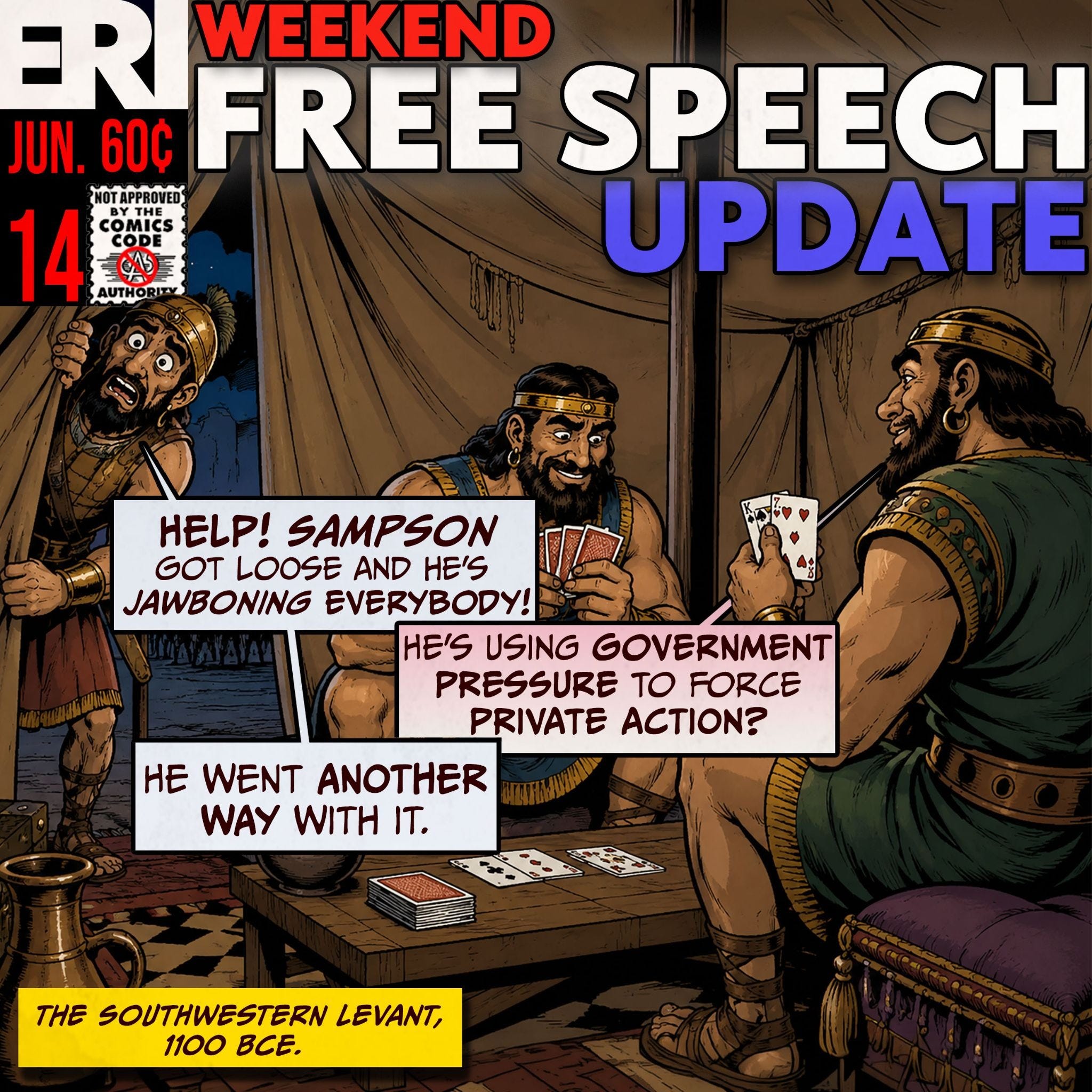
If the JAWBONE Act becomes law, Americans will be able to sue federal officials for violating the First Amendment when they coerce social media companies, AI platforms, or broadcasters to change or take down protected speech. If the federal official did the jawboning “willfully and wantonly,” they’ll have to personally pay the damages. (Otherwise, the government will pay on their behalf.) That means federal employees will be personally incentivized to make sure they’re staying on the right side of the First Amendment when they reach out about speech on social media, AI platforms, TV, or radio.
This week in Expression
We’re not surprised to see a proposal like this filled with ambiguities and holes. As states have attempted to turn around the losing streak social media regulation has faced in court, we’ve seen a number of half-baked schemes to find some kind of creative workaround. States have tried to avoid scrutiny by casting their speech restriction as regulating “design choices,” by targeting platforms through the app store, and by labeling their target “conduct” rather than “speech.”
Woodrow Wilson: America’s worst president for free speech by Angel Eduardo
For now, censorship stays at the University of Alabama by Marie McMullan
American Diabetes Association ejects researchers from conference for sharing editorial from its own journal by Aaron Terr
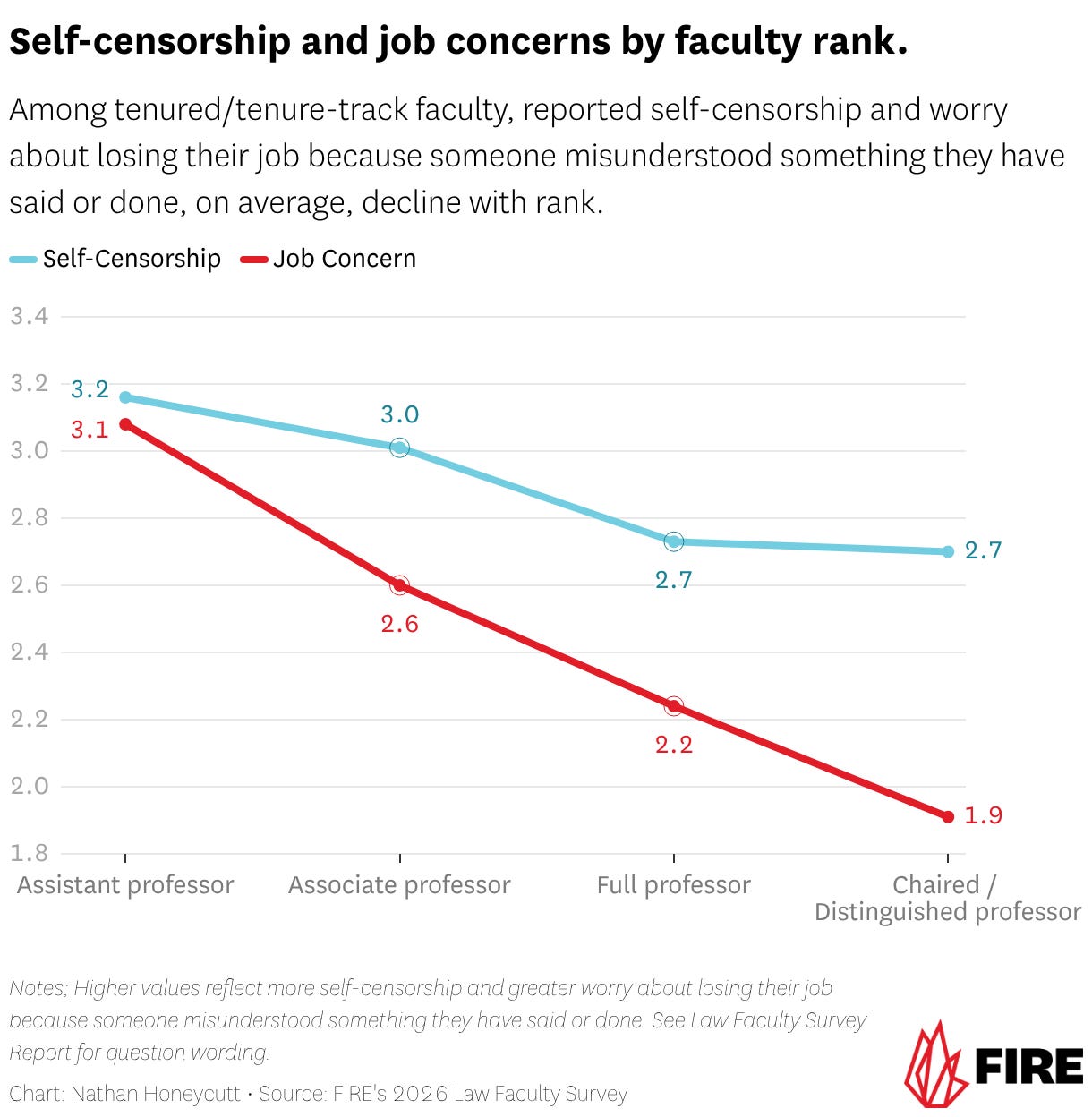
The law faculty who self-censor the least are not the ones you think by Nate Honeycutt
This week on So to Speak
This week, So to Speak host & FIRE EVP Nico Perrino sat down with rainey reitman, author of Transaction Denied: Big Finance’s Power to Punish Speech, to talk about “what happens when people are denied access to financial services because of their lawful speech and conduct.”
This week in FIRE’s blog
Auburn’s governing overhaul guts accountability by Graham Piro
FIRE endorses Senate bill that would prevent government coercion of protected speech
FIRE in the press!
Law Professors Say They Support Free Speech. Many Are Afraid To Practice It (Daily Wire) by Nate Honeycutt
N.J. school ethics law has become a gag order. It’s time to change it (NJ.com) by Greg Harold Greubel
The European Court of Human Rights Is Betraying Its Purported Values (Persuasion) by Jacob Mchangama
London Calling: Ronnie’s First Amendment Roundup
Sixth Circuit rebuffs speech-restrictive open-meeting shibboleths while reinforcing the unconstitutionality of the heckler’s veto—and why it can’t be grounds for silencing speakers at local board and council public comment periods
The U.S. Court of Appeals for the Sixth Circuit reversed denial of a preliminary injunction, and ordered one entered, in a case by a local citizen whose remarks the president of the Xenia, Ohio, school board cut off during a public open comment period after she found them offensive, forcefully stated as much to the assembled open-meeting attendees, then used the heckles and boos fomented as grounds to recess the meeting before the speaker could finish. Doing so based on the speaker’s respectful criticism of the board and other local officials, the court held, likely violated her First Amendment rights, resulting in irreparable harm, and thus warranted the preliminary relief the lower court had denied.
In reaching its decision, the court rejected open meeting prohibitions on directing public comments to specific members of the body, ad hominem attacks, and remarks lacking “reasonable decorum” (beyond prohibiting those causing disruption, true threats, incitement, etc.), all of which, alas, are common in the rules of local boards and councils. Insofar as such a body uses those restrictions, imposed formally or simply in how it conducts meetings, because it deems such remarks offensive, the court held, the result is unconstitutional viewpoint discrimination. And that violates the First Amendment, the court explained, because a comment simply being directed to or about a specific official, or amounting to an ad hominem attack, does not make it unprotected.
But the court saved its greatest ire for the extent to which in cutting off the plaintiff the board president effected an unconstitutional heckler’s veto, i.e., a curtailment of peaceable First Amendment-protected speech to appease an audience that reacts disruptively and/or to stave off potentially violent action by them. The court first made clear that constitutional bar applies equally to limited public forums (like meetings restricted to board-related business) as it does traditional public forums (like public sidewalks and parks), because a heckler’s veto necessarily involves viewpoint discrimination that violates the First Amendment in any type of forum (or in the absence of one). In this respect, the court said, “several important throughlines surface regardless of the forum at issue” when it comes to the heckler’s veto:
When a peaceful speaker engages in protected speech and is confronted by a hostile crowd, the state may not silence the speaker as an expedient alternative to containing or snuffing out the lawless behavior of the rioting individuals. Nor can the government sit idly by as the crowd imposes a tyrannical majoritarian rule. It should take any appropriate action to maintain law and order that does not destroy the right to free speech by indefinitely silencing the speaker.
As cutting off plaintiff’s remarks based on reactions of the public meeting attendees—resulting primarily from instigation by the board president, no less—was unconstitutionally viewpoint-discriminatory, she was likely to succeed on the merits of her First Amendment claim and able to show irreparable harm, so a preliminary injunction against future violations lies.
(It’s also worth noting the decision includes a powerful concurrence featuring a thorough history lesson illustrating the heckler’s veto problem through the lens of pre-Civil War abolitionist speech, and several rousing paeans to the right of citizens to exercise their free speech rights, not to mention that its lead footnote explicitly cites FIRE missives to illustrate that: “In the modern day, we have seen our fair share of crowds stifling free speech and debate.”)
International free speech stories of the week
Signal, DuckDuckGo, and NordVPN threaten to exit Canada if metadata surveillance law passes (Techspot) by Daniel Sims
The latest version of Canada’s Bill C-22 would require digital services such as internet service providers, messaging platforms, email providers, and potentially hardware companies to retain up to one year of user metadata. In addition, tech companies would have to implement mechanisms that allow authorities to obtain “lawful access” to that information for criminal investigations.
Starmer gives tech firms ultimatum to block explicit images on children’s phones (The Guardian) by Rajeev Syal
The prime minister said tech companies must activate nudity-detection algorithms or other technical solutions on smartphones and tablets to prevent users taking photos or sharing images of genitalia unless they are verified as adults.
If businesses do not comply within three months, legislation will be brought forward requiring the protection to be added to all phones and tablets sold in the UK. Tech firms that fail to do so could face fines, and their senior managers could be made criminally liable.
Politician-insult law faces scrutiny amid some disagreement (GermanPolicy.com)
Landmark German ruling declares Google’s AI Overviews are Google’s own words and makes it liable for false answers (the-decoder.com) by Matthias Bastian
Podcast of the week
I always enjoy sitting down with Emily Jashinsky, and my recent interview on After Party was no exception. We talked about free speech in Europe and what America can do to avoid going down that very dark road, DEI in American higher ed, and a whole a lot more!
Give up your free speech at your peril. Once they are able to silence you, the game is over. The loss of all of your other freedoms will fall like dominos after. Anyone that advocates to censor you, or to unmask your anonymity is your adversary. Treat them like one - no matter what else they say.
But why is it so vital and necessary for the combined monolithic apparatus of government, corporations, and NGOs, to brute force censor everyone while decimating the careers and reputations of the dissenters? Here is why:
The reason the First Amendment is prime directive order 1, is because it is the most important freedom we have for the same reason it is the first target an adversary subverts, disrupts, and destroys during a crime, a war, or a takeover—preventing a target from assembling, communicating, and organizing a response to an assault grants an enormous advantage to the aggressors.
"If freedom of speech is taken away, then dumb and silent will be led, like sheep to the slaughter." —George Washington
The Second Amendment is second because it is the remedy for anyone trying to subvert the First.
----
"The 1-A is first for a reason. The 2-A is it's twin. Together they make a bond of freedom." —S.P.H.