


Early one gray morning in late April 2026, I found myself walking around Copley Square alone, cheering.
I was in Boston for a gathering of people from across the political spectrum worried about the future of small-l liberalism. The city had gone unusually cold overnight, which suited me fine. The Irish, British, and Russian parts of my family tree have never entirely understood why other people complain about gray skies. I went out for coffee before the conference sessions started, and it was just cold enough that I could occasionally see my breath whenever I laughed or took a sip. It made the effect more theatrical than the weather probably deserved, which was unfortunate for anyone hoping not to notice me. My laugh has never been accused of subtlety. To people crossing Copley Square, I probably looked like an overcaffeinated man listening to a playoff game.
But I was actually listening to Yale’s newly released Report of the Committee on Trust in Higher Education, which I had converted to an audio file from a PDF, something I do all the time (it lets me keep moving). And every so often, I literally cheered in response to what I was hearing.
Yale president Maurie McInnis had appointed ten faculty members to investigate why Americans had lost so much trust in higher education and what Yale itself ought to do about it. She also gave them wonderfully dangerous instructions for any committee: “think big, tell the truth, and entertain controversial ideas.”
They did.
The report confronted problems FIRE and I have been talking about for much of my twenty-five-year career: political homogeneity, free speech, self-censorship, grade inflation, administrative bloat, academic rigor, and the increasingly murky question of what all this enormous institutional machinery was actually for.
It cited a ratio of thirty-six registered Democrats to every Republican across Yale’s Faculty of Arts and Sciences, Law School, and School of Management. That’s bad, though hardly the worst in elite higher education. Nearly a third of Yale undergraduates did not feel free to express their political beliefs on campus. The median grade was an A. Yale’s published annual cost was $94,425 plus travel. And the real amount of money Yale spends per student per year is probably closer to $200K–which may sound nice until you realize how many students that amount of money could educate the hell out of if spent more judiciously.
But what had me cheering was the premise underneath the report, which was that maybe the public had noticed something.
This sounds like a very low bar until you’ve spent a quarter century watching higher education respond to criticism. I’ve often joked about what I call the Silver Spoon Rule. The name owes a little to the Golden Rule, but much more to the rules preferred by the silver-spoon set: It can never, ever, ever be elite higher education’s own fault… even when it obviously is.
And to my delight, Yale had broken the Silver Spoon Rule.
I found it genuinely moving. Vindication is pleasant, particularly after years of being told that things you could plainly see were exaggerated or somehow your fault for noticing. But vindication wasn’t really the emotion that had me making noises at strangers in Boston. It was hope. Ten professors at one of the world’s most powerful universities had been willing to consider that their institution, their profession, their colleagues, and perhaps they themselves had gotten some important things wrong.
That willingness is rarer than intelligence.
I came away thinking that maybe genuine reform of American higher education was finally possible. And then I thought about the headwinds and the many interests that want higher education to continue, or even deepen, its status-quo downward spiral.
And then I may have made an even worse decision: I decided to write a wee, little article about the chances for reform and how the higher-education mega-industry will protect itself. How badly could that go?
The summer vacation that wasn’t
My original idea for this project was a long article about Yale’s report, what I had learned during twenty-five years at FIRE, and why I thought this moment mattered so much. Back in August I started researching in earnest, when I was supposed to be taking something resembling a vacation.
I technically took time off, I just never stopped working.
Over the years of working closely with technology, I have learned that I can be in constant motion and keep writing and researching through a combination of listening to books, dictation, and now interacting with artificial intelligence, even when I’m at the gym. Now when something gets its hooks into me, I can leap out of bed and start working almost immediately, then keep going until I finally put my phone down at night. And having an AI research partner available at any hour removed even the modest restraint imposed by other people’s need to sleep. I did far too much of that over the summer. Unfortunately, knowing that and actually stopping are two very different talents, and I appear to have invested heavily in only one.
The subject also mattered to me too much to put down. My biggest fear is that we’ll squander a rare moment of genuine momentum toward reform, and the next opportunity won’t come until the next inevitable disaster caused by ideology, groupthink, and organized direct action. I don’t want to have to wait for another catastrophe before universities take seriously what they (and everyone) already know.
So I read obsessively. I went back to the campus culture wars of the 1980s and 1990s, to Neil Gross, John K. Wilson, Donald Downs, and, of course, Alan Kors and Harvey Silverglate’s The Shadow University — essentially FIRE’s founding document. I reread work I had been arguing with for decades and chased down new research on faculty politics, academic standards, grade inflation, governance, and how this gigantic industry protects itself. Then came the reports from Yale, Harvard, Vanderbilt and Washington University, and Cornell. I would find a study, chase its footnotes, and emerge hours later with three more books to read.
Michael Bérubé and Jennifer Ruth’s It’s Not Free Speech was particularly clarifying, though hardly in the way its authors intended. I had long favored giving faculty more power over academic governance instead of leaving everything to administrators. As I’ve written before, Bérubé and Ruth convinced me, rather abruptly, that some influential faculty weren’t the least bit interested in fixing the problems at all and would make them much worse if given greater authority to decide which views and which scholars were acceptable.
We’ve known an enormous amount about what needed fixing for fifty years, and I have spent my entire career talking about it. What I wanted everyone else to understand this time was why so much evidence, so many warnings, and so many perfectly foreseeable failures had produced so little lasting reform. The answer is that largely vested interests within higher education are incredibly skilled at kicking the can down the road, accusing their opponents of political cooties, and otherwise obscuring problems that everyone knew higher education had back when I was in grade school, aren’t really problems and… hey, everybody look over there!
The project kept growing. The article became a short book, threatened to become a long book, shrank into a proposed feature article, and then grew again because every round of cutting seemed to take away some of the best points and language. It was a process of expanding and squishing it back down, then expanding and starting fresh, only to expand again. Several times I was sure I was almost finished, which was an unusually persistent delusion.
I’ve always dictated essentially everything I write, so technology has long been part of my writing process. AI made the dictation much better, and I thought using it as a research and writing partner would make a big project go much faster. I suspect it actually slowed me down. It kept drastically rewriting me, bleaching away distinctive language and strong opinions and replacing them with the disembodied vaguely somewhat Greg-like gray mush. That was infuriating, but I learned some useful lessons about how to make AI improve my writing instead of trying to turn me into a particularly cautious committee.
Working through this history kept bringing me back to two connected ideas. One is Home-Field Advantage. Higher education is a trillion-dollar industry that produces, certifies, and polices much of what our society treats as authoritative knowledge. Its own experts often get to decide which criticisms of the industry count as serious, and far more powerfully which topics should be largely ignored or forced to jump through so many hoops that the critics just give up. And its customers include an extraordinary number of genuinely happy alumni, many of whom now occupy positions of power throughout American society. The institutions have enormous prestige, money, influence, and sentimental loyalty on their side. Try arguing against your own alma mater when half your friends went there, your boss’ name is on a building, and everyone is wearing the sweatshirt.
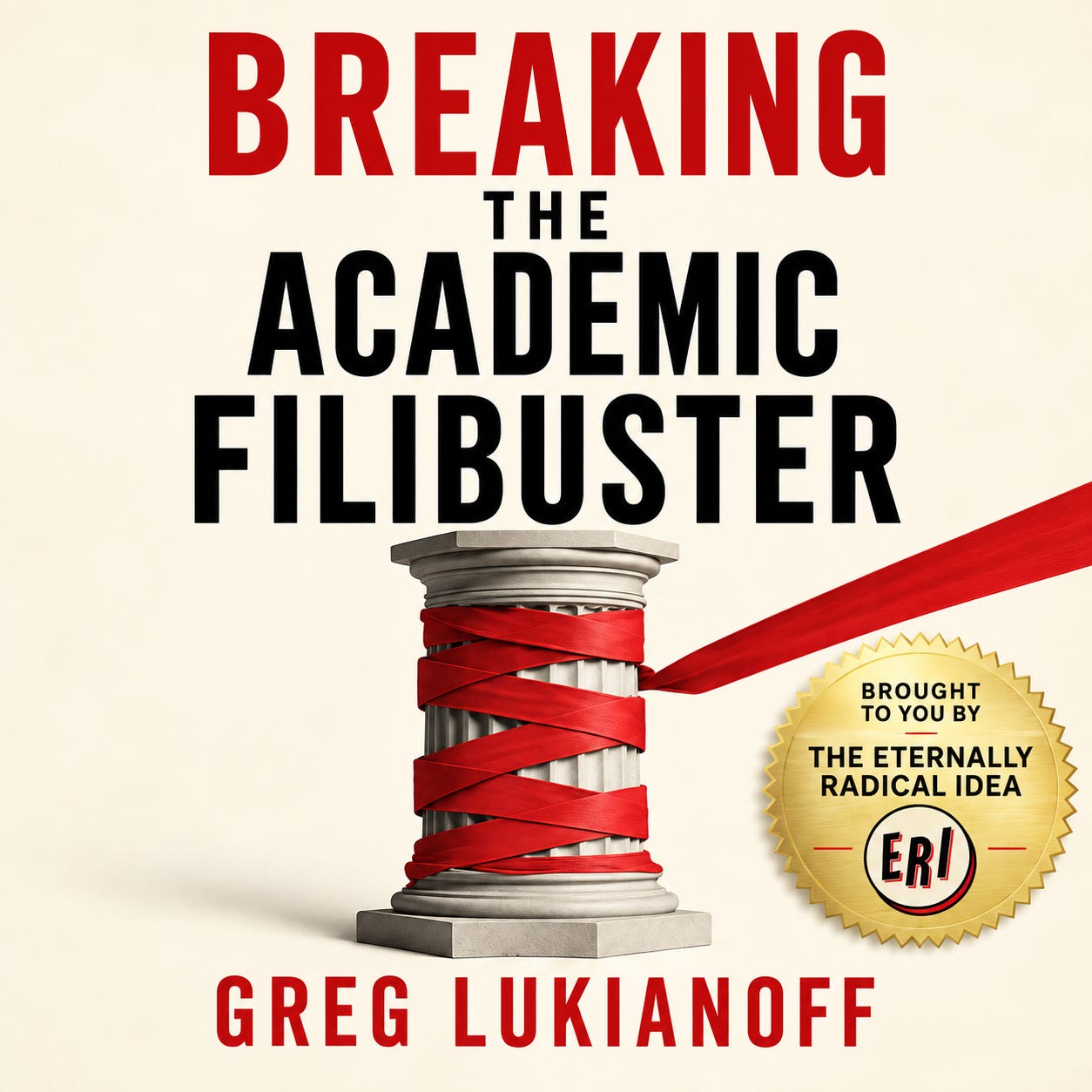
The other idea is what I call the Academic Filibuster. When critics document political bias, censorship, ideological conformity, or institutional dysfunction, defenders of the status quo can demand more evidence, a better methodology, a different denominator, another survey, or another committee to assess the last committee. FIRE has been clearing every hurdle only (to badly mix a metaphor) to see the goalpost moved gradually closer to infinity. When the standard of proof keeps changing in only one direction, skepticism becomes a highly effective instrument of delay.
A university doesn’t have to vote against reform. It can simply declare the ones demanding reform are, well, icky (an anti-intellectual habit if there ever was one). Or it can simply schedule another meeting. And when the people with the home-field advantage are also the referees, the meeting can last a very long time.
But something has shifted. Now some of the country’s most influential universities are finally acknowledging problems they spent decades minimizing. Will serious change actually follow, or will the same machinery run down the clock again?
That brings me to this project, and the rather unique way I’d like to work through its next phase.
A Substack publishing experiment and a fundraiser for FIRE
Rather than forcing this all into a conventional book or chopping it down to fit a magazine, I’ve decided to publish Breaking the Academic Filibuster here on The Eternally Radical Idea in installments over the next six weeks. The first paid installment follows this introduction, right now, in this post. And the idea is, I want your help and insight.
I particularly want feedback from readers who’ve followed my work for years, and from those of you who know parts of this subject better than I do. Tell me what I’ve missed, where I’ve been unfair, what I got wrong, and whether the solutions could actually work. I intend to use your comments to improve the whole thing, then release a finished, freely available article before the end of the year.
That’s the goal, anyway. I’ve learned not to make especially confident predictions about this manuscript.
I’d also love to use the series to raise some money for FIRE. This isn’t a new arrangement, of course. All the proceeds that would ordinarily go to me as the Substack author go to FIRE instead, and always have. Substack takes its share; FIRE gets the author’s share. We simply haven’t pushed paid subscriptions very hard until now because our priority has been getting our work and message out there. We appreciate those of you who have chosen to support us regardless, and we hope you’ll continue doing so. We also hope more of you will consider joining the fold as we roll this project out. If you’re a promoter and defender of free speech and a fan of FIRE, your paid subscriptions are a great way to help us keep this work going!
It’s also a pretty economical way of doing things. A book of mine might retail for about $30. A month or two of paid ERI is a pretty reasonable way to read this one as it comes out — especially since it includes perks like getting to argue directly with the author, help shape the book’s final form, and help fund the organization I’ve devoted 25 years to.
We’re also planning more premium ERI material in the coming years, and I would love it if The Eternally Radical Idea became a genuinely cash-positive enterprise for FIRE. You can help us make that happen, while also contributing to a project that might just move the needle in the right direction for higher education.
I’ve published several books the traditional way, and a great editor is invaluable. But I would be delighted if Substack eventually made much of the existing book-publishing model unnecessary. Why shouldn’t a writer be able to choose the length, publish while the subject is still urgent, get serious feedback from readers along the way, earn money, and produce a better finished work without waiting for the machinery of conventional publishing to clear its throat?
I love the idea that the people reading a book might help make it better before it becomes a book. And after spending two months arguing with word counts, formats, and an AI that was determined to make me sound less like myself, the prospect of having more control over how I publish is awfully appealing.
I don’t know if this experiment will work, but I’m excited to try it. And if you have advice about how to make this whole damn thing shorter without losing the good stuff, I’d be particularly grateful. I’ve been trying since August.
That’s it for the preamble. What follows is the first installment of Breaking the Academic Filibuster, which you can access by becoming a paid subscriber to ERI.
