



Higher education has spent years worrying about its loss of public confidence. Now Washington is asking colleges to tell the public what they plan to do about it.
Last month, Education Secretary Linda McMahon issued a “Call to Action” asking every U.S. college and university to publicly describe how they will strengthen free speech, intellectual pluralism, academic rigor, affordability, and other areas on their campuses. Whatever one thinks of the administration’s approach, the implicit underlying question is a legitimate one: if trust and confidence are low, what would actually restore it?
This question has become more pressing as confidence in higher education has continued to erode. Earlier this year I documented that Americans’ confidence in colleges and universities remained near historic lows, that talk of a recovery was premature, and that the newest erosion was among Democrats. Gallup’s July survey found nearly the same pattern, reinforcing that the decline is real, broad, and is no longer confined to Republicans.
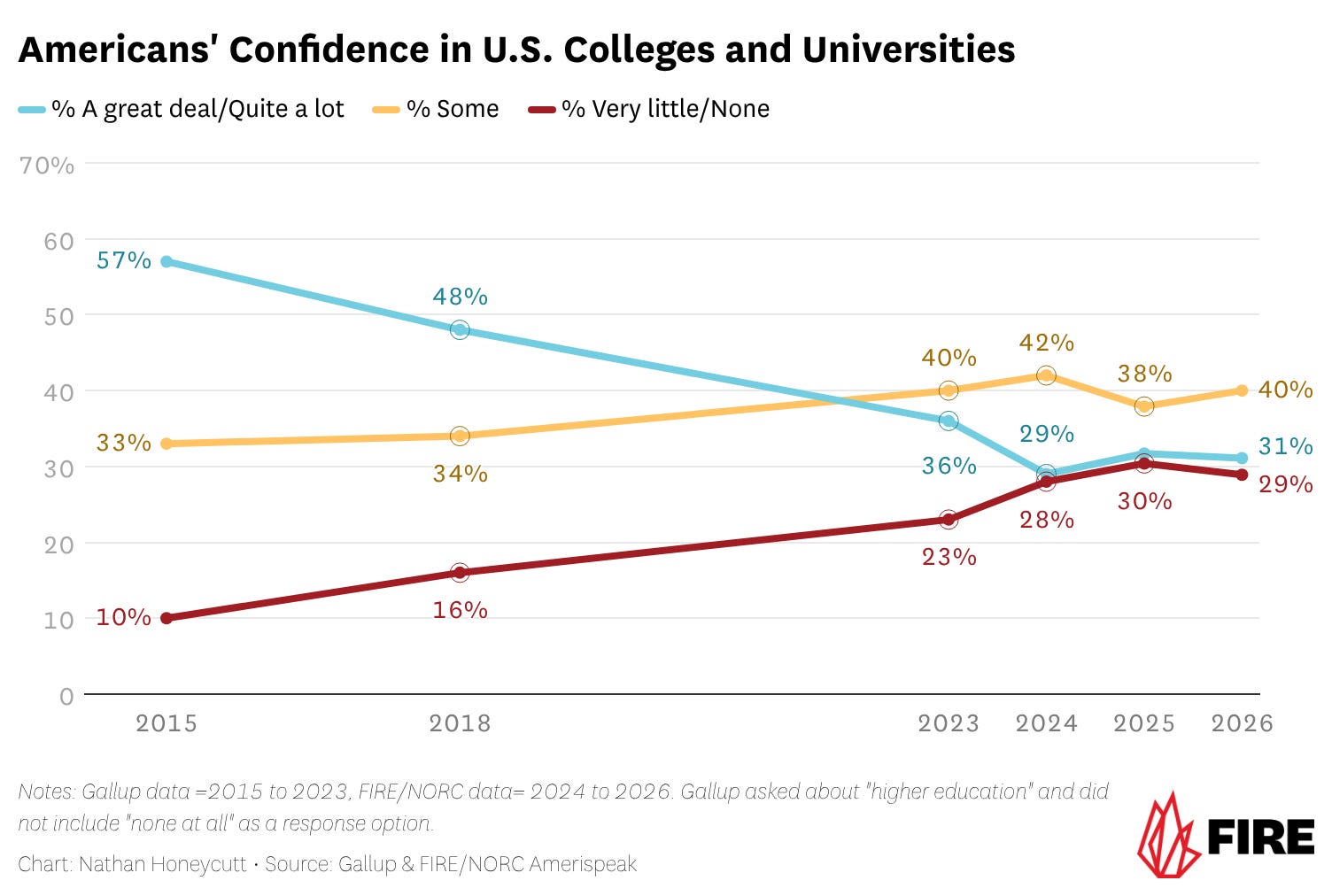
This then raises the question that follows every one of these releases: why?
Higher education has a standing answer: low confidence is a narrative failure. That is, it’s a communications problem, a reputational challenge, and a story that critics have told more effectively than institutions have told on their own. The proposed remedy, then, that institutional leaders lean into is better outreach, clearer articulation of value (“return on investment”), and a more compelling case for the enterprise. That is, public relations and marketing.
Now, this solution isn’t offered in bad faith. After all, there are praiseworthy things happening in higher education. But buried inside this is an empirical assumption: that Americans hold a distorted picture of what happens on college and university campuses, and if they would only see things accurately then they would think better of higher education.
This is testable, so we tested it.
Americans underestimate the skew
In our February 2026 FIRE/NORC survey, along with our confidence questions, we asked a nationally representative sample of 1,092 American adults to estimate what percentage of college and university professors are liberal, conservative, or something else. The participants knew that college and university professors lean left, but they thought faculty were substantially more ideologically balanced than they actually are.
On average, American adults estimated that 54% of professors are liberal and 29% are conservative — a ratio of almost 2 to 1. The 2016 benchmark from HERI that we later showed respondents pegged the ratio at about 5 to 1.
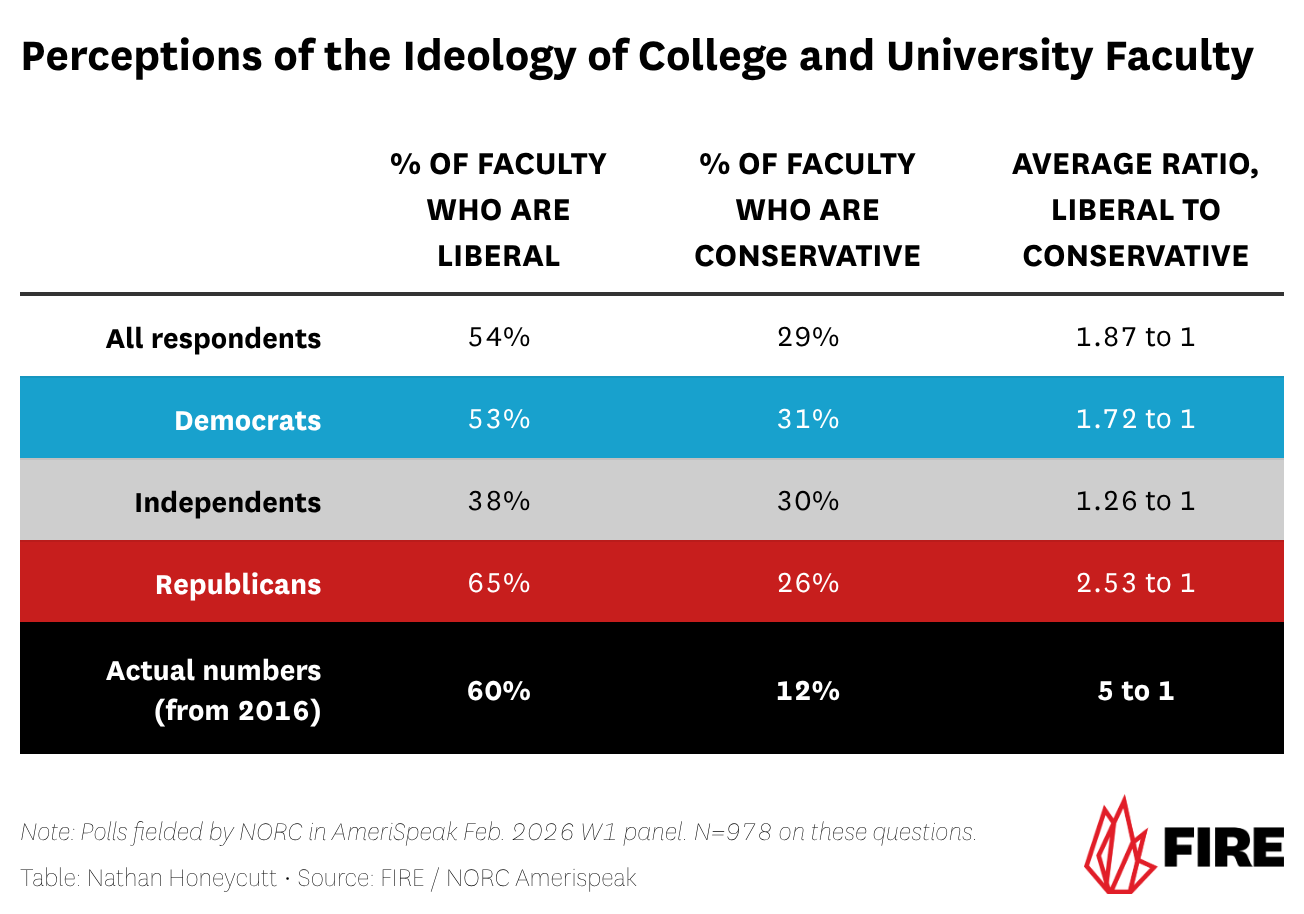
Overall, roughly 76% of respondents generated a ratio below where it actually was in 2016, and no political party grouping came close to being accurate. Republicans were the closest, estimating that 65% of faculty are liberal and 26% are conservative for a ratio of 2.5 to 1. But even Republicans overestimated how many faculty identify as conservative.
Note what the error is: Americans estimated that 54% of faculty are liberal against an actual 60%, which is close. But they estimate that conservatives make up almost a third of the professoriate (29%) when they actually make up closer to an eighth (12%).
Overall, the average American imagines a faculty that leans slightly left but still contains a substantial conservative minority and a modest middle — a picture that is more politically balanced than reality. Americans are not exaggerating the tilt, instead they are imagining conservative professors who are just not there.
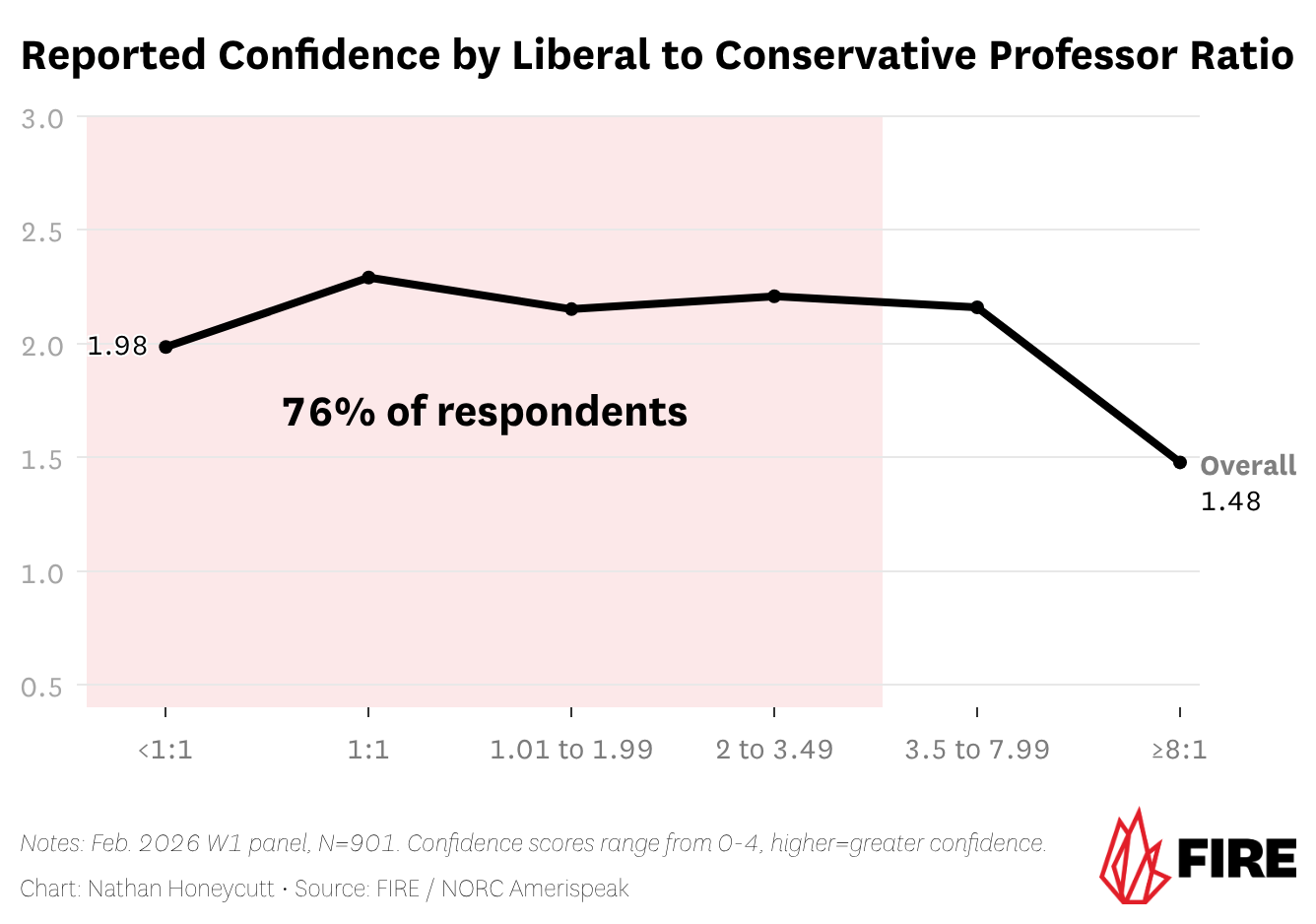
These faculty ideology estimates also tracked how respondents viewed colleges and universities. As seen in the figure below, where six bins (e.g., <1:1, 1:1) for generated ratios are on the x-axis and average confidence scores are on the y-axis (for confidence, 0=“none at all,” 1=“very little,” 2=“some,” 3=“quite a lot,” and 4=“a great deal”), confidence in colleges and universities was highest among Americans who believed liberal and conservative professors exist in roughly similar numbers. This held roughly level through the middle of the distribution, with respondents who perceived a slight tilt in favor of liberals, but then confidence dropped off among respondents estimating high imbalances.
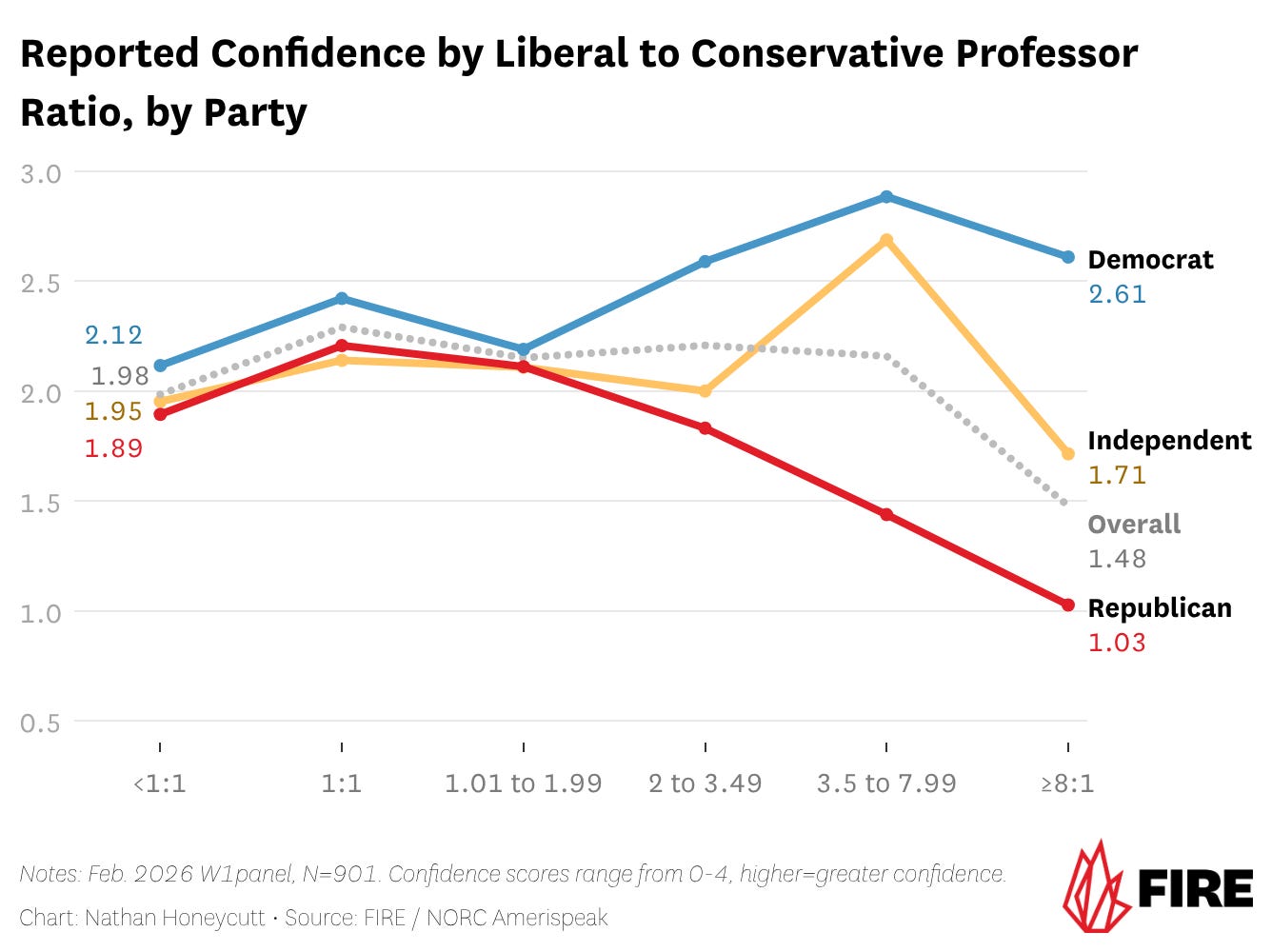
But, this overall pattern hides an important partisan split, which was driven largely by Republicans and Independents whose confidence declined the most when the imbalance they perceived was more severe. Democrats, though, went in the other direction, reporting higher confidence when they perceived a more heavily liberal faculty. These same splits also appeared in our 2024 surveys on the same topic.
That said, these findings alone don’t tell us that perceptions about faculty ideology drive confidence and trust. People who already dislike universities may be more inclined to see them as politically skewed, and partisan identity is related to both. So we dug a little deeper to see what happens when respondents are given more accurate information.
Correcting the record makes it worse
After respondents had given their estimates, we showed them the 2016 HERI benchmark figures and asked again how much confidence, if any, they had in U.S. colleges and universities. Remember, even though these numbers are a decade old, they reflect a ratio higher than what was estimated by 76% of the respondents.
Among those who answered both questions, half (50%), reported no change after receiving this information (though 8% of respondents were already at the bottom of the scale and couldn’t report anything lower). For 30%, confidence dropped, and for 20% it rose. And the movement was asymmetric. The confidence decline upon receiving the HERI ratio was concentrated among Republicans and Independents, while reported confidence changed very little among Democrats.
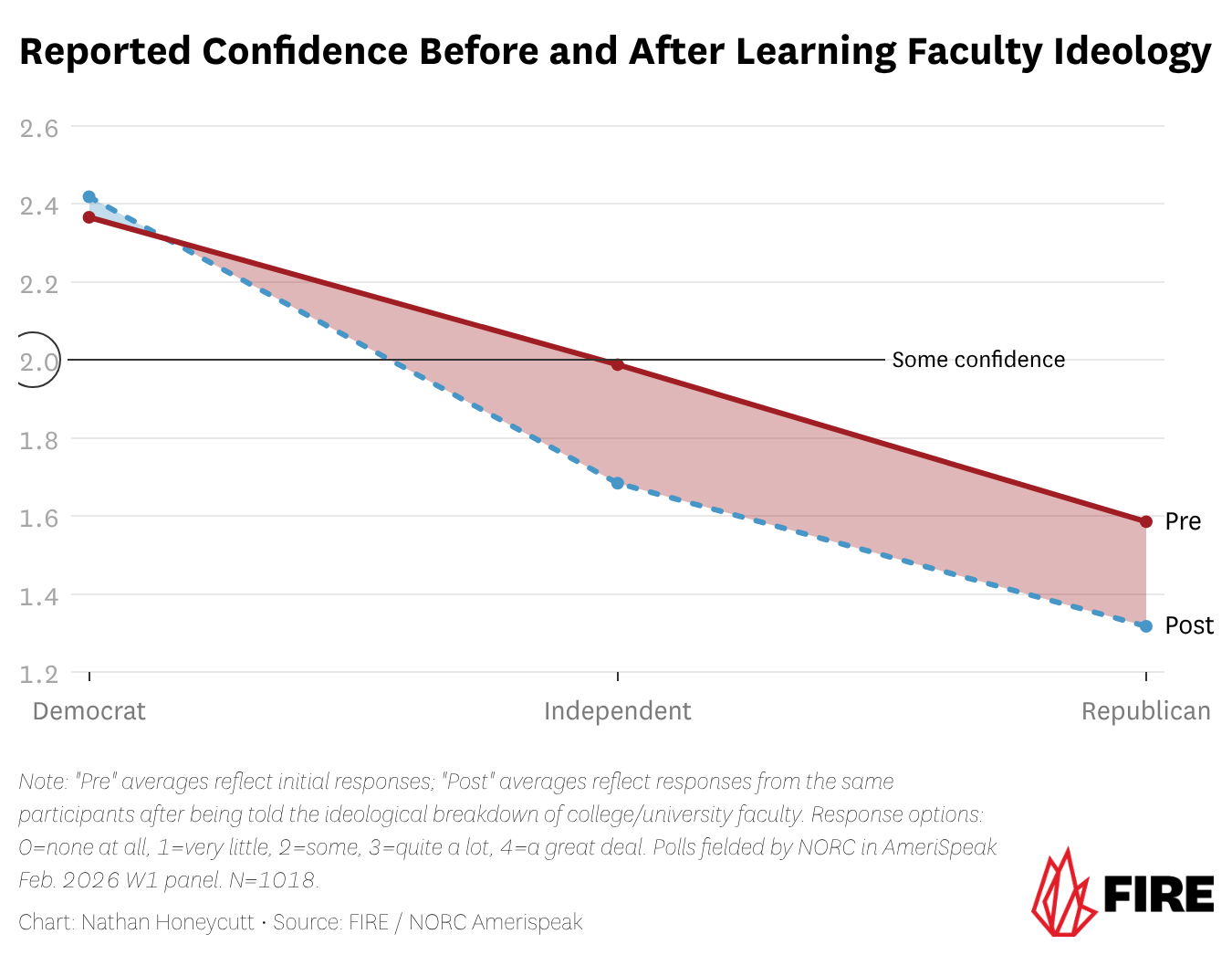
The effects found are modest. But the direction is consistent across both the 2024 and 2026 samples. And because the benchmark figures date to 2016, they are likely an underestimate of the current ideological imbalance. Respondents actually received a milder correction than would result from providing more recent estimates.
Across surveys conducted two years apart we found that Americans hold a more politically balanced image of the professoriate than the available data support. Additionally, confidence doesn’t improve when that image is updated. Rather, it moves modestly downward among the groups that already distrust higher education the most. The fact that reported confidence is linked to beliefs about who is teaching also suggests that low confidence may reflect more than a generalized decline in institutional trust. Public confidence appears to depend on whether colleges and universities are seen as ideologically diverse or politically one-sided.
Now, the ideological composition of college and university faculty is certainly not the only reason Americans lack confidence in these institutions. Gallup makes that clear: among those lacking confidence, 31% cite political agendas on campus, 30% cite cost, and 25% say colleges don’t adequately prepare students for the workforce. Eight percent even specifically cited the administration’s interference in higher education as a reason they lacked confidence.
But these results also make it difficult to dismiss campus politics as an issue manufactured entirely by outside critics. If distrust were primarily the product of Americans holding an exaggerated impression of the academy’s imbalance, correcting that impression ought to help. On faculty ideology, though, it doesn’t help because the public already holds the more flattering picture. If Americans generally understood the actual ideological composition of the faculty, overall confidence in colleges and universities would likely be even lower than it already is.
As such, “tell our story better” likely isn’t the best response to the higher education confidence crisis. Colleges and universities should tell their story, as there are enormous amounts of valuable work that is nearly invisible to those outside these campuses. But that approach doesn’t address a major problem many Americans appear to have with higher education. And while public relations can correct a false belief, it can’t solve a problem where greater factual accuracy makes these institutions look less like what the public wants them to be.
The HERI benchmark given to respondents is also a national average, which doesn’t account for lopsided differences between institutions. For example, in April a Yale faculty committee released a report on declining trust in higher education which didn’t hedge or back down on its discussion of politics and intellectual pluralism. Nationally, the committee noted, registered Democrats outnumber registered Republicans on college faculties by roughly 10 to 1. At Yale specifically, among the faculty from Arts and Sciences, the Law School, and the School of Management, the committee put the ratio at 36 to 1.
A conclusion this Yale committee reached from these numbers was quite blunt: “echo chambers do not produce the best teaching, research, or scholarship.” Yale deserves credit for being realistic about this issue and for recognizing this about itself. But this also sharpens the issue being identified by our data, because the HERI benchmark our respondents saw was both a decade old and an average. At the elite institutions Americans hear about the most, the distance between what the public imagines and what actually exists is substantially wider than the five to one ratio we showed respondents.
That leaves us with a question higher education has mostly avoided asking itself: if Americans looked closely at the ideological composition of faculty, is what they would see something these institutions would be willing to defend?
How confident are the leaders at your local college or university that people with heterodox or non-liberal political views receive fair treatment in admissions, hiring, promotion, teaching, and research? How much intellectual disagreement and debate actually exists inside academic departments? Do opposing viewpoints receive fair treatment when teaching controversial topics?
How willing are scholars to pursue research questions whose answers may be unwelcome to their colleagues? These questions, and others like them, don’t become illegitimate because a presidential administration is asking them, and answering them doesn’t require accepting government management of academic life.
In the short run, it would likely be easier for institutions to emphasize the good, rebuff unfair attacks, and wait for the storm to pass. But if the public’s picture on some key elements is already more favorable than reality, that strategy can only work for so long.
There is a reading of all this in which some may say higher education has simply lost Republicans and many Independents, and that there is nothing anyone can do about it. But in FIRE’s July 2026 National Speech Index, 57% of Americans said they believe the lack of ideological diversity in higher education is a somewhat or very serious problem, including 62% of liberals. Clearly, the constituency that sees a problem here extends well beyond those higher education is already losing.
Higher education’s problem isn’t that Americans see it inaccurately. It’s what Americans will see when they take an even closer look. Trust and confidence will not be restored by making the status quo easier to explain, but rather by making the reality easier to defend.
SHOT FOR THE ROAD
While Hedwig and the Angry Inch is my favorite musical of, say, the last 30 years, Singin’ in the Rain is my favorite musical of all time (with notable mentions to West Side Story and My Fair Lady) and, as I recently wrote on X, probably the best musical for normies. It’s approachable in a way that musicals often fail to be, and its humor and entertainment value is unparalleled in the genre. And since FIRE board member and host of This History of the Americans podcast, Jack Henneman, pointed out that it was Gene Kelley’s birthday recently, I figured it was as good a time as any to reup this classic.

I agree higher education has more than a perception problem. What I find endlessly frustrating about these discussions is they tend to be framed as a left versus right issue instead of an authoritarian versus libertarian issue. I'm far less concerned about whether a faculty member leans to the left or the right than I am about whether that faculty member supports intellectual freedom and freedom of speech in practice. Emphasis on in practice.
"Liberal faculty" severely misrepresents the problem.
"Faculty who viscerally hate the very concept of integrity" is closer to being an accurate capture of why people who notice have plummeting regard for the academy. The very mechanism of truth-seeking is gone.