


Stories of the week
Government withdraws subpoenas of 3 reporters for The New York Times after admitting legal errors (AP) by Michael R. Sisak, Eric Tucker, & Larry Neumeister
“Subpoenas are the last step, not the first step, but the last step,” the judge said, citing rules set to protect against violations of the First Amendment. He said the government’s actions had turned the law and the regulations “on its head.”
Assembly Bill 2392 would require the California State University and the Chancellor of the California Community Colleges to convene a working group and establish procurement standards for generative AI — or GenAI — in line with certain state requirements. These requirements include ensuring that GenAI tools are evaluated for “potential harms, misuses, abuses, and bias,” and ensuring they will not produce “harmful” or “illegal” content. Although the bill provides a few examples of covered content, such as “disordered eating,” they don’t cure the underlying issue: these terms have no settled meaning and often depend on contested political and social judgments, making this mandate as broad as it is subjective.
This week in Expression
Asch’s response draws on a cornerstone free speech principle: what we consider “true” or “dangerous” can change, sometimes very rapidly. John Stuart Mill wrote in On Liberty that we must embrace speakers’ right to express controversial, unpopular ideas, because those ideas may in fact be true. And even if they are not, the proper remedy is truthful speech, not censorship. Got fun nekome is a case in point. Today, the play’s rejection of racialized essentialism and embrace of same-sex relationships are points of pride for many Yiddish theater aficionados; and its radicalism in its own era inspired Paula Vogel’s award-winning play Indecent. Suppressing Got fun nekome — even assuming it might have prevented some gentiles from believing negative stereotypes about Jews — would have erased what many view as a transformative work of Jewish art.
Shiloh Hendrix’s conviction can’t be squared with the First Amendment by Aaron Terr
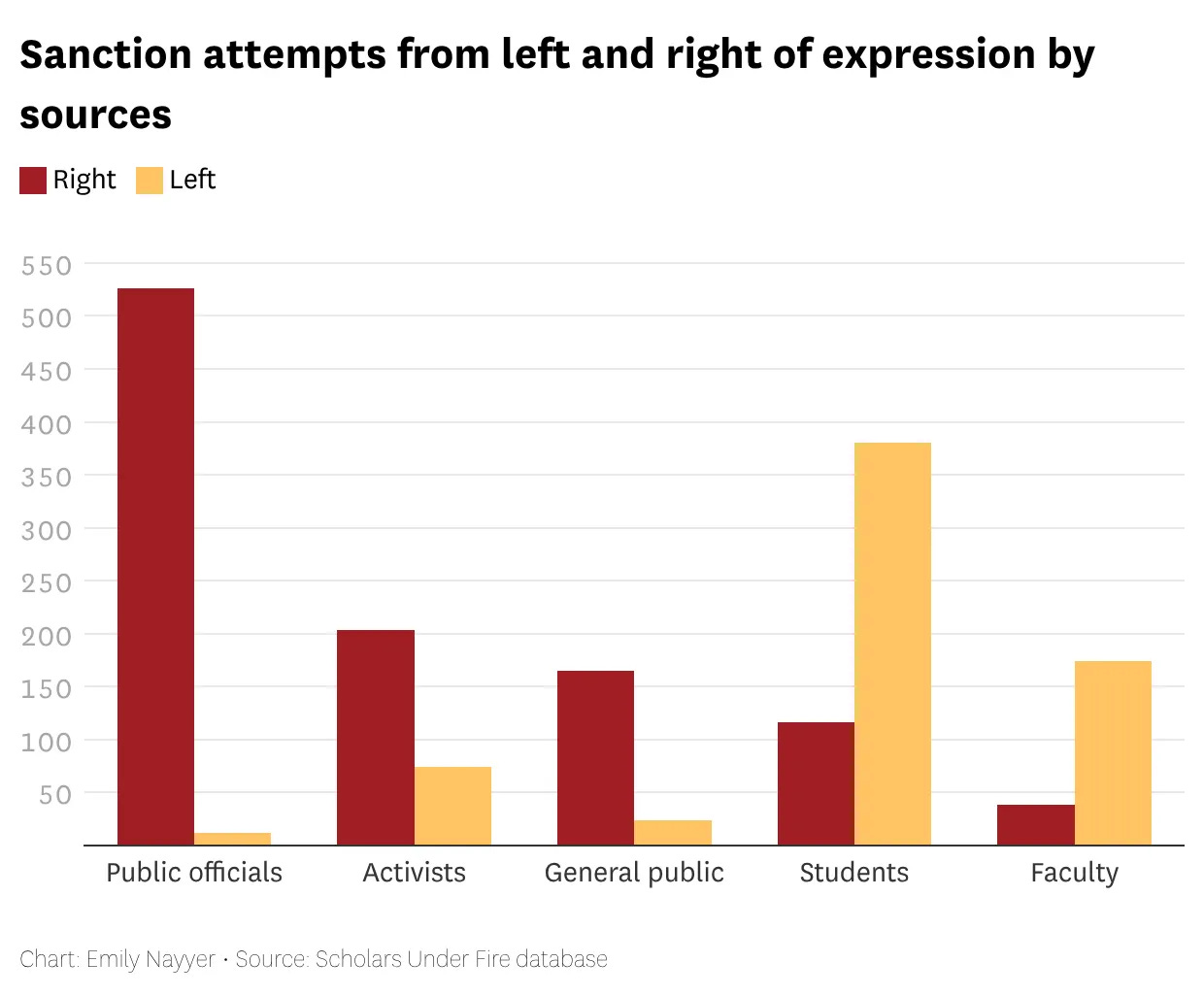
Who is trying to punish scholars for their speech? by Sean Stevens
Is training AI on copyrighted materials protected by the First Amendment? By Tyler Tone
The new war on political satire by Athena Rem
Hawaii is a forgotten First Amendment failure by Elyse Everest
This week in FIRE’s blog
“A government that gets away with censorship won’t stop at just two words. It will target other speech, too — particularly criticism,” said FIRE attorney Zach Silver. “The council president himself has said he wants to ban more words in the future, and you should believe him.”
Pennsylvania shields public universities from transparency. This student wants to change that by Marie McMullan
International free speech stories of the week
French senators had opted for a two-tier system distinguishing between blacklisted platforms flagged as harmful to a child’s development, and those that could still be accessed with parental consent.
But the lower house’s blanket ban prevailed, despite criticism from some on the left over the age verification process, the speed of its implementation and risks of circumvention as well as privacy concerns.
Vietnam: 5 Arrested for Ho Chi Minh Book (Human Rights Watch)
Georgian journalist sentenced to 14 days over Facebook post (OC Media) by Mikheil Gvadzabia
Russian activist arrested a day after predicting Putin will end up in handcuffs (South China Morning Post)
Ilya Remeslo, 42, faces charges of “spreading fakes on the Russian army”, under censorship laws Moscow introduced when it sent troops to Ukraine, according to the TASS news agency.
The charge carries a maximum penalty of up to 10 years in prison. Sergei Badamshin, named by independent media as his lawyer, said on social media that Remeslo was being transported to Moscow to face court.
[Can we add in monster tweet thread of the week? And then link to the monster tweet thread and response to Jeffrey Sack?]
TV Series of the week
I guess I technically knew that my beloved canceled show Community had a sixth season. It originally ran on NBC from 2009 to 2014, surviving cancellation scares, a famously rocky fourth season, and just about every other indignity a cult classic can endure. Then NBC finally canceled it for good… except not quite.
In one of the stranger episodes of the streaming wars, Yahoo! decided that Community would be the flagship original series for Yahoo Screen, its attempt to break into streaming. They ordered a 13-episode sixth season in 2015. The experiment didn’t exactly work out—Yahoo Screen was gone soon afterward—but somehow Community got one last chance.
I knew all of this once. Somehow I’d filed it away under “alternate timeline” and convinced myself that Season 6 either didn’t really exist or couldn’t possibly be very good.
Then Hulu added the entire series, including Season 6, and I finally gave it a shot.
The premiere didn’t do much for me. But then again, Community has always been a brilliant, gloriously uneven show. Even its pilot isn’t particularly good. Once it finds its rhythm, though, it’s unlike anything else on television.
If you’ve never watched it, it’s one of the funniest and weirdest sitcoms ever made. Dan Harmon and an absurdly talented cast somehow turned a show about a community college into a playground for formal experimentation: stop-motion animation, an 8-bit video game episode, fake documentaries, alternate timelines, action movies, westerns, and what remains the greatest paintball war in television history.
What really surprised me was that Season 6 is every bit as inventive as the best years. Rather than pretending Donald Glover’s Troy Barnes, Yvette Nicole Brown’s Shirley Bennett, or even Chevy Chase’s Pierce Hawthorne could simply be replaced, the show evolved. Keith David’s Elroy Patashnik is an absolute revelation—one of the rare late additions to a sitcom who actually makes the ensemble stronger. Paget Brewster’s Frankie Dart has become a genuine fan favorite. I liked her well enough, but she absolutely has her moments.
My favorite is the clip below, where Frankie has to deal with Dean Pelton (the incomparable Jim Rash), who has somehow become a delirious evangelist for Honda—exactly the sort of sentence that makes no sense unless you’ve watched Community.
And yes, after all these years, the prophecy is still alive. What began as an absurd throwaway line—“six seasons and a movie”—is finally becoming reality. Dan Harmon and most of the original cast are still working toward Community: The Movie. Somehow Greendale refuses to die.
It's well worth noting that the DOJ attorneys didn't act out of any sense of professional responsibility or legal ethics when they withdrew "subpoenas of 3 reporters for The New York Times after admitting legal errors." The DOJ attorneys acted to stifle speech. They acted to avoid a judicial order that would have exposed how remarkably rotten their misconduct actually was.
The DOJ expressly admitted that they had failed to even try to even identify (much less comply with) "the leading case [judicial decision] in this field." See, e.g,, https://www.lawdork.com/p/thursday-was-the-worst-day-for-doj-so-far. Even after the Judge exposed the blatant illegality (and unconstitutionality) of the DOJ attorneys' misconduct, Sean Buckley, a senior DOJ attorney "initially said the government didn’t want to withdraw the subpoenas but instead preferred to keep them held in abeyance while the investigation continued, [so Judge] Subramanian shot back, “Either we can quash the subpoenas, or you could withdraw the subpoenas,” as reported by the [New York] Times’s Michael Grynbaum and Jonah Bromwich."
Love the Emily Nayyer graph. Those darn right wing activists!
Thanks for the laugh!
Sincerely,
A Conservatife in California