Stories of the week
This week in ERI

This week in Expression
AI systems are powerful expressive systems. They generate language, shape ideas, consume and interpret knowledge, and embody the values embedded in their design. The developer has the right, protected by the First Amendment, to make decisions about what capabilities to include or exclude. Anthropic isn’t willing to remove safeguards from its models for use in autonomous weapons targeting or domestic surveillance. Those limits reflect a deliberate expressive choice about what tools the company is willing to build, including what it is willing to provide to the government, and what its existing AI system is capable of achieving.
After a professor’s hot-mic racial remarks, Hunter College faces a free speech test by Zach Greenberg
Hamit Coskun wins Quran-burning case, but threats to free expression linger in UK by Sarah McLaughlin
Professors are inviting dialogue. That’s not the same as free speech by Samuel J. Abrams
Calls for censorship are a familiar wartime mistake by Nico Perrino
London Calling: Ronnie’s First Amendment Roundup
Florida federal court holds state’s governor cannot unilaterally designate Muslim civil rights group a “terrorist organization” and withhold government benefits from anyone assertedly providing it material support or resources
A federal court in the Northern District of Florida granted a First Amendment challenge in preliminarily enjoining an executive order issued by the state’s Governor designating the Council on American-Islamic Relations as a terrorist organization and denying it or “any person known to have provided [it] material support or resources” any “contract, employment, funds, or other benefit or privilege” from any state agency, county, or municipality. CAIR challenged the EO as unconstitutional retaliation for its speech, viewpoint discriminatory, and violative of its rights to petition and of association, but the court held the EO’s unconstitutional coercion of third parties to disassociate from CAIR was enough for a preliminary injunction.
The court first held CAIR has standing to challenge the EO even if based on how coercion of third parties to cut ties creates a prior restraint on CAIR’s future speech, rather than on direct censorship of CAIR. It held injury-in-fact lied given a Florida-based production company withdrew from producing a podcast with CAIR due to the EO, and the South Florida Muslim Federation publicly disassociated from CAIR-FL (a state-level affiliate) while explicitly citing the EO, after the state’s Attorney General, ahead of the Federation’s conference in Coral Springs, said on social media the city “should remember that state and local resources cannot be used by any organization affiliated with CAIR” so the city commission “is on notice.” “In short,” the court held, CAIR “has been publicly designated a terrorist organization from Florida’s bully pulpit and continues to suffer for it.”
Then, citing Supreme Court law that both dates back to 1963’s Bantam Books v. Sullivan and was reaffirmed as recently as 2024 in NRA v. Vullo, the court explains that: “Where a government uses the threat of invoking legal sanctions and other means of coercion to achieve the suppression of disfavored speech, it functionally creates a system of prior administrative restraints that bears a heavy presumption against its constitutional validity”—and this case, the court notes, “bears all the hallmarks of unconstitutional coercion that the Supreme Court identified in Bantam Books and Vullo.” On the Vullo factor of the state actor’s authority, the court held it is “at its zenith here” where the Governor “is Florida’s head of government and controls Florida’s executive branch and cabinet agencies.” Next, on whether alleged coercive communication is understood as a threat or inducement, the court cites the EO as “sweeping and clear” that “[a]ny relationship with [CAIR] will be punished by cutting off access to all benefits even peripherally within Defendant’s control.” And regarding reactions from coerced parties, between the production company and the Federation, recipients “interpreted the EO as a threat to disassociate … and responded accordingly.”
The court then held it “need not determine whether intermediate scrutiny or strict scrutiny applies … because, under either standard” the Governor “fails to point to any evidence justifying his indirect censorship of Plaintiff’s speech.” And it rejected his argument that “to the extent any speech is involved, ... the EO nevertheless passes muster” under the Supreme Court’s Holder v. Humanitarian Law Project decision, noting “authority to designate a foreign terrorist organization under federal law is subject to procedural safeguards that are absent from” the EO. So, the court ultimately concludes: “The First Amendment bars the Governor from continuing the troubling trend of using an executive office to make a political statement at the expense of others’ constitutional rights. The Governor’s decree coerces third parties, under threat of losing government benefits, to disassociate from [CAIR], thereby closing avenues of expression and suppressing CAIR’s protected speech.”
It thus enters a preliminary injunction, and refuses to stay it pending appeal – though it enjoins enforcement of the EO only as to CAIR and not its state-counterpart CAIR-FL “or any other organization named in the EO” – followed by a wrap-up that among other things notes the ease of targeting minority-group speech and George Washington’s letter to the Hebrew Congregation in Newport extolling religious tolerance, concluding: “The Constitution protects Plaintiff’s speech just as it protects any other organization’s lawful speech from suppression by governmental coercion of third parties.”
Bonus Case: In the FIRE-litigated Kershnar v. Kolison case of SUNY Fredonia removing a philosophy professor from teaching and barring him from campus since early 2022 for philosophizing on the underpinnings of adult-minor sex taboos on two podcasts he appeared on outside his instructor’s role on his own time away from campus, the court denied a motion to dismiss the First Amendment challenge to the punishment, holding debate about moral and philosophical justifications for criminalizing adult-child sex is a matter of public concern, that any graphic parts of his comments were not gratuitous but part of a broader discussion of age-of-consent laws, that the university repeatedly failed to identify credible threats against Kershnar or other security concerns to outweigh his free speech rights, and that banishment from campus effecting a no-contact order with colleagues and students is a prior restraint.
International free speech stories of the week
Ministers urged to investigate students’ posts mourning Ayatollah (THE)
Dubai Police Threaten Arrest for Social-Media Posts Contradicting Officials (WSJ)
How Germany’s unusual approach to fighting antisemitism is ensnaring Jews who are critical of Israel (JTA)
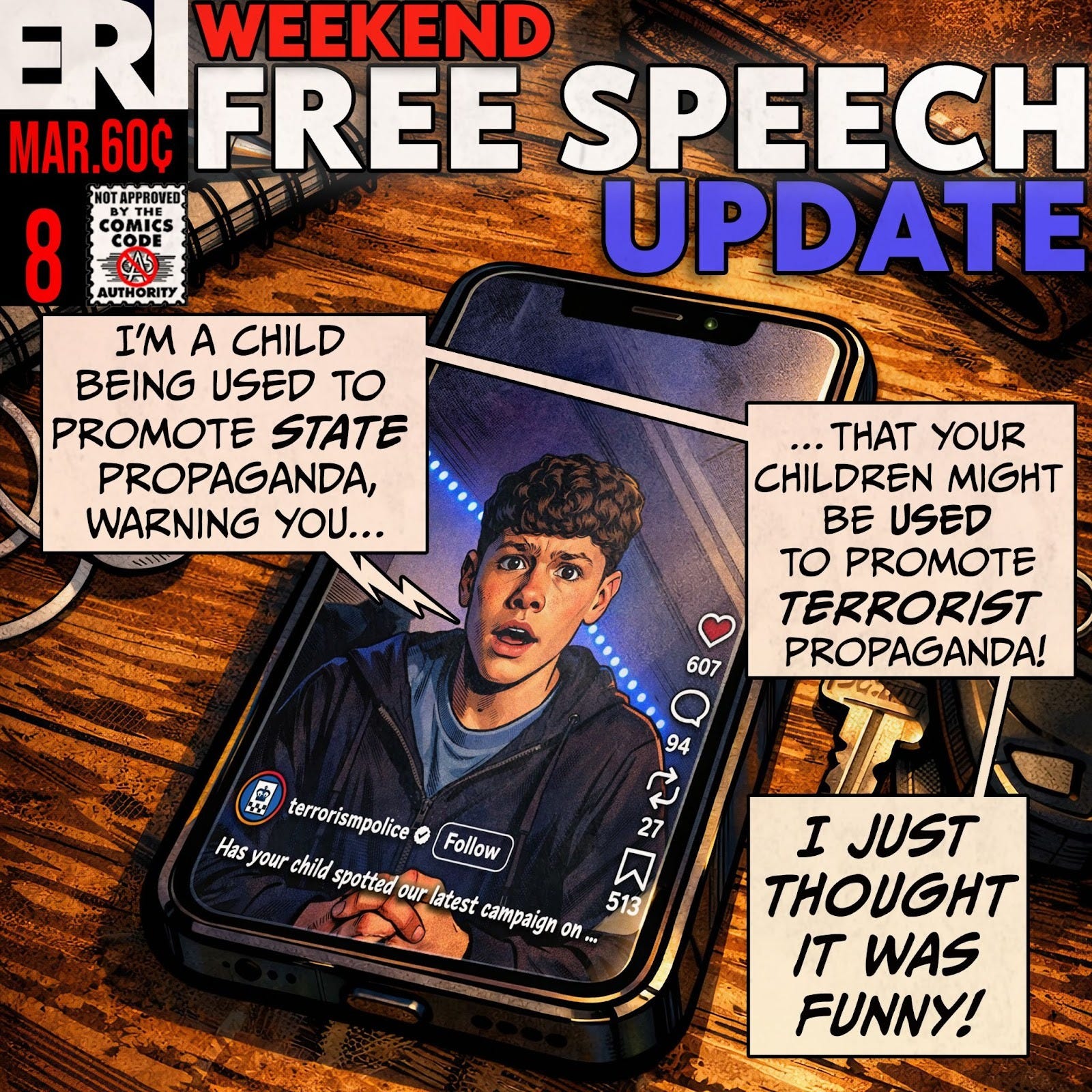
UK Counter Terrorism Police release insane video on Instagram
As I posted on X, “It’s positively dystopian to scare the hell out of kids and their parents about their responsibility to censor themselves on behalf of the state.”
Video of the week
When I was invited to speak at UVU in the immediate aftermath of Charlie Kirk’s murder on their campus, I felt a moral obligation to show up. At a moment marked by shock, grief, and anger, it was important to stand for the principles of free expression and peaceful engagement. In light of FIRE’s release of the latest episode in our 1AX series—focused on political violence and specifically the muder of Charlie Kirk — here are my full remarks from my visit.
BONUS: Citation of the week!
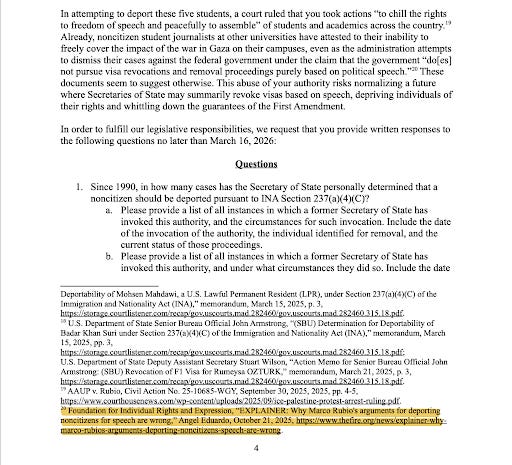
ERI Managing Editor Angel Eduardo cited by Congress!