


Stories of the week
“For 20 years, I’ve taught students how to engage with stories that excite them, challenge them, and broaden their experience of what it means to be human,” said Prabhakar. “I don’t plan on stopping now. If what happened to me becomes the norm, colleges across America will become less curious, less vibrant, and less free.”
This European country launched a task force to target ‘hate speech.’ Now a journalist who insulted politicians is going to prison (Expression) by Sarah McLaughlin
There are many lessons to learn from Georgia’s continuing descent into censorship, but an especially important one is that this is simply an inherent risk of giving government officials a wider mandate to crack down on “hateful” expression: Authorities may very well take it as an opportunity to punish speech they deem hateful toward . . . authority.
This week in Expression
The current research presents little evidence that the fears about AI-generated content are materializing, or that the medium is proving more formidable at persuasion than the long line of content manipulation tools which preceded it. In fact, the lesson from those tools has been that society is fairly resilient to novel fabrications. And for the rare fabrication that is truly dangerous or damaging, the law already has existing remedies.
The applause that disrupted nothing — yet still led to an arrest by Isabelle Brito
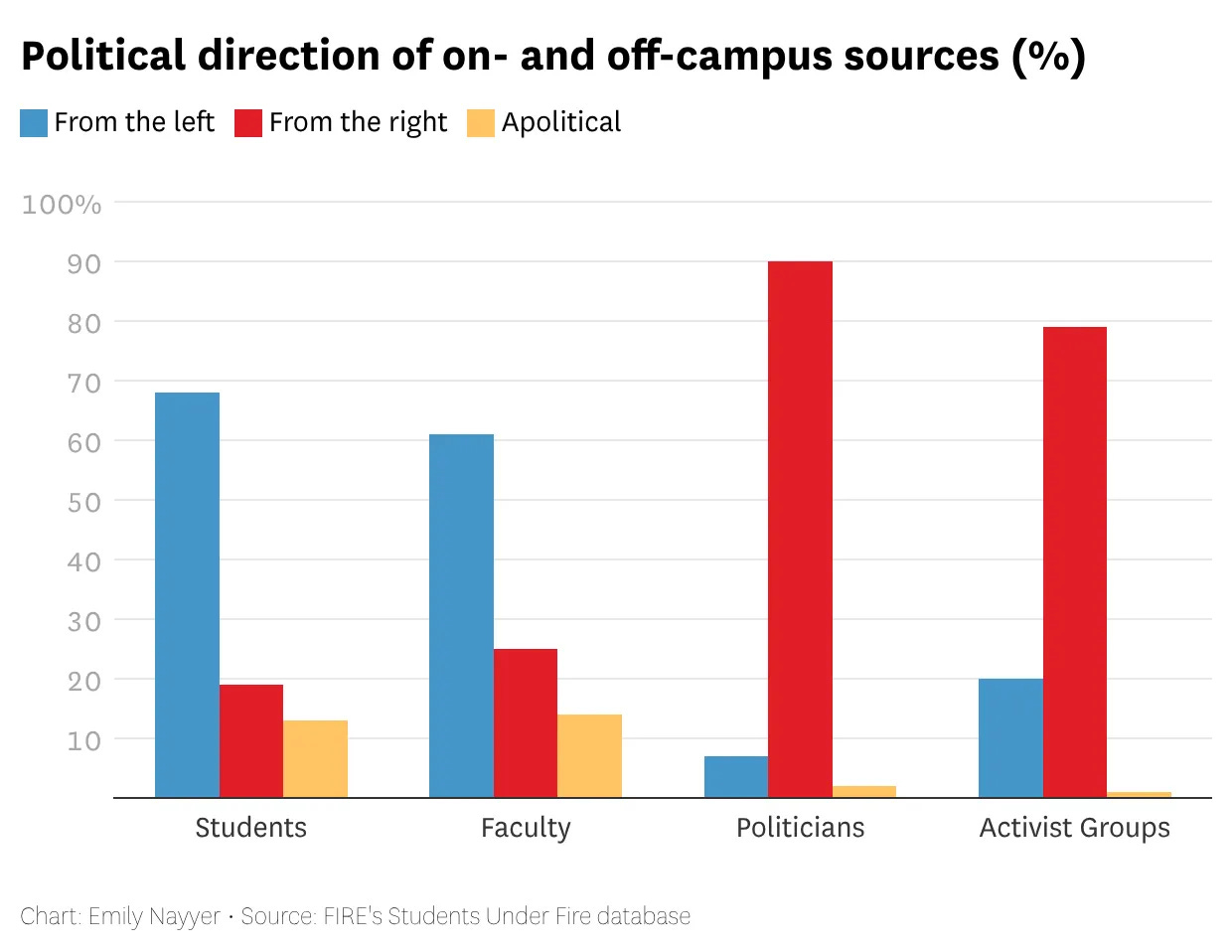
The on-campus left and the off-campus right by Logan Dougherty
The front line of combating self-censorship is the classroom by Caroline Cunningham
Peer culture is an important reason students self-censor, and classroom environments have the potential to influence this too. Conversations are carried over from the classroom to the broader campus. If students are meeting each other’s ideas in classrooms where they feel unafraid to raise their hand and express a controversial opinion, this will likely spill over into their interactions with their peers outside of the structured classroom setting. This could produce greater tolerance among students of opposing viewpoints, and could lead to a higher number of productive discussions as well as a decrease in self-censorship, as students will have learned from the example set in their classes.
Why student journalists are asking to remove their names from articles by Michelle Liao
Pennsylvania shields public universities from transparency. This student wants to change that by Marie McMullan
FIRE in the press!
Censorship never stops with just two words (LA Times) by Angel Eduardo
Last July, the council adopted a motion to prohibit two terms — a racial epithet and a slur against women — during the legally required public comment periods of their meetings. As the rules document states, anyone who says “any variation of either of these words” during public comment will be warned. If they say a banned word again at that meeting or any subsequent one, they’ll be removed. Ejected speakers automatically are prohibited from attending future meetings for up to six business days.
This policy, championed by Council President Marqueece Harris-Dawson, is meant to push back against words he argues are “designed to attack someone’s personhood and their protected status.”
Now, you may loathe the words in question and never use them yourself. You may share the council’s desire to make public comment more civil and appropriate. You may believe Harris-Dawson and the other council members’ hearts are in the right place. But make no mistake: The council is effectively claiming the authority to ban any words it decides are inappropriate or offensive in the future. That’s a very dangerous power to grant any government official.
This week on So to Speak
This week on So To Speak, host & FIRE EVP Nico Perrino was joined by Harvard T.H. Chan School of Public Health Senior Fellow Catharine Young , Yale professor of radiology and biomedical imaging, Evan D. Morris, and FIRE Director of Research Ryne Weiss to discuss the Office of Management and Budget’s proposed overhaul of federal research grant rules, exploring how the changes could reshape scientific funding, academic freedom, and medical innovation.
This week in FIRE’s blog
What student journalists need to know about social media by Dominic Coletti
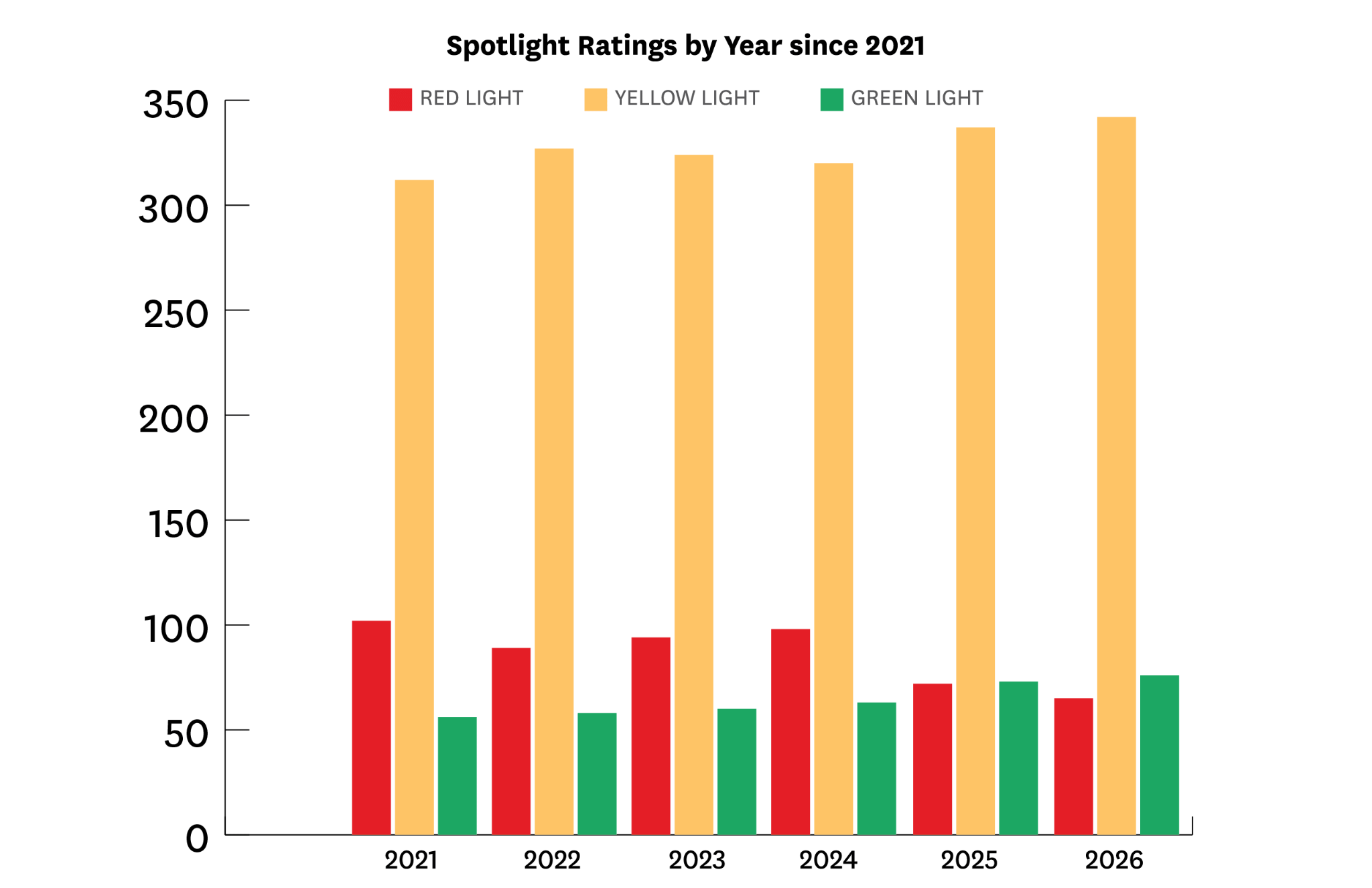
New FIRE study finds record low number of restrictive campus speech codes
London Calling: Ronnie’s First Amendment Roundup
Eleventh Circuit revives First Amendment unconstitutional conditions retaliation claim based on denial of COVID-relief funds
The U.S. Court of Appeals for the Eleventh Circuit reversed the dismissal of First Amendment retaliation claims by a civil rights nonprofit serving the African community, which challenged a Florida county’s denial of the group’s access to federal COVID-relief funds for radio-station equipment to broadcast local health, educational, and emergency alerts, based on its association with the socialist Uhuru movement that promotes black community empowerment.
Viewing the essence of the First Amendment claim as being “the County manipulated the … grant program to suppress ideas that it viewed as dangerous—namely, those associated with the Uhuru Movement,” the unanimous appeals court reversed the dismissal below, holding APEDF plausibly alleged unconstitutional retaliation. While the court acknowledged “APEDF wasn’t (and isn’t) legally entitled to a COVID-relief grant,” and that “the government doesn’t engage in viewpoint discrimination simply because it selectively funds a program to encourage … activities it believes to be in the public interest, without at the same time funding an alternative program,” it is still the case, “even in the provision of subsidies,” that the government “may not aim at the suppression of dangerous ideas.”
And within that framework, the court held APEDF plausibly alleged it engaged in protected expressive association with the Uhuru movement, and that the County’s actions would likely deter a nonprofit of ordinary firmness from engaging in it. In so holding, the court disagreed that denial of what the County called “the benefit of grant funding” cannot cause objective chill simply because APEDF can “engage in protected expressive association (including with the Uhuru Movement) without the benefit of grant funding” and in fact does so. As the court put it: “The short answer is that Supreme Court precedent is to the contrary. In particular, the Court’s unconstitutional-conditions decisions … make clear that the denial of a government benefit for speech-discriminatory reasons can have a chilling effect because that type of denial can operate to penalize a speaker’s viewpoint.”
The court then held APEDF also plausibly alleged both that “the County effectively punished it for associating with the Uhuru movement—forcing it to choose between that association and an important infusion of cash that, by objective markers, it seemed to have warranted,” as well as the necessary link between the protected activity and adverse government action. The court cited text exchanges between a county board member and his aide, and transcripts of a board work session, as permitting reasonable inferences that the board member objected to funding APEDF because of its association with the Uhuru Movement, and that the board heeded that objection and revoked APEDF’s first grant and denied its application for a second because of that association.
The court thus reversed the dismissal of the First Amendment retaliation claim and remanded the case for the district court to resume proceedings. (It also reversed dismissal of equal protection claims based on the same denial of grant funding, but affirmed dismissal of a due process challenge.)
Bonus case: In Whateley v. Lackey, the U.S. Court of Appeals for the Fourth Circuit, on “a question that has divided district courts and state supreme courts in recent years: whether the character combinations on personalized license plates (or ‘vanity plates’) are government speech or private speech,” held that “Virginia’s personalized license plate messages are private speech subject to First Amendment protection,” and that the trial court erred by dismissing plaintiff’s challenge to the state’s recall of his “FTP&ATF” (“Fuck the Police & Alcohol, Tobacco, and Firearms”) vanity plates, though the court did not decide if the recall/restriction of the personalized message is unconstitutional, but rather left that to the lower court in the first instance. That outcome on First Amendment protection for vanity plate messages mirrors that which FIRE advocated in supporting U.S. Supreme Court resolution of the division in the lower courts on this issue.
International free speech stories of the week
Australian watchdog files legal action against Telegram, saying it failed to remove violent content (AP) by Rob McGuirk & Charlotte Graham-McLay
The United Arab Emirates-based app, which reports having 1 billion users worldwide, faces a fine of up to 54.6 million Australian dollars ($38 million) if convicted in the Australian Federal Court for “alleged failure to detect and remove pro-terror material,” eSafety Commissioner Julie Inman Grant said Thursday.
The civil action is a test of Australia’s 2021 law requiring tech platforms to work to keep illegal and pro-terrorism material off their networks.
Police arrest dozens at London rally supporting Palestine Action (Al Jazeera) by Daniel Khalili-Tari
[Finland] Päivi Räsänen appeals conviction to European court (Helsinki Times)
[UK] University lecturer’s dismissal appeal leaves academic freedom questions unanswered (CAF) by Frederick Attenborough
Azerbaijan Jails Prominent TV Journalists, Media Workers (HRW) by Giorgi Gogia
An Azerbaijani court on July 27 sentenced nine journalists, media workers, and civil society activists to between 12 and 15 years in prison. It is the harshest verdict since the government began its ongoing crackdown on independent journalism.
Announcement of the Week
A quick heads-up: We’ll have more information in the coming days and weeks, but ERI plans to begin offering occasional premium pieces that will initially be available only to paid subscribers.
The overwhelming majority of ERI will remain free. But please consider becoming a paid subscriber for as little as $8 a month — especially because every dollar goes directly to FIRE!
Requiem of the Month
On this weekend of triumph, in which Spider-Man: Brand New Day became the most successful movie of the past five billion years — excuse me, 13.8 billion years — there is also a terrible crime to report: Season 2 of Wonder Man has been canceled.
As devoted ERI readers will know, I was a huge fan of Wonder Man. I thought it was wonderfully done: funny, creative, and genuinely moving in its own strange way. It reminded me of the best quirky comics I grew up with, which could come at a serious problem from such an odd or funny angle that they somehow reached something more honest.
Adding insult to injury, Wonder Man was co-created by Destin Daniel Cretton, who directed its first two episodes—and who also directed the apparently civilization-redeeming Spider-Man: Brand New Day. So, on the very weekend we celebrate his triumph, we must also mourn the destruction of one of the best things he helped create.
This is not quite a Firefly-canceled-after-half-a-season level of betrayal. At least we got a full season of Wonder Man. Still, to quote Liz Phair, it is a mark I will carry with me for a long, long time.
People on Substack would be surprised by the claim that AI isn't having an impact. Pangram being integrated with Substack is definitely a panic that is worried about something that isn't worth people's time to have to deal with. Yet Substack is forcing the issue on speech.