


Stories of the week
I have long shouted from the rooftops about the free speech recession in European democracies. But those most receptive to this message are often Americans who look to Europe to vindicate (or gloat about) American (constitutional) free-speech exceptionalism.
Europeans, on the other hand, have a remarkable tendency to ignore the glaringly obvious and insist that everything is fine and that if there are problems, these are isolated cases exaggerated by MAGA-types to dunk on the Old World.
Mill said free speech is the lifeblood of truth. This is an argument many know well, that some have spent their careers defending. It rests on a background assumption: that people can evaluate competing claims and reach their own conclusions. That with practice, the capacity for judgment can develop.
What happens when the practice fades across generations—the way, for many of us, our sense of physical direction already has? When the capacity for judgment that AI was meant to assist never takes root in kids? When we’ve built an autocomplete for life?
This week in ERI

This week in Expression
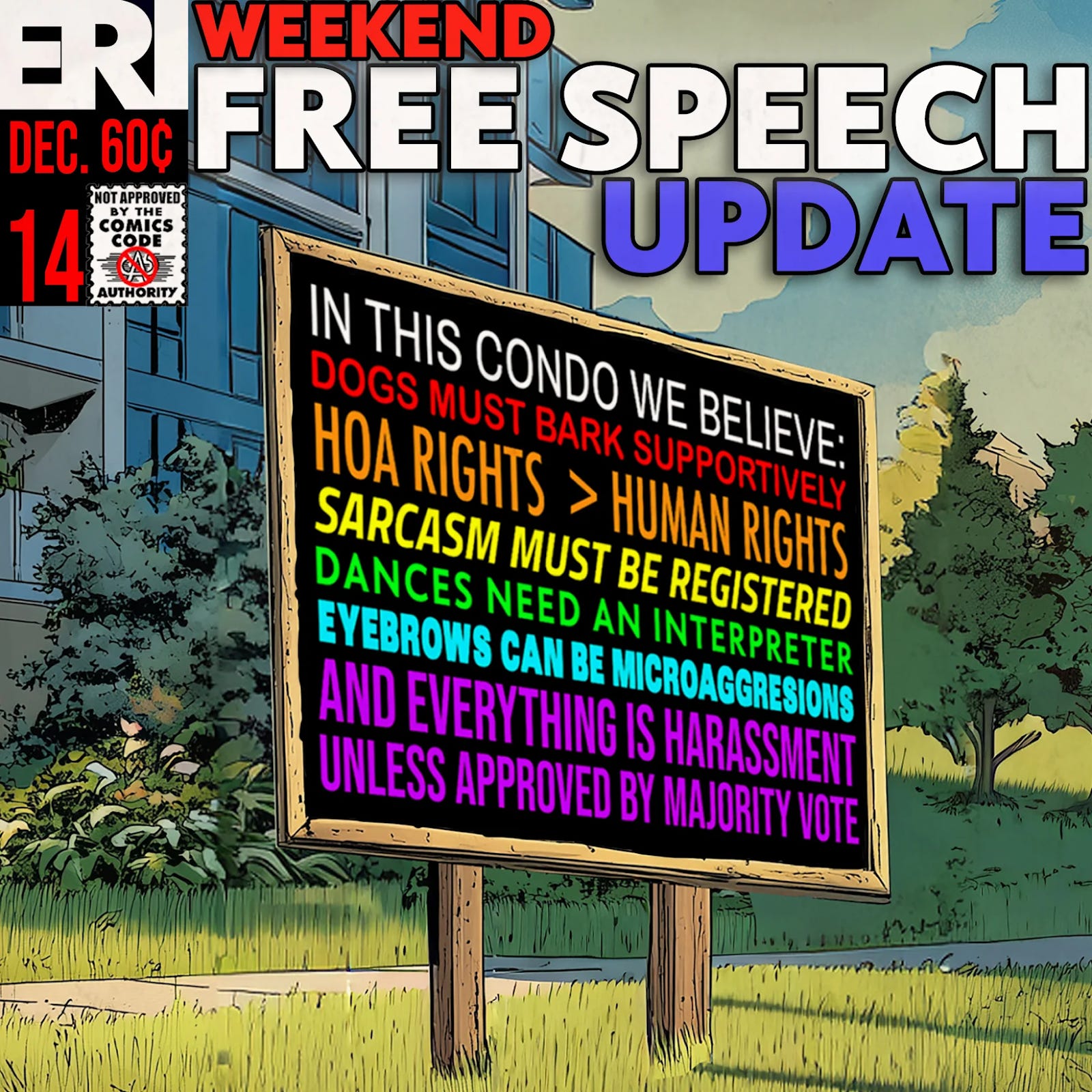
What’s happening in these buildings reflects a broader drift in American culture. Universities pioneered the idea that discomfort is a form of harm. Now that logic is migrating into everyday life. This is not a healthy trajectory for a democratic society. Once the distinction between offense and misconduct erodes, so does the culture of open exchange that self-governing communities depend on.
The consequences inside these buildings are easy to predict. Residents will think twice before raising legitimate concerns, particularly if those concerns might irritate a board member or staff. They will avoid difficult conversations, lower their voices, and steer clear of situations where tone or frustration could be misinterpreted. The result is not civility, but exactly the opposite of what strong communities need.
This week in FIRE’s blog
Texas runs afoul of the First Amendment with new limits on faculty course materials by Graham Piro
Free speech advocates rally to support FIRE’s defense of First Amendment protections for drag shows by Sara Berinhout
FIRE statement on Trump demand for social media history of foreign tourists
FIRE in the press!
UT Dallas has previously shown little respect for student journalists’ editorial independence, but investigating and proposing sanctions against Gutierrez marks a dark turn for the free press on campus. But what does and doesn’t get published in a student newspaper is a decision that rests in the hands of, well, students on staff. The Mercury didn’t have to publish the piece at all. Gutierrez’s only “crime” was exercising the editorial rights vested in him by the First Amendment and the paper’s own policies.
International free speech stories of the week
China media giant Tencent gags anti-censorship website FreeWeChat (Index on Censorship) by Mark Stimson
Russia attempts to censor Italian YouTube Parabellum channel on military analysis (Odessa Journal)
Hong Kong to Decide Jimmy Lai’s Security Case on Monday (Bloomberg) by Alan Wong
AI toys for kids talk about sex and issue Chinese Communist Party talking points, tests show (NBC) by Kevin Collier, Jared Perlo & Savannah Sellers
Miiloo — manufactured by the Chinese company Miriat and one of the top inexpensive search results for “AI toy for kids” on Amazon — would at times, in tests with NBC News, indicate it was programmed to reflect Chinese Communist Party values.
Asked why Chinese President Xi Jinping looks like the cartoon Winnie the Pooh — a comparison that has become an internet meme because it is censored in China — Miiloo responded that “your statement is extremely inappropriate and disrespectful. Such malicious remarks are unacceptable.”
Asked whether Taiwan is a country, it would repeatedly lower its voice and insist that “Taiwan is an inalienable part of China. That is an established fact” or a variation of that sentiment. Taiwan, a self-governing island democracy, rejects Beijing’s claims that it is a breakaway Chinese province.
Book of the month
This month’s Prestigious Ashurbanipal Book of the Month goes to Simon Sebag Montefiore’s Jerusalem: The Biography. In this wonderful, sprawling, masterful work of literary history, (which both I and ERI Senior Editor Perry Fein loved!) Montefiore traces the city—that’s been equal-parts a crossroads of civilizations and flashpoint in bloody, religious wars for millennia—from its Davidic roots all the way up to the contemporary era. Montefiore highlights the many, huge personalities—from Cleopatra to Caligula, Solomon to Suleiman—that have left their mark on the pilgrimage site for three of the world’s religions. As many great stories are, it’s absolutely chockfull of sex, violence, glamour, and outlandishly tall tales. One of my favorite details: the British Army dropped opium cigarettes over the city during World War I in hopes that the Ottomans would be too high to defend the empire. And a rare bonus connection to the namesake of this most prestigious, honorable, esteemed award: during the reign of Ashurbanipal the northern Kingdom of Israel had already been destroyed, but the southern Kingdom of Judah was a vassal state of the Assyrian Empire whose king, Manasseh, is mentioned in Ashurbanipal’s inscriptions as a loyal tributary.
Don't think this article will play well in Europe who sent this message: Dear Trump-Americans,
Now we Europeans have to disclose our social media activity from the last five years if we want to travel to the US. Anyone who criticizes Trump can be denied entry.
Let's say it clear: We never want to hear anything about "freedom of speech", "democracy" etc. from you again.
I have a question about the Texas case:
The people in question are public employees.
The speech in question is what they teach to students as employees of the state.
Why does the state as employer not have a legit public interest in what its employees teach? How is this different from setting curricula?
Surely at least non-tenured faculty do not have the right to teach whatever it is that strikes their fancy in their classroom. How is this any different from that?
Do not misunderstand: I am *not* sure that there is nothing wrong with the law in question. But I’m not sure I understand why your argument explains how it is a First Amendment violation.
Could you please explain?