


Stories of the week
The short answer is: You cannot come up with a principled way to mete out who is permitted to speak about a matter of public concern, and how much they can say. One of the greatest strengths of the First Amendment that we enjoy in the United States is that it understands, and accounts for, the inherent danger of giving anyone that kind of authority over speech or press. What looks like a simple fix may very well be the lid to Pandora’s box.
The common thread for both Mackey and Lemon is that a single word — conspiracy — has proved elastic enough to be stretched toward a meme-maker and a journalist by administrations that agreed on little except the usefulness of the stretching.
We have to be cautious about what we call a conspiracy because expression that’s actually a conspiracy is unprotected by the First Amendment. Lawyers would describe the specific carve-out as “speech integral to criminal conduct.”
This week in Expression
Thank you, Brendan Carr by Bob Corn-Revere
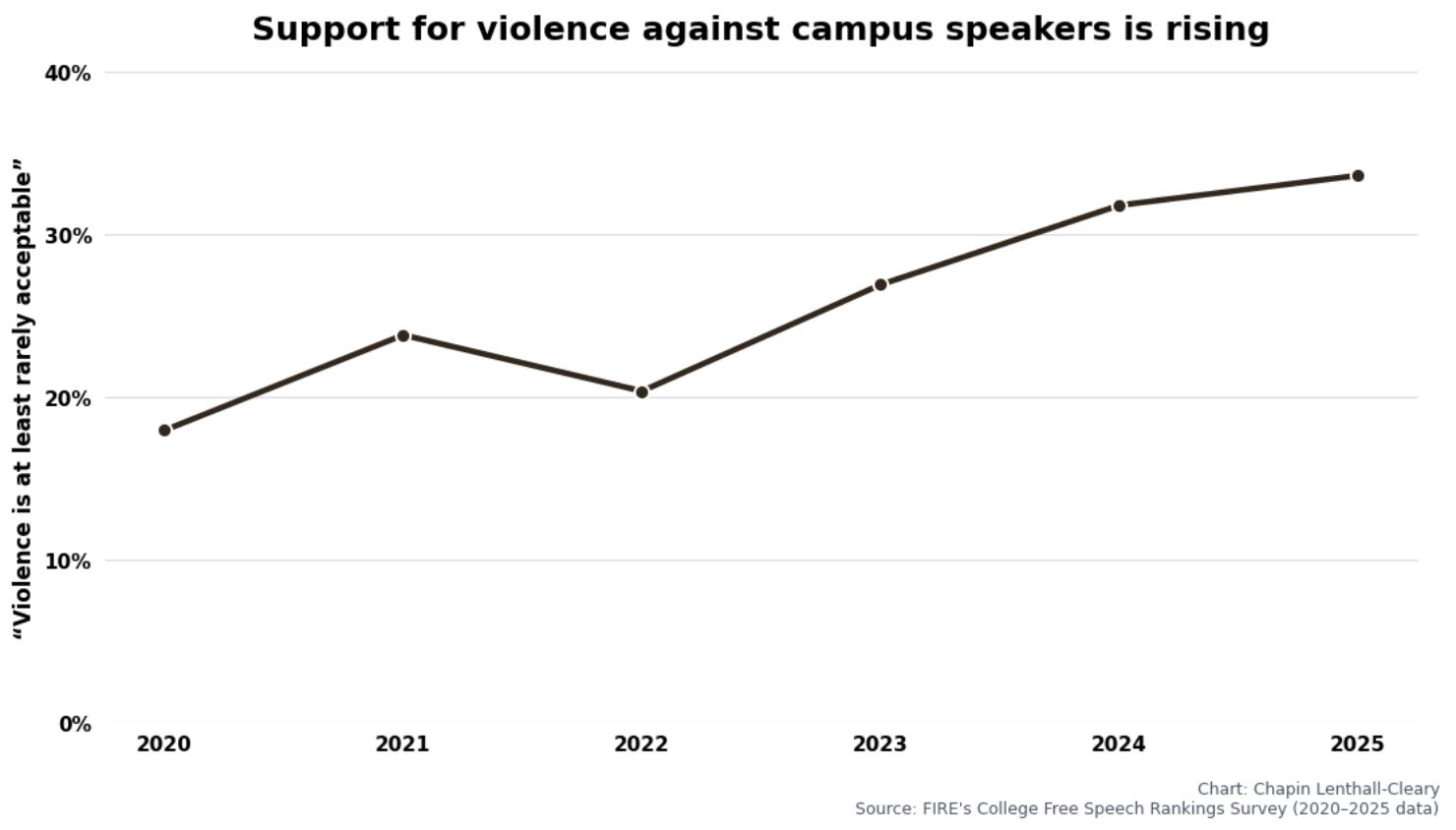
Violence is up and tolerance is down. What comes next? by Chapin Lenthall-Cleary
Professors are being squeezed on all sides. The GUARD Act can protect them by Michael Hurley
Foreign journalists to face social media vetting for U.S. visas by Sarah McLaughlin
When the cure is worse than the disease — FIREwire No. 41 by David Josef Volodzko
Campus hecklers are silencing pro-Israel speakers. Speech codes are not the fix by Max Friedman
Debates over Israel and antisemitism must not be controlled through censorship by administrators, governments, or mobs. Even if certain perspectives are uncomfortable or offensive to some, the First Amendment prescribes more speech as a remedy, not less. This approach allows all of us to gain a more robust understanding of contentious issues, even if we don’t ultimately change our minds. As Justice Louis Brandeis famously wrote in Whitney v. California, “Those who won our independence by revolution were not cowards. They did not fear political change. They did not exalt order at the cost of liberty.”
FIRE interview of the week
Check out FIRE Chief Counsel Bob Corn-Revere on CNN’s The Lead with Jake Tapper discussing Disney’s lawsuit claiming retaliation by the FCC against ABC.
London Calling: Ronnie’s First Amendment Roundup

Seventh Circuit affirms injunction on enforcing Indiana law that bars aiding or assisting unemancipated minors in obtaining abortions without parental consent and notice insofar as it restricts accurate speech pertaining to abortion providers lawfully operating in other states.
The U.S. Court of Appeals for the Seventh Circuit affirmed a permanent injunction against the “aid-and-assist” provision of Indiana’s law governing abortion procedures for unemancipated minors that (the parties agree) make it a violation to give them accurate information about legal abortion practices and providers in other states and/or to contact, or provided referrals to, such out-of-state providers on behalf of unemancipated minors.
The court first confirmed plaintiff’s organizational standing to bring its challenge, noting that “[l]ike other corporations, Planned Parenthood has its own free speech rights” and “[w]hen … sufficiently chilled, a corporate plaintiff can establish standing to challenge a law that prohibits its speech … even when the consequences of any violation might fall most immediately and directly on the corporation’s employees rather than on the corporation itself.” The court went on to reject the state’s argument that “the private enforcement mechanism in Indiana’s aid-or-assist law means the injunction cannot actually redress or prevent the First Amendment injury,” because “Article III standing does not require a plaintiff seeking an injunction against enforcement of a statute to sue all defendants who might possibly enforce the statute against that plaintiff in the future” and a “possibility of private enforcement … does not defeat standing against members of the Indiana Medical Licensing Board.”
On the merits, the court rejected the state’s arguments that the speech at issue is integral to criminal conduct as that First Amendment exception “demands a separate underlying offense that is not the challenged restriction on speech itself,” and while “we can assume that speech aiding an unemancipated minor in obtaining an illegal abortion in Indiana would constitute speech integral to criminal conduct, … providing information and referrals to out-of-state abortion providers operating lawfully in other states does not.” “Indiana officials may disagree with the purposes behind plaintiff’s speech and with the laws and policies of other states,” the court continued, but they “cannot … make it illegal to provide information about lawful conduct in other states. Nor can they apply Indiana’s own parental consent laws to out-of-state abortions.” The court also invoked the recent Supreme Court decision in Chiles v. Salazar to rebuff the state’s argument that the aid-or-assist law cannot be enjoined because it covers more than just giving unemancipated minors information about legal alternatives and/or setting up contacts/referrals, noting that, as with Chiles’ talk-therapy-only as-applied challenge, the challenge here targeted only applications of Indiana’s law to speech that does not involve unlawful conduct.
The court next held the law is content-based applied to the speech at issue, and not viewpoint-neutral, and to invalidate that application under strict scrutiny. It began by observing the state opted to ague only that there is a rational connection between the speech restriction and its asserted interests – at too high a level of generality, without proof – noting defendants “failed to present any evidence that the state’s interests in safeguarding the parent-child relationship or protecting the physical and psychological well-being of minors would actually be furthered by prohibiting private individuals from disseminating truthful information to pregnant minors about lawful abortion practices in other states.” In doing so, the court embraced the independent right of minors to receive information, citing “a significant difference … between a parent’s right to consent to or to be notified before her child receives an abortion and a parent’s right to block access to accurate information about or a referral to an out-of-state provider of legal abortion care,” before stating: “We also cannot square defendants’ asserted interest in protecting the parent-child relationship with the strong constitutional protections given to factually accurate speech about conduct that is legal in another state.”
The court then held the law fails narrow tailoring, citing the extent to which in restricting speech it is both over- and under-inclusive. The former because the law “assumes, without showing, that Planned Parenthood intentionally provides this information to help minors evade Indiana’s parental consent requirements [whereas it] identified numerous reasons why its minor patients seek this information that are not efforts to bypass parental consent and notification.” And on the latter, “the speech at issue—information for minor patients—[is] readily available to a pregnant minor without help from plaintiff,” but rather a “minor patient herself can access it easily with a computer or smartphone” while “placing the phone call to an out-of-state abortion provider is not something only the professionals at Planned Parenthood can do.” The court also noted how “Indiana has not explained how applying this statute … where it forbids plaintiff from sharing its desired information about and referrals to out-of-state abortion providers, is sufficiently tailored to those interests where all other medical advice relating to the minor’s pregnancy is not subject to these stringent parental consent and notice requirements.”
The court accordingly affirmed the preliminary injunction, though it modified it to enjoin only Indiana’s Medical Licensing Board members from disciplining physicians based on providing information/referrals, and various county prosecutor defendants and a county juvenile court judge, but not the Commissioner of Indiana’s Department of Health (because, as plaintiffs agreed, changes in Indiana law that allowed abortions when the case started in 2017 now bar them, so the clinics are no longer licensed to perform abortions and thus cannot face licensing sanctions from the Commissioner).
Bonus case #1: In Minnesota Voters Alliance v. Ellison, the U.S. Court of Appeals for the Eighth Circuit reversed denial of a preliminary injunction on a challenge to a law that bars transmitting information within 60 days of an election if the speaker intends to impede or prevent another from exercising the right to vote and knows the information is materially false, where plaintiff seeks to opine that felons on parole cannot vote in Minnesota, even though the state’s law is “knowable and certain” that they can. The court held the prohibition is not against speech falling into any unprotected category, is obviously content-based, invalid under strict scrutiny—primarily as it “overreaches because at least one speech-promoting alternative exists: counter speech,” but also because it’s underinclusive given other speech that undermines election integrity that the state doesn’t restrict—and features a prior restraint in allowing lawsuits to “restrain a violation ... if there is a reasonable basis to believe that an individual or entity … intends to commit a prohibited act.”
Bonus case #2: In Massimino v. Benoit, the Second Circuit joined the vast majority of U.S. Courts of Appeals that have held the First Amendment clearly establishes the right to record law-enforcement activity in public (leaving only a few Circuits that have not), moving past the fact that it was not clearly established when police arrested the self-described “First Amendment auditing hobbyist” plaintiff, to deliberately articulate that it is now clearly established in the Second Circuit going forward.
International free speech stories of the week
Azerbaijan Suing CNN for Libel: Can They Do That? (Reason) by Eugene Volokh
Retired Police Officer Fined £1,000 Over Bacon Meme in UK (Reclaim the Net) by Cam Wakefield
The first paired “time for mass deportation” with a supposed 12-year-old migrant asking donors to move him from a three-star hotel to one with “a better halal menu, free wifi and Sky” nearer a girls’ school. The judge called that “a political issue which had been debated in Parliament” and acquitted him; the second read, “Fun facts about Bacon! People who eat bacon have a lower chance of marrying a 9-year-old!” and that one cost £1,000.
Gray said the second post was “intended to be satirical” and meant to “spark a serious debate” about Mohammed’s marriage to Aisha and child marriage in Muslim countries, The Telegraph reported. District Judge Steven Hood found it “designed to be offensive” and not capable of seriousness because it was “framed in a jokey way,” so English comedy has acquired paperwork.
LGBTQ+ passages cut from Russian edition of Pope Francis’ memoir (TVP World) by Maria Kaminska
Videos of the Week
First up, we’ve got the latest installment in FIRE’s 1AX series: Free Speech in Donald Trump’s America | Part 1. Hear from experts like FIRE’s Will Creeley, NCAC’s Lee Rowland, Knight Institute’s Alex Abdo, ACLU’s Esha Bhandari, & Cato’s Thomas Berry on whether the second Trump administration has lived up to the lofty free speech promises made on the campaign trail.
Next up, enjoy the latest offering from Jeffrey Rosen’s FIRE-sponsored The Blessings of Liberty podcast; a live conversation and meditation on the philosophies and aspirations of America’s Founders with law professor Robert P. George at the Chautauqua Institution.
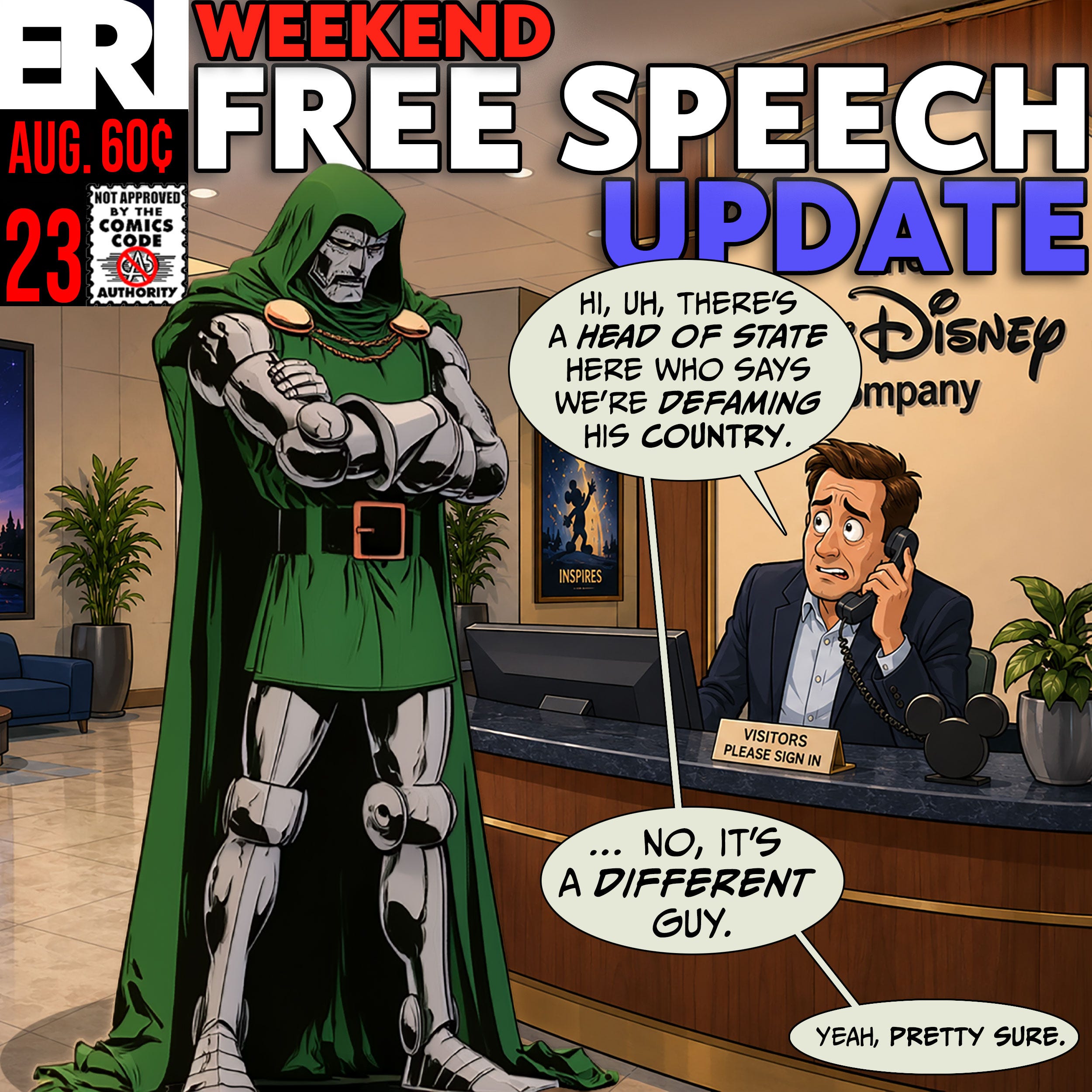
DOOM does not politely wait for lackeys to confer with others, that is for lessers. DOOM speaks immediately to whom he wishes to speak, because he is DOOM.
When you print something like "In Minnesota Voters Alliance v. Ellison, the U.S. Court of Appeals for the Eighth Circuit reversed denial of a preliminary injunction on a challenge to a law that bars transmitting information within 60 days of an election if the speaker intends to impede or prevent another from exercising the right to vote and knows the information is materially false, where plaintiff seeks to opine that felons on parole cannot vote in Minnesota, even though the state’s law is “knowable and certain” that they can" can you give some kind of brief statement saying what the Court decided? There are so many negatives in that statement (reversed, denial, injunction, challenge, bars, impede) that even after reading it several times, I still couldn't figure out what the Court decided, and I just gave up.
In other words, can you please not print things that don't describe what didn't happen if it's not clear that the reader won't understand?