



Stories of the week
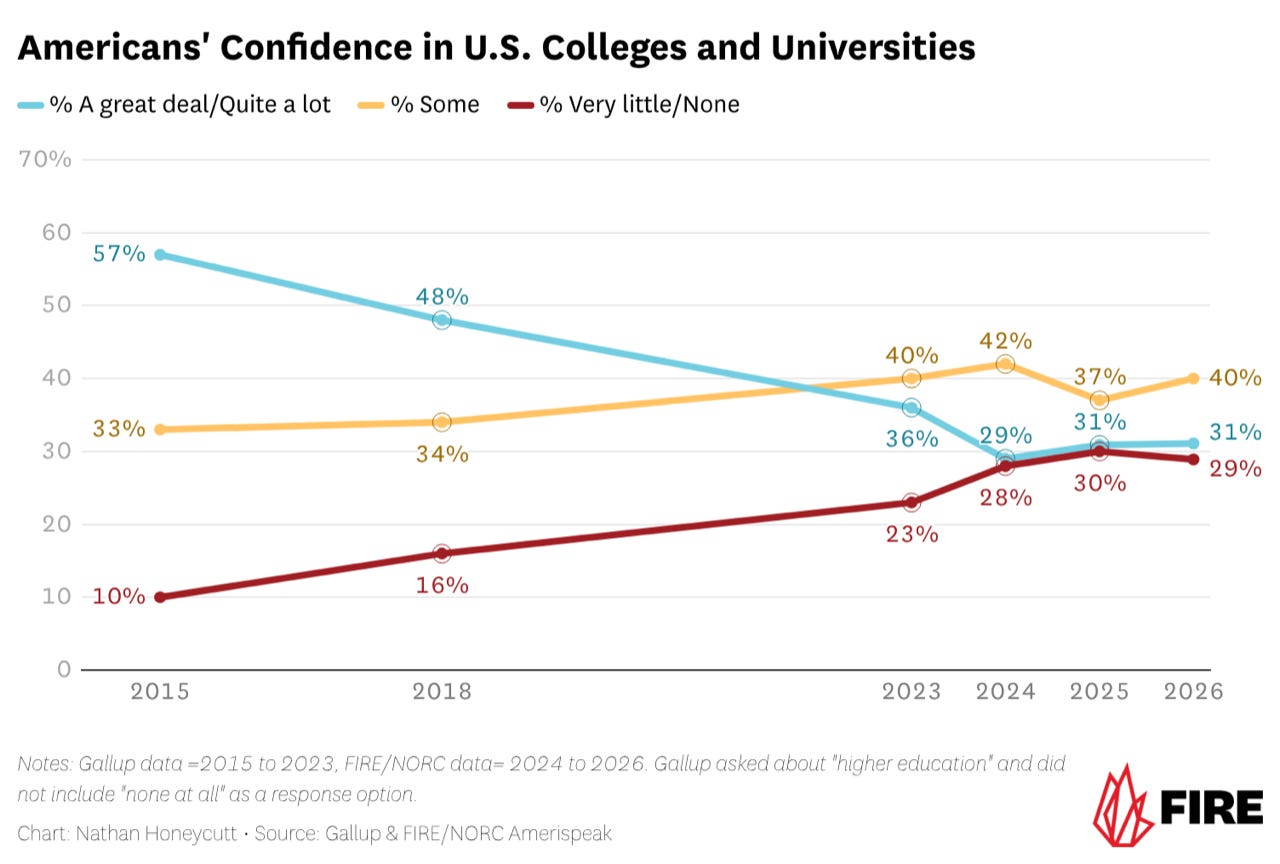
The decline of confidence in higher ed by Nate Honeycutt
My take on alleged coercion of Anthropic by the federal government
This week in Expression
Netflix and…chilled? New UK rules target ‘harmful or offensive’ streaming content by Sarah McLaughlin
This week, communications regulator Ofcom announced “enhanced” regulation for video-on-demand services with more than 500,000 UK-based users. Some of the requirements will address accessibility features such as subtitles, but there will also be a significant focus on the aired material itself: specifically “harmful or offensive material.” Platforms with user bases of this size will be subject to a forthcoming video-on-demand code modeled on rules already in place against stations like the BBC.
What FIRE’s critics get wrong about our ICE app lawsuit by Jacob Gaba
Australian police raid Canberra bar’s artwork under new counter-extremism legislation by Sarah McLaughlin
Do K-12 students have the right to walk out in protest? by Adam Goldstein
NY attorney general threatens to remove school board members over trans comments by Jacob Roth
Bad cop: Brendan Carr’s manipulation of the FCC’s equal-time rule shows why it’s a bad idea to give federal regulators power over broadcast speech by Bob Corn-Revere
Carr frequently cites the “public interest” requirements imposed on broadcast licensees, but that general obligation to serve the public (that is, to provide broadcasting service) has never been understood to give the FCC power to restrict particular programs, and it would be unconstitutional if it did. He neglects to note that both the FCC and the courts historically have interpreted the public interest standard to require broadcasters to exercise independent editorial judgment, and not to follow the whims of some government functionary.
This week on So to Speak
This week on So to Speak, host & FIRE EVP Nico Perrino sat down with Jeff Kosseff, a nonresident senior legal fellow at The Future of Free Speech and author of The United States of Anonymous, to discuss the legacy of anonymity in the United States.
This week in FIRE’s blog
Victory! High school clears publication of stalled student articles after FIRE’s intervention by Marie McMullan
FIRE in the press!
Apple’s First Amendment rights aren’t limited by the fact it’s a technology company, despite the FTC’s attempt to frame it as an issue of the platform’s terms of service. This kind of inquest is about as transparent and lazy as censorial pressure can get. But the consequences of letting it slide can be fatal to free speech and a liberal democracy. If the government can supplant a website or app’s interpretation of their subjective terms of service with its own, the FTC could easily censor any ideas it doesn’t like by threatening to punish an alleged “failure to live up to” them.
Senate’s new AI regulation bill nightmare for free speech and your wallet (Richmond Times-Dispatch) by John Coleman & Angel Eduardo (free version)
AI is an expressive tool, much like a camera or the printing press. And just as it was with those technologies, the introduction of AI into our culture and discourse will profoundly disrupt the way we’re used to receiving, creating, and interpreting information. It already has. But the First Amendment does not contain an exception for artificial intelligence or misinformation, and these attempts to legislate our way out of the challenges they pose threaten the fundamental rights that keep us free. As always, the appropriate remedy for false and misleading speech is more speech, not government suppression.
London Calling: Ronnie’s First Amendment Roundup

Federal judge rescinds authorization for government to open, access, and review Washington Post reporter’s seized laptops, mobile devices, and portable drive, to allow court to conduct its own review instead of “unsupervised, wholesale search” by the feds’ “filter team”
The U.S. District Court for Eastern Virginia issued an order seeking to balance First Amendment and newsgathering rights of the Washington Post and its reporter Hannah Natanson against law enforcement interests in investigating and prosecuting the alleged unlawful transmission and retention of classified national defense information by a government-contractor employee.
Natanson used Reddit and Signal, accessed via phone and laptop, to develop nearly 1,200 confidential federal employee sources at more than 120 agencies—averaging up to 100+ tips a day, allowing her to write or co-write 200+ articles—whose identities she worked to protect given their need for anonymity due to fears of government retribution. As part of its investigation of classified defense materials, government lawyers sought an expedited search warrant for information thought to be in the reporter’s possession, citing a first-person article she authored. Though the court denied the warrant multiple times over concern about its proposed scope and apparent intent to identify confidential press sources, it ultimately issued one “limited to records and information … received from or relating to” the contractor employee. The FBI controversially executed the warrant at the reporter’s home, seizing two laptops, and a mobile phone, portable drive, recording device, and smart watch (while also issuing the Post a grand jury subpoena for basically the same information). After asking the government to not review the seized material until a court could weigh in, and being refused, the Post and Natanson intervened in the search warrant case to move for return of the devices on grounds they contain material protected by the First Amendment and/or attorney-client privilege.
The order on that motion chides the government for not bringing the court’s attention to the federal Privacy Protection Act, which bars government officials from searching or seizing “work product” or “documentary materials” held by those “reasonably believed to have a purpose to disseminate to the public a newspaper, … broadcast, or other similar … public communication.” After a bit of mea culpa (“the Court acknowledges … it did not independently identify the PPA when reviewing the warrant” but “had never received such an application”), and noting the government’s failure to flag the PPA “seriously undermined … confidence in the [its] disclosures in this proceeding,” the court held that “seizing the totality of a reporter’s electronic work product, including tools essential to ongoing newsgathering, constitutes a restraint on the exercise of First Amendment rights.”
That left the court to address both the “complicating factor … that classified national security information may be among the seized material,” and “the need to identify and protect classified information before any materials are returned,” by deciding between the government proposal for its own filter team “with an appropriate protocol, … to search all of [the] data” and the Post’s and Natanson’s view that they or the court must conduct the review to protect First Amendment and attorney-client privileges. The court resolved that tension by holding that “[b]alancing [the] First Amendment … and newsgathering rights against the government’s compelling interest in its prosecution,” makes it “reasonable for the government to retain only the limited information responsive to the search warrant—and nothing more.” It noted: “Given the documented reporting on government leak investigations and the government’s well-chronicled efforts to stop them, allowing the government’s filter team to search a reporter’s work product—most of which consists of unrelated information from confidential sources—is the equivalent of leaving the government’s fox in charge of the Washington Post’s henhouse.”
So, the court granted in part and denied in part the motion for return of property, rejecting “the government’s request to conduct an unsupervised, wholesale search of all [the] seized data using a government filter team” in favor of the court doing that review itself. It thus rescinded the portion of the original search warrant authorizing the government to open, access, review, or examine any of the seized data, and ordered return of all but the limited information authorized by the search warrant—i.e., all non-responsive information on the devices. But that necessitated denying the Post’s and Natanson’s motion as to the limited information authorized by the search warrant, and denying without prejudice the request for return of the seized devices, until after developing a process for independent judicial review of the seized materials (in consultation with the parties) and then conducting said review.
International free speech stories of the week
German prosecutors say calling Merz Pinocchio covered by free speech (DPA)
Thailand: Free Speech Activists Get 32-Month Sentences (HRW)
$750,000: B.C. Human Rights Tribunal orders payout in ruling against former school trustee (Canadian HR Reporter)
Reel of the week
In the interest of engaging folks in this brave, new, “post-literate society” I’ve been told we’re now living in, this week I tried something new; posting short-form video content about anything and everything that happens to pop into my brain at any given moment. The first clip explained a bit of my reasoning, and the second clip (included above) responded to breaking news regarding claims that the federal government may be attempting to coerce the AI company, Anthropic, into altering its code. But no cause for alarm, yee faithful Substack subscribers, I’m not going anywhere. You’ll still have thousands-of-words-long pieces to look forward to here on ERI every couple weeks! But in the meantime, enjoy seeing more off-the-cuff, short video content. Let me know what you think and some topics you want me to talk about in future ones!