Stories of the week
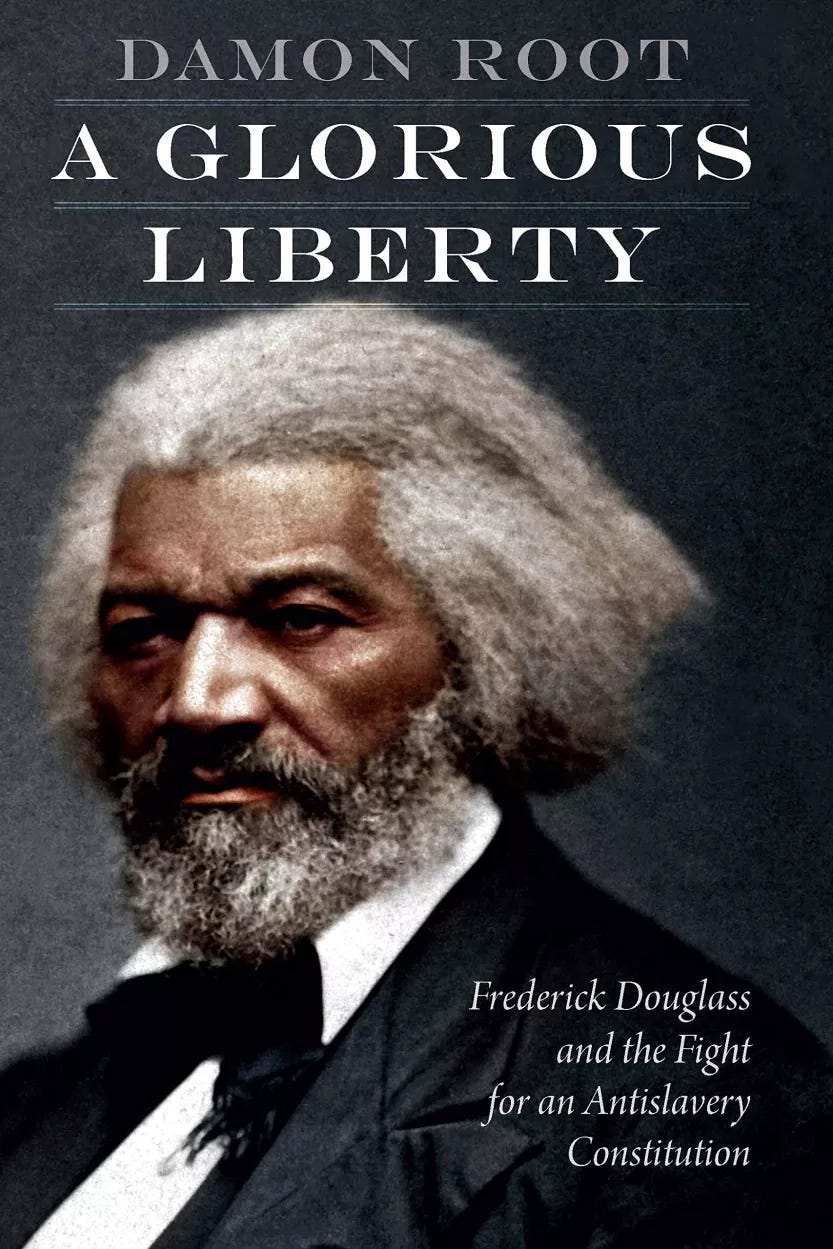
To Douglass, free speech wasn’t a side issue. It was a weapon essential to the cause. “To utter one groan, or scream, for freedom in the presence of the Southern advocate,” Douglass said in a 1854 speech, “is to bring down the frightful lash upon their quivering flesh … The right of speech is a very precious one, especially to the oppressed.” Douglass knew that free speech is essential not for those in power, but for those who are not. If the enslaved could not speak for themselves, he would speak for them. And he did so for decades as the sectional tensions continued to rise.
This week in ERI
By the time of his death, there was little gratitude for Paine’s contributions to the United States outside of workingmen’s associations because of his blistering attacks on revealed religion, particularly Christianity. But as America barrels toward its semiquincentennial, Thomas Paine emerges as the Founding Father Americans can celebrate without regret. Unlike his contemporaries, Paine’s radical liberalism feels strikingly modern—pro-democracy, pro-market, anti-poverty, and antislavery—and worth defending as the forces of reaction mount here at home and abroad. Without the pen of Paine, in fact, there might not be a United States to celebrate today.
This week in Expression
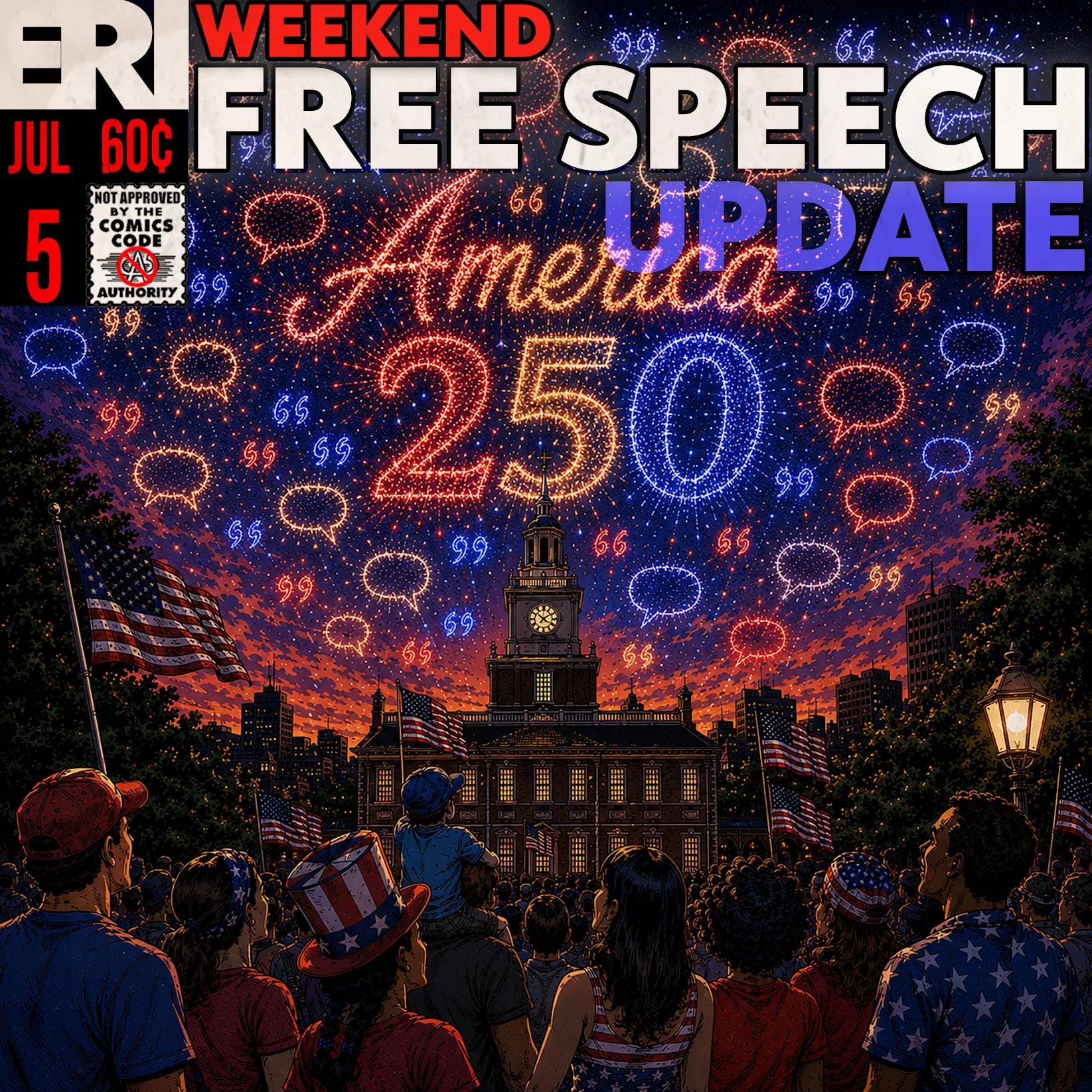
Human beings will always be living through times that try our souls. The New World is constantly on the verge of sliding back into the dogmas of the Old. The Declaration’s signers felt the temptation to abandon principle for the sake of preservation, and we feel that same temptation today. But we cannot give in. Ever. These twin ideas — America and free speech — are so much bigger than us. Particulars of time and place, no matter how uncomfortable or disagreeable, cannot and should not destroy our faith in them. No matter how ugly it gets.
Will Germany amend one of its most censorial laws? by Sarah McLaughlin
250 years later, free speech is still revolutionary by Angel Eduardo
Of course, people have been fighting for freedom since time immemorial. But what makes America unique is that this struggle was enshrined in its founding. The bedrock of our country wasn’t blood and soil, but the ideas and ideals — chief among them being the freedom to speak, to hear, and to engage in the open exchange of ideas — that make democracy possible.
This is why Philadelphia is neither a surprising nor a coincidental birthplace for these American principles. William Penn strove for religious toleration and liberty of conscience as fundamental tenets of his newfound colony of Pennsylvania. In the years leading up to the Declaration, Philadelphia became a center of colonial pamphleteering, newspapers, and political debate, renowned as the “Cradle of Liberty.”
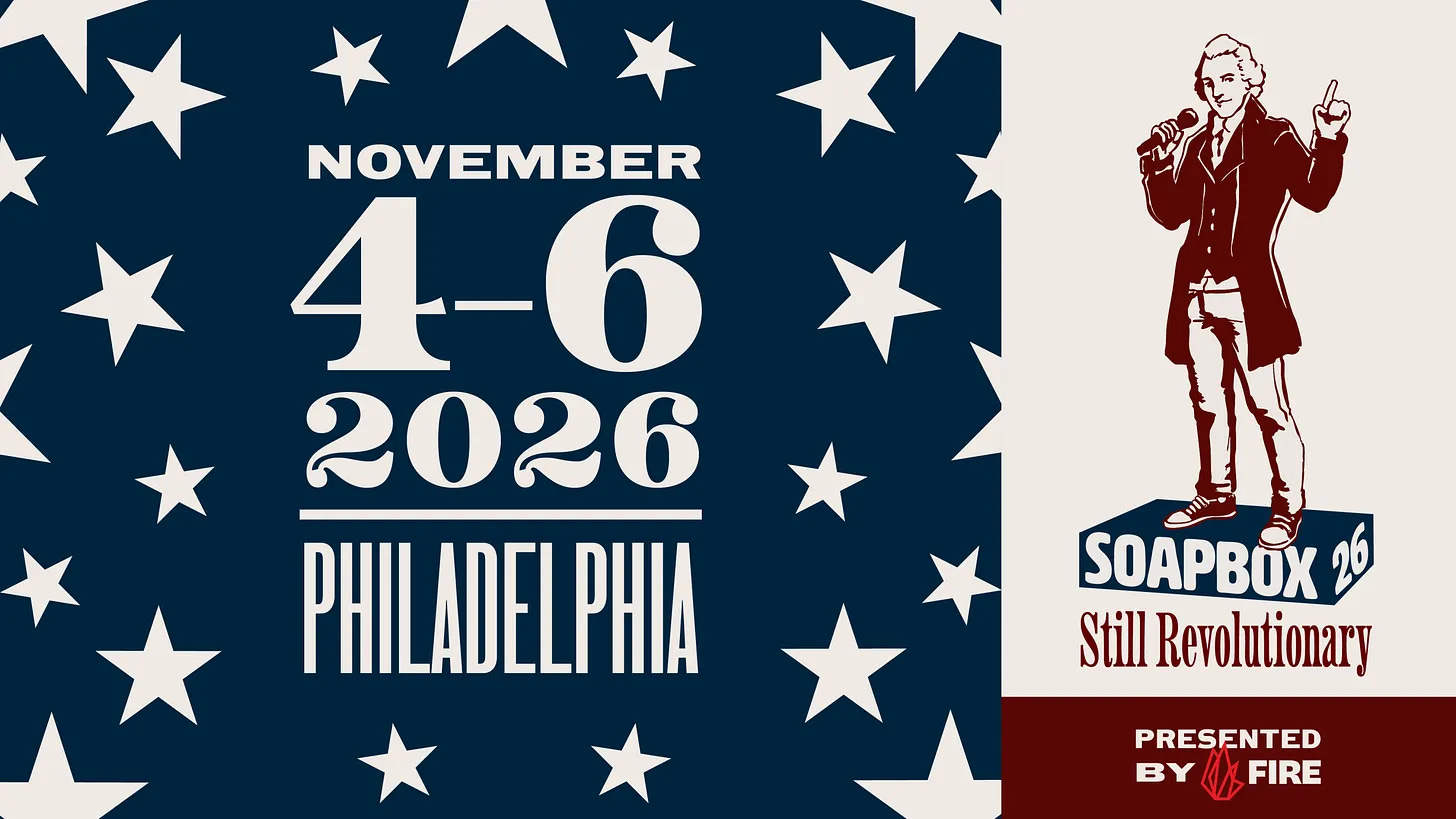
America’s 250th deserves more than fireworks. It deserves a celebration of the right to free speech that has helped make this nation great. That’s why FIRE is launching a new event right in the birthplace of American democracy itself.
In Philadelphia from November 4–6, 2026, Soapbox is bringing together headline speakers, unflinching debates, and unforgettable entertainment to explore the ideas and freedoms that will shape America for the next 250 years.
The KIDS Act would put Washington in charge of how we can communicate online by Carolyn Iodice & John Coleman
This week on So to Speak
This week, FIRE EVP & So to Speak Host Nico Perrino sat down with Anthony Aycock —author of Just Plain Filthy: The Story Behind Book Banning’s Trial of the Century—to discuss the history and lasting impact of Island Trees School District v. Pico, the Supreme Court’s landmark school library book-banning case, and what it reveals about today’s debates over censorship, parental rights, and access to books.
This week in FIRE’s blog
London Calling: Ronnie’s First Amendment Roundup
Sestercentennial Independence Day Lightning Fireworks Round
A few quick hits and updates from a busy pre-holiday week
The U.S. Tenth Circuit Court of Appeals reversed in significant part dismissal of a challenge to the Utah Legislature’s Capitol Media Access and Credentialing Policy—which requires reporters to be from “an established reputable news organization” and “adhere to a professional code of ethics,” while categorically excluding those from “blogs, independent … or other freelance” media—by a previously credentialed, award-winning reporter who covered the statehouse for a 25 years for institutional media, but was denied credentials on starting and becoming editor and sole reporter for his own independent newsletter. The court held the reporter plausibly alleged the policy is facially viewpoint discriminatory insofar as it allows denial of access the Legislature to reporters/media organizations for choosing to not affiliate with a larger outfit and/or to not have an editor. It also held that insofar as the credentialing policy is at least a nonpublic or limited public forum to which plaintiff had a constitutional right of access, and he averred the Legislature denied him credentials due to prior critical reporting on it, he plausibly alleged unconstitutional viewpoint discrimination. However, the court upheld dismissal of a prior restraint claim on grounds that a denial of credentials does not restrain speech but only access, and a First Amendment retaliation claim on grounds that plaintiff alleged only conclusorily that such denials objectively chill speakers of ordinary firmness. FIRE filed an amicus brief in the case, joined by Reporters Committee for Freedom of the Press.
In an update to this case, where the D.C. federal court previously held unconstitutional and enjoined a then-new DOD policy for restrictively granted “Pentagon Facilities Alternate Credentials,” the court has now preliminarily enjoined a new policy—adopted the next business day after its earlier order—that closed effective immediately the Pentagon’s designated “Correspondents’ Corridor” from which journalists had long worked, and required going forward that all credentialed journalists are barred from entering the Pentagon altogether unless specifically invited to a press conference or prearranged interview, and even then, only if escorted by a DOD official. The court held the escort requirement violates the First Amendment because DOD issued it in retaliation for the plaintiff journalists exercising their constitutional rights, easily deeming it an adverse government action that would chill speakers of ordinary firmness, and that it was causally linked to plaintiffs’ speech given the “myriad statements by Department officials expressing disdain for reporting by The Times and other ‘legacy’ media outlets.”
An update here, too, in the case where the D.C. federal court issued a temporary restraining order against the National Parks Service/Department of Interior revoking a protest group’s permit for displaying an “8647” flag at their downtown demonstration or from otherwise seizing or ordering the flag’s removal. The court has now entered summary judgment for plaintiff and converted the TRO into a permanent injunction, holding: “Although the Court’s opinion is lengthy, that does not mean that this is a hard case. It is not. Plaintiff’s signs and flag fall well within the heartland of protected First Amendment speech, and Defendants offer no plausible basis for suppressing Plaintiff’s core, political speech.” The court’s reasoning is, indeed, straightforward:
Plaintiff’s signs accusing President Trump of raping a minor might outrage or offend some, but they do not, by any measure, cross the line from protected political speech to unprotected obscenity. That is true, moreover, even under the less demanding obscene-as-to-minors standard. Similarly, Plaintiff’s “8647” flag and similar materials, which were displayed along with other materials calling for President Trump’s removal from office, do not constitute a “true threat” or criminal “incitement” to violence. Rather, both sets of materials represent core protected speech, and, as a result, the NPS may not compel their removal or condition Plaintiff’s continuing entitlement to a demonstration permit on Plaintiff’s refraining from that speech.
Another federal district court enjoins another state social media age-verification/parental-consent law, this time the U.S. District Court in Nebraska, which preliminarily enjoins the requirements that social media platforms use reasonable age verification to verify those seeking to become an account holder a on a social media platform, and to obtain “express parental consent” for minors wishing to sign up, for many of the familiar reasons, i.e., failure to satisfy strict or even intermediate scrutiny for lack of sufficient tailoring, trips the same constitutional wires as the video game restrictions for minors in EMA v. Brown, etc.
International free speech stories of the week
“We can all agree we would like the scheme to work better than it is currently, but that is on Big Tech taking the Mickey,” Wells told the Australian Broadcasting Corp., using an Australian slang term for deceiving, teasing or mocking.
The government announced Sunday it would introduce draft legislation into Parliament this week that would double the maximum fine to 99 million Australian dollars ($68 million) for platforms that fail to take reasons steps to prevent Australian children from holding accounts.
Book of the Semiquincentennial
Damon Root’s A Glorious Liberty won my Prestigious Ashurbanipal Award back in 2021, but, frankly, it’s so good that I’m also making it my “book of the semiquincentennial.” As I’ve said before, it remains the only exception to my rule that if you’re interested in Frederick Douglass, you should read Frederick Douglass.