


Stories of the week
Rapper Afroman is back in the news after winning a high-profile lawsuit brought by Ohio sheriff’s deputies over his viral “Lemon Pound Cake” music videos, which mocked a 2022 police raid on his home. A jury ruled fully in his favor, affirming that his videos were protected free speech and artistic expression.
The White House properly recognizes AI developers should not be penalized for third-party misuse, a welcome and important step to protecting the expressive rights of people who use and develop AI. Echoing FIRE’s longstanding concerns about coerced censorship, the framework also recommends legislation prohibiting the government from pressuring tech companies to censor (or speak) based on partisan agendas, and that Americans should have legal recourse if the government censors or compels expression on AI platforms.
This week in Expression

Maintaining principle in a time of polarization by Robert Corn-Revere
Today’s challenges are not entirely unique, and the ones we endured in earlier times made us stronger. I believe the era we are living through now will make us stronger still. Just considering the law of free speech, we went through the Red Scare of 1919, World War II, the McCarthy Era, the civil rights and antiwar demonstrations of the 60s and 70s, and since then an upheaval in the technology of how we communicate. Each was seen at the time as an existential crisis.
Somehow, we managed to get through those challenges. And, in terms of First Amendment jurisprudence, they lead to vast improvements in the law. The cases decided during those periods of turmoil and polarization formed the backbone of the protections we have today. And those decisions are the essential building blocks of the law we are using to confront the current challenges.
Lies in politics are bad. That doesn’t make Wales’ new plan to criminalize them a good idea by Sarah McLaughlin
Censoring Iran war news sets a dangerous precedent by Aaron Terr
Why are school board members afraid to speak? by Sheridan Macy
Spain’s new AI ‘hate’ tracker raises familiar risks for online speech by Sarah McLaughlin
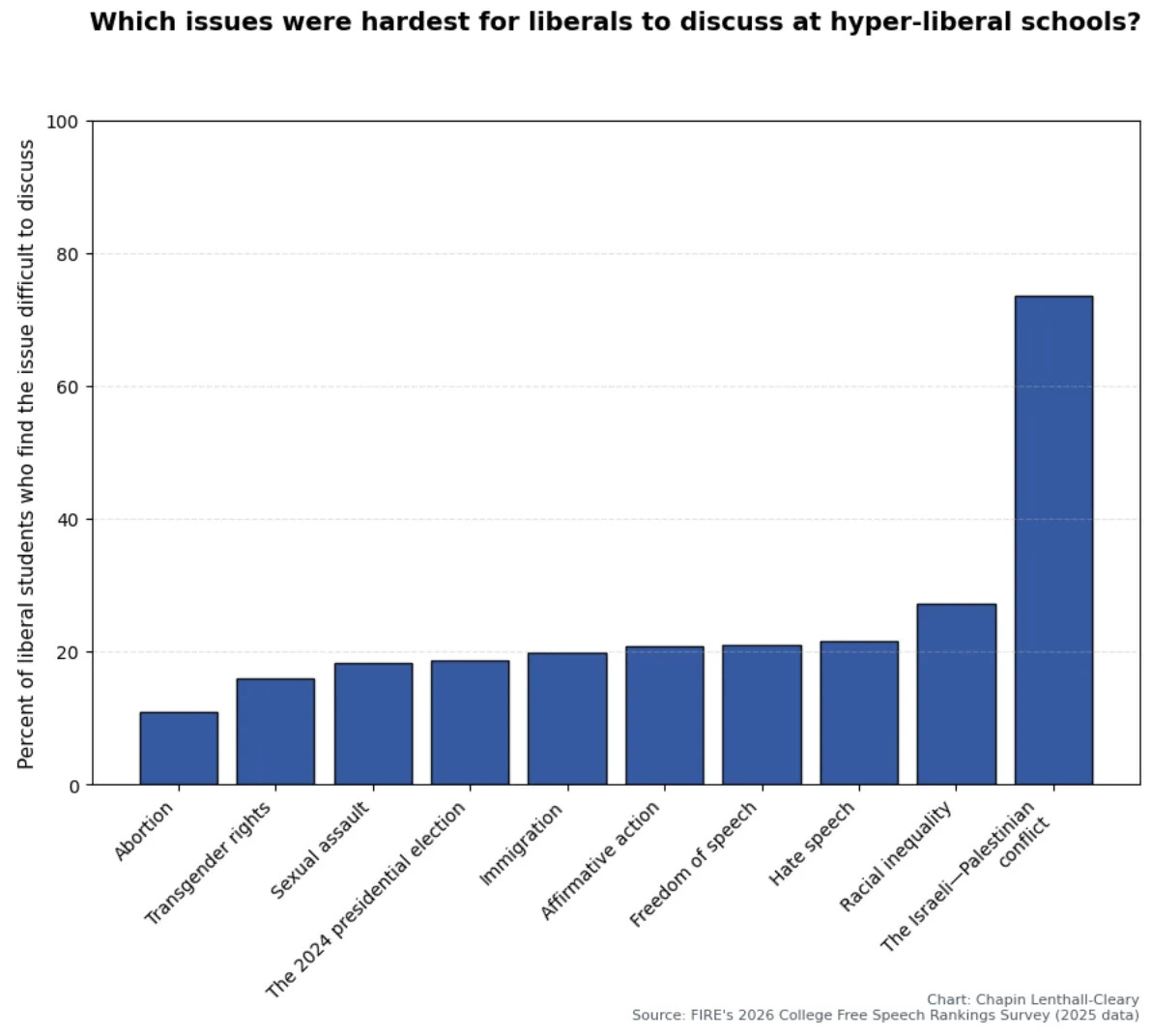
Why are liberal students at liberal schools terrified to talk about Israel? by Chapin Lenthall-Cleary
This week on So to Speak
This week on So to Speak host & FIRE EVP Nico Perrino sat down with Preston Byrne, an attorney and expert in international law and emerging technologies, to discuss how foreign censorship doesn’t respect American borders.
This week in FIRE’s blog
Tennessee city bans ‘blasphemous’ and ‘offensive’ pamphlets, First Amendment be damned by Isabelle Brito
FCC warning that networks risk licenses over Iran reporting a ‘shocking’ abuse of power
FIRE in the press!
Thanks to Ethan Tran for the kind words about theFIREorg and the Eternally Radical Idea shout-out in The Davidson Lux!

London Calling: Ronnie’s First Amendment Roundup
Supreme Court confirms constitutional challenges for purely prospective relief, like injunctions against future enforcement, can proceed against laws under which the plaintiff was previously convicted
The Supreme Court unanimously clarified that its 1994 decision in Heck v. Humphrey, which bars using the Civil Rights Act’s civil suit provision to challenge the validity of a conviction or sentence to obtain damages or a release from custody, does not bar the convicted party from challenging the constitutionality of the law underlying their conviction by seeking going-forward relief like an injunction or declaratory ruling.
The plaintiff Mississippi street preacher—who had entered a no-contest plea, paid a fine, and got a year’s probation in lieu of a 10-day sentence after his arrest for violating a City of Brandon ordinance restricting protests or demonstrations near the city’s amphitheater to “designated protest areas”—sued to obtain a declaration that the law violates the First Amendment and to enjoin its future enforcement. But the city argued his suit was barred by the line in Heck that “when a state prisoner seeks damages in a § 1983 suit, the [] court must consider whether a judgment in favor of the plaintiff would necessarily imply the invalidity of his conviction [and] if it would, the complaint must be dismissed.” The district court and the Fifth Circuit both agreed, but the Supreme Court reversed.
The Court acknowledged that, “strictly speaking,” Heck’s “necessarily imply” language “fits” because, if the suit challenging the ordinance’s constitutionality succeeds, “it would mean [the] conviction was unconstitutional.” But, the Court clarified, that language in Heck “was used to identify claims that were really assaults on a prior conviction, even though involving some indirection,” that is, those that require “looking back” to the conduct resulting in the conviction. The suit here, conversely, seeking a declaration of unconstitutionality as to the amphitheater ordinance and to enjoin it prospectively, requires no such retrospection. Heck accordingly does not prevent the claims.
The Court observed that, before Heck, defendants like the city would have had “no plausible basis” to argue such a suit is barred because, so long as there is a credible threat of future prosecution, a plaintiff may bring a constitutional challenge and seek to prevent a law’s future enforcement. The Court noted cases like Steffel v. Thompson and Wooley v. Maynard—the latter of which, the Court said, “taken alone,” would defeat the city’s position. It also cited two post-Heck cases in which the Court drew a line between Heck-barred claims and those seeking forward-looking relief, Edwards v. Balisok, and Wilkinson v. Dotson, which the suit here resembled in seeking “wholly prospective” relief, i.e., “only to be free from prosecutions for future violations.” So, the Court held, Olivier’s First Amendment suit to “enjoin the ordinance, so he can return to the amphitheater” may proceed.
All of which is entirely consistent with FIRE’s amicus briefs in the case.
Bonus case: In The New York Times Company v. Department of Defense, the federal district court in D.C. granted summary judgment to the Times and one of its national security reporters, declaring unconstitutional, vacating, and enjoining new DOD policy for restrictively granted “Pentagon Facilities Alternate Credentials,” on grounds the rules—which excluded the Times and other longstanding Pentagon press corps members—violate the Fifth Amendment as unconstitutionally vague in “fail[ing] to provide fair notice of what routine, lawful journalistic practices will result in the denial, suspension, or revocation of a PFAC,” and the First Amendment as viewpoint-discriminatory and unreasonable, holding: “record evidence supports the conclusion that the Policy discriminates … based on editorial viewpoint,” as it “tells the story of a Department whose leadership has been and continues to be openly hostile to the ‘mainstream media’ whose reporting it views as unfavorable, but receptive to outlets that have expressed support for the Trump administration.”
International free speech stories of the week
Nepal investigating burning of Xi Jinping’s book at university (Reuters) by Gopal Sharma
‘The Voice of Hind Rajab’ Censored in India Amid Fears Theatrical Release ‘Would Break Up the India-Israel Relationship’ (EXCLUSIVE) (Variety) by Nick Vivarelli
Canada parliament’s push to criminalize hate crimes sparks free-speech concerns (JURIST) by Derren Chan
The Standing Committee on Justice and Human Rights of Canada’s House of Commons ended the debate on the Combating Hate Act on Wednesday. Several groups criticized the push for passage, claiming that the bill is poorly drafted and would violate the freedoms of speech and religion.
The Combatting Hate Act, Bill C-9, would criminalize the “wilful promotion of hatred” by display of symbols of listed terrorist groups, the Nazi swastika, and other symbols that “so nearly resemble” them. The legislation would also criminalize offenses motivated by “hatred” based on specific personal characteristics. On Wednesday, the committee passed the finalized version of the bill for third reading by a vote of 5-4.
Greg on the Run!
I just can’t get this out of my head!
Some reflections on my visit to UW-Madison
Video of the week
In honor of the recent announcement that Bill Maher will receive the next Mark Twain Prize for American Humor, here’s my appearance on Real Time from December 2023:
I also stuck around for Overtime to talk Taylor Swift as TIME’s person of the year, Hunter Biden’s drug indictment, Russian election interference, and the attempt to ban hate speech in Ireland.
At what point does "freedom of the press" devolve into "knowingly publishing an adversary's propaganda"? The press has repeatedly and willfully published the claims of Hamas, Iran, and other terrorist groups without acknowledging the sources, not to seek truth, but to embarrass and undermine the President and one political party. This is NOT news, this is fiction. When a "news" organization becomes the mouthpiece of a single political party, it is no longer "the press" and is no longer protected by the First Amendment.